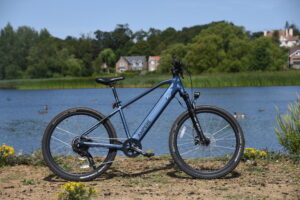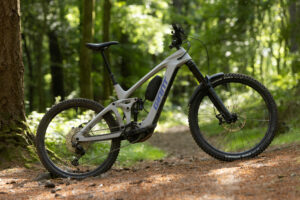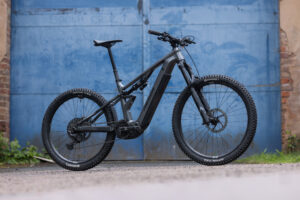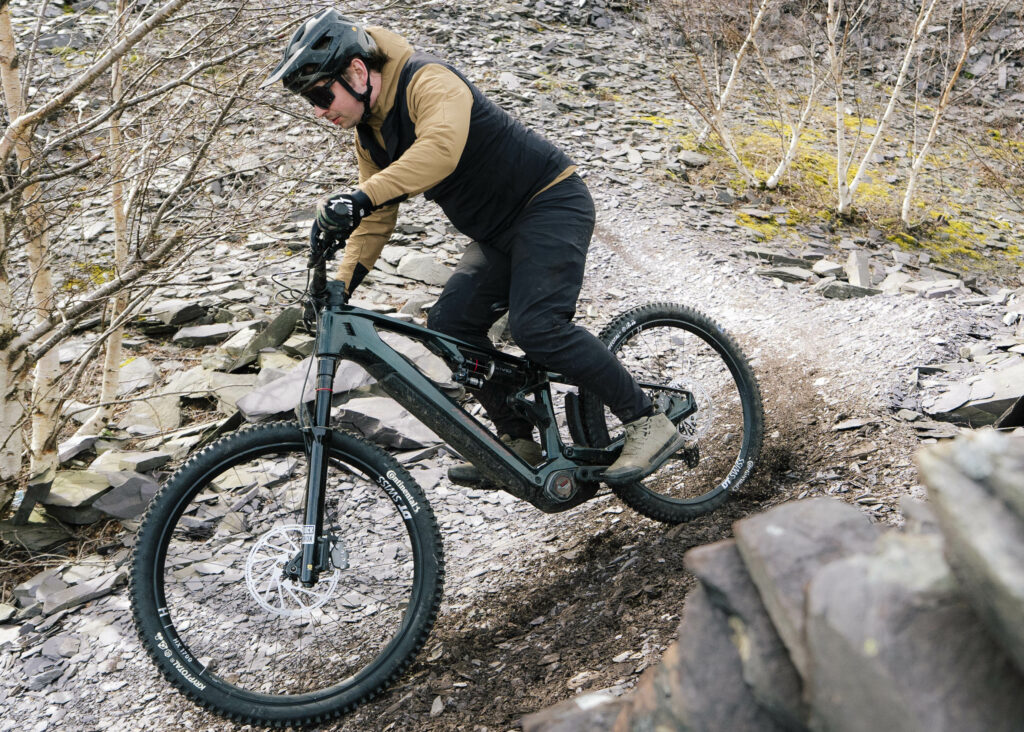

Translating to ‘rock’, or ‘stone’, in Greek, Merida’s new Lithos may be better named as Kratos, as it’s a strong e-enduro bruiser, packed with Bosch’s powerful CX-R motor. It’s wisely equipped, well shaped, and its suspension kinematic is a jewel in an already richly encrusted crown. As far as e-enduro goes, Merida has developed a real winner, and I’ve become rather enamoured.
Merida Lithos 8000 – Technical details
At first glance, I’d forgive you for thinking that the Lithos is a chunkier eOne-Sixty SL because the mid-power e-MTB was the starting point for this very bike. The Lithos builds upon that foundation and points it towards a more enduro persuasion with a revised geometry. Many of the points are the usual affairs, such as the steep seat tube angle and ‘balanced’ reach figures, but Merida has graced the Lithos with a longer chainstay and a taller stack, to better balance stability with confidence on the steeps, as well as to provide a playful feel on flatter terrain.
As for those geometry figures, the size long bike that I tested comes with a 485mm reach, a 78.5-degree seat tube angle, a 64-degree head tube angle and a 447mm chainstay. Yep, this one fits into Merida’s Agilometer sizing concept that allows riders to choose a bike’s size for their desired riding character.
You bet that there’s a flip chip here, but rather than tweaking geometries, it allows for users to chop and change from a full mullet (650b rear, 29” front) wheel setup to a 29” rear wheel. With that comes a difference in suspension travel, where the smaller rear wheel gives the bike 174mm of rear travel, whereas a 29” rear wheel reduces that to 160mm. However, the flip chip conserves the geometry regardless of its orientation when combined with the correct wheel size.
Speaking of suspension, there’s 170mm up front, and the rear’s kinematic has been built to offer top-notch small bump sensitivity as well as compatibility with coil and air shocks. The layout then uses the design founded on the eOne-Sixty SL, which Merida says reduces side loading, thus fending off premature wear.
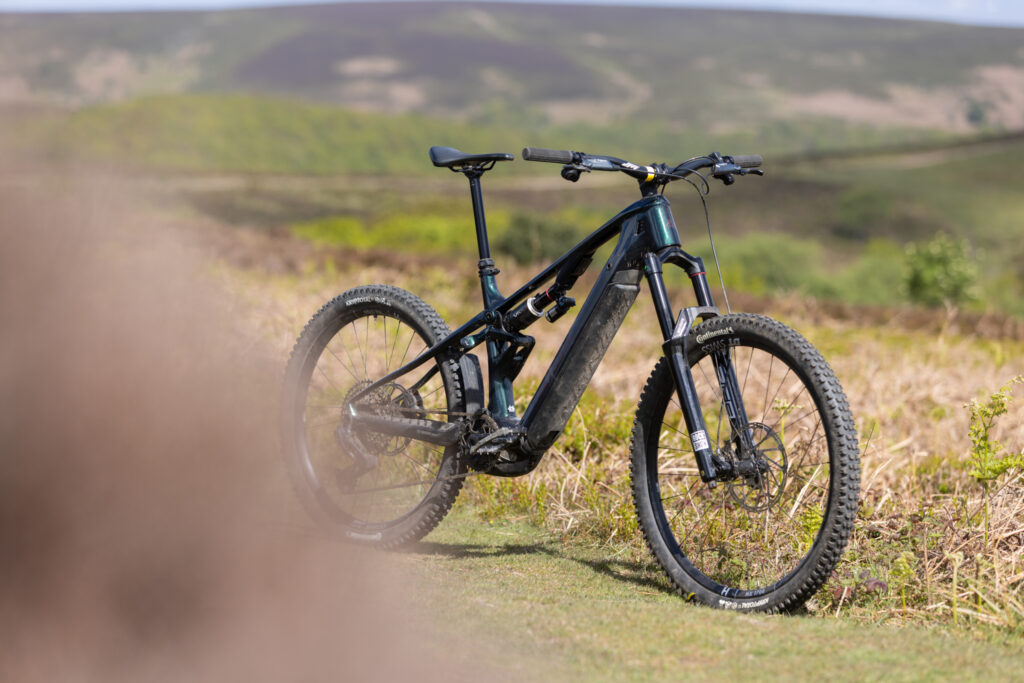
As expected of the brand, the Lithos uses a flexstay, which reduces the number of bearings while achieving Merida’s desired suspension performance.
Compliance has been a big deal for Merida and its latest enduro e-MTB. In fact, the brand has done loads of testing with several different carbon layups in order to fine-tune the compliance-to-stiffness ratio, especially in its rear triangle. The result of this is a more compliant rear end compared to what we might expect of a Merida e-bike.
At the heart of this bike is Bosch’s Performance Line CX-R motor, offering up 120Nm of torque and up to 750W of peak power. That’s combined with a ‘modular’ battery set-up. That means that the battery is easily removed thanks to a Fidlock-equipped cover, but the system can run either Bosch’s 600Wh or 800Wh batteries (the latter of which comes as standard), along with the 250Wh PowerMore range extender.
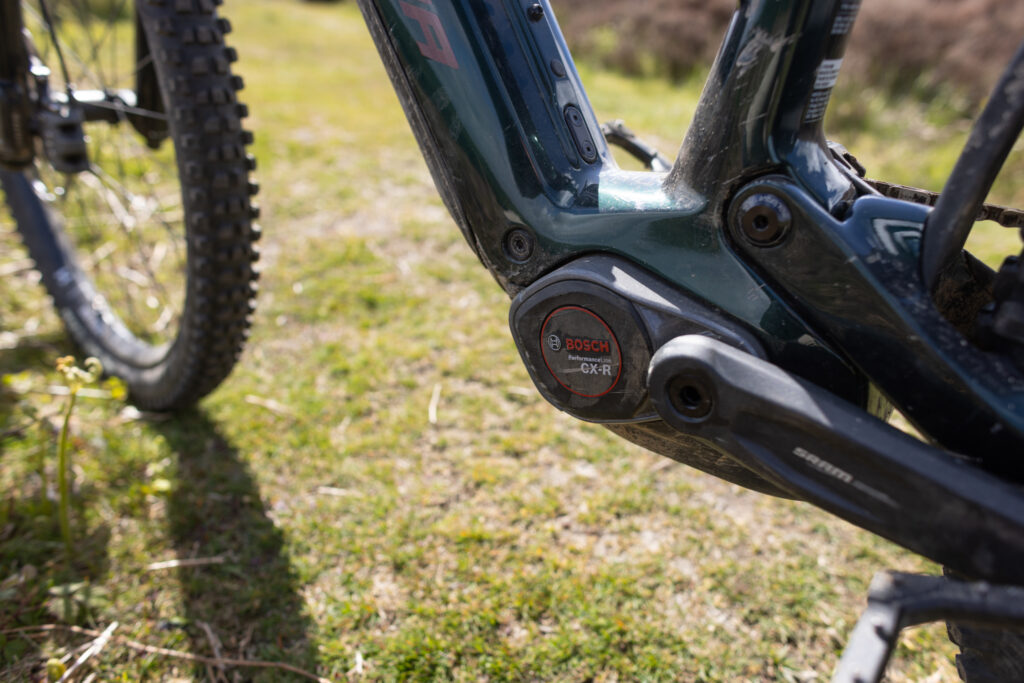
For reference, the top-of-the-range Lithos 10k and this 8000 model get the CX-R motor, while more affordable models get the Performance Line CX system.
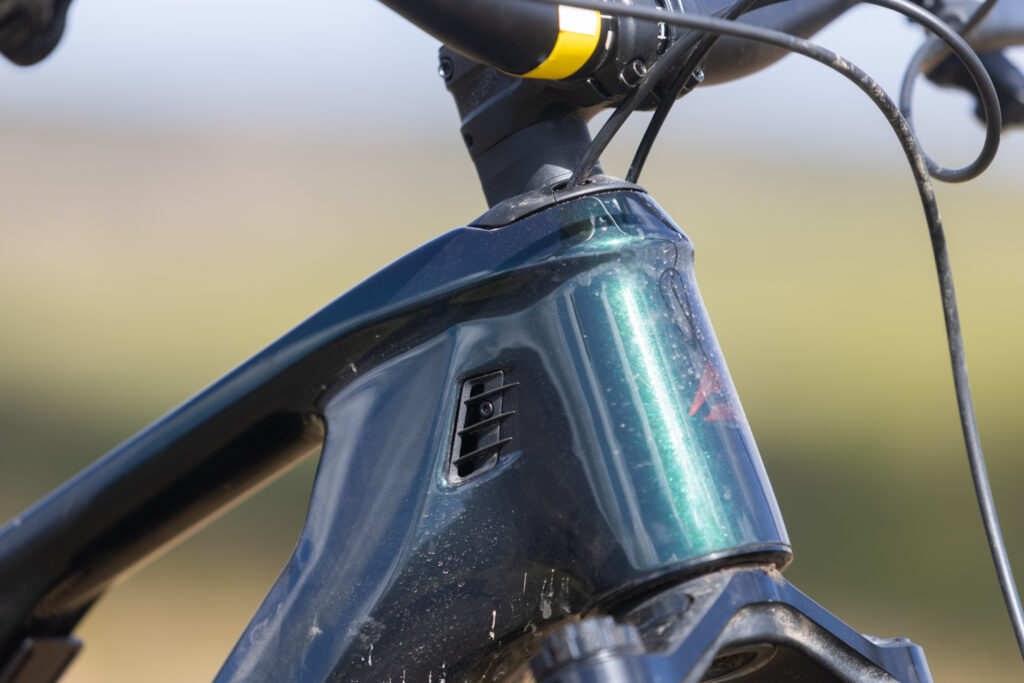
For the Lithos, Merida has kind of dropped the through-headset cable routing. Instead of being a permanent fixture, the brand has taken on board feedback from the masses of headset routing naysayers, and now the hoses can be run either through the headset, if that’s your thing, or through the ports found on either side of the head tube.
Lastly, the frame is tested to exceed Category 4 testing, so it’s approved for all-mountain and enduro riding.
Merida Lithos 8000 – Componentry
With the specification, Merida has spent its money where it really counts, while holding back a little where extra bling is merely that. So it’s got RockShox’s very latest ZEB and Vivid Air suspension, both in Ultimate models, which really does up the performance game. But the bike uses SRAM’s Maven Bronze brakes and GX AXS T-Type shifting.
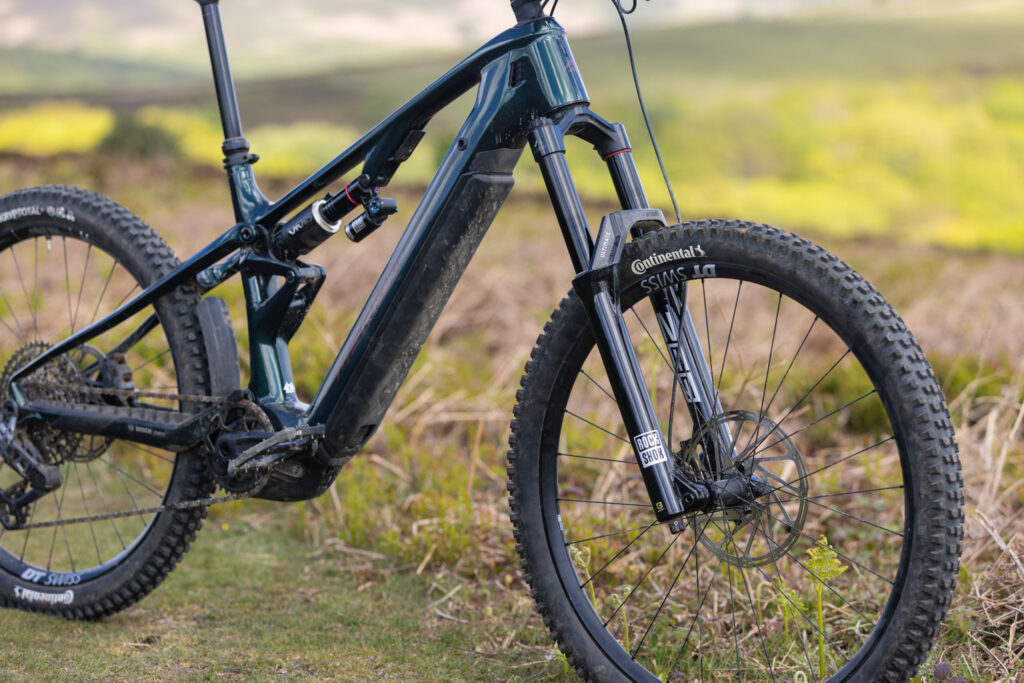
The latter components are definitely not top-shelf offerings, but they work incredibly well and match the Lithos’s intentions without blowing the budget. Alright, you might lose a bit of adjustment with the Bronze Mavens, but you still get their renowned power, which on an e-bike of this weight and potential speed, is more than enough.
Another area in which this point is proven is in the rotors. Rather than go for SRAM’s posher HS2 rotors that I like quite a lot, Merida has gone for its more affordable Centreline discs. Again, they’re not as exciting as the spendier rotors, and the brakes’ feel isn’t quite as positive, but they do the job perfectly well.
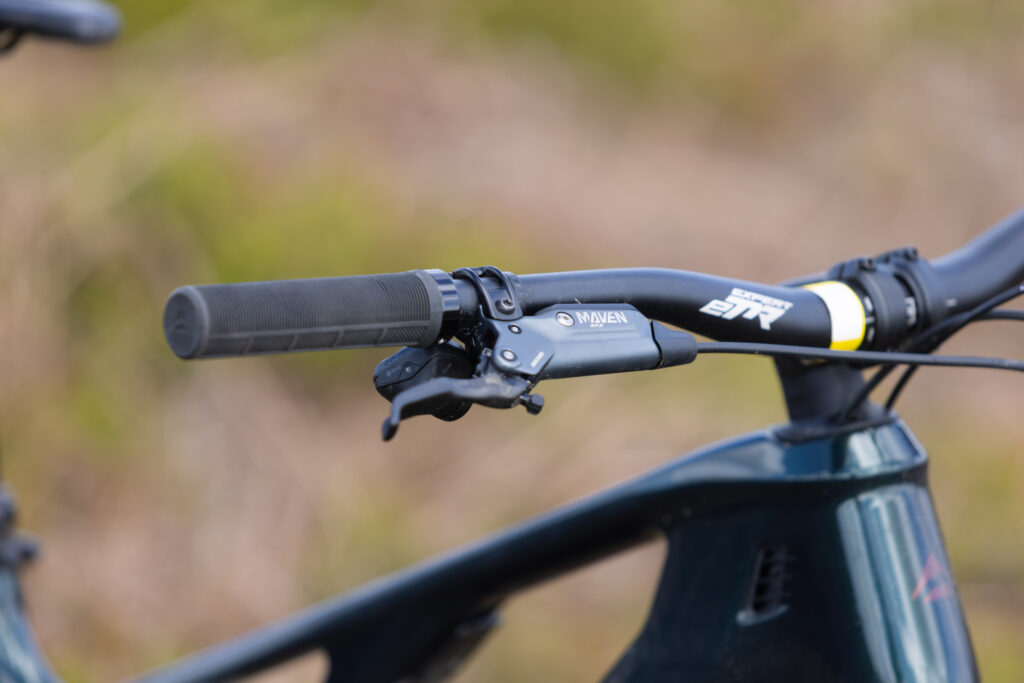
Elsewhere, the DT Swiss HX 1700 wheels house the brand’s Degrees of Freedom tech and support Continental’s Kryptotal FR and RE tyres. There’s the travel-adjustable dropper post offering up to 230mm of dropper action, and Merida has finally thrown on some different grips. Though they’re still not the greatest, and are worth changing if you prefer a bit more vibration damping.
It’s tough to complain about the build kit in general. Though both tyres come in Continental’s Enduro casing and Soft rubber. During my time with the bike, I’ve had no issues with this on either wheel, but harder charging riders may find themselves wanting the burlier downhill casing for extra support and puncture protection.
Merida Lithos 8000 – Performance
With the release of the One-Sixty and One-Forty a couple of years ago, and then later the eOne-Sixty and so on, the Lithos is a real refinement of Merida’s modern formula. I mean, the brand has had an enduro e-bike in its range for ages now, the eOne-Sixty and has played with even longer travel e-bikes, like the eOne-Eighty. But the Lithos takes all of that experience and amalgamates it into an enduro e-MTB that’s just the top of its class.

Where e-enduro bikes can really lean into a plowable, linear feel, and the Lithos does do that, to an extent, Merida has created a very well-rounded character to the bike’s suspension. Of course, you can point it at some large, demanding terrain and it’ll calmly rattle through it with extreme composure. But there’s still a good feel of progression throughout the leverage curve. At the start of the stroke, it’s remarkably sensitive, as the Lithos takes full advantage of the Vivid Air’s fresh redesign and the DT Swiss Degrees of Freedom tech.
Small bumps? The Lithos has never heard of them. Ploughing into smaller rock gardens and webs of roots doesn’t phase the Lithos as it hardly transmits a jolt of feedback to the rider. With that, it drives through uneven terrain as if it’s not really there, holding onto precious momentum all while maintaining control, and tracking exactly where you point it. If it gets knocked off line, it’s nothing but rider error.
Of course, as an enduro bike, it’s well up to the task of staying true while absorbing larger, travel-munching impacts. It performs impeccably when deep in its travel, recovering neatly when it can, while totally avoiding bottoming out. It remains rather active and comfortable under braking, too, which helps it take full advantage of the Maven’s full braking might.
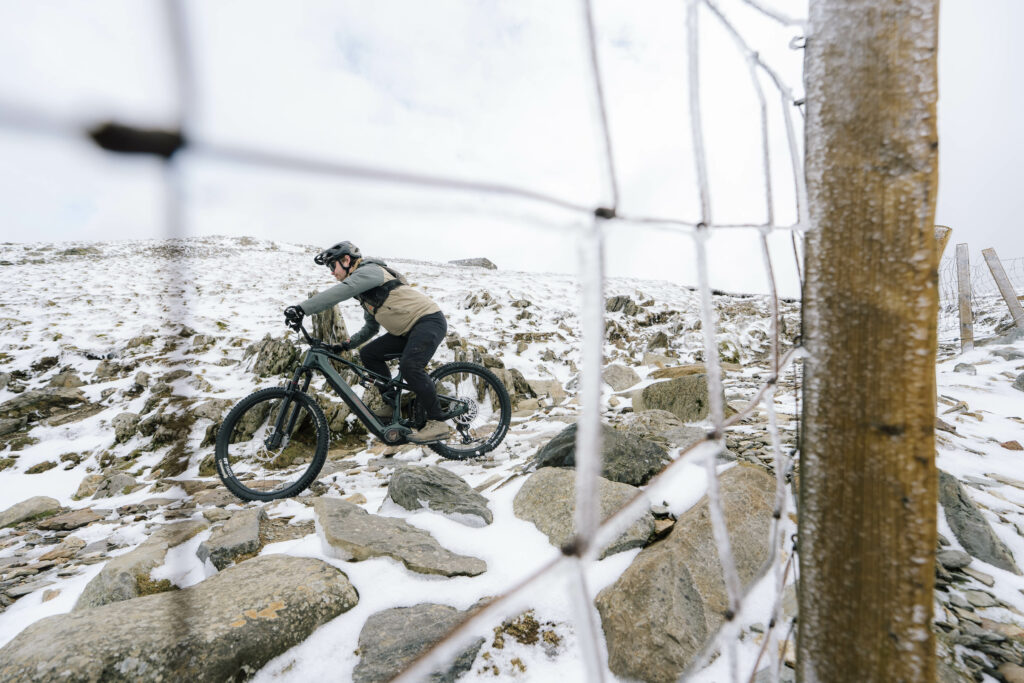
Many e-enduro bikes can feel a little muted, as they’re tuned to handle nothing but the roughest of tracks, and that is somewhat the case with the Lithos, but Merida has managed to conjure something of a platform into its millimetres, as a result of its flex stay, which is a little stiffer than previous iterations. The bend that occurs in the flex stay kicks in after the first quarter of the travel, where the bending moment increases as the bike sinks deeper into its travel. Within the first half of the travel, it helps produce support in the suspension, alongside the shock’s tune, while keeping the whole thing active, grippy and comfortable. It’s not harsh, but it helps the bike remain taller in its travel, communicative and provides a light feeling ride, despite the Lithos weighing a little over 24kg.
Traction is one of the Lithos’s many strong suits. Because its rear suspension is so active, it works with the terrain, rather than skipping over it, so grip is simply abundant. Throw in the Continental tyres for good measure, and I’m yet to find a situation where I wanted more, apart from over ice, but there’s no winning there, regardless. I’ve ridden the Lithos through a surprisingly vast range of conditions, too, like snow and ice (in March, who’d have thought!?) through to soft wet stuff, and hard dry tracks. Through all of that, the Lithos has rustled up enough confidence to just ride it, without having to worry about what the wheels are up to.

Place that suspension onto a bike with this geometry, and Merida has delivered one of the best enduro e-mountain bikes I’ve ridden. Like many of Merida’s bikes, its geometry is progressive, but owing to its steep seat tube angle, it’s welcoming and rather familiar.
It has a wheelbase that instils a serious amount of stability, which, of course, increases with the faster you travel, but combine its reach with the head angle and the front end provides plenty of support over a range of gradients. It’s by no means too slack, either, as the general feel of the bike’s front end is rather neutral and easy-going, without feeling vague or overly wobbly.
I guess a drawback, which isn’t really a drawback, is that it’s a bike that errs towards predictability as a result of its chainstay length… which it should… It’s an enduro bike. With that, it’s sure-footed and mega dependable, but it’s not a bike you’re going to be whipping around corners and getting super rowdy on. It’s more of a ‘business’ bike, where it gets the job done, rather than one that handles like an overexcited spaniel. It’s a longer bike, so it’s not the most direct or telepathic to corner, but as there’s a little wheel bolted into the rear, it’s easy enough to initiate a lean and muscle through turns, owing to the lesser rotational mass.
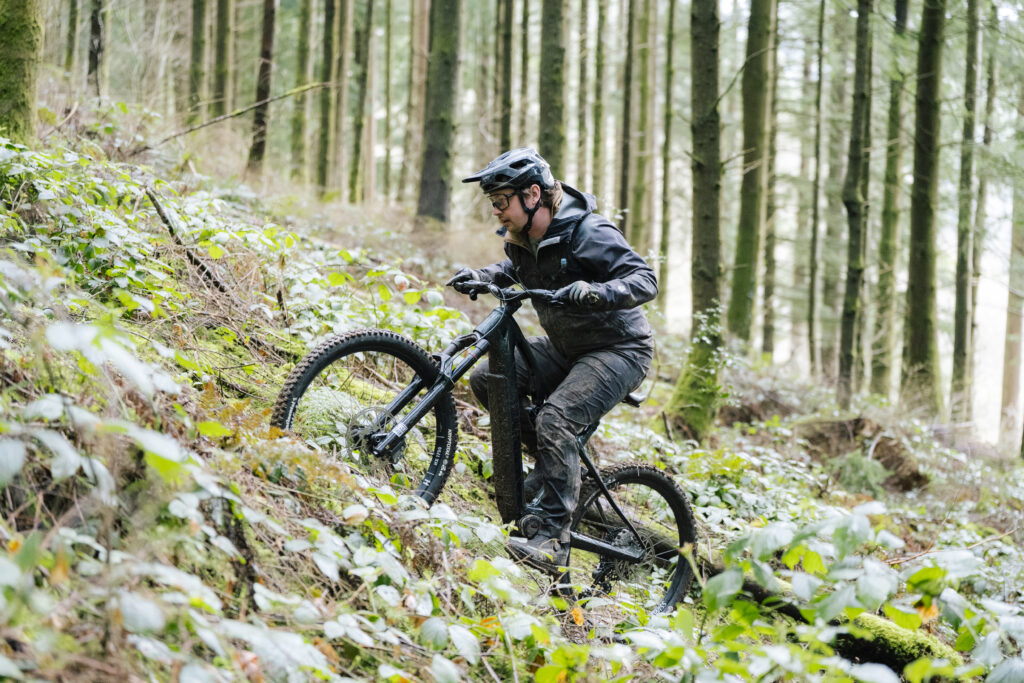
The Lithos soars up the climbs, too. That seat tube angle comes into play to even out weight distribution between the wheels, keeping both glued to the ground, along with that chainstay. With that supple suspension, it summons up plenty of grip to make techy climbs a doddle while the motor’s 120Nm just makes the whole ordeal easy. Throw in Bosch’s hill climb assist and traction control features for good measure, and it’s really hard to find fault.
Merida Lithos 8000 – Verdict
At £8,500, there’s definitely a little persuasion needed when it comes to its value, especially when Avinox MS2-equipped machines are so rife in the market. One of which is Atherton’s S.170E.2. It is an alloy-framed bike that uses Atherton’s subtractive manufacturing approach, but it gets the same suspension components and similar tyres, but Haye’s Dominion A4 brakes, which are great, but not quite the calibre of the Mavens on the Lithos. The Atherton S.170E.2 costs £8,000.
The Lithos reminds me an awful lot of Yeti’s LTe. I rode a very expensive Fox Podium-equipped model, but compared to the not-quite-as-pricy C-Series C2 model, the Lithos value is looking much better. The LTe C2 gets Fox Factory suspension, with a 38 fork and Float X2 shock, but RockShox has Fox pipped here, with the Ultimate level kit on the Lithos performing better, I’d say. There’s then mechanical shifting and the lower-level CX motor, though there’s a wireless dropper post. But that bike will set you back £9,499, making the Lithos look a lot easier on the wallet, at least for what you get for the money.
The Lithos is everything a good enduro e-mountain bike should be. It’s well shaped, wisely specced, massively capable and above all else, predictable. It rocks a ride that’s easy to get on with while making incredibly light work of demanding tracks by utilising its very impressive suspension design and its spot-on geometry. It’s easy to live with too, as its battery is removable and users can ditch the headset routed cables in favour of regular internal cable routing. Throughout my time with this bike, I’ve struggled to find anything I don’t like.
Test Report
What does the manufacturer say about this product?:
Merida says, “Even in the most imposing terrain, it is possible to find flow. Named after the
Ancient Greek for rock or stone, the new LITHOS is designed for serious enduro
riders and racers, with a single minded focus on speed, no matter what turn the
trail takes.”
Tell us some more about the technical aspects of this product:
Carbon frame, RockShox ZEB Ultimate shock, RockShox Vivid Air Ultimate shock, SRAM Maven Bronze brakes, SRAM GX AXS T-Type drivetrain, DT Swiss HX 1500 wheels, Continental tyres.
Any further comments on performance?:
An excellent enduro all-rounder.
How does the price compare to that of similar products in the market, including ones recently tested?:
£500 more expensive than the alloy-framed Atherton S.170E, cheaper than Yeti’s LTe.
List the components used to build up the bike:
Carbon frame, RockShox ZEB Ultimate shock, RockShox Vivid Air Ultimate shock, SRAM Maven Bronze brakes, SRAM GX AXS T-Type drivetrain, DT Swiss HX 1500 wheels, Continental tyres.
Tell us what the bike is for and who it’s aimed at. What do the manufacturers say about it?:
It’s an enduro bike.
Where does this model sit in the range? Tell us briefly about the cheaper options and the more expensive options:
One below the most expensive. Prices start at £5,250 and go up to £11,000.
Tell us about the materials used in the frame:
Carbon fibre
Tell us about the geometry of the frame:
64-degree head angle, 485mm reach, 78.5-degree seat tube angle, 447mm chainstay.
How was the bike in terms of sizing and angles? How did it compare to other bikes of the same stated size and intent?:
Spot on.
How much suspension travel does the fork have?:
170
How much suspension travel does the rear end have?:
174/160mm
Was the bike comfortable to ride? Tell us how you felt about the ride quality:
Very comfortable.
Did the bike feel stiff in the right places? Did any part of the bike feel too stiff or too flexible?:
Good balance of stiffness and compliance.
How did the bike transfer power? Did it feel efficient?:
The motor does all the work.
How would you describe the steering? Was it lively, neutral or unresponsive?:
Neutral
Tell us some more about the handling. How did the bike feel overall? Did it do particular things well or badly?:
Excellent handling in most areas but it requires a little more thought through tighter corners.
Which components had the most effect (good or bad) on the bike’s performance? Would you recommend any changes?:
Maybe a burlier rear tyre.
Any comments on sprinting?:
It’s an e-bike.
Any comments on high speed descending?:
Super planted and very confidence inspiring.
Any comments on technical descending?:
Super planted and very confidence inspiring.
Any comments on cornering?:
Predictable and grippy, but needs more attention through tighter corners
Any comments on technical climbing?:
Plenty of length, support and traction.
Any comments on climbing efficiency?:
It’s an e-bike.
Any comments on agility?:
Agility isn’t the Lithos’s strong suit, but it does a commendable job.
Any comments on fork performance?:
This new RockShox kit is awesome.
Any comments on rear suspension performance?:
Very grippy, very comfortable but lively as well.
Any comments on drivetrain performance?:
Classic AXS experience.
Any comments on tyre performance?:
Harder riders will want a more robust casing on the rear wheel.
Any comments on brake performance?:
Maven Bronze is a dark horse.
Any comments on controls comfort?:
Grips are improved over previous Merida grips, but they’re still not my favourite.
What kind of motor is it?:
Bosche Performance Line CX-R
What are the stated motor system specs? (Torque/power/maximum assistance speed):
120Nm, 750W.
Tell us some more about the motor. How did it feel overall? Did it do particular things well or badly?:
I’m a big fan of the Bosch systems.
How did the motor perform at higher speed? Was it noisy? Did assistance cut out smoothly/abruptly at the 25km/h assistance limit?:
Quiet
What type of battery is it? Is the manufacturer named?:
800Wh
Where is the battery on the bike? Is it removable?:
Removeable.
Tell us about the assistance levels. How many are there? Are they all useful?:
Five levels including off. All useful.
What do the manufacturers say about the range of the bike?:
No statement
What was your experience of the operational range of the bike?:
over 30km and 1,200m of ascent.
Did you enjoy using the product? Yes
Would you consider buying the product? Yes
Would you recommend the product to a friend? Yes
Use this box to explain your overall score
the Lithos is a true enduro e-bike that does what it’s built to do extremely well. Only minor faults hold it back from a perfect score.
About the tester
Age: 33Height: cmWeight: kg
I usually ride: Santa Cruz BronsonMy best bike is:
I’ve been riding for: 10-20 yearsI ride: A few times a weekI would class myself as: Experienced
I regularly do the following types of riding: Mountain bike Enduro