



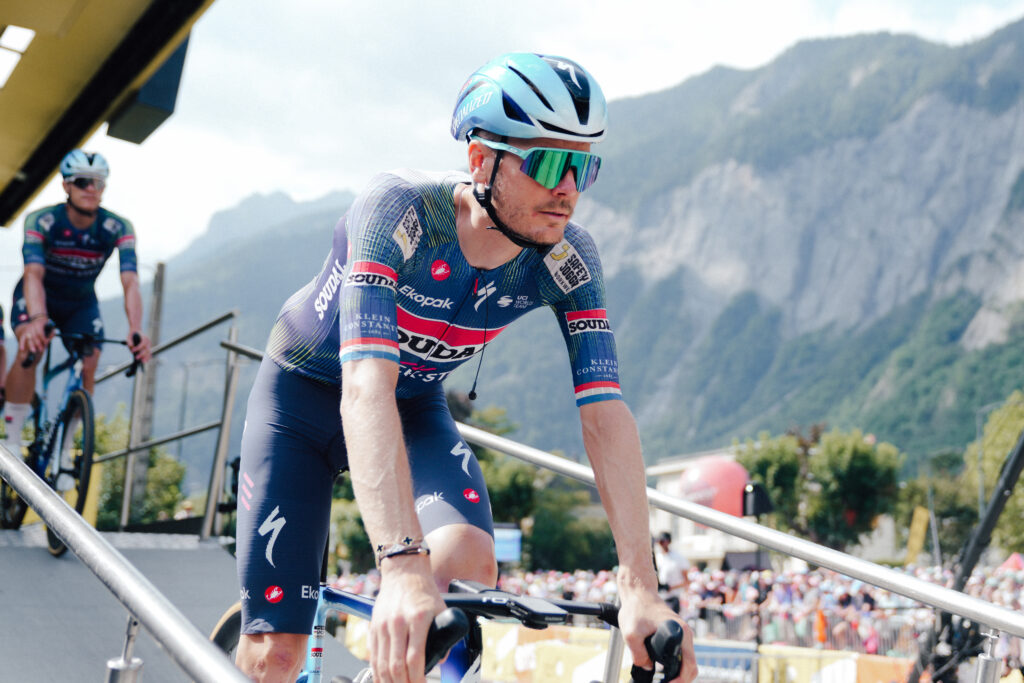
Cycling’s much-discussed power data passport trial is currently underway and involves 60 riders from five professional teams, including Jonas Vingegaard’s Visma-Lease a Bike squad, the International Testing Agency confirmed this week.
According to the anti-doping body, the two-year ‘feasibility and pilot study’, first announced on the eve of last year’s Tour de France, aims to monitor riders’ power and training data, exploring whether it could be used as a “supplementary source of intelligence”, alongside existing measures such as the biological passport, for anti-doping purposes.
This so-called power data passport trial, which has divided opinion within the peloton over the past year, is funded by the UCI’s anti-doping programme and run in collaboration with the University of Kent and University College London.
In a statement this week, the ITA said the trial “aims to assess whether longitudinal performance modelling based on riders’ power data can meaningfully support anti-doping strategies in a scientifically robust and operationally responsible manner”.
Despite objections from some within the sport, the ITA insists that the trial’s purpose is not to create a situation where anti-doping rule violations can be established solely by analysing performance and power data.
Instead, the trial will be used to “evaluate whether certain patterns or evolutions in performance may, in the future, help inform areas such as targeted testing strategies, sample retention decisions, additional laboratory analysis, or investigations”.
“A central objective of the research is to better understand typical variability in performance over time and across different rider profiles and age groups,” the agency said.
“Researchers are studying how performance evolves throughout a rider’s career, how race performances relate to training data and how repeated efforts can be analysed in a meaningful and reproducible way despite the many variables inherent to elite cycling.
“The work particularly examines what researchers describe as ‘excess performances’, which represents individual performance trajectory of an athlete adjusted for the average performance of all athletes within the population at the same age as well as any confounders.
“The model therefore examines the change in an athlete’s performances over time rather than focusing solely on an isolated exceptional performance.”
The study aims to assess the range of factors which influence power data, including differences between power meter devices and calibration methods, systematic and random measurement error, race dynamics and rider specialisation, and the relationship between training outputs and race performances.
In March, the ITA told road.cc that just under 60 riders from five different teams have signed up and have consented to share their historical power data as part of the trial on a voluntary basis.
Those teams were this week confirmed to be Visma-Lease a Bike, led by two-time Tour de France winner Jonas Vingegaard, along with Picnic PostNL, Jayco AlUla, Decathlon AG2R, and Cofidis. Meanwhile, Uno-X Mobility, Tudor, and TotalEnergies have approved “participation frameworks” and talks are ongoing with other squads.
The first year of the trial will focus on retrospective analysis, using historical rider data to “determine whether a meaningful and sufficiently reliable” monitoring approach can be developed, before a pilot phase assessing data from that current season.
The ITA has also established a dedicated ‘Power Data Advisory Panel’, bringing together experts from the world of sports science, athlete representation, cycling technology, and integrity operations.

“We are constantly looking at how to make the cycling anti-doping program smarter and more effective”, ITA director general Benjamin Cohen said in a statement.
“Power data has been part of the conversation in cycling for many years. It is one of the sport’s most widely used performance tools, yet until now its potential contribution to anti-doping has remained largely unexplored.
“Thanks to the commitment of riders, teams and recognised experts, we now have the opportunity to assess its potential through a structured scientific process and determine whether it can meaningfully complement the anti-doping toolbox in the future.”
If the trial proves a success, and is approved by the UCI, the governing body’s regulations will be amended to require the mandatory sharing of individual power data for all professional men’s road riders, before potentially moving to the women’s peloton and other sports such as triathlon, the ITA says.
It’s this potential for mandatory power data sharing that has proved controversial within the cycling world, attracting criticism from Adam Hansen, the president of the CPA, the professional riders’ association.
“The CPA is not really happy about this at all,” Hansen told road.cc earlier this year. “There are some riders who don’t mind it, they think it is okay. But I do think it is bringing things too far.
“Riders have so much responsibility at the moment. Their whole life is under WADA, they have to do their whereabouts, they have to be at a special location every day for one hour, they have to fill those details in, they have to make sure that they eat the correct diet, they have a training plan they have to follow.
“And while this is voluntary at the moment, I’m really worried when it becomes mandatory.”

The Australian continued: “I always ask the question what happens if the rider refuses to upload his training? And they said, ‘well, they’d have to enforce it.’ And then, for me, it’s like, ‘okay, what happens then?’
“At first they said it’s just a test. I said, ‘okay, that’s fine. But what happens when it’s not a test? What happens when a rider does not submit his training data? What happens if his SRM or Garmin is flat? What happens if his power meter does not work?
“What happens if his bike doesn’t work that day? What happens if he doesn’t ride on his road bike, and he rides on his mountain bike, and this changes his whole training programme? How can you know this?
“How do you know when he’s training at 80 per cent and not 100 per cent? Because if he has a week of training at 80 per cent and then he decides the week after to train at 100 per cent because he’s following the instructions from his coach, how did they know that he was training that week at 80 per cent and that’s not 100 per cent?
“And then the week after it [appears to be] 120 per cent, where they are thinking ‘is it 20 per cent over his limit? How can he do that?’ But it’s because he’s been training easier before.
“I highly believe it won’t be successful. And then it will be scrapped. But we will see how it goes.”

The trial has also been criticised by high-profile rider agent Alex Carera, who has represented four-time Tour de France winner Tadej Pogačar and several other professional cyclists for many years, Carera arguing that the use of power data as an anti-doping measure is unnecessary and unwarranted.
“I know that a commission wants to analyse the data of Training Peaks and decide some elements. No. Why? Our sport has changed a lot. Now cycling has credibility,” he told road.cc.
“Maybe 10 or 15 years ago, no, but now we have credibility because the mentality has changed. We don’t [need to] find other stupid things to create only problems, because cycling is different than 15 years ago.
“Maybe we needed to come back to have the credibility to show to the fans that we want more controls, 24 hours availability, and so on.
“But now the mentality has changed. We do not have this problem, the doping problem. Why do we need to create something [new]?”














9 thoughts on “Visma-Lease a Bike taking part in anti-doping power data trial that Tadej Pogačar’s agent claimed would “only create problems”, testing agency confirms”
Not discussed here but couldn’t this also be used to detect any instances of motor doping (or at least highlight for targeted testing).
@Gravel1-2 How would that work? Are you talking about during races they could see that wattage suddenly spiked by a flat 30w? I guess it could help but I really don’t think motor doping is happening in the pro peleton. People just love a potential scandal and a conspiracy. The risk of getting caught and the consequences for the team and the rider would be catastrophic.
Acceleration/speeds that don’t match the power profile, especially uphill (e.g no change in crank power but a change in speed out of line with other riders). It wouldn’t be foolproof but would provide an indication.
I agree that I don’t think anyone is doing it, but it would give extra confidence that it’s not going on!
@Gravel1-2 If that was going to be a smoking gun the teams would likely just be circumventing it. Fiddle the power data either pre-flight or post-flight based on the motor usage. If someone has gone to enough effort and expense to create an invisible motor inside a WT team bike that doesn’t set off any more obvious red flags like weight, random buttons, scanning etc then they will get around this one as well.
I don’t buy Hansen’s arguments.
Presumably one of the things the analysts will do is estimate VO2 max for each rider using HR-, HRV-, power data and rider weight; and then monitor this over time both during each ride and across all rides. A sudden change in VO2 max would indicate something is amiss.
In which case questions like “How do you know when he’s training at 80 per cent and not 100 per cent?” is irrelevant as long as the VO2 estimate is robust to different training intensities.
However, if the analysts suspect there is an issue it will be up to them to prove it using the data and be able defend their methodology.
@Pub bike I don’t think they can prove it. Thats what they are saying. They can use it as an indication to guide further testing but as an actual “gotcha” its not going to work. I don’t know if this is all part of a strategy to make people so paranoid about getting caught that they don’t even try to get away with it.
Yet another dumb idea. Too many variables. Just look at the latest Lorena Wiebes fiasco.
Does anybody actually like UCI, can they just go the way Guy Fawkes intended the Palace of Westminster to go? Get sensible people like Adam Hansen to come up with a more sensible governing body with a set of fair but sensible rules.
Regardless of whether such a test would be workable, Carera’s remarks are stupid and naive.
Of course there might be doping. That spectre will never go away. Some of Pogaçar’s performances are just insane, they beggar belief. Is he doping? I don’t think so. Can I be 100% sure? Of course not.
I don’t see an issue, if you’ve nothing to hide… If they see a large increase in V02 max or FTP values then they can do extra investigating and maybe more actual testing. They team can show if a certain training program could indicate larger than historically seen gains by a rider.
I think if I was a rider, I’d sooner let then have my TP files than have to be watched while having a piss into a cup.