


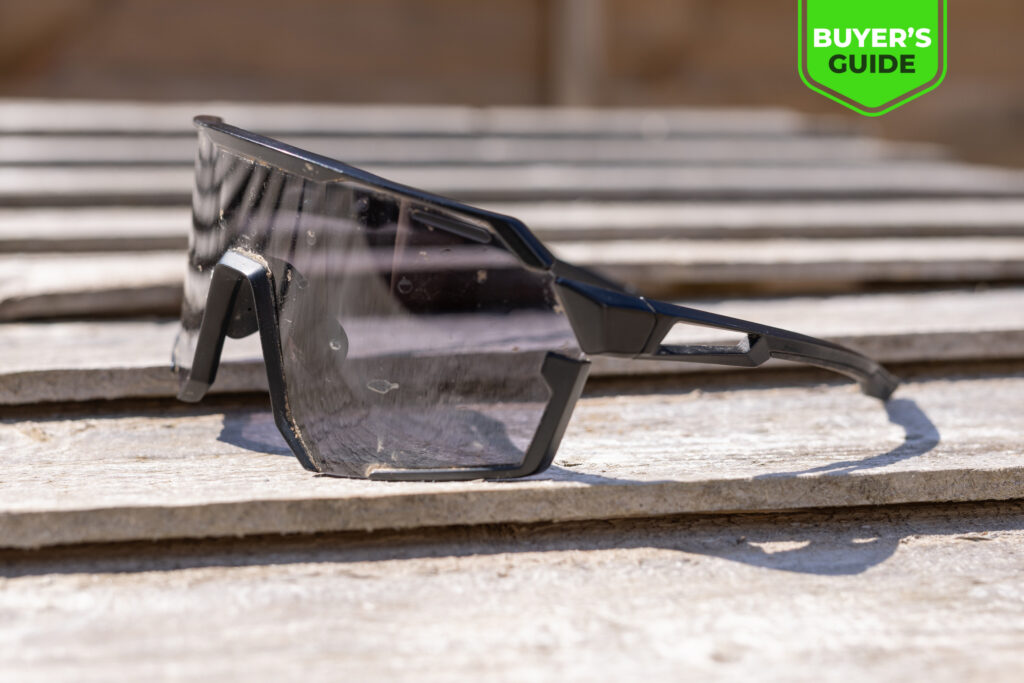

Often overlooked and sometimes down to personal preference, sunglasses serve two purposes. One is to keep your vision comfortable and clear in the sun, and the other is to keep wind, mud, water, and stray foliage from getting into your eyes. Here are the best we’ve tested for mountain and gravel biking.
What to look for in a pair of cycling glasses
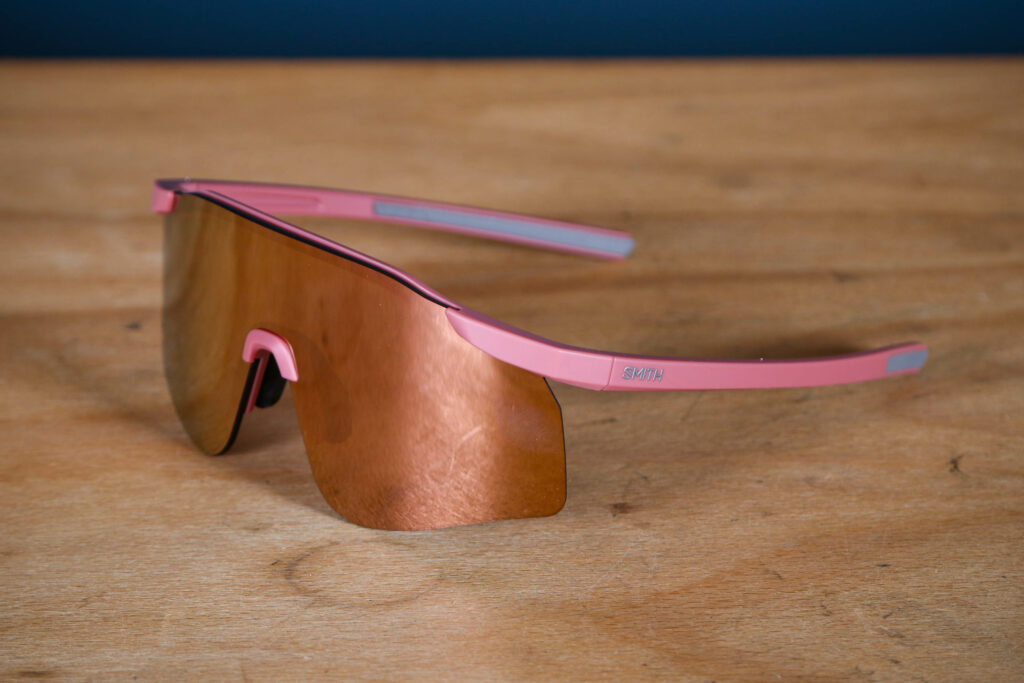
Sunglasses for mountain biking and gravel riding come in many shapes and forms, but many follow the same formula, and with good reason. Most glasses on the market use a single-lens design, which means that there’s one lens spanning the width of the glasses for both eyes. While this is very different from your regular fashion or prescription specs, this allows for greater uninterrupted coverage, so there’s not as much frame in the way of where you’re looking. That said, some glasses do use dual-lens designs.
The most important factor to look out for is fit. All glasses are different sizes, and while it’s easy to go for the largest in the hunt for maximum coverage, that’s not the best approach. That’s because if you go too large for your head size, the glasses can literally be too big for your face, and some can even knock against the brow of your helmet, which can be very annoying and rather uncomfortable. The best way of finding the best-sized glasses for you is to try before you buy with your helmet, or trawl through our reviews.
Next up, the best way to get the most value from your sung lasses is by choosing a set that comes with interchangeable lenses or the ability to swap them out. Let’s face it, you don’t want to be riding in the winter with a tinted lens, and you won’t benefit from the sun protection of a clear lens in the summer. Many brands have their own ways of swapping lenses, with some being simpler than others. Better still, photochromic lenses offer the best of both worlds. These change from almost clear to tinted automatically, according to the light levels outside. These are great because you don’t need to swap lenses, but they can pose a bit of a compromise, as often, they’re slightly tinted at their clearest, and it takes some time for them to shift tints. They can be rather pricy, too.
Then, look for glasses that come with lens technologies such as anti-fog, water-resistant and scratch-resistant coatings. These pretty much speak for themselves.
If you usually wear prescription glasses, a lot of models on the market come with RX insert compatibility. An RX insert sits on the inside face of your glasses’ lens and carries a pair of extra lenses, cut to your prescription. RX inserts are often model-specific and come at an extra cost. Sometimes the prescription lenses can come at another cost.
Which lens is best?
Most sunglasses on the market benefit from interchangeable lenses. This keeps them versatile and technically, more affordable, as you won’t need to buy a whole new set for changing conditions. Lenses on offer range from clear to pink through to tinted and mirrored options. All of these are designed to block or allow through a percentage of visible light, described as VLT on brands’ websites. The higher the number, the less light it blocks and vice versa.
The truth is, unless you’re going for a photochromic lens, no lens is perfect for all conditions. Clear lenses are great for winter riding, or night rides where there simply isn’t much light around. Pink lenses boost colour and contrast between mud or dirt, and anything green, making the trail ahead easier to see, whereas tinted lenses block the amount of light before it hits your retinae.
Several higher-end lenses then come with fancy technologies such as Smith Optics’ ChromaPop and 100%’s HiPHER. These technologies are built into the lenses and are designed to separate wavelengths of light in order to boost contrast, resulting in clearer vision.
Glasses or goggles?
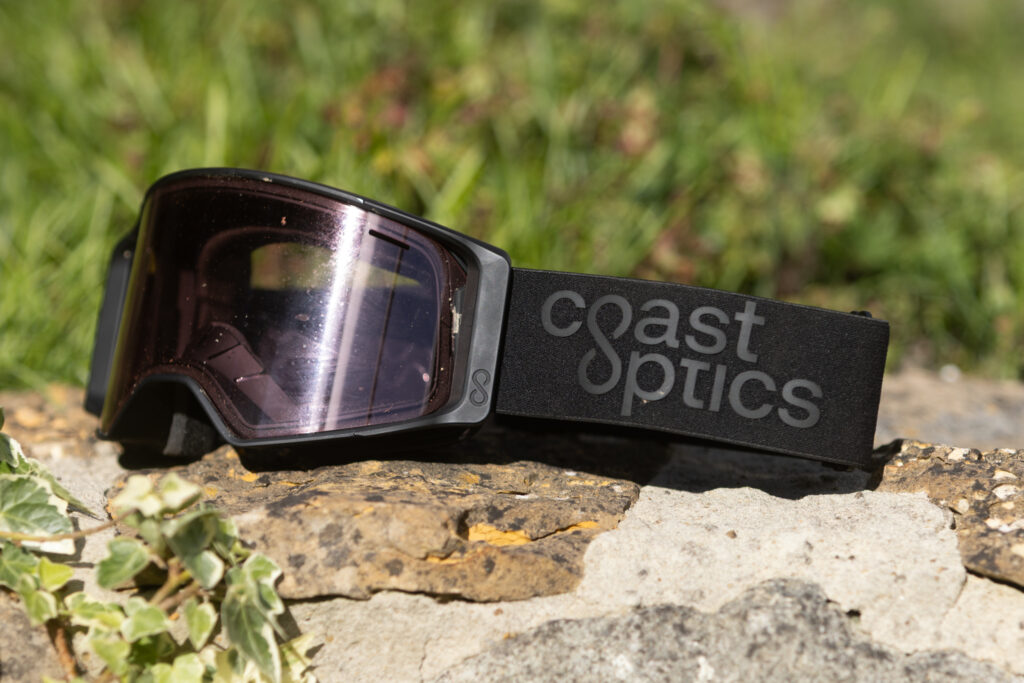
If you’re a mountain biker, you’ll have a choice between the type of eyewear you choose – glasses or goggles. Glasses are the go-to for cross-country, trail and enduro riding because they’re comfortable enough to be worn at all times. However, they can be unstable and need regular adjustment to keep them in the best place on your face.
Goggles up the security game as they’re strapped around your helmet and to your face. While goggles won’t move around as you ride, they can be bulky, heavy and uncomfortable over longer periods of time. This is why they’re preferred by downhillers, or those who prefer to ride in full face helmets. Though we had that emerging trend of combining goggles with open face helmets but I’ll leave that one of the MTB fashionistas out there to squabble over.






12 thoughts on “Best MTB sunglasses 2026: Top eyewear for gravel and mountain biking”
How about something similar for bi-focal glasses for us oldies that can’t see the Garmin without them?!
This is on ROAD CC. Take it down. If I wanted to read about MTB, I’d go to this site or MTB CC. I don’t. You’re just using this to pad out your story count. Don’t.
One day last week, a Tuesday I think it was, just like St. Paul on the way to Damascus ( don’t know where he was travelling from. Jerusalem?. Seems a long way. Perhaps he had a donkey. ) I had an epiphany – there was a blinding flash of light and I suddenly realised I didn’t have to read articles I didn’t find interesting even though other people might. I’m sleeping a whole lot better now, well, apart from the oppressive heat.
(Ignoring the fact it says off-road.cc at the top and bottom, but yes it is indeed the road.cc domain)…
… if you wish for further hill-martyrdom I can recommend a review of a tent they’ve done which mounts to a motor vehicle – zero bikes involved.
Good to see you back Perce!
And so it came to pass that upon a certain day Saul was riding to Damascus and a blinding flash struck the shades from his eyes and lo a voice did cry out, “Saul, Saul, thou ridest a Dogma yet verily thou art clad in MTB sunnies, and this, as thou knowst, is against my law.” Thereafter Saul was sore afflicted until he was guided to that place where road.cc is pure and bought the same glasses but verily they were stamped “road use” and there was great rejoicing through all the nations, especially in Surrey.
@Surreyrider Take this comment down. Put it on moan.cc where it belongs.
I use Rudy Rydon carbon’s with ImpactRx 2 Black Photochromic that works for me. I do not exceed an SPH of 4.0. Whilst I have a new pair, they are still my go to glasses for almost twenty years. My wife has just bought some Bolle Victus Pro Prescription Sunglasses as her SPH is 4.5.
I just returned here after a long pause and couldn’t resist this as I think it is an important topic for many people and I am notdoneyet!
Replying to Perce (site not letting me reply properly)
Donkey? Don’t be an ass, surely it would be a gravel bike – with a road helmet and MTB sunnies just to really confuse things.
As CoB said – good to see you back.
@Surreyrider and now they’re padding the live blog with your comments on this article. Top trolling.
@Surreyrider oh no, I wear the Oakley Sutros on my road bike but it says 0ff-road.cc here! For what it’s worth I enjoyed the car tent article too. Please stop.
It was when perce and that Clem Fandango bounced off one another that they both did their best work…