


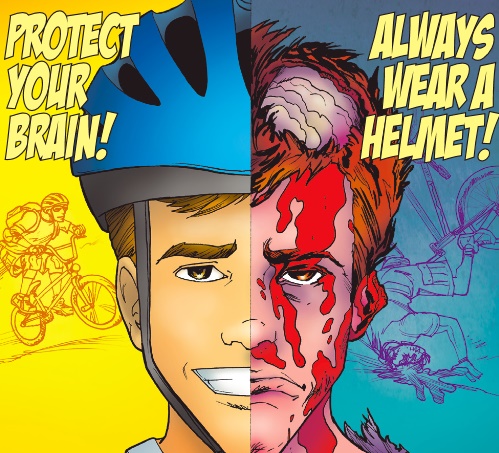

A fixation on cycle helmets is hampering efforts to improve bicycle safety in the United States, according to a professor from the University of Heidelberg. Streets Blog reports how Gregg Culver is arguing that the helmet occupies a special place within official bicycle safety discourse and that this distracts from more effective strategies to improve safety.
Early on in his paper, published in Applied Mobilities, Culver emphasises that his issue with helmet advocacy is purely one of proportionality: “I wish to make clear that I do not seek to make claims or recommendations on helmet use, one way or the other. Instead, my intention is to interrogate an exaggerated and arguably misplaced fixation with helmets.”
He goes on to say that… “cyclists in the United States are far likelier to wear helmets and yet five times likelier to be killed and about 21 times likelier to be injured than in the Netherlands, where helmet use is a rarity.
“If safe cycling can be achieved without helmets, and if relatively dangerous cycling persists despite helmet use, then basic logic dictates that the helmet simply cannot possibly be the most significant factor of bicyclist safety.”
Culver believes that attitudes to cycling in America, “must ultimately be understood within the larger context of the subordination of the bicycle to the automobile.”
He explains: “Virtually everyone involved in automobility has an understandable inclination to reflexively consider the death of cyclists as tragic accident rather than manslaughter. The helmet fixation redirects attention away from the overarching problem of vehicular violence, assisting in its denial.”
To analyse the attitudes of American public officials to cycling and cycle helmets, Culver conducted analysis of the official bike-related texts posted online by the planning departments of 25 US cities.
What he found was a “fixation” with cycle helmets which he says sees them prioritised over other safety measures in a number of different ways.
Helmet use was typically mentioned either first or among the first safety measures relating to cycling. He also found that ‘admonishments’ about helmet use were given special emphasis via exclamation marks, italics, or similar, whereas other safety measures were not.
He describes one example, from the city of Phoenix, where a strikingly graphic comic was used to illustrate the dangers of not wearing a helmet to children. In it, a cyclist’s head is split open and his brains can be seen by other cyclists.
In many cases, Culver identified an “overtly moralising tone that is largely unique to helmets compared to other elements of bicycle safety.” He said helmet use was presented not as a legitimate personal choice, but as “a moral duty.”
Reflecting on what he perceives to be a disproportionate emphasis on helmet use, he concludes: “Whether they (choose to) wear a helmet or not, cyclists should refuse to acquiesce to vehicular violence, and push for serious bicycle infrastructure investments and policies that safeguard vulnerable traffic participants. Considering that motorists operate fantastically lethal machines, a greater focus on improving motorist awareness for and responsibility toward vulnerable traffic participants should be pursued.”










120 thoughts on “Helmet fixation distracts from effective safety strategies says US professor”
This man speaks a lot of
This man speaks a lot of sense; what will it take for governments to listen?
Grahamd wrote:
A forklift fuckload of evidence-free ideology. Or lobbying $$$$.
In other news: bears make use
In other news: bears make use of the woods, Pope a catholic, yada yada yada…
cyclists in the United States
cyclists in the United States are far likelier to wear helmets and yet five times likelier to be killed and about 21 times likelier to be injured than in the Netherlands, where helmet use is a rarity”
“far likelier to wear helmets” isn’t exactly a stat and the US isn’t really the same as the Netherlands. Kinda like comparing apple (pie) and oranges. So apart from mixing stats and opinion with two different situations it’s fantastic analysis.
LJS wrote:
that is the point. There are much more effective interventions that actually make things safer for cyclists than helmets. They implement them in Holland, but not in the US (or indeed the U.K.). And when they do, helmet wearing becomes a statistical irrelevance…
LJS wrote:
I think the whole point is that the dutch approach, segregation, low speed limits tolerant drives DOES improve cycoist safety, meanwhile the US approach of wear helmets you little people does not.
The point is not that wearing helmets ios more dangerous than not wearing helmets
this seems to be lost on you, just as it is lost on legislation makes in America (and the UK)
It isn’t just the USA, this
It isn’t just the USA, this seems to apply to a lot of countries, and certainly the UK, where the fixation with helmets can be observed daily, with lots of organised rides having a helmet rule, and frequent demands for a helmet law.
As the good professor points out, this obsession with helmets is counter-productive, merely distracting from measures which do make cycling safer, and giving the motoring lobby a quick and easy way to attack cyclists, and blame them for not protecting themselves from their bloody awful driving. I wonder if there was some way to make BHIT and RoSPA and the helmet zealots and misguided MPs read this report?
When helmet wearing was
When helmet wearing was increasing in NY they found that the incident/injury rates went UP not down. Same in Canada, same in Australia, ridiculously so in NZ and it’s the same in the UK and everywhere else in the worldd, not to mention the pro/amateur raacing scene.
When will these people wake the fuck up and actually take notice of facts #Winstonisnotascientist
BehindTheBikesheds wrote:
Actually, if you look at real, statistically sound, peer-reviewed studies such as you can find in PubMed and other legit resources, you will find the opposite. Head injuries went down in US, Canada, and Australia. Read Culver’s article; here’s a direct quote:
After years of debate on the basic question of the efficacy of bicycle helmets (e.g. Attewell, Glase, and McFadden 2001Attewell, R.G., K. Glase, and M.McFadden. 2001. Bicycle helmet efficacy: A meta-analysis. Accident Analysis & Prevention 33, no. 3: 345–52.10.1016/S0001-4575(00)00048-8[Crossref], [PubMed], [Web of Science ®], [Google Scholar]; Elvik 2013Elvik, Rune. 2013. Corrigendum to: “Publication bias and time-trend bias in meta-analysis of bicycle helmet efficacy: A re-analysis of Attewell, Glase and McFadden, 2001”. [Accid. Anal. Prev. 43 (2011) 1245–1251] Accident Analysis and Prevention 60: 245–53.10.1016/j.aap.2012.12.003[Crossref], [PubMed], [Web of Science ®], [Google Scholar]; Thompson, Rivara, and Thompson 1989Thompson, Robert S., Frederick P.Rivara, and Diane C. Thompson. 1989. A Case-control study of the effectiveness of bicycle safety helmets. New England Journal of Medicine 320, no. 21: 1361–67.10.1056/NEJM198905253202101[Crossref], [PubMed], [Web of Science ®], [Google Scholar]), there appears to be consensus that, all else equal, bicycle helmets do provide protection against head injuries (Olivier and Radun 2017Olivier, Jake, and Igor Radun. 2017. Bicycle helmet effectiveness is not overstated. Traffic Injury Prevention18, no. 7: 755–60.10.1080/15389588.2017.1298748[Taylor & Francis Online], [Web of Science ®], [Google Scholar]).
ROADEAGL wrote:
I think you missed an important word in BTBS’s post; he said injury *rates* went up. The most quoted study I’ve seen is from Australia, where they saw reduction in head injuries after a mandatory helmet law went into effect. However, some people reviewed the data and saw that overall cycling #’s plummeted, so of course overall head injuries went down. They seemed to find that the # of head injuries per cyclist (injury rate) was higher, though.
I think most on here would agree that helmets do provide some protection against head injuries (I know not everyone, but most). The bigger issue they have is the amount of protection claimed, and the fact that it’s paraded around as the single most important element of cycle safety. Because of this, much more significant elements get overlooked or ignored. That brings about a lot of the vitriol towards helmet evangelists.
OR_biker wrote:
Injury rates in isolation don’t necessarily tell us anything.
Some types of cycling are higher risk than others. If a mandatory helmet law dissuaded low risk cyclists to a greater extent than it dissuaded high risk cyclists you may see an increase in the injury rate on a national level without any increase at the individual level.
FWIW I do believe that helmets provide some protection from head injuries but am opposed to mandatory helmet laws.
Rich_cb wrote:
I think you missed an important word in BTBS’s post; he said injury *rates* went up. The most quoted study I’ve seen is from Australia, where they saw reduction in head injuries after a mandatory helmet law went into effect. However, some people reviewed the data and saw that overall cycling #’s plummeted, so of course overall head injuries went down. They seemed to find that the # of head injuries per cyclist (injury rate) was higher, though.
— Rich_cb Injury rates in isolation don’t necessarily tell us anything. Some types of cycling are higher risk than others. If a mandatory helmet law dissuaded low risk cyclists to a greater extent than it dissuaded high risk cyclists you may see an increase in the injury rate on a national level without any increase at the individual level.— OR_biker
Very true. I don’t know for certain, but I would guess that many of those higher-risk cyclists were already wearing helmets before any mandatory helmet laws, so their participation #’s may have been less affected. Which, if that’s the case, reinforces the idea that helmet laws are a net negative as they reduce overall cycling participation, reducing the “safety-in-numbers” effect that many believe is much more important to cycling safety than helmets.
ROADEAGL wrote:
Oh dear, where to start. Okay, let’s go with the fact you mentioned the bent as a nine bob note Jake Olivier in reference.
The guy is sponsored by the worst state government in the world with respect to cycling, uses flawed methodology already denounced by peers and others, he uses cut lips as head injuries in the data to help prove his/NSW states point (Yes, that really happened) and even ignores his own advice on meta analysis.
The guy fawns over the paper from Thompson Riveira and Thompson (their much maligned load of bollocks paper) in his meta analysis and kyboshes others that come into conflict with his very clear bias/agenda.
That alone is enough for me to know you’re talking a load of cack, I can’t even be bothered to wade through the rest of your worthless bilge.
ROADEAGL wrote:
As others have already said, claiming that your research is statistically sound while quoting Thompson, Rivara and Thompson is an exercise in total and utter logic-defying hypocrisy. As one professor said, “I could use the TRT paper to demonstrate to my students how not to do research.”
BehindTheBikesheds wrote:
When someone demonstrates a causative link between helmet wearing and the statistics you mention. The rise of autism and increase in popularity of farmersmarkets align almost spookily. A causative link is yet to be established, so no-one takes the correlation seriously. For 60 years a reduced fat intake was thought to be insturmental in reduced mortality, a paradigm that our dietary advice was based on for 40 years. It turns out that although linked, there is many confounding factors, and no causative link, which informed a dietary approach which is almost certainly responsible for a decrease in heart disease, but with an overwhelming rise in obesity and diabetes, at far higher ‘cost’ than the original heart disease.
When will people wake the fuck up and realise that public medical policy, while prompted by statistics and correlations, should only be informed by established causative links. Like helmets can, and do, prevent some head injuries, while it is certainly not well established that helmets themselves are responsible for greater injuries.
Mandated helmets = reduced
Mandated helmets = reduced cycling. Surely that’s established.
For me, it’s not a huge leap from there, to
‘encouraged helmetting = less uptake in cycling’. Much less established.
So it comes down to doing what this bloke has done and looking at what countries that have high cycling uptake and low helmet wearing are about. Turns out we have a couple that are geographically and culturally close by. And what those countries are about is stuff like grown-up separate infrastructure, strict liability, less ‘car is king’ and also less cyclist KSIs.
The logical conclusion then is ‘stop fixating on helmets – there is much bigger shit’. Which is this guy’s message, and St Chris’s message.
The real debating point should be the wider *harm* that encouraging helmet wearing (schools, BC, sportives etc) does through possible reduction of uptake, because that encouragement is based on ideology at the moment. My own take is that that encouragement overall is harmful, but I can’t prove how much, so my own position is ideological too.
‘We’re all safer if more people cycle.
Encouraging cycle helmets stymies participation.
Discuss.’
davel wrote:
Can I like this twice?
madcarew wrote:
Hang on, helmets were introduced without any evidence of working, they were legislated on the back of no evidence and are continually pushed on the back of no evidence of working. I suggest that those wanting to push for helmet use have the burden of proof, so far after decades there is precisely diddly squat to support their effectiveness.
The burden is for proponents, not those that want to carry on as before, being unecumbered as the law allows.
BehindTheBikesheds wrote:
You assertion that bike helmets have no evidence of working is absolute tosh. Bike helmets demonstrably prevent or reduce the severity of some head injuries. You could demonstrate this for your self by putting a bike helmet on and throwing yourself off your bike head first at a lamp-post at 25 kph. Then do the same without your helmet. Testing and empirical evidence ably demonstrate that bike helmets prevent or reduce the severity of some head injuries. They certainly don’t save cyclist from injury, and it is possible that wearing them increases the risk of other injury . However we dont mandate against smoking on the basis that it reduces mortality from all causes, only that it reduces mortality from those directly associated causes in those individuals.
madcarew wrote:
This is spurious logic. There’s not even the slightest suggestion that smoking reduces mortality from other causes, not to a degere that comes anywhere close to matching the well-established incresse due to smoking-related diseases. There’s no comparison whatsoever between the two issues, it’s a dishonest analogy.
And so what if testing demonstrates that helmets ‘prevent or reduce the severity of some head injuries’? Why does that logic ony apply to cycling, why not to all other forms of movement?
FluffyKittenofTindalos wrote:
Yup: we definitely need those five point harnesses and formula one helmets for all drivers… 😉 And madcarew’s just argued for it, haven’t they?
madcarew wrote:
“Medical policy”? What’s that got to do with the topic?
Anyway, your point here is a major argument against compulsory helmet laws. There are no established causitative links between more helmet use, still less compulosry use, and improved public health.
(I’m not sure whether that’s what you were trying to say or not.)
(I’m actually not at all clear at this point what the truth is about sat fat and health, every other report seems to contradict the previous one…but nobody’s seriously suggested making saturated fat either compulsory or illegal, so I don’t see it’s that relevant to the current argument)
The obsession with helmets is
The obsession with helmets is distracting. But it is an easy win for all the anti-cyclists. “You all don’t take minimal precautions for your own safety so why should we spend millions on you safety”. And in the propaganda war that simple argument is a flat out winner with the voting public.
Until you all give up and just accept a helmet law you aren’t going to get progress on anything else.
kevinmorice wrote:
Exacly right – all the helmet promoters are essentially acting as tools, deliberately or otherwise, of the motor lobby.
oldstrath wrote:
We definitely need an emoji on here for a Wolfie Smith style revolutionary raised fist!
Learning the alphabet the
Learning the alphabet the second time is a baitch.. My riding partner had a slow speed crash..split the helmet in two …the nruro surgeon said he was lucky to be alive.. $40 can save you $40,000 in rehab costs…the choice is yours
rg9rts [at] yahoo.com wrote:
Indeed it is…
rg9rts [at] yahoo.com wrote:
At the age of 15 I was hit from behind by a drunk speeding motorist (no helmet; it was 1979, for gods’ sake). The bike absorbed the shock and was wrecked but although thrown into the road I got up and walked away with only a small scratch on my left hand.
There you are, proof that drunk driving may damage bikes but is harmless to cyclists.
So much for the power of anecdotal evidence.*
* a contradiction in terms if ever there was one.
rg9rts [at] yahoo.com wrote:
Neurosurgeons are good at mending broken brains but don’t usually know the effectiveness (or otherwise) of a polystyrene hat full of holes. If you want to wear one then fine but don’t parade your ignorance on here and expect us to thank you for it. Patronising twat.
Simon E wrote:
While I wouldn’t wish to be as derogatory as Simon, I’d echo his basic message. I was a doctor myself. The curriculum at my Medical School contained no training in materials science or assessing the likely effect of a helmet on a head injury. I’ve yet to find a Medical school which does give such training so I’d be disinclined to trust any “The Doctor said…” type ‘evidence’.
As I recall, a few years ago, one of the country’s most eminent neurosurgeons offered his opinion that bicycle helmets simply weren’t strong enough to offer any degree of protection from serious head injury. Rather than being treated as a valuable contribution from an expert in the field, his opinion was howled down by the compulsionists and ignored.
rg9rts [at] yahoo.com wrote:
yeah but you are lying so I believe you are the biatch. (Bot?)
Bikebikebike wrote:
Seriously, you think someone is using a bot to troll Road CC comments in favour of helmet use? Who’s behind this, Kask, Casco? Obviously you don’t want to wear a helmet as it’d bend your tinfoil hat out of shape.
This whole debate depresses me deeply. There is no compulsory helmet law in this country and there never will be, yet cyclists, who should be supporting each other against the shared threats to our existence, seem to get far more passionate over insulting each other and points scoring over this issue than any other. Both sides, wear a lid if you want, don’t if you don’t, but for God’s sake shut the fuck up about it and start talking about something important!
Roubaixcobbles wrote:
You’re absolutely right.
However, helmet skeptics are often treated to abusive comments such as “you’d have to be an idiot to cycle without a helmet” and these comments come from all sections of society. The annoying aspect is that most helmet skeptics have actually done some investigation into the efficacy of helmets and usually the person advocating helmet use for all cyclists (yet not other people for some strange reason) has not done any research and instead declares it “bloody obvious”.
Roubaixcobbles wrote:
I dearly hope you’re right but the threat seems very real to me – it has happened in other similar countries, victim-blaming is already rife in government publications and advice while contributory negligence has been used in previous court cases to reduce compensation payouts to victims.
I find that nearly everyone who disagrees with the helmet proponents is not anti-helmet per se but anti-compulsion. This includes the current situation in the UK which feels like ‘virtual compulsion by stealth’ where helmet protagonists, family members and even strangers, having unthinkingly swallowed the hype, decry bare-headed riders are irresponsible, dangerous and stupid (as happened further up this discussion).
This thinking so pervasive that even drivers who close pass and stop to argue say it (because the c**ts can’t bring themselves to apologise, certainly not to a cyclist!). I’ve seen it mentioned on here and heard it myself. It beggars belief why an entitled, selfish bigot piloting a 2-tonne vehicle thinks that putting a polystyrene hat on my head will make any fucking difference when he takes me out with his vehicle. One summer’s afternoon a guy riding in a rapha jersey caught up with me at some lights and, instead of mentioning the lovely weather or my bike, he felt the need to ask why I didn’t wear a helmet as he wouldn’t ever ride without his. I was polite but was thinking that my choice was none of his fucking business!
I really don’t mind whether people wear one or not. You won’t catch me slagging a helmet wearer for their choice. And I’m willing to bet that I have spent a hell of a lot longer than you researching, reading and pondering my views the subject and I’m still unsure whether I’ve made the best choice.
The debate probably depresses you because you think the decision is unimportant, which suggests to me that you have a closed mind. If you want us to discuss something you consider more important then by all means get on with it and leave this thread to those of us who are prepared to articulate our thoughts (and yes, also to those who just want a slanging match).
Simon E wrote:
I remember at the end of last summer, riding home after work (about 6 pm, still bright sunlight, obviously) and some blokes sitting outside a pub in my village shouted out at me as I rode past that I should be wearing a f-ing helmet, common sense innit! As you can imagine, I was very pleased that a group of slightly drunken complete strangers took such care in my safety (and rather hoped none of them decided to drive home… ).
Simon E wrote:
No, it depresses me because I believe it’s entirely up to the individual if they wear a helmet or not (I do), I don’t believe compulsory laws for helmets will ever come to pass in the UK and I’m fed up with watching cyclists bawling each other out with increased levels of pomposity from both sides (everyone on here’s a bloody expert, it seems) when there are far more important issues facing us a group. That’s not having a closed mind, it’s having a sense of priorities.
Roubaixcobbles wrote:
We don’t need laws for something to effectively be mandated. All it takes is the defence lawyer, or the headteacher, or the constable, or the rentagob, indulging in a bit of ignorant victim-blaming, or misguided compulsion, or deliberate obfuscation, or blatant lobbying.
Or the national authority mandating them in its competitions.
That stuff tends to sway public opinion.
And that’s the real crux of the argument, for me. Forget the ‘saved my life’ and ‘polystyrene? bitch, please’ sideshows.
To believe personal choice isn’t being eroded, just because the written law doesn’t say you have to wear one, is to miss the point. Restrictions ARE currently being placed on cycling. Right now, with zero justification. That shit matters, so you can forgive people having an opinion about it.
Roubaixcobbles wrote:
I’m not.
Unless we’re talking about cheese. Can we talk about cheese?
Beecho wrote:
I recently tried one of those new-fangled cheese diets as I wanted to cheddar few pounds.
rg9rts [at] yahoo.com wrote:
Indeed the choice is ours, and long may it remain so. Your anecdote is just that, a story with no supporting data, and I’m sure we’ve all seen the quote “the plural of anecdote is not data”.
Anecdotes are very useful ways of supporting a scientifically proven case, but on their own mean absolutely nothing, and in the case of cycle helmets, the long term, large scale reliable data is precisely opposite.
All neatly summed up here http://www.cyclehelmets.org/1209.html
rg9rts [at] yahoo.com wrote:
So there was a crash (cause not given). Your ride partner suffered a serious and distressing head injury as a result. He was wearing a helmet but it just broke in two, giving no protection whatsoever and not preventing the injury. Neurosurgeon is quoted as saying he was ‘lucky to be alive’, presumably because the injury was so severe (and not illustrating that neurosurgeon’s have a strange idea of what ‘lucky’ means). With you so far: Helmets are a complete distraction because (in this one anecdotal incident, at any rate) they don’t prevent serious head injury or possibly death, even in low speed incidents.
Then you say something about saving rehab costs which I don’t follow at all. Could you elucidate?
PS I hope your partner is well on the road to recovery.
g9rts [at] yahoo.com wrote:
Putting aside the helmet split in two (instead of polystyrene crushing as its supposed to) == saved my (friends) life anecdata, this makes me glad I don’t live in a country with Trumpcare !
If “Breaking Bad” Had Been Set In The U.K. https://www.buzzfeed.com/lukelewis/if-breaking-bad-had-been-set-in-the-uk?utm_term=.mkDZNgR0ga&sub=0_1617947#1617947
I would think the author
I would think the author could have just eliminated mention or focus on helmet or no from his discussion and just done a comparison of cycling prevalence/practice/acceptance in The Netherlands and other countries vs. the United States. I’ve ridden in Europe and the U.S. and it is just a different attitude by motorists and local/state governments here in the U.S. about who owns or has a right to use the motorway.
I wear a helmet whenever I ride (and a rear view mirror) just like I wear a seat belt every time I drive a car. I wear brighter clothing and avoid riding at night in the hopes it will make me easier to see. And I ride defensively all the time. Two cracked helmets from being run off the road by a car and motorcycle tells me wearing a helmet is a good idea. Now if we could just focus on more recognition, acceptance and value for cyclist and cycling for commuting purposes here in the U.S. — now that would really be something. – Safe cycling to all.
The emphasis on helmet
The emphasis on helmet wearing distracts from greater changes that can be made to increase cyclists safety, wearing a helmet may have a positive affect on a head injury if suffered. These two things don’t need to be mutually exclusive!
@Roadeagl,
@Roadeagl,
If you wish your offering to be taken seriously you should probably drop the ‘Thompson, Rivara, and Thompson’ paper from your list. I think you’ll find it’s attracted one or two adverse criticisms over the years.
Bentrider wrote:
Can you point me at some commentary on that, please – I’d never heard of the paper, let alone any criticism of it.
brooksby wrote:
Can you point me at some commentary on that, please – I’d never heard of the paper, let alone any criticism of it. — Bentrider
I’m getting big numbers off the Wind-upometer here but on the off-chance that you’re serious (and for the benefit of those new to the debate) start here
http://cyclehelmets.org/1068.html
and then try Google.
Bentrider wrote:
Can you point me at some commentary on that, please – I’d never heard of the paper, let alone any criticism of it.
— brooksby I’m getting big numbers off the Wind-upometer here but on the off-chance that you’re serious (and for the benefit of those new to the debate) start here http://cyclehelmets.org/1068.html and then try Google.— Bentrider
Thank you
brooksby wrote:
Can you point me at some commentary on that, please – I’d never heard of the paper, let alone any criticism of it. — Bentrider
You’ve got to be joking! Either that or you really, really don’t know anything about cycle helmets. The most quoted, the most infamous, most disproved paper in the history of cycle helmets, and probably science in general, and you haven’t even heard of it?
At the very least, posting a paper that you’ve never heard of is sloppy and demonstrates your lack of logic and knowledge.
burtthebike wrote:
Erm, I’m sorry but no I haven’t heard of it (I also didn’t post the first reference to it, hence why I was asking)
Ive seen the helmet debates in here, and I don’t wear a helmet myself unless it’s icy or otherwise very cold, but I haven’t really done much reading on the subject.
id thought it was better to ask people who know more than me on here rather than just hitting Google, and the vitriol that paper seemed to be attracting upthread made me think I’d want to find out more.
No wind up, honestly.
brooksby wrote:
Erm, I’m sorry but no I haven’t heard of it (I also didn’t post the first reference to it, hence why I was asking)
Ive seen the helmet debates in here, and I don’t wear a helmet myself unless it’s icy or otherwise very cold, but I haven’t really done much reading on the subject.
id thought it was better to ask people who know more than me on here rather than just hitting Google, and the vitriol that paper seemed to be attracting upthread made me think I’d want to find out more.
No wind up, honestly.
[/quote]
Then you’ve got a lot to learn. As has been posted many time, start at cyclehelmets.org and compare their approach with that of the helmet promoting sites, i.e. it includes all research and critiques, but the others cherry pick and ignore anything critical of what they have selected.
burtthebike wrote:
Looks like I do. Thank you, and please consider my wrist well and truly slapped!
brooksby wrote:
No problem, and it is refreshing to find someone who admits that they don’t know it all and is prepared to learn. Good luck, there are a lot of studies out there, and even more opinions. One thing you might find useful and save you some time: if a study quotes Thompson, Rivara and Thompson uncritically, the study can be instantly dismissed.
There are statistics and then
There are statistics and then there are statistics!
I live in Denmark. Together with Holland we have the highest ownership and usage rates of bicycles. Cars are used to seeing cyclists everywhere, in the cities and many places outside, there are bike lanes along the highways. So biking is by definition safer here than in the US for example where a motorist is not used to seeing cyclists and probably ignorant of giving sufficient space when passing the rider.
In Denmark most cyclists wear a helmet in contrast to Holland. It’s part of the accepted cycling culture. I have no idea why the dutch don’t use them. If you’re hit by a car, the helmet will not save your life in most cases, eg turning lorries that can’t see you. But it will reduce brain injuries and their severity.
My daughter was almost killed when a pedestrian stepped out on to the bike lane from the sidewalk while she was descending a 8% grade hill at probably 40 mph. She was almost killed. Wore no helmet. I have no doubt that a helmet would have limited the damages when her head smashed into the tarmac. She didn’t move for 3 days and took 1½ years to recover completely. I have worn a helmet ever since.
Another simple example. A middle-aged lady falls off her bike going 10 mph. Her head hits the curb made of granite with sharp edges. She was paralysed for life. With a helmet nothing would have happened to her.
I get his point, it’s not only down to the helmet to keep us safe, but it’s also very naive to think that you can educate motorists in the US and elsewhere to be more careful or that more bike lanes or other government programs will help in any significant way.
You could argue the same with car seat belts. Be more carful in traffic, drive slower, safer roads etc. and you don’t need the seat belt. Such a change in driving behavior is just as naive.
Conclusion: why not use it – it might just save you from sitting in a wheel chair for the rest of your life.
risoto wrote:
As others have pointed out, anecdotes do not equate to evidence. While it’s possible that a helmet may have reduced the effects on your daughter or on the middle-aged lady, you have no way of confirming this.
However, you appear to have missed the point of the article. The very fact there is a focus on the potential benefits or lack thereof of helmets is taking time, effort and resources away from addressing the root cause of incidents leading to cyclists being killed or seriously injured in the first place.
Not only that, but the lack of helmet use is often used to pass blame onto cyclists who are killed or seriously injured and away from the person responsible for causing the incident in the first place, even in cases where the injuries are not head related.
You haven’t provided any information regarding the rate of head injuries in Denmark vs the Netherlands as a result of helmet use, but let’s assume for a second there is a lower rate in Denmark. The fact that both those countries have a lower KSI rate of cyclists than either the US or the UK suggests the debate over helmet use is a distraction and one that is costing lives. If we ever manage to lower our rates to that of Denmark or the Netherlands then I’d be more willing to discuss whether helmets could lower that figure further, but until then, I’d much prefer resources were put towards things that could make the biggest difference now.
risoto wrote:
That’s pretty impressive missing of the finer points that have gone before.
1: yeah, helmets prevent some injuries. But which and how many is entirely uncertain. Maybe, if you’re a materials scientist and medical doctor, your opinion about what happened to you or those you know while wearing a helmet, or not, has some qualification. But it’s much more likely to be shaped by confirmation bias and a lack of detailed understanding about what actually happened.
What I am certain about is that they do not save anywhere near as many cases as the proportion of ‘helmet saved my life’ stories that appear on threads like this, would suggest.
2: yeah, why not, let’s all wear helmets. What harm can that do?
Well, quite a lot, actually, if unintended consequences concerning
– increase in the fear factor,
– decrease in cyclist numbers
– and how much less safe we all are when there are fewer of us around
are anything to go by.
That’s before we get into more contentious arguments about how safe the helmets themselves are, and risk compensation.
3: this fella also lives in Denmark, and seems to disagree with your points. If my words don’t convince you to reconsider, have a read of his superior ones: http://www.copenhagenize.com/2017/01/bike-helmets-something-rotten-denmark.html
Conclusion: if us all wearing helmets results in fewer cyclists, which in turn raises the chance that a driver hits me, THAT makes it more likely that I’ll spend the rest of my life in a wheelchair.
risoto wrote:
No they don’t “Current helmet wearing rates in Copenhagen are at 11%”
This article is well worth reading and applies 100% to the UK, with disinformation, dodgy stats and emotional blackmail, just like your post.
http://www.copenhagenize.com/2017/01/bike-helmets-something-rotten-denmark.html
Denmark, home of the Safety Nannies.
risoto wrote:
In the US and Canada and other motor centric countries (Australia and indeed the UK) cycle helmet use has increased and yet injury rates have not gone down as a consequence of that. There is no evidence that helmets work, how many more times! The stats from New York one of the busiest and most dangerous cities in the world on the roads they found the complete opposite once helmet use increased.
Yours and others way of thinking is massively flawed becvause you won’t accept the reasons why helmets are not effective.
Conclusion: why not use a helmet in ALL circumstances, particularly driving, walking and sporting activities – it might just save you from sitting in a wheelchair for the rest of your life, oh wait, it can’t physically do that nor indeed does statistically and in some activities it is proven to be massively detrimental. Cycling, boxing, gridiron are three for a start off.
risoto wrote:
Well, America is the country where one gets serious calls for schools to have armed gaurds or school kids to have compulsory bullet-proof vests, so I don’t know that what goes on there should be taken as a model for anywhere elsee. It might indeed be impossible for anything to ever improve in that country because its political system is irredemiably broken, but what does that have to do with the rest of us?
risoto wrote:
No they don’t.
Maybe a greater proportion wear one than in the Netherlands (but I’ve not seen actual figures) but the vast majority of cyclists in Denmark do not wear helmets.
As for your example middle aged lady scenario – I saw almost exactly that in Copenhagen in December except without major injury – the lady cycling probably between 10 and 15kph, had a handbag in her basket and it became caught in her front wheel causing her to go head first over the handlebars onto the paving. We went to her aid and she was neither concussed not badly injured despite the head impacting on concrete. After a short while to recover, som help from me to make her bike rideable and advice to get her injury checked she was on her way, still without a helmet, but with her safety assured this time by stowing her bag securely.
risoto wrote:
Well there are helmets and there are helmets. The one I use for BMX racing is a road legal MX type motorcycle helmet. It offers a lot of protection. If you ahve one of those plastic and foam shell type things with holes in, I’m sorry but you’re deluding yourself if you think it offers you any proper protection.
I wear my BMX helmet when I’m racing and training because it’s required and also because the sport is by its very nature, risky.
I don’t wear a helmet when I’m commuting on my bicycle because it’s not and it’s not.
OldRidgeback wrote:
As you say, there are helmets and helmets. Back in the day, I used to design integrated display helmets for the miltary. In terms of protection, pilot’s helmets need to meet two basic criteria, impact, and penetration. Penetration protection needs a hard shell (eg Kevlar), and impact protection needs shock absorption. Same for your road legal motorcycle helmet. The cycle industry decided for whatever reason, that our risk comes from impact (hitting a smooth object) rather than penetration (hitting a sharp object), which is why we wear what is basically a bit of padding. Whether, as you put it, this offers “proper” protection, depends on what you are going to hit!
Griff500 wrote:
FACT: when the English British ‘Tommy’ started wearing the good old Brodie helmet in WWI (as opposed to a cap) it increased head injuries/injuries overall, the overall effect was worse and it costs more money and takes more manpower/resources to recover/treat an injured soldier than it does for a dead one in those situations.
Given the nature of the environment this is hardly a surprising outcome after the fact but I’m sure at the time and as with cycle helmet advocates they truly believe/d that it was going to help matters. The problem is now that those advocates will not look at the facts and desist from their damaging insistance that helmets are the solution to safety.
BehindTheBikesheds wrote:
Just out of interest, who are these people? I have never seen anybody on here or elsewhere suggest that helmets are the answer.
Griff500 wrote:
Seems to be most medical professionals and accident investigators. Also anyone involved with the Daily Fail and most people at the BBC. Random people in the street are often fond of shouting at cyclists and not wearing a helmet gives them an excuse to enjoy themselves.
Also, this girl: http://www.bbc.co.uk/news/av/uk-england-hampshire-42345928/girl-says-cycle-helmets-should-be-compulsory
hawkinspeter wrote:
Don’t forget the headteachers who are banning their students from cycling to or from school unless they’re wearing a helmet.
Pudsey Pedaller wrote:
Where did any of these people say that helmets are the solution? Quote please?
What I think reasonable people are saying (and by reasonable I exclude the compusory wearing advocates), is that a bit of polystyrene between you and a hard object might just make a difference in some cases. Of course it won’t compensate for mass driver education or segregation, but these aint going to happen anytime soon for the majority of us.
Griff500 wrote:
I think that’s the point though, they aren’t being reasonable if the evidence doesn’t support the idea that a helmet offers protection, or that the potential adverse effects of wearing a helmet aren’t considered also.
With respect to mass driver education or segregation, they may not happen anytime soon, but by focusing on helmet use as [I]a[/I] solution, if not [I]the[/I] solution to safety, these things are likely to take even longer to arrive. That was the point of the article.
Griff500 wrote:
If a headteacher sent a letter to you, saying that on Monday, your kid’s bike would be confiscated if they didn’t wear a helmet, would you
a) need a quote from them quantifying, to two decimal places, how much of a solution they consider helmets to be, in order to clarify their exact position or
b) infer exactly where their priorities lie, and take the lack of justification of their stance in the letter to confirm their approach to be dogmatic?
If you answered mostly a) congratulations! You are Griff500 and breeze through life, seeking to take words at face value over unreasonable actions.
If you answered mostly b) uh-oh, you are the cynical bastard that is davel, and are doomed to judge people by their actions until one day being sucked into an unstable wormhole created by Rich_cb correlating the number of visitors to Uluru with the number of Argentinian radio broadcasters called Mario. And it’ll serve your dark heart right.
davel wrote:
Firstly, I’d probably seek legal advice as I suspect he is stepping well outside his remit, but that is not the point I was making. There are a lot of people on here who seem only able to hold one idea in their head at a time: ie If Iget hit by a driver at 60mph a helmet won’t help, so lets educate drivers and campaign for segregation and not encourage our kids to wear helmets. Here is an idea, why not do both?
A couple of days ago you said on this thread “Yeah, helmets prevent some injuries” You have also said that helmet encoyragement overall is harmful. Let me ask you, do you have kids, and if so, based on the two views you have expressed, do you encourage your own kids to wear?
Griff500 wrote:
Yes! Yes to doing all the good stuff based on evidence, and proportionately. So let’s devote our efforts, debate, education etc along the lines of, say, 50% drivers being dicks, 25% politics and law enforcement, 25% quality infrastructure, and 0.1% helmets. Or something.
The point loads of people are making is that the amount of attention helmets get misses the crucial points of cycling safety, is manipulatedm and is disproportionate at the very least.
A couple of days ago you said on this thread “Yeah, helmets prevent some injuries” You have also said that helmet encoyragement overall is harmful. Let me ask you, do you have kids, and if so, based on the two views you have expressed, do you encourage your own kids to wear?— Griff500
I don’t encourage them. They sometimes wear them, sometimes don’t. Their mum tends to push it more. They own them; if they can be bothered picking them up with their bikes, they do so. I try not to make anything of it. I figure the chances of one of them having an accident without one, that might leave me thinking ‘what if…’ are smaller than having an accident stepping into the garage and picking their bikes up in the first place, and plenty of other activities that I don’t push helmets for.
BUT: I wear one about half the time. Sort of fell into it a few years back when British Cycling, club rides and British Triathlon started mandating them, and I was wearing one on training rides and commutes to try them out/get used to them. I find them useful for strapping a light to the back of (a safety feature I have time for, but that’s another debate).
I feel a bit of a dirty hypocrite who decided he wanted to compete in tris unencumbered on race day more than make some silent stand against compulsion, but there we go. Had they not been mandated for tris anywhere, I doubt I’d’ve ever even tried one on.
Griff500 wrote:
I’m not going to bother finding a quote as you’re just being ridiculous. If you really need a quote just read the comments on any article about cyclists/motorists and traffic incidents.
Are these “reasonable people” like true Scotsmen? Most of the comments I encounter from helmet advocates are about how people must be completely mad to not wear a helmet when cycling.
Would a “reasonable person” advocate that motorists and pedestrians would also gain the same benefits (head protection) from wearing helmets? I’ve never understood why they are only recommended for cyclists unless it’s a ploy to disuade people from cycling by exaggerating the risks.
hawkinspeter wrote:
I’m not going to bother finding a quote as you’re just being ridiculous. If you really need a quote just read the comments on any article about cyclists/motorists and traffic incidents.
Are these “reasonable people” like true Scotsmen? Most of the comments I encounter from helmet advocates are about how people must be completely mad to not wear a helmet when cycling.
[/quote]
I’m not being ridiculous at all. Nobody, repeat nobody, thinks that helmets are the answer. Helmest are simply the low hanging fruit, something easy and quick to achieve, which may be a waste of time, or might just help in an accident. As for “Most of the comments” you encounter, you obviously move in different circles to me. Most of my circle regard a helmet as a last resort, as it is.
Griff500 wrote:
Okay, you’ve goaded me. I’ll repeat that BBC link to the girl who thinks helmets are the answer (because a doctor told her so): http://www.bbc.co.uk/news/av/uk-england-hampshire-42345928/girl-says-cycle-helmets-should-be-compulsory
Here’s Tom Watson’s opinion: http://www.cyclist.co.uk/news/4068/labour-party-deputy-shows-support-for-compulsory-helmet-use
Jesse Norman’s bit: https://www.thetimes.co.uk/article/compulsory-helmets-plan-for-all-cyclists-on-british-roads-jesse-norman-cycling-uk-rb7c026l0
Hampshire police: http://www.cyclingweekly.com/news/latest-news/hampshire-police-apologise-flyer-threatening-cyclists-50-fine-not-wearing-helmet-311858
Sandringham school: http://road.cc/content/news/232962-academy-school-makes-cycle-helmets-compulsory-and-says-it-will-suspend-pupils
Wiggins quote: “Ultimately, if you get knocked off and you don’t have a helmet on, then you can’t argue…Once there is a law passed for cyclists then are protected and you can say, ‘Well I have done everything to be safe’.”
Now we can play word games and argue whether any of those people are literally saying “helmets are the answer”, but it’s quite clear that a lot of people think that cycle helmets are worthy of discussion, as evidenced by your “low-hanging fruit” comment.
The main argument as to why helmets aren’t a solution is that forcing/imploring/persuading people to wear helmets for cycling invariably reduces the number of people cycling. There is some evidence that reducing the number of cyclists on the roads increases the danger for the rest , so I think you’re not looking at the wider picture.
hawkinspeter]
Not me Sir, ride with one on club rides because I like to hit 40+ on downhills and sometimes run out of talent (as has been proven). Don’t wear one on a busier 2 mile commute as most of the drivers are just going to hit me at low speeds (as has been proven).
Those people that annoy me:
People that think they should be mandatory
People that (as the article suggests) use it to distract from the real issue
People that us it to victim blame
Headteachers putting in unlawful rules
People that think a helmet can’t possibly serve some purpose sometimes
Also, I do think that motorists and pedestrians should be considered alongside cyclist for any mandatory wearing…
Griff500 wrote:
Are you blind?
BHIT/HEADWAY, police, local authorities, cycling clubs who now force members to wear helmets or no longer allowed to participate in rides, sportive organisers, charity organisations, there are even four individuals at present with petitions on the .gov website to get mandatory helmets. Several MPs, certain people in the media, motoring organisations, even the EU Road Safety Commission think cycle helmets are a solution to the ‘problem’ of cycle related KSIs … so much so they even stated in their 2016 annual paper that low helmet wearing countries were problematic AND NL and DK were more dangerous for riding a bike than in the UK.
The EU used absolute numbers in their mantra as helmets as a main solution totally ignoring that the amount of cycling in NL is about 12x per person than the UK.
Would you like more examples?
Australia, New Zealand, Jersey, Canada, parts of US government all see helmets as a solution and yet helmets have not just failed to protect, they’ve removed freedoms, pushed blame upon victims and other solutions have being neglected or simply not even considered.
HTH
BehindTheBikesheds wrote:
All this carp about the need for helmets tends to overlook the obvious truth that most injuries to cyclists are to the limbs and torso. Most deaths of cyclists occur due to major trauma and crush inuries. In most crashes involving cyclists, helmet use would not help in other words.
Just for the record, my ride
Just for the record, my ride was sin helmet this morning. No injuries, I conclude that it is 100% safe to ride without a helmet.
There were a few cockends out and about in fluoro jackets. Can we ban these to stop cockendedness?
don simon wrote:
don’t you mean ‘helmets’?
don simon wrote:
Well, if you will wear a sin helmet, you should think yourself lucky to get away with a few cockends.
I think motoring helmets
I think motoring helmets would be rather effective. No worries about heat dissapation and they can be a great deal heavier They are mandatory in motor sport and actually work in protecting the head.
While we are at it why not 5 point safety harnesses and HANS systems.
If we are to be requires to wear the same as the pros…
I’ve always felt that people
I’ve always felt that people who make a big fuss about helmets (and to a lesser extent headphones) haven’t really thought through what actually happens on the roads. The major problem is the collision with the motorised vehicle. What happens afterwards is a matter of physics and the extent and location of your injuries are outside of everybodies control. Protecting one part of your body with a device that is only guarenteed to work in low energy impacts is really only dealing with a tiny part of the problem. Yes it will help in certain collisions but it will be no use in the vast majority.
In “real” health and safety(i.e. not that discussed in the tabloids) using personal protective equipment (PPE) such as a helmet is normally an option used when every other route to protecting the individual has failed.
My children don’t have a
My children don’t have a choice. They have to wear a helmet. When they are older and have become adults they can choose for themselves.
I’m glad I was wearing mine the other day. One moment I am cycling along, the next I’m lying on the ground after hitting a patch of black ice. I had hit my head on the road but it was only when I arrived at work and took the helmet off that I realised the damage to the helmet.
I will never know for sure, but kind of thinking I would not be here if I hadn’t have been wearing a helmet.
leaderthiever wrote:
So your helmet failed and by fact of science didn’t even absorb close to the maximum in lab reduction of forces which in itself (in best case scenario) isn’t even enough to lower those forces to below concussion thresholds. Have you even remotely considered that your head might well have missed the ground completely not wearing a helmet?
It’s (not) strange that helmet wearers hit their heads a hell of a lot more often than non wearers and despite the supposed benefits helmet wearing doesn’t improve injury rates.
by your logic you should wear a helmet for other activities, walking and driving are two for starters, make sure your kids wear helmets in the car and walking too, both activities proven to be far more likely to cause death by head injury than ALL child cycling deaths in England and Wales.
My child had a choice, he looked to me to offer him advice and guidance, I said f he wanted to he could wear one, I even bought him one, he wore it once, maybe twice then didn’t bother, much like his peers.
He cycled to school for 7 years down a 7-8% 60mph limit road and then onto a busy residential road, he started doing that on his own at the age of 10. I now encourage my grandsons to ride and even the older one (at age 9) understands the logic behind not wearing as against wearing a lid as being the safer option and that a helmet increases the chance of a head strike.
Your children are at more risk wearing, children take significantly more risk doing activities when they think they are protected, more so than adults, this is proven time and time again and in multiple peer reviewed studies (google it).
Kids are in the same bracket as those risk takers in the competitive ranks who exhibit the exact same traits and hence why despite all the additional H&S improvements on courses, despite better tyres, better brakes, better handling bikes, crash more, get injured and die more often since helmets were mandated. This also happens on the club run, it happens in weekend warrior riding and in all types of riding to the point that we have clear evidence that helmets have done precisely the sum of nothing to increase safety.
leaderthiever wrote:
Please allow me to remove your doubt: the helmet didn’t save your life.
Helmets are supposed to work by compressing the expanded polystyrene, which absorbs quite a bit of energy, and if they crack or shatter, as yours did, they absorb very little energy; the more energy absorbed, the more protection they provide and yours provided almost none. To demonstrate the point, take a ceiling tile or some expanded polystyrene packaging, and try to compress it with your fingers; hard isn’t it. Now try snapping it: easy isn’t it.
The picture of your helmet shows no sign of compression deformation, it has simply snapped, and thus provided very little protection. Experts in helmets have examined hundreds of them involved in collisions and found no evidence of compression, and there are thousands of pictures like yours on the web, all showing clearly that helmets don’t work as intended, they fail catastrophically instead.
All neatly summed up here http://www.cyclehelmets.org/1209.html
burtthebike wrote:
So the compression of the polystyrene is the only way in which helmets work?
No.
There is also energy dissipation.
A small force collision with a small area (eg a rock or the edge of a kerb) will produce very high levels of pressure at the point of impact, this can easily cause a skull fracture and a brain injury. If the force of collision is dissipated over a larger area by a helmet then the pressure becomes much reduced along with the likelihood of a skull fracture.
So a cracked helmet doesn’t prove that the helmet hasn’t worked at all.
It’s absolutely impossible to tell this from just a picture, your certainty is merely a reflection of your own bias.
Rich_cb wrote:
Please allow me to remove your doubt: the helmet didn’t save your life.
Helmets are supposed to work by compressing the expanded polystyrene, which absorbs quite a bit of energy, and if they crack or shatter, as yours did, they absorb very little energy; the more energy absorbed, the more protection they provide and yours provided almost none. To demonstrate the point, take a ceiling tile or some expanded polystyrene packaging, and try to compress it with your fingers; hard isn’t it. Now try snapping it: easy isn’t it.
The picture of your helmet shows no sign of compression deformation, it has simply snapped, and thus provided very little protection. Experts in helmets have examined hundreds of them involved in collisions and found no evidence of compression, and there are thousands of pictures like yours on the web, all showing clearly that helmets don’t work as intended, they fail catastrophically instead.
All neatly summed up here http://www.cyclehelmets.org/1209.html
— Rich_cb So the compression of the polystyrene is the only way in which helmets work? No. There is also energy dissipation. A small force collision with a small area (eg a rock or the edge of a kerb) will produce very high levels of pressure at the point of impact, this can easily cause a skull fracture and a brain injury. If the force of collision is dissipated over a larger area by a helmet then the pressure becomes much reduced along with the likelihood of a skull fracture. So a cracked helmet doesn’t prove that the helmet hasn’t worked at all. It’s absolutely impossible to tell this from just a picture, your certainty is merely a reflection of your own bias.— burtthebike
Surely basic physics means the energy is going to go somewhere? It’s not ‘dissipated’ into nothing (what’s the definiton of ‘dissipated’, in this context, by the way? Where is the energy ‘dissipated’ to?).
I would have thought it would largely go into rattling your brain around inside your skull, which still seems rather unpleasant. But I expect the helmet would mean less of it went into direct abration and localised impact on a part of the scalp and skull…though what the helmet breaking says about that is entirely non-obvious.
The previous poster does indeed display too much certainty, but I think its understandable in the face of yet another ‘look at what happened to this helmet, it’s obvious it helped change the outcome’ post. He can’t know it _didn’t_ help, purely because it broke, but excessive certainty begats excessive certainty.
The central point is a valid one – a helmet breaking doesn’t prove it “absorbed” more energy, nor that it ‘dissipated’ it. I can’t imagine a bit of plastic snapping emits much heat energy or noise, so how oculd it ‘absorb’ more energy? Where did it go? Some sort of elastic compression spreading out the transmission of that energy over a few microseconds? It seems a very long way from ‘obvious’ what it all means.
All one can rationally do is look at that picture and think ‘and? what am I supposed to conclude from that?’ Where’s the detailed physical analysis?
FluffyKittenofTindalos wrote:
The energy is still mostly transferred to the head with a small amount being absorbed by the cracking of the helmet.
The crucial point is the surface area. As the impact is transmitted through the helmet the surface area that the impact is spread over is greatly increased.
By spreading the force/energy in this way the likelihood of a skull fracture is reduced.
You can’t prove anything by looking at a picture of a broken helmet. A large crack could indicate that the helmet has hit a sharp rock and successfully spread the energy over a large area avoiding any injury. It could also mean the helmet simply failed.
The well worn argument that ‘unless you see compression of the polystyrene the helmet has done nothing’ is obviously flawed.
FluffyKittenofTindalos wrote:
In an ideal World, it is as you suggest, the impact energy is converted to heat, but don’t expect your helmet to become too hot to handle. Arresting a 2.5kg head from 30mph releases 211Joules, which will only heat up your 300g helmet by 0.5C.
Burtthebike is possibly correct. It is not easy to see from the photographs, but if the helmet broke due to a large area impact, which is what cycle helmets are designed to protect against, there would be some sign of permanent deformation of the foam. Breaking foam, due to applying an uneven load, does not take much force, and therefore does not absorb much energy.
Rich_cb wrote:
Please allow me to remove your doubt: the helmet didn’t save your life.
Helmets are supposed to work by compressing the expanded polystyrene, which absorbs quite a bit of energy, and if they crack or shatter, as yours did, they absorb very little energy; the more energy absorbed, the more protection they provide and yours provided almost none. To demonstrate the point, take a ceiling tile or some expanded polystyrene packaging, and try to compress it with your fingers; hard isn’t it. Now try snapping it: easy isn’t it.
The picture of your helmet shows no sign of compression deformation, it has simply snapped, and thus provided very little protection. Experts in helmets have examined hundreds of them involved in collisions and found no evidence of compression, and there are thousands of pictures like yours on the web, all showing clearly that helmets don’t work as intended, they fail catastrophically instead.
All neatly summed up here http://www.cyclehelmets.org/1209.html
— Rich_cb So the compression of the polystyrene is the only way in which helmets work? No. There is also energy dissipation. A small force collision with a small area (eg a rock or the edge of a kerb) will produce very high levels of pressure at the point of impact, this can easily cause a skull fracture and a brain injury. If the force of collision is dissipated over a larger area by a helmet then the pressure becomes much reduced along with the likelihood of a skull fracture. So a cracked helmet doesn’t prove that the helmet hasn’t worked at all. It’s absolutely impossible to tell this from just a picture, your certainty is merely a reflection of your own bias.— burtthebike
Actually, all the data supports what I say. There are thousands of these “helmet saved my life” stories and pictures, but the death rate of cyclists does not fall as helmet wearing rates rise, so either the stories aren’t true, or wearing a helmet increases your chances of being in a life-threatening collision by several billion times. Which do you think is the more likely?
burtthebike wrote:
No it doesn’t.
Look at the UK data.
Helmet wearing rates went up.
KSIs went down.
Serious head injuries went down.
The overall accident rate remained static.
Countries that introduce mandatory helmet laws aren’t a good source of data as the risk profile of cyclists is likely altered by the law.
Rich_cb wrote:
(courtesy of the excellent Tyler Vigen)
davel wrote:
Actually, all the data supports what I say. There are thousands of these “helmet saved my life” stories and pictures, but the death rate of cyclists does not fall as helmet wearing rates rise, so either the stories aren’t true, or wearing a helmet increases your chances of being in a life-threatening collision by several billion times. Which do you think is the more likely?
— davel No it doesn’t. Look at the UK data. Helmet wearing rates went up. KSIs went down. Serious head injuries went down. The overall accident rate remained static. Countries that introduce mandatory helmet laws aren’t a good source of data as the risk profile of cyclists is likely altered by the law.— Rich_cb (courtesy of the excellent Tyler Vigen)— burtthebike
Yay! A graph! This thread definitely needed a graph…
Rich_cb wrote:
Actually, all the data supports what I say. There are thousands of these “helmet saved my life” stories and pictures, but the death rate of cyclists does not fall as helmet wearing rates rise, so either the stories aren’t true, or wearing a helmet increases your chances of being in a life-threatening collision by several billion times. Which do you think is the more likely?
— Rich_cb No it doesn’t. Look at the UK data. Helmet wearing rates went up. KSIs went down. Serious head injuries went down. The overall accident rate remained static. Countries that introduce mandatory helmet laws aren’t a good source of data as the risk profile of cyclists is likely altered by the law.— burtthebike
LIAR, Look at the stats again, KSIs in cyclists have gone UP the last two years despite more infra, despite campaigns, despite better policing, despite increases in helmet wearing, and despite the fact there hasn’t ben any increase in cycling as a modal share, you’re lying agenda driven grub!
yYou also attribute any/all all of the reductions to helmets, you can’t have it both ways sonshine, you again have ZERO evidence to prove that helmets prevented a single one of those KSIs.
KSIs of cyclists went up compared to other modes as helmet wearing increased, I have a chart to show you from the government you lying pig headed gnome, where is yours?
2005-2009 Average compared to 2013, guess which year has the highest Seriously injured? Yeah, 2013, 31% higher than for the av of 05-09, each year increasing helmet use, some reports say around 45% at present.
Directly from the 2013 Gov annual report.
“The number of seriously injured pedal cyclists also fell each year from 2000 to 2004, reaching a record low of 2,174 in 2004. Since then there has been an upward trend year on year up until 2012 when there were 3,222 seriously injured pedal cyclists, 48 per cent higher than the 2004 low”
Helmets in the pro ranks and for all competition cycling was mandated in 2005, have a little think about that fool!
BehindTheBikesheds wrote:
You’re having a comprehension failure. Again.
Where are you getting your stats for UK helmet use for the last 2 years?
Rich_cb wrote:
Actually, all the data supports what I say. There are thousands of these “helmet saved my life” stories and pictures, but the death rate of cyclists does not fall as helmet wearing rates rise, so either the stories aren’t true, or wearing a helmet increases your chances of being in a life-threatening collision by several billion times. Which do you think is the more likely?
— Rich_cb No it doesn’t. Look at the UK data. Helmet wearing rates went up. KSIs went down. Serious head injuries went down. The overall accident rate remained static. Countries that introduce mandatory helmet laws aren’t a good source of data as the risk profile of cyclists is likely altered by the law.— burtthebike
Look at the data again then. The number of road crashes of all types in the UK is now far lower than it was even 10 years ago. Therefore, your analysis of one portion of those incidents, involving bicycles, is not correct.
OldRidgeback wrote:
That makes no sense. If we are looking for a correlation between helmet wearing rates increasing and cyclist KSIs decreasing (which Burtthebike claims doesn’t exist) then what relevance is the accident rate for other road users?
AFAIK I don’t think there are helmet wearing stats for the last ten years in the UK so drawing any conclusions based on that accident data will be impossible.
If you don’t wear a helmet
If you don’t wear a helmet you are literally Hitler
Yorkshire wallet wrote:
Once upon a time, the application of Godwin’s law was enough to end any forum thread… alas these days there is seemingly no killing off of a thread!
Jesus people, you are going
Jesus people, you are going to make me agree with Rich!
Readers will probably know I had a high speed Mont Ventoux issue and my helmet also ended up a mess (as did my shoulder from hitting a metal pole. I wouldn’t be so brave as the poster in the picture to say it saved my life but I do reckon my shoulder is a tad harder than the side of my head and that was well and truly totalled.
Arguing that a helmet can never have a positive impact is as stupid as those suggesting it is the primary consideration for safer cyclists.
The fella fell, his helmet smashed, his head didn’t = win!
Many people who chose to
Many people who chose to invest in – and wear one – have a need to believe in it’s efficacy, just as people who opt out need to believe it won’t make any difference in a crash, or worse, that it will make you less safe. So on they go selecting their stats out of context and confirming their biases. After all Google can be made to prove pretty much anything.
This is the problem when the debate descends into this particular black hole of entrenchment!
If the perfect helmet was
If the perfect helmet was invented that did everything you wanted (proven with stats and everything), weighed nothing and actually was invisible…..I’d imagine a percentage of Road.cc would still claim it caused accidents, global warming, increased the likelyhood of a disc-brake injury etc.
More graphs!!
More graphs!!
Davel, not doubting that you
Davel, not doubting that you’re right here. Do you think the compulsory wearing in events is partly down to insurance though?
alansmurphy wrote:
Not sure… I don’t remember the original reasons BC and British Triathlon etc gave. I know some sportives use the insurance excuse…
But I don’t think insurance companies themselves have much truck with mandated helmet wearing? (I recall a debate on here about holiday insurance where one insurer seemed to be going out on a limb by mandating them.)
davel wrote:
Indeed. I was just thinking of the risk assessments etc. that must be a shit load of paperwork. As others have said perception versus reality is a factor. I could quite imangine the insurance, public liability etc. may be significantly different for 2,000 riders versus 2,000 riders with a helmet…
If I hit you on the head with
If I hit you on the head with a sledgehammer I know the result.
Fancy volunteering to try it with a helmet.
30, 40 mph headbut on a wall is the same dead, helmet or not!
Sorry, just being ott
,
If I hit you on the head with
If I hit you on the head with a sledgehammer I know the result.
Fancy volunteering to try it with a helmet.
30, 40 mph headbut on a wall is the same dead, helmet or not!
Sorry, just being ott
,
Spore-ious correlation
Spore-ious correlation
Curd we all agree to disagree
Curd we all agree to disagree, constant bickering isn’t the whey forward. As a starter, there is no conclusive evidence for either argument. Rennet (ouch) becomes law, I will consider wearing a helmet, until then it is my choice.
I’d rather see stats for:
I’d rather see stats for:
1. Cyclist deaths with Motor Vehicle involved
2. Cyclist deaths without Motor Vehicle involved
Then I think we could make some progress.
Morat wrote:
This!
You don’t stop fingers getting cut in the kitchen with sharp knifes by forcing those who prepare food wear chainmail gloves! You do so by educating those people to use the tool properly and safely and designing the kitchen in a way that makes it safe.
Helmets are not the main cause of injury, they are a distraction, as the article states and as this lengthy discusion proves!
Interesting that Sir Bradley
Interesting that Sir Bradley of Wiggins would say that; I’ve a video of me passing him on Ventoux (he wasn’t trying btw – i’m not THAT guy) and he was wearing a jaunty cap…
@Griff500: Also some BMA
@Griff500: Also some BMA members: https://www.helmets.org/bmareport.htm
… but apart from that, what have helmet wearing advocates ever done for us?
Same as Davel (as we are the
Same as Davel (as we are the same person – hi me) but perhaps a bit harsher.
Daughter aged 11 now has a road bike and has a helmet with a built in light. She also has proper shoes, padded shorts, gloves etc. just picks up the helmet as part of her kit. The club rides i do involve helmets so she’s one of the gang.
Across at the park, messing about on a bmx, not so much. Swings and roundabouts…
are best avoided when on the bike 😉
alansmurphy wrote:
I definitely think helmets should be mandated for swings and roundabouts.
Homeopathy may have health
Homeopathy may have health benefits. On your next check up Mr. Griff I shall be solicitously enquiring whether or not you have taken your dried frog pills. You never know, it may help, in addition to the open heart surgery. Just being reasonable. Thank you.
Ush wrote:
No-one has actually demonstrated any harm coming from taking Homeopathic treatments (except for fake news like https://arstechnica.com/science/2016/10/fda-homeopathic-teething-gels-may-have-killed-10-babies-sickened-400/ ), so the most sensible course of action is to hedge your bets and take all of the medicines just in case. Personally, I swig down a pint of sea water as that’s basically got a tiny bit of everything diluted and I’ve NEVER died!!!!
Dagnammit!! There goes my next KickStarter idea.
Oh, also, I would like to
Oh, also, I would like to state that I am unequivocally against mandating dried frog pills for anyone and think it should be left to be an individual choice. Now, back to work filing misleading PR briefs for Headway.
Ush wrote:
Well, the next time you send your kid in without a dried frog pill, I will confiscate their property and mode of transport. Shoes, cars, whatever.