


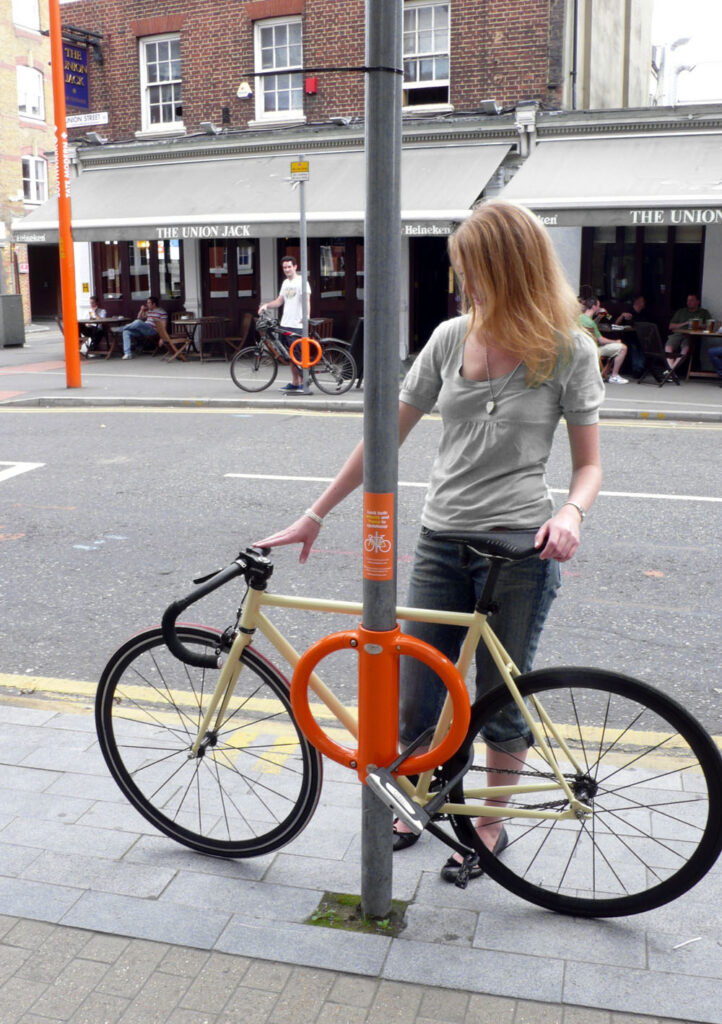

The London Borough of Islington has been accused of making a “cock-up” and wasting more than £40,000 of taxpayers’ money in deploying Cyclehoops on more than 200 sign posts – but the company that makes them has hit back at critics, saying they misunderstand what the product is designed to do.
On Thursday, the Islington Gazette ran a story under the headline £40,000 of taxpayers’ cash “wasted” by Islington Council in cycle lock-up “cock-up” which quoted a local cyclist as saying the Cyclehoops weren’t necessary because a D-lock performed the same function.
Opposition politicians also chipped in to say that the money spent on the security devices had been wasted, but Cyclehoop has highlighted what it sees as fundamental misunderstandings of the needs its product meets and other benefits.
The borough, like several others in London, has used the award-winning Cyclehoop to provide a relatively low-cost solution to bicycle security, deploying it in 211 locations throughout the borough at a cost of £200 each.
The product’s inventor, Anthony Lau, came up with the idea after his own bike was stolen by being lifted off a sign post, a common type of theft that provides an unwelcome surprise for owners who assumed they had locked their bike securely.
That feature seemed lost on Islington resident and bike rider Leo Chapman, however, who told the Islington Gazette: “Most cyclists use D-locks to secure their bikes, which are four inches wide, but sign posts are three inches in diameter, meaning D-locks fit on them anyway.
“But lampposts are around seven inches in diameter and so are too wide for D-locks. Cycle hoops should be on these instead, because it’s these we’re currently not able to lock our bikes up to.
“Islington Council has wasted £42,200 by putting these on the wrong posts.
“To put these on posts we can already attach our bikes to is a complete waste of money and a waste of scarce resources.”
Councilor Terry Stacy, leader of Liberal Democrat opposition in Labour-run Islington, added: “What a wasted opportunity. These 200 bike hoops should not have been put where you can already attach a bike anyway.
“Anything the council does to encourage cycling is a good thing and I support that cause, but this is a total waste. It doesn’t exactly fill you with confidence.”
However, a council spokesman told the newspaper: “We want to provide safe and practical places for people to secure their bikes. Cyclehoops on sign posts offer this, while minimising obstructions for pedestrians.
“We don’t allow bikes to be secured to lamp posts as we need to have unimpeded access to their electrical entry points for maintenance and emergencies.”
In an email seen by road.cc, Cyclehoop pointed out that using its product gave cyclists increased security when locking their bikes on a sign post compared to simply using a D-lock, and also prevented the bike from slipping to the ground – something that can not only lead to the bicycle itself being damaged, but also presents a hazard to pedestrians.
Cyclehoop asked for the article to be corrected, and while some of its comments were added, the headline and opening paragraphs accusing the borough of wasting money and having made a “cock-up” remain.
In its email, Cyclehoop said:
The article is incorrect and we are disappointed you have not looked into the project in detail before labeling it a ‘cock-up’. We are upset that our Cyclehoops have been unfairly portrayed in your article and that you did not consult us before releasing it.
Islington council specifically chose to install the Cyclehoops onto signposts rather than lampposts, as the majority of lampposts cannot be used as it would block the lighting access panel.
The councilor mentioned in the article does not understand that Cyclehoops are installed onto signposts to help reduce the risk of theft or bike damage. They prevent thieves from stealing the bike by lifting it over the top of the signpost or ripping the post out of the ground.
They also prevent the bike from sliding down the post and getting damaged, as well as blocking pedestrian pathways, which is particularly inconvenient for pedestrians with disabilities and parents with pushchairs who may require extra pavement space.
Based in South London and offering a variety of products that go well beyond that original concept, Cyclehoop supplies local authorities businesses and other organisations throughout the UK, and is also now undergoing rapid international expansion. You can find out more about its activities on the company website.

















15 thoughts on “Islington accused of “wasting” £40k on Cyclehoops – bike security firm hits back at critics”
Two hundred pounds each!
I
Two hundred pounds each!
I worked in street furniture and cycle storage for a number of years, and someone is making a KILLING with those hoops.
@Grub
It’s not made clear
@Grub
It’s not made clear what the £200 covered.
Reactionary idiots
Reactionary idiots criticising without thinking?
In this country??
Not such a daft idea, I’ve
Not such a daft idea, I’ve seen an attempt at my local station (we called the police so they might actually nab them!) where two guys were trying to lift a bike over a post – they cleared off before anyone arrived. I certainly wouldn’t trust locking up to a signpost in general, and especially not in central London.
Comment and criticism made
Comment and criticism made without thought and a Liberal Democrat jumping on a popularity bandwagon.
Who’d have thought?
I like the idea of stopping
I like the idea of stopping it slipping to the ground. The number of bikes I picked up and stood back up to stop them getting damaged is sillily large. Even for a tatty Dutch bike, rules 4 and 11 apply.
Cycle hoop, lamp post, fence,
Cycle hoop, lamp post, fence, whatever it is I ain’t locking my bike to it cus it’ll be nicked. I think councils should introduce super safe cycle boxes where users pay for each 30 minutes. I’d pay a pound for thirty minutes (cheaper than bus) to know when I return from shop my bike is still there.
A great product being
A great product being criticised by morons. Let them bleat on but lets support the whole initiative
Cycle hoop replicates the
Cycle hoop replicates the design conceived by the City of Toronto to convert parking meter poles and other posts for cycle parking about 25 years ago. The Canadian solution used a casting, and required holes to be drilled in the post. Cyclehoop neatly avoids this.
The £200 cost refers to what? Surely this must be supply and fit, given that a typical Sheffield stand costs under £100 per bike space provided. I can understand therefore the questioning of value for money, unless the option to install Sheffield stands was not available.
They have installed a few
They have installed a few cyclehoops in Glasgow and they are a pretty smart idea. Not only do they stop the bike being lifted over the top of posts, but they are a visible sign that bike parking is welcome.
Re the £200 cost, I don’t think that will include fitting costs as that’s part of the point of the cyclehoops They are easy to install, I suspect taking no more than half an hour and that will currently be reflected in the costs. They provide a good solution in some instances, particularly in areas where there is no space for a Sheffield stand… and as cyclists we know that innovation costs. I’m sure the cost will come down in time.
FMOAB wrote:They have
If they ever stick any in the Ibrox area, they might want to use a pseudonym 😉
It is a bit much to complain
It is a bit much to complain about the GBP200 cost when we pay out over GBP100 for a mobile phone that costs less than a fiver to make. Most of the cost will be associated with start-up and marketing, not the actual cost of production. As the customers are mainly local authorities they probably have to pay for some fairly lavish lunches.
The Cyclehoops are cost
The Cyclehoops are cost effective, as they are in fact under £100 per bike space (each Cyclehoop can part two bicycles) and the cost includes installation, delivery, storage and site surveys.
Installing only takes a minutes by a single person and it does not require noisy works, digging or concreting saving the council time and money. It also helps to reduce street clutter by reusing existing street furniture.
Installing a Sheffield stand is much more expensive especially if you take into account the extra work, permits, and parties involved when digging up the pavement.
I want to add that everything
I want to add that everything is designed and manufactured locally in the UK supporting our many small industries and businesses.
Our iron foundry and workshops are in the midlands, paint companies are in the South East and assembly and installation in SE London. Many other street furniture companies now source their steel from China or Eastern Europe to offer cheap prices.
I’m pleased that can still make things in the UK – it costs slightly more but you get good quality and manufacturing expertise.
Nice one Islington Gazette –
Nice one Islington Gazette – rather than praise a cost-effective, innovative solution that will make Islington all the more desirable; you shoot down a council that for once is trying to make a difference, and the people attempting to make your neighbourhood a safer place! Not only do they do a range of great products, Cyclehoop do their best to keep it local, and organise fun-social rides as well. Have you taken a moment to report on that?!