


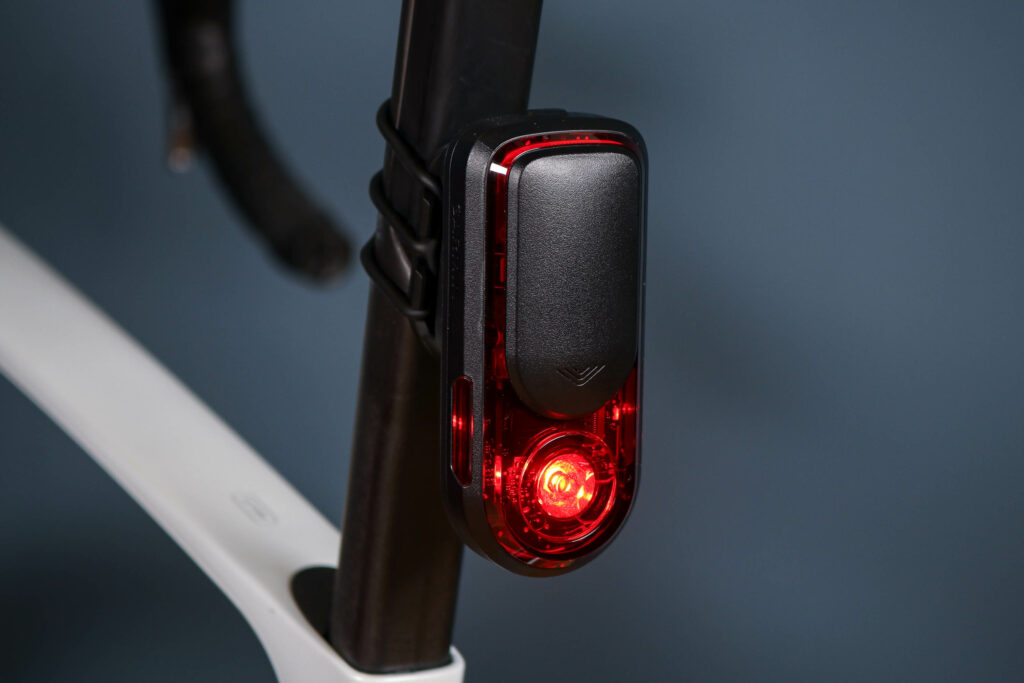



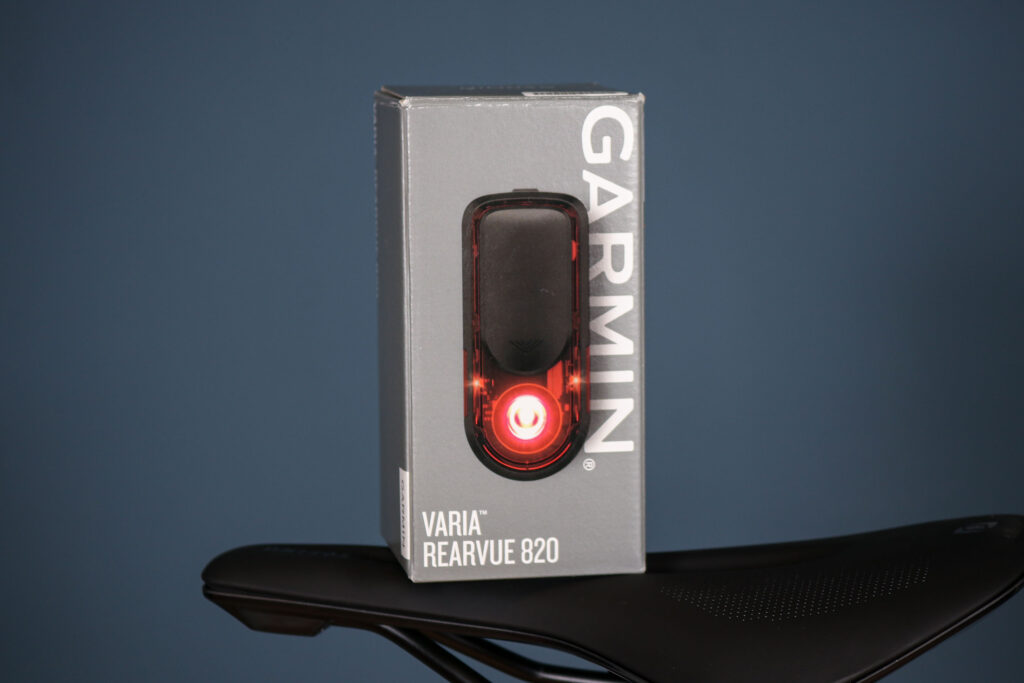
Garmin’s Varia RearVue 820 takes on the best of the competition and proves why Garmin’s radar lights are still the benchmark. This model ups the radar game, visually showing more useful detail than before, but retaining the right amount of audible alerts. It improves situational awareness significantly, and is now more customisable than ever. Add in an excellent light and a fast recharge time, and it’s pretty much unbeatable. However it is quite expensive and you may not be able to access all of the additional features if you use an older Garmin or other brand of head unit.
I’ve been a fan of rear light radars since early 2022 when I first started using a Garmin Varia RCT715 (with a camera). I found it to be a game changer. While the Garmin Varia is regarded as the benchmark, recently the impressive Coospo TR70 seriously upped the standard for these units. Garmin’s response is the RearVue 820, a radar light with an impressive spec that moves the game on once more.
So how does it deliver in practice? Generally very well is the good news, but there are two scenarios to consider one of which plays out slightly better than the other.
Scenario one is you’re using a current version of a Garmin head unit, or Varia app on your smartphone, that can connect to the light using BLE (Bluetooth), as that is how the extra information is communicated. You then get access to all of the features available.
In scenario two you don’t have a current version of a Garmin head unit: the RearVue 820 will work with older head units, and other brands but using the ANT+ protocol rather than Bluetooth and you won’t have access to the full suite of customisable options.
> What exactly is a bike radar system and why does everyone want one?
I tested the 820 using a modern Garmin Explore 2, a Wahoo Elemnt Roam v1, and the Varia App on an iPhone. Connecting the 820 to any of the above units was easy and quick. However, somewhat ironically the Garmin Explore 2 initially wouldn’t display the radar even though it was paired. After a lot of back and forth trying to get a more up to date firmware from the app, I eventually plugged the Explore 2 into a computer using a USB lead to make the update. That got it working, and it has worked reliably ever since. To be clear this was an issue for the Garmin Explore 2 not the RearVue 820.
The RearVue 820 paired with Garmin Explore 2 was my scenario one option, so how did it do?
Apart from that initial firmware upgrade glitch, the pairing has been consistently strong and reliable. The main difference over the previous generation of radars/ANT+ head units is that the display shows a lot more detail. You can see ‘objects’ (bikes, motorbikes, cars and lorries etc) as rectangles, but depending on their size, speed and lateral distance from your lane they will have an orange or red warning triangle on them. The difference could be a car versus a lorry for example, or a slower car and a faster car. If a bicycle is approaching you then the same rectangle initially appears but turns into a slimmer rectangle, particularly if it then sits on your wheel.
Another significant change is that if an ‘object’ is sitting behind you it remains visible on the screen, until it leaves the carriageway, or overtakes you. The other visual change is that instead of a single column of ‘objects’ the device can detect when you are riding on a wider road and display what’s behind you accordingly. So if you’re on a section of dual carriageway it should show both lanes of traffic behind you.
Switching to an iPhone 13 using the Varia app, the radar output now uses the whole width of the screen, with ‘objects’ that are further away appearing at the bottom of the screen, as well as across the screen. These ‘objects’ then move up the screen as they get closer to you. The ‘objects’ become clearer in purpose as they move up the screen. Which is to say they ‘become’ a car, bike or lorry. This is shown by the size of icon on the screen, as well as having a yellow halo or red halo to show relative speed or danger. Helpfully you can also add a Speedometer function to the bottom right of the screen to show your speed as you ride along.
The 820 is also able to detect objects from further away now too, a claimed 175m, and uses a wider 60 degree beam. Cars do alert sooner than on the older radars. The audible alerts are well timed and accurate. In fact it’s the audible alerts that I rely on primarily, then the screen is secondary. For me this pairing of the 820 and Explore 2 is pretty hard to beat as a combo.
Onto Scenario Two: The RearVue 820 paired with an older Wahoo Elemnt Roam.
Whilst this head unit might be long in the tooth now, I still really like its clear-to-read screen, even in the brightest sunlight. Add in its easy screen info customisability and it’s been a reliable companion for a number of years now. The Elemnt Roam and 820 paired very quickly, and the connection has stayed rock solid ever since. The audible alerts, as with the Explore 2, have been timely and accurate. In fact quite often the alert has beeped before the ‘car’ is shown at the bottom of the column, such is the extra detection distance of the 820.
However there is one fly in this ointment. If a bicycle is sitting on your wheel, it remains shown. With previous radars once an ‘object’ matched your speed it disappeared from the screen. It was a small bugbear. So, why the problem? Well, having a bike sitting behind but being shown on the screen audibly masks anything else coming up from further behind. So whilst a car is shown on the screen you don’t get an audible beep, unless it’s a ‘red’/fast approaching car. This doesn’t happen with Garmin/Garmin pairing in scenario one. They do beep in this scenario.
As I’ve mentioned it’s the beeps that are the most useful part for me, so not having them was disappointing. In all other situations it behaved as I would expect. Apart from that one scenario I loved the accuracy of the unit and its reliability. It appears to be the use of the older ANT+ protocol rather than the Bluetooth protocol used by the Garmin/Garmin pairing that causes this behaviour.
As a light
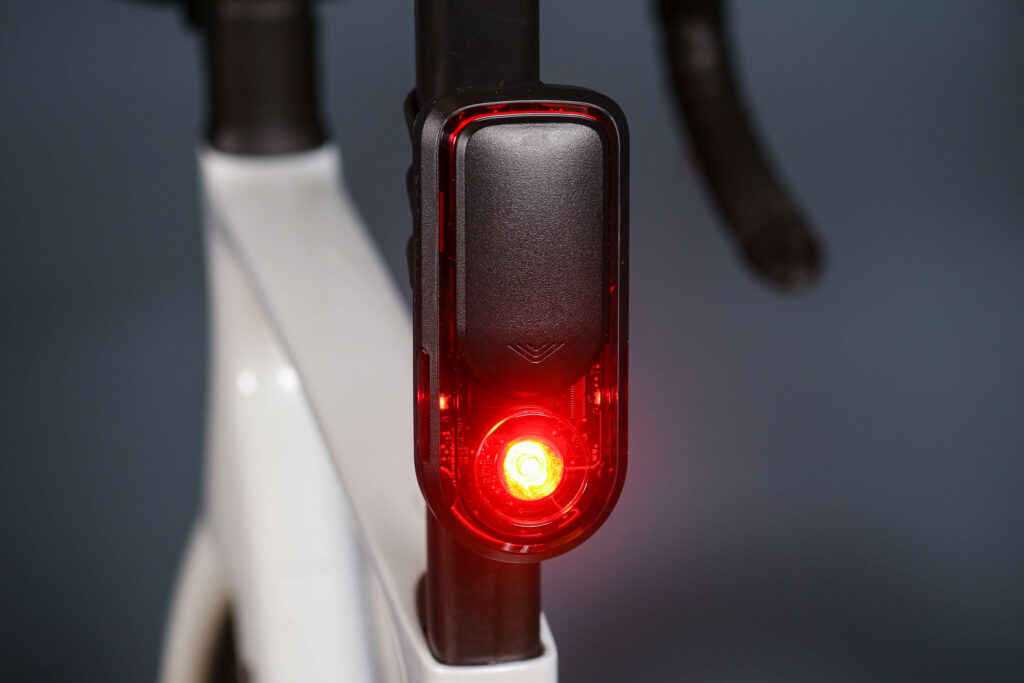
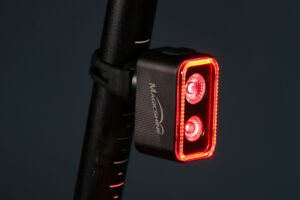
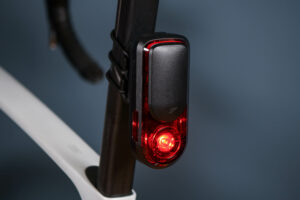
This is an excellent and powerful rear light. It is clearly visible, has four modes to choose from, as well as the ability to customise other light patterns. The battery life is excellent, ranging from 10 to 24 hours with the light plus radar, or 30 hours with just the radar functioning. Charge times were pleasingly fast and output strong. Solid mode is a solid 25 lumens. In fact both my friend and I judged it more powerful than my benchmark Exposure TraceR rear light (on high mode)! Pretty impressive.
In fact in some circumstances it could actually be too bright… for the rider sitting on the wheel on a night ride. Even on a Low 8 lumen setting it was a bit uncomfortable to ride behind if you’ve dropped back one, two, or three bike lengths. It seems churlish to complain about a light being too powerful, but there you are. At least you can easily turn off the Flashing Radar Threat mode for a group ride in the Varia app, and you’ll be thanked for that. If you’re solo riding or commuting then switch it back on.
Customisation within the app
This is excellent and easy to do. You can activate or deactivate light modes, and order them to your own logic. Just want Solid and Day Flashing modes, then set it up like that. No more toggling through options on the light that you don’t use. It’s easy to add them back in, or set up a custom light pattern. Additionally you can select a Flashing mode when a car is detected. There’s a brake light too, for when deceleration is detected!
Bracket
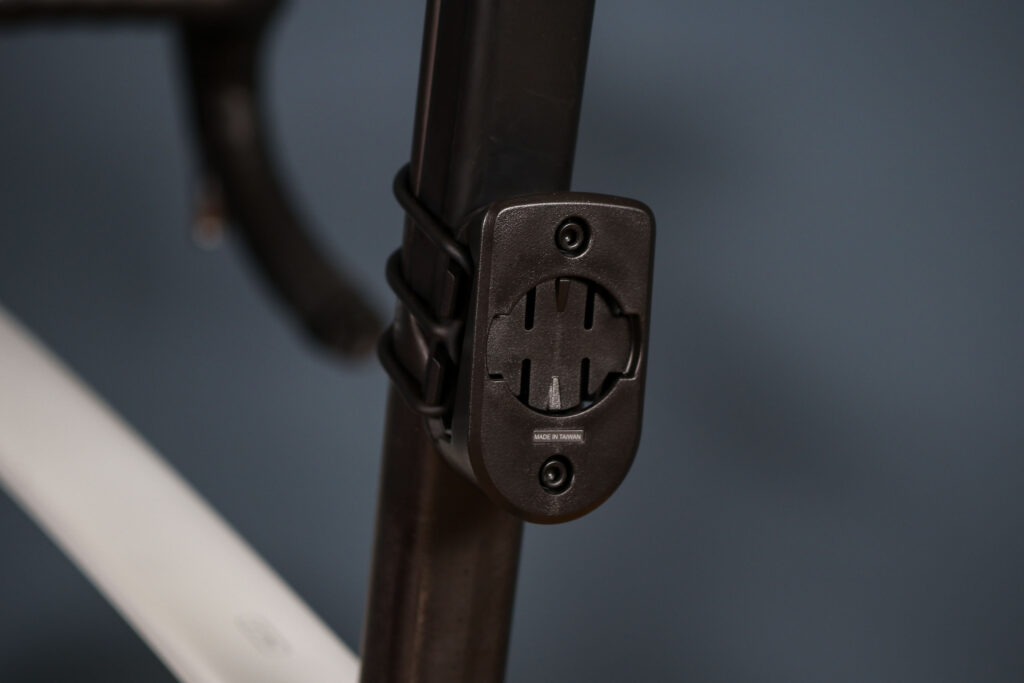
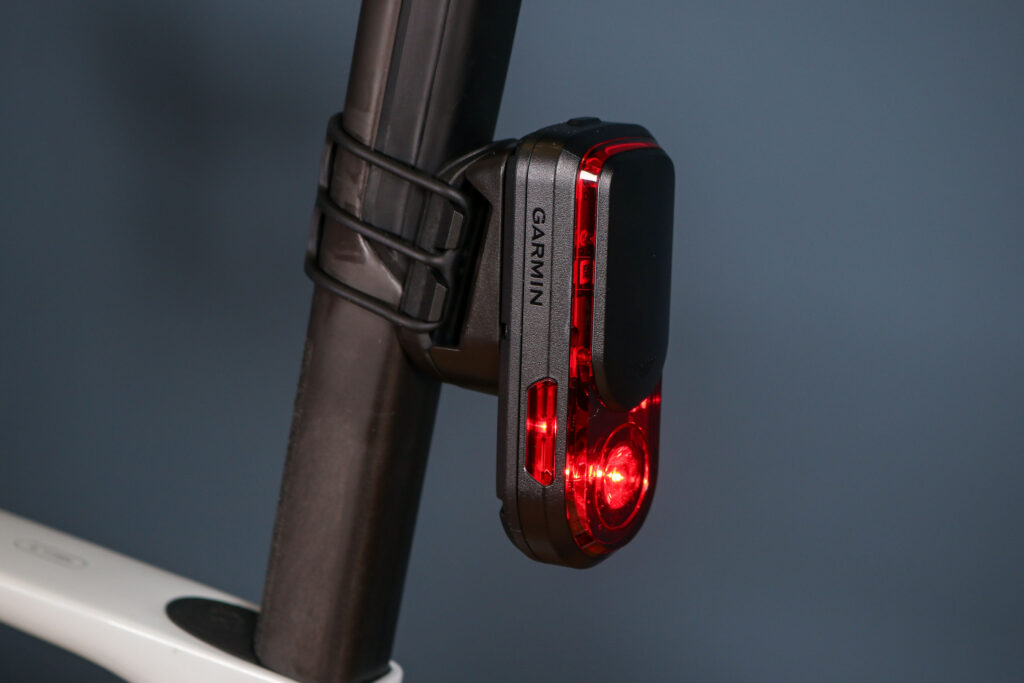
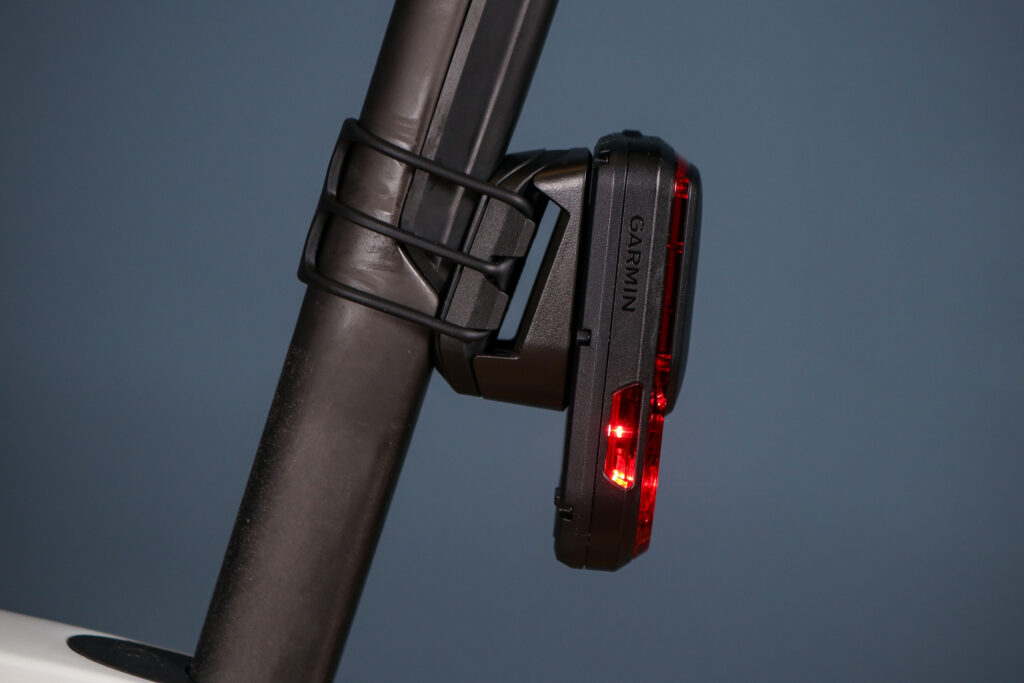
The seat post bracket uses the quarter turn Garmin standard, and comes with three seat post shape inserts and two lengths of band. It weighed 37 grams when set for a round post with a long band. It worked very smoothly and securely. I already have a Garmin Seat Rail Mount kit (£34.99) on my main bike, and often rode with it mounted there, which also worked well.
Battery and charging
The battery life is very good on this unit. I soak tested the Solid mode and got the 10 hours claimed from it. It’s quite refreshing not to worry about checking and charging kit after every ride. I usually checked it every 3 or so rides using the Varia app to see the battery level. Again in Solid mode the indicator light on the 820 went amber after seven hours, then to red at eight hours, and finally flashing red for the final hour and a half. Plenty of warning to recharge.
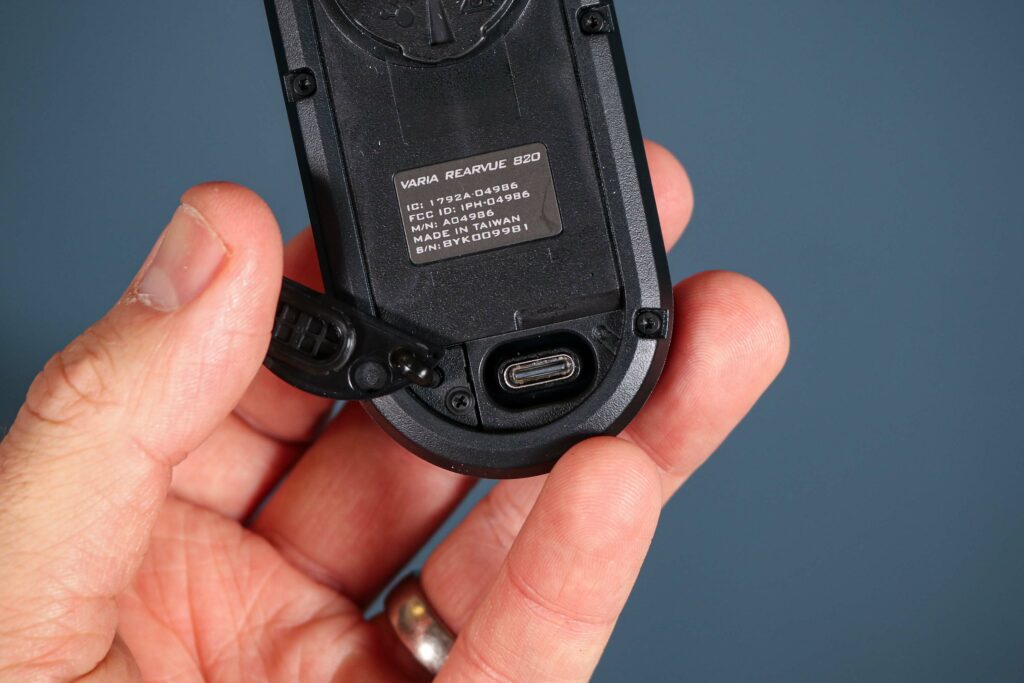
The unit was quick to recharge from a standard 5V 1A USB source, using the USB-C cable provided. Garmin quote between 2hrs 15 mins and 2 hrs 30 mins to fully recharge. I found that a full 1%-100% charge took 1 hr 40 mins! There is one indicator light next to the power button which tells you the status of the light. Flashing green and Red indicate the battery level, where other colours/patterns tell you the pairing, standby and software update status.
Build quality
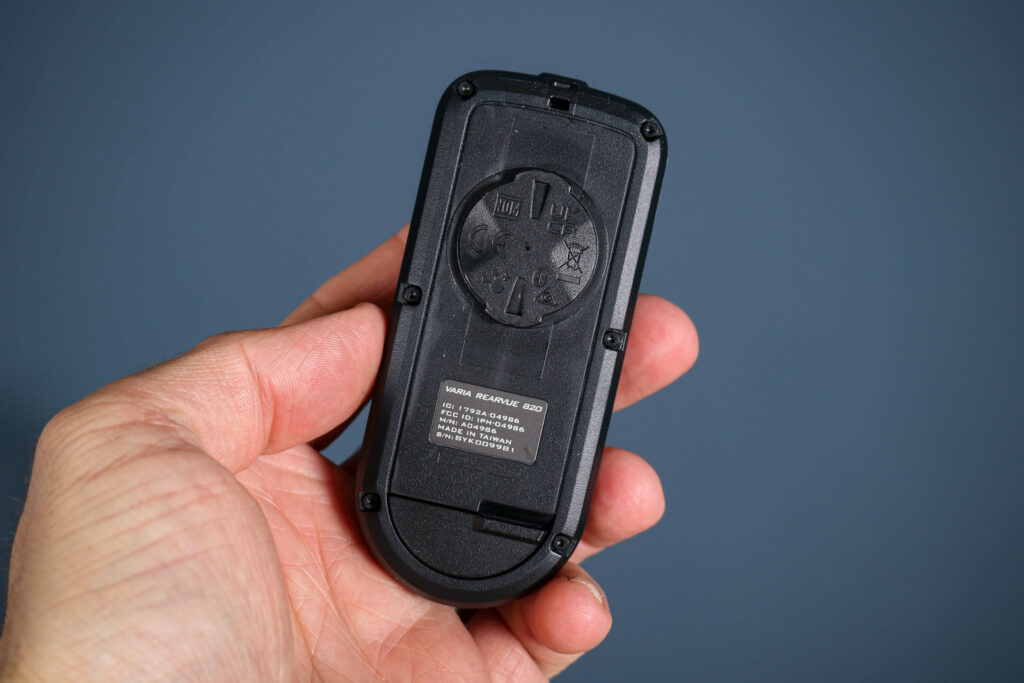
The RearVue 820 feels well made, and uses good quality plastics. The water port is a good fit and was easy to pop off with a finger nail for charging. It stayed put, and didn’t let water in during the test period. Interestingly there are several tiny torx screws holding the front and rear half together. Maybe this will make it easier to repair or service during its lifetime. I hope so.
Comparison
If you have a Garmin head unit that is compatible with the RearVue 820 and can show all the detail that it is able to do, and you can afford the £260 price tag, then I don’t think that you’ll be disappointed. The RearVue 820 really works very well, is reliable, well made, has a great light and is usefully customisable. Equally if you’re happy to use a smartphone with the Varia app it is also a strong pairing.
If you’re using a previous generation head unit then the price tag is a little harder to justify as you’ll be missing out on a few of the key new features. As an alternative the Coospo TR70, which I reviewed earlier this year, is around £100, but can be found for as little as £70. It is a great unit, with a very good light, is also customisable within the app, and the radar is good and reliable.
The Coospo TR70 has a very similar level of of app customisation to the RearVue 820, is as accurate and timely radar-wise as other radars that I’ve used, but it does sit behind the 820 with the 820’s extra range and beam width. The Coospo’s light is again very good, but the Garmin beats it. Both have good battery life, and decent charging times. In my opinion the Coospo unit is the best of the rest if you like, but this is not to give it faint praise, it is still a good radar light, it is just the the 820 is an excellent radar light.
The Lezyne Radar Drive 300 is another another option you might want to consider, like the 820 and the Coospro it offers Bluetooth or ANT+ connectivity and can be controlled via an app, it can also be paired with the Lezyne React Drive front light, doing away with the need for a head unit altogether. But for its mount Iwein was very impressed by everything about it, however, at 35° the beam angle isn’t as wide as the Varia 820 and the range isn’t quite as long either – 150m, it’s SRP is though ninety pounds cheaper – and you can get it for substantially less than that.
Alternatively if you want the extra security of having a camera as well then the Garmin RCT715 is £299. The radar is also good and reliable, the light is good, but the battery life isn’t great and it takes a long time to recharge compared to the latest units. Fair to say Mike Stead wasn’t that impressed when he reviewed one back in 2023.
Conclusion
The Garmin Varia RearVue 820 is a fantastic radar and rear light, that is very customisable to your own preferences and setup. It is best paired with a compatible Garmin head unit to make the most of its rich feature set. The extra distance and wider beam angle of the radar make a difference with earlier detection whichever head unit you are using. It is expensive, but you are getting more for your money than the competition currently provides.
Test Report
What does the manufacturer say about this product?:
“Varia RearVue 820 features our most powerful and precise bike radar yet with a wider field of view, giving you more reliable alerts than ever before. The tail light offers up to 2 km (1.24 miles) of visibility and has a brake light that shows when you’re slowing or stopping.
– TRACKS VEHICLES UP TO 175 METRES AWAY WITH WIDER FIELD OF VIEW
– GET UP TO 24 HOURS OF BATTERY LIFE IN DAY FLASH MODE
– SEE THE SIZE OF APPROACHING VEHICLES WHEN RIDING WITH A COMPATIBLE EDGE CYCLING COMPUTER OR THE VARIA APP.
– STAY ALERT TO VEHICLES TRAVELING AT THE SAME SPEED
For visual and audible alerts while you ride, connect this bike radar to the Varia smartphone app, compatible Edge bike computers or Garmin smartwatches. In addition to haptic alerts on your wrist, selected Garmin smartwatches can also give voice alerts for approaching vehicles — this feature is currently available in the Garmin Public Beta programme for selected smartwatches³.
Ride with four different light patterns: day flash, night flash, solid mode and peloton mode, which helps preserve the eyes of riders behind you. Create your own custom light patterns in the Varia app on your smartphone.”
Tell us some more about the technical aspects of this product:
DIMENSIONS: 98.9 x 25.9 x 43.2 mm (3.9” x 1” x 1.7″)
WEIGHT: 90 g (3.2 oz)
ANT+: Yes (radar, bike lights)
BLE: Yes (radar, bike lights)
LIGHT MODES: Solid, peloton, night flash, day flash
CUSTOM LIGHT MODE CONFIGURATION: Yes (with Varia Mobile App)
RADAR-ONLY MODE: Yes
LUMENS 25 solid, 8 peloton, 40 night flash, 100 day flash
WATER RATING: IPX7
BATTERY LIFE: 10 hours solid
15 hours peloton
10 hours night flash
24 hours day flash
30 hours radar-only
LIGHT VIEWING ANGLE: 220°
VISIBILITY DISTANCE: 2 km
REAR TAIL LIGHT: Yes
BRAKE LIGHT: Yes
REAR RADAR: Yes
LATERAL VEHICLE POSITIONING: Yes
VEHICLE SIZE CLASSIFICATION: Yes
VEHICLE THREAT CLASSIFICATION: Speed-, size- and lateral range-based
MAXIMUM VEHICLE DETECTION RANGE: 175 m
RADAR BEAM WIDTH: 60°
Any further comments on quality?:
It feels well made and uses good quality plastics. Operation is simple and clear. Using the Varia App unlocks a wide range of customisation.
Any further comments on performance?:
It alerts clearly, and is timely and accurate with its information. The light is also really strong.
How does the price compare to that of similar products in the market, including ones recently tested?:
The Garmin RearVue 820 is expensive, but it works incredibly well, as we’ve come to expect from Garmin. If you wanted a rear facing camera then the previous generation Garmin Varia RCT715 works well, but is similarly expensive. https://road.cc/content/review/garmin-varia-rct715-301599
However if you don’t need all the bells and whistles that the Garmin offers then the Coospo TR70 is a really strong contender. Priced at £100, but often found nearer £70, it offers an accurate radar, a good rear light and strong customisability. It uses the ANT+ protocol, so should work with any compatible bike computer. https://road.cc/review_v2/coospo-tr70-smart-radar-tail-light
Any further comments on design and usability?:
A single button controls the power and light/radar modes. Very straightforward. Connect using the Varia app and all the customisability is unlocked. A good app and easy to find what you’re after. I’ve stopped by the roadside to adjust a setting, then carried on. Simple to use.
Any further comments on the clamp?:
The clamp is well made and fitted securely to a 27.2mm round seatpost without issue. It was easy to move between bikes.
Does the light have a waterproofing rating? If so, what is it?:
IXP7
Any further comments on waterproofing?:
No issues during the test period
Any further comments on battery life and recharging?:
Charging the light using a 5V 1A USB computer port was significantly quicker than Garmin quoted. A full charge took 1hr 40mins. Top up charges were quick too.
Any issues with durability?:
None
Any further comments on weight?:
It is similar to many other radar lights on the market
Did you enjoy using the product? Yes
Would you consider buying the product? Yes
Would you recommend the product to a friend? Yes
Use this box to explain your overall score
Using a Garmin Edge compatible computer or the Varia app on a smartphone it was hard to fault this unit. Timely and accurate with its information, a great light and a good app to customise the settings. Whilst it worked well with non-Edge computers you do lose some of the features that the Edge and app provide, so if your computer isn’t an Edge it’s probably less good value. Easily a 9 if you’ve got a current Garmin head unit, more like an 8 if you don’t.
About the tester
Age: 56Height: cmWeight: kg
I usually ride: Condor Fratello 55cmMy best bike is: Gios Evolution 55cm
I’ve been riding for: Over 20 yearsI ride: A few times a weekI would class myself as: Expert
I regularly do the following types of riding: Commuting, Touring, Fitness riding

3 thoughts on “Garmin Varia Rearvue 820”
I own the unit, was curious. To be honest, if I had to do it again, I wouldn’t purchase it. Not because it doesn’t work, it does work, exactly as described. But in the city it’s useless, too many cars. Couldn’t stand the incessant audible alerts on my Edge1040 so switched them off.
Outside the city, yes, detection is good but the question is: how does it help you? If you take evasive action whenever there’s an alert you’ll spend a lot of time by the roadside. The only time that I find it really useful is when I have to merge at speed from a cycling path on a road or if I need to take a left turn (right hand drive here). That’s about it and to me, that’s not worth the price.
@Xenophon2 I agree. I tried a different route from Garstang to Leeds on Saturday to avoid the Death Highways from Barnoldswick to Skipton. I had to turn off Hazard warnings on the 1040 because people have ruined the hazard facility by warning about every pothole, instead of only the bad ones. UK roads are full of them, and the red Hazard was turning up constantly. Similarly, radar is useless in the UK because nutter drivers are everywhere and the alarm will be going off all the time. I’m convinced this is a good radar and it’s what I’d get if I had any use for it. I’m pretty sure it would have warned me about this Stagecoach bus on The Lancashire Terminator Express, and lots of the other vehicles as well- then what?
ttps://upride.cc/incident/px12dnv_stagecoach41_closepass/
This article (and probably this post😀) would be greatly improved with a few images of the additional screen layouts and individual icons for the various vehicles.
I upgraded to the Rearvue 820 and have found that the lack of disappearing vehicle icons -from when they match your own pace- a game changer. The intelligent use of new size icons also really excellent. Other than that, the additional added screen showing 2 lanes of approaching vehicles, interesting but not really adding much value. This screen lasted a month before I removed it from my activity profiles and I don’t miss it .