


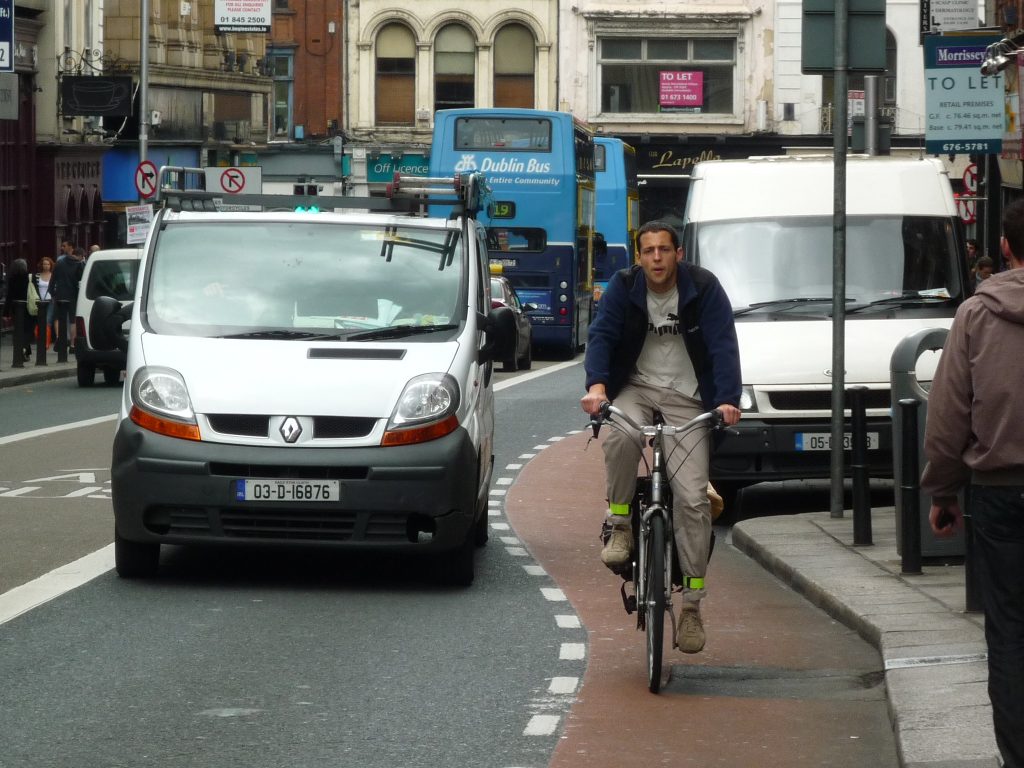

A trial in Dublin will allow cyclists to ride through red lights when making a left turn at certain junctions in the city.
It has been a rollercoaster few weeks for cyclists in the Irish capital, a judge having made headlines for his court comments calling Dublin bike riders a “nightmare”, before a wild 24 hours when the Irish government proposed fining all cyclists not wearing helmets or hi-vis, only to quickly backtrack on the plan.
Now, in a move reported by IrishCycle.com, a pilot programme is set to allow cyclists to make left turns, even if their traffic light is still on red. The proposal is just a trial, not yet city-wide, and it is believed it will be put in place at at least one south Dublin junction within the next six months.
Riders approaching the junction will still have to yield to other road users who have a green light, for example pedestrians crossing or drivers travelling in other directions who have the signal to proceed. However, the trial would see Ireland follow in the footsteps of France and the Netherlands where similar allowances are made when a relevant road sign is visible.
In a written answer provided by Ireland’s Transport Minister Darragh O’Brien, the government addressed a question about if it is considering enabling cyclists to turn left at red traffic lights.

O’Brien replied: “A feasibility and international best practice review into cyclist turning left on red provision is now complete, and a pilot location has been identified with Dún Laoghaire Rathdown County Council agreeing to act as the pilot local authority. The National Transport Authority (NTA) is responsible for the management and delivery of the pilot scheme.
“Planning for undertaking the pilot project is advancing for implementation over the next six months, with a steering group to be established shortly.”
At relevant junctions, cyclists would be allowed to continue, regardless of a red light, provided they give way to road users who have a green light, and as long as there is a sign giving permission for proceeding. That sign is a downward-pointing red triangle with a bicycle in the middle and an arrow denoting direction of travel when proceeding on a red light.
Similar signage and rules have successfully been implemented in France, where the country’s Ministry of Ecology suggested it “contrary to preconceived notions, also provides improved safety”, as well as making cyclists’ journeys easier. It has now been extended to travelling straight on and turning across the opposite lane too, in all cases only where there is signage permitting riding through the lights.
“It should never be forgotten that traffic lights are primarily a tool for regulating motor traffic,” France’s Ministry of Ecology stated in a video communicating the change. “Even though they sometimes allow pedestrians to cross streets more comfortably they are, in general, very restrictive for non-motorised users. Giving cyclists right of way to red lights is a simple and innovative way to make cycling more comfortable. It is also and somewhat less intuitively, a safety device that facilitates cycling without endangering cyclists or other users.”
News of the trial in Ireland comes just days after the country’s government announced, then almost instantly backtracked on, the introduction of mandatory hi-vis and helmets for cyclists, as well as fines for those who do not comply. The move was widely criticised by cycling campaigners and the next day the Department of Transport stated the introduction of ‘mandatory PPE for users of bicycles is outside the scope of the current measures’ focused on e-scooter and e-bike users.




















7 thoughts on “Dublin cyclists allowed to ride through red lights when turning left”
I presume this is trying to emulate a give way sign, but using a red symbol to indicate permission to proceed seems a bit liable to confuse.
I think generally it’s only red circles that are prohibitive – using the give way triangle as a base seems sensible given that it is not carte blanche to proceed. Example of the Parisian version here: https://www.bbc.co.uk/news/magazine-33773868
Oh – I see – so it’s a sign separate to the light? That makes a bit more sense. It’s not very clear from the article above (which doesn’t have illustration) – I’d understood that the red triangle with bike was the light itself.
France and Netherlands mentioned, but this should also include “Idaho Right”.
And while I expect a very small, if any, increase in issues with this it will be interesting to see if it is made permanent.
Assume you mean “Idaho Stop”?
“Right turn on red” is quite widespread in USA and Canada, and generally applies to all vehicles, not just just cyclists. Not saying it always works perfectly, but worth pointing out that this is not some hugely radical experiment.
More properly may be the “California right” as that was the first state to allow right turns on red (for all vehicles, not just bicycles) and it’s now legal in all 50 states (except when signs explicitly prohibit).
The equivalent thing has been in place in many parts of Switzerland (where I live) for the past several years. It just makes sense and doesn’t seem to have any downsides, so it should be adopted more rapidly everywhere IMO.