


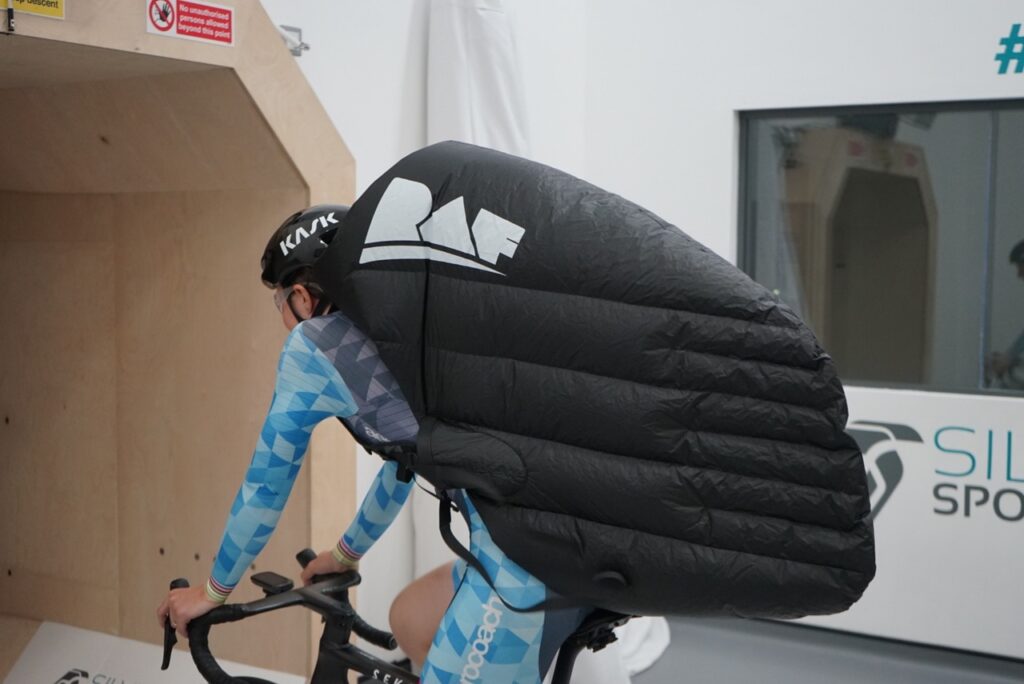

An air-filled cycling backpack designed to reduce drag that we told you about a couple of years ago does the exact opposite, according to aero products and testing service AeroCoach. Stunned, aren’t you? No, neither are we.
We told you about the Ram Air Fairing RAF1 in 2024 when it was crowdfunding, and again when it hit its Kickstarter funding target.
The “pioneering bike bag” designed by Hong Kong’s Ram Air Fairing is designed to be a giant fairing that you wear on your back.
When we wrote our second report, 18 people had pledged £31 apiece for the RAF1, and a couple of backers had pledged £62 for two of them. Two? In for a penny…
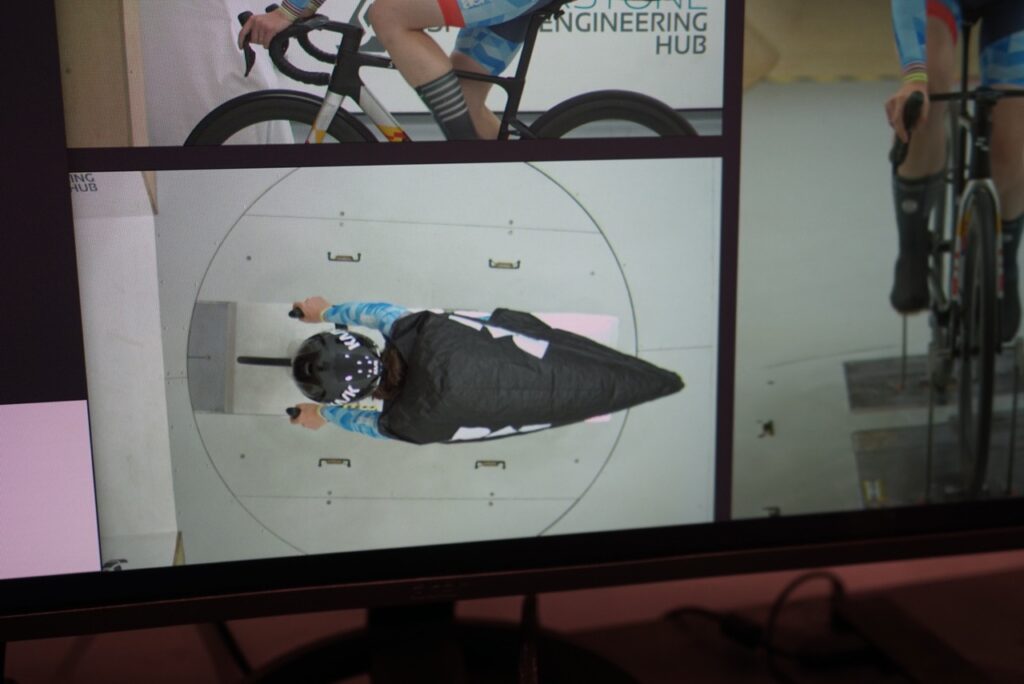
The project’s founders said that their “one-of-a-kind accessory… sets you apart on the road”. No arguments on that front. They also said the design represents the “next level of cycling safety and performance”. That claim is a little harder to swallow.
RAF said the 300g air-filled backpack boasts “unparalleled” efficiency and has been “meticulously engineered to elevate your speed on the road”. How? By “significantly reducing air drag”, apparently… although the designers gave no details relating to the scale of benefits they were claiming.
Luckily, AeroCoach – a UK-based company specialising in cycling aerodynamics – has bought an RAF1 and taken it to the wind tunnel for aero testing.
Here’s AeroCoach’s video. It’s not exactly positive, which is great news if you don’t want to look completely bizarre in your quest for speed.
View this post on Instagram
AeroCoach’s Xavier Disley says, “We’ve just published our video with the results; it was 15w slower on [wind tunnel rider] Jess in an upright position at 45km/h [28.0mph], and about 3.5w slower at 30km/h [18.6mph].”
Aerocoach apparently didn’t cut any corners here, testing across a range of yaw angles; a 10° sweep to simulate outdoor riding.
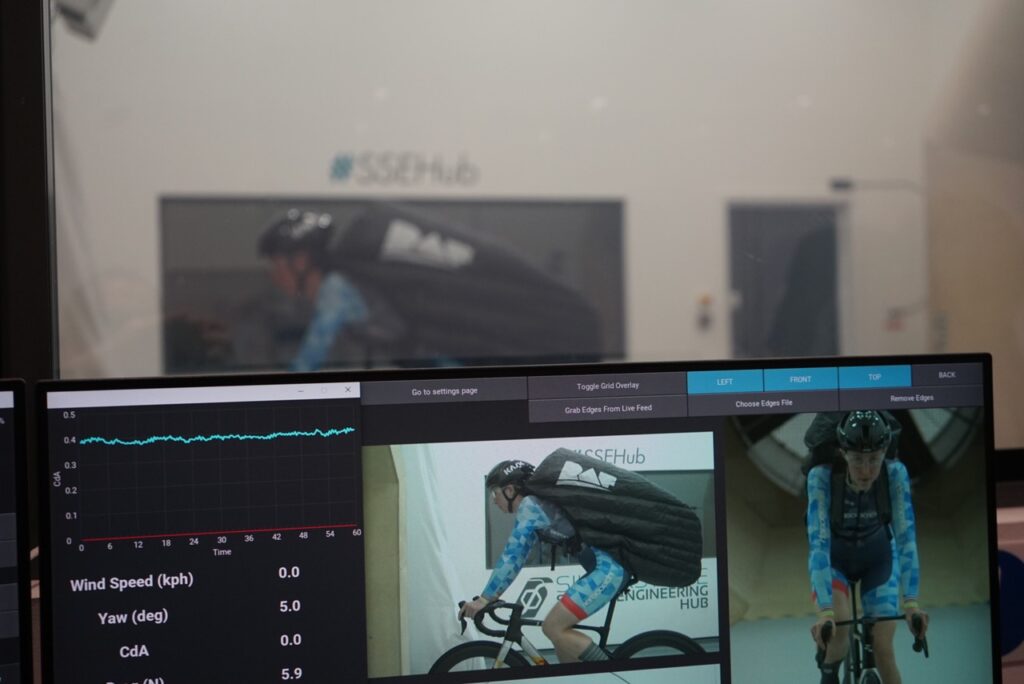
“Everyone who missed out on the crowdfunding, you haven’t missed out. It’s terrible. It’s going in a bin,” says Xavier Disley.
What about the “next level of cycling safety” claim? That’s not something AeroCoach addressed but, well, what do you think? We’re not seeing it.
At least you can carry loads of kit to the office in the RAF1, right, so all’s not lost.
Um, we’ve got some bad news for you there too: it’s not well-suited to carrying much at all.
In short, if you didn’t pledge £31 to the RAF1 Kickstarter campaign, it looks like you made a wise decision.












9 thoughts on ““Drag-reducing” cycling backpack actually makes you slower, says AeroCoach wind tunnel test”
Which area how fast or slow you are when you look that cool? Sometime style is worth it.
Having once been blown off my bike by a tunneled gust by Centre Point tower, much to the amusement of the black cab driver next to me, this looks fit to hugely enhance black cab driver amusement.
Next up, scientists reveal the truth about ursine fecal habits in arboreal areas.
who would have guessed that a bag that must act as a parachute would decrease aerodynamic efficiency?!
The fact it inflates in moving air like a parafoil tells us that it is, in fact, some kind of parafoil.
That reminds me, it’s the Bristol Balloon Fiesta this weekend
Oh, to be the dangling nether parts of a giant red swollen baseball-cap-wearing sky hamster!
To be fair the principle is sound, the problem is in the execution. This specific attempt is especially ludicrous, but a century of efforts ranging from Oscar Egg’s Velofusée to modern streamlined recumbents has not managed to produce a setup matching the practicality of the standard bicycle.
If only the R.A.F. designers had waited until this year’s Womens’ TdF they would know to fill in the front rather than the back. Limited gains, but more attainable.
The basic upright bike is indeed supremely practical (ideally built with sturdy metal frame, equipped with mudguards, rack, perhaps baskets and kickstand etc).
But that doesn’t seem to be what most professionals are racing?
It’s an open question whether a modern pro would win eg. the TdF on a (faired?) recumbent benefitting from the developmental efforts that modern bikes have received. Would the aero and comfort benefits outweigh the likely weight disadvantage? Given what we know of the huge aero benefits of group riding perhaps uprights might still edge it?
However the reason it’s still an open question is that it was resolved on the flat a long time ago and as a result the UCI acted and amended the rules to effectively disqualify recumbents! (Perhaps in part to protect the interests of builders of upright bikes).