



A new police road safety campaign urging pedestrians and cyclists to “stay visible” and “think about what they are wearing” during the winter months has been met with criticism after it failed to acknowledge motorists’ responsibility for safety on the roads.
On Wednesday evening, Nottinghamshire Police released a statement promoting ‘Operation Dark Night’, a nationwide police education campaign timed to coincide with the clocks going back and the ever-increasing hours of darkness.
“As drivers take more journeys during the hours of darkness, walkers, runners, dog walkers, and pedal cyclists of all ages are being asked to take a moment to think about what they are wearing,” the force said in a statement.
The police added that while “any light or bright clothing increases visibility to drivers”, reflective items such as strips and tags, which can be attached to jackets, school bags, and shopping trolleys, are “the most effective way to be seen”.
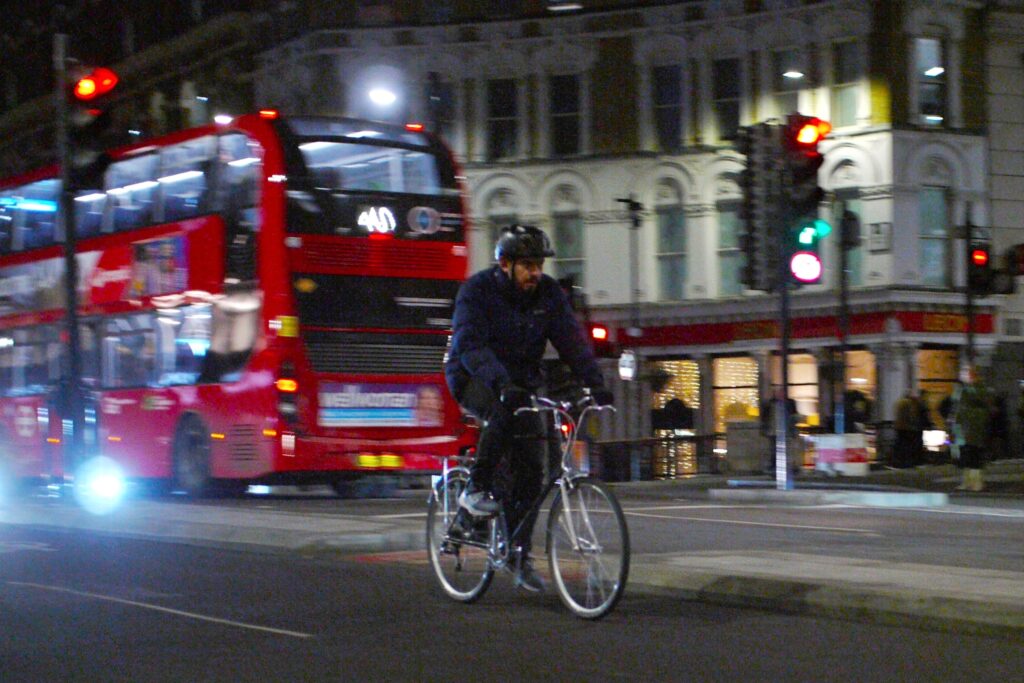
According to Nottinghamshire Police’s statement, dark clothing “has been deemed a contributing factor in many fatal or serious injury collisions involving pedestrians and cyclists” in the county over the past two years.
The force also noted that almost all of these serious collisions occurred in 30mph zones where, police claim, “drivers feel most comfortable and familiar in their local area”.
“Travelling at night or in hours of darkness brings additional risks to drivers, pedal cyclists and pedestrians alike,” Heidi Duff, Nottinghamshire Police’s traffic management officer, said.
“That’s why it’s so important as a pedestrian and cyclist to maximise your chances of being seen by wearing brighter items of clothing or, ideally, some kind of reflective material to improve your conspicuity to other road users.
“This is particularly important for children and older people, who are especially vulnerable to death or serious injury as a result of collisions.
“There are a wide range of relatively inexpensive reflective items available in shops or online, including strips and patches that can easily be applied to bags or clothing.
“Other items, such as running jackets, can be purchased with reflective pigments embedded in them, so I encourage potential buyers to look out for that functionality when making purchasing decisions.”

This call for cyclists and pedestrians to “maximise your chances of being seen”, however, has been criticised on social media for appearing to place the responsibility for safety at night on vulnerable road users.
The police’s Facebook post promoting the Operation Dark Night campaign prompted a number of comments criticising the force’s approach to road safety during winter. And while some of these comments involved calls for greater enforcement when it comes to delivery riders without lights, many others urged the police to reframe the campaign and its seemingly overt focus on pedestrians and cyclists.
“How about asking drivers to pay attention, put their phones away and slow down? They’re the ones doing the killing. Headlights are pretty good nowadays,” Daniel Ward said.

Meanwhile, Richard Winter asked: “Will Nottinghamshire police ask drivers of black and dark grey lorries and cars to put reflective stickers on their vehicle so we can see them?”
“We light ourselves like a Christmas tree on our bikes,” Tracey Lloyd said, while sharing a photo of a crumpled hi-vis ambulance. “Being hi-vis doesn’t mean someone is looking.”
Criticising the police’s claim that dark clothing was a contributory factor in recent fatal crashes, Mike Adams wrote: “It’s the clothing that killed them! NOT the car driver, obviously.”
Of course, this isn’t the first time police hi-vis campaigns – a common sight after the clocks go back – have been accused of ‘victim blaming’ by cyclists.
In 2023, Police Scotland found itself at the centre of its own “victim blaming” row after a chief inspector urged pedestrians to wear “reflective or fluorescent” clothing after six people walking were killed after being hit by other road users in just 13 days.
In February, Ireland’s Road Safety Authority was criticised after it shared its Hi Glo Silver Pledge, a certificate signed by schoolchildren promising “to make sure that I am seen, in reflective clothing that is bright orange, yellow, or green” when they “walk or cycle, night or day, after school or when I go to play”.
And it’s not just hi-vis campaigns that fall into this dubious, problematic category. In June, an education campaign led by the National Police Chiefs’ Council (NPCC), claiming that road safety is a “shared” responsibility, was criticised by cyclists who argued that particular stance “ignores the massive imbalance in risks” faced by vulnerable road users.
According to the NPCC, the annual ‘Two Wheels’ campaign “aims not only to encourage riders to make safer choices, but also to remind other drivers of their responsibility to remain vigilant and look out for more vulnerable road users”.
“Every person using the road network, whether behind the wheel, on two wheels, or on foot, has a critical role to play in preventing life-changing and fatal collisions,” the police chiefs’ council said.
In response to the campaign, a number of local police forces launched their own initiatives, including in Herefordshire, where West Mercia Police carried out targeted patrols and engagement to “encourage safe, responsible riding and driving”.
West Mercia Police said the patrols will aim to educate riders on “skills, knowledge, and protective equipment, promote awareness of the Highway Code and road user hierarchy, and remind everyone to share the road safely”.
However, in Hereford, the local safe neighbourhood team took advantage of the campaign to clamp down on cyclists riding on the city’s Victoria Bridge, designated a ‘no cycling’ zone, officers stopping and speaking to 30 cyclists and reminding them to dismount and walk their bikes across the bridge.









3 thoughts on ““How about asking drivers to pay attention?” Police force slammed for hi-vis campaign urging cyclists and pedestrians “to think about what they are wearing””
I could wear a giant Las Vegas neon sign on my back and a driver looking at their phone still wouldn’t see me.
comparable blue-sky lunacy, apparently a small keychain pendant is going to save lives.
i was going to reply on fb with images of stationary police vehicles that other motorists collided with despite being festooned in hiviz markings, but y’know .. jail time for hurt feelings.
https://www.inverness-courier.co.uk/news/be-bright-be-seen-inverness-schools-to-receive-7500-keyrin-448570/
Strangely, an active transport safety study carried out by Dundee University showed that female cyclists wearing black French maid’s uniforms, with black stockings were highly visible to most male drivers irrespective of the time of day, even those who were using their phones.
However, there was an increased risk of drivers colliding with other vehicles, lamp posts etc.