



More than eight in ten serious collisions involving cyclists in Ireland occurred on straight roads during daylight hours, Ireland’s Road Safety Authority (RSA) has reported.
Data released yesterday also shows the number of fatal or serious collisions has increased by more than 20 percent, with the total number rising for the first time since 2021. 265 serious cyclist injuries were recorded in 2025, compared with 213 the year before. 14 deaths were also recorded, twice as many as were recorded in 2022.
The information comes at a time when the Irish Government has been criticised for its confused messaging on cycle safety, centred on the wearing of hi-vis clothing and helmets. In January, there was confusion after the Department of Transport announced that “requirements for mandatory helmets and high-visibility equipment are currently being considered for e-scooters, bicycles, and e-bikes,” with police potentially given the power to issue fines to anyone who didn’t comply with the new rules. That statement was contradicted shortly after by Tánaiste (Deputy Prime Minister) Simon Harris, following criticism from several active travel campaigners.

In February, the National Bus and Rail Union told the Oireachtas (Parliament) that it should be “mandatory” for cyclists to wear hi-vis clothing at all times to improve the “poor visibility” of people on bikes.
“Driving a large public service vehicle is hard,” assistant general secretary Thomas O’Connor told the Joint Committee on Transport. “Navigating all the hazards when there is a deluge or at night is even harder.
“The requirement for mandatory high-viz clothing for all cyclists and scooters, from the perspective of a bus driver, would make the roads a safer place, as it would make potential hazards easier to spot.”
Adding his concern about faster, battery-powered e-bikes, O’Connor added “mandatory hi-vis clothing will save us.”
But the latest figures from the RSA paint a different picture, with 81 percent of serious injuries occurring in the daytime, suggesting that the wearing of hi-vis would have a significantly more marginal impact on rider safety. On the same visibility theme, 83 percent of recorded serious injuries occurred on straight roads, compared to 13 percent on a slight bend and 4 percent on a severe bend. The majority of injuries also occurred at T-junctions and cross-roads.
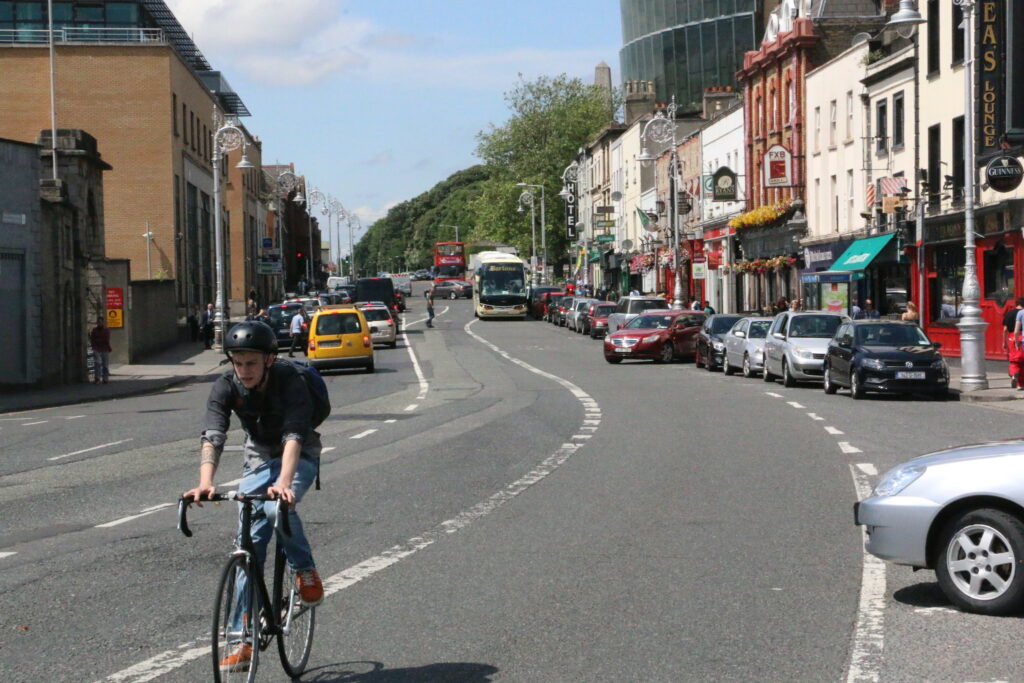
Of the recorded incidents, 69 percent of serious cyclist injuries were a multi-vehicle collision, of which 88 percent involved a car or van driver. 11 percent of collisions were classified as a hit-and-run incident, also likely involving a driver. The remaining 20 percent of total injuries were classified as a single-vehicle collision, meaning the cyclist injured themselves without the direct involvement of another vehicle or driver. The top reasons given for these injuries were dangerous road surfaces or having to avoid a driver, pedestrian or fellow cyclist.
Other data collated shows the majority of injured cyclists are male and likely to be aged 26-55, with most collisions occurring between May and September, when favourable weather makes cycling a more popular activity, and when daylight hours are longer.
More than half of all serious injuries occurred in Dublin, where both more than a quarter of the population live, and where cycling has seen a surge in popularity in recent years. Earlier this year, a pilot programme was announced giving cyclists priority over red lights at certain junctions in the city.
> Dublin cyclists allowed to ride through red lights when turning left
Outside the capital however, the question of responsibility on the road is more conflicted, with County Councillors in Tipperary writing to the Transport Minister urging them to consider making hi-vis mandatory for cyclists, e-scooter users and even pedestrians. In response, the Irish Cycling Campaign accused the government of “upending decades of established risk-management practice and putting yet another barrier in the way of healthy, safe, sustainable transport.”









15 thoughts on “More than 80% of serious or fatal cycling collisions occur in daylight and on straight roads, new data from Ireland shows”
Straight roads, daytime. In other words, exactly the conditions when drivers tend to go too fast, and when they often allow themselves to be distracted (fiddling with phones, in-car touch-screens, etc.).
But yeah, let’s keep trying to fix motor-vehicle-driver safety problems by sticking plastic on their victims.
Cycling equipment along with lighting accessories will never improve reckless driving. Unattentive drivers and angry motorists make roads dangerous for everyone. More specifically in broad day light.
As others have said, not exactly shocking. Despite the huge amounts of whinging about red light jumping etc from drivers and how fantastically dangerous cyclists are, its of no surprise that its shit driving that causes the most accidents. Its no surprise that when people have a straight bit of road to speed on they pay the least attention.
If they want a campaign slogan there’s an old one which would seem to cover this very well; tweaked slightly: “speed and inattention kills”.
As someone who investigates traffic accidents, I should point out that this doesn’t actually refute the arguments in favour of hi-vis. There are multiple hazards vying for a driver’s attention and by wearing hi-vis it is more likely that the cyclist will be the one who catches the driver’s attention. When I cycle, I always wear a helmet and hi-vis.
IIRC, it was 2006 when motorcycle design was changed so that their headlights were permanently on when the engine was running. You can argue as much as you like that “motorcyclists shouldn’t be forced to have their headlights on” but the reality is that accident rates went down when this measure was introduced.
How does wearing a helmet help drivers to see you?
“How does wearing a helmet help drivers to see you?”
Some people don’t have a head as conspicuous as yours?
@mdavidford its more about reducing your injuries if something bad happens. My bro is a cyclist and works in A&E. He says “wear a helmet” and high viz.
@mdavidford its more about reducing your injuries if something bad happens. My bro is a cyclist and works in A&E. He says “wear a helmet” and high viz.
@BIFFSTER I think chucking PPE has got more in common with the lucky rabbit’s foot than many imagine.
But I can see value in reducing the size of the “open goal” for police / CPS / defence lawyers to remove the chance of *any* feeling of justice for your relatives. (Absence of evidence of PPE finessed into evidence of absence of care for one’s own safety and thus “they probably weren’t cycling carefully / competently…”).
But I chuck on hi-viz if my clothing’s dark (and more importantly reflectives) because why not. And a helmet’s certainly good for bumps from branches and falling off when you didn’t get your arm down first and may well save skin loss when sliding!
It should also be pointed out that the article doesn’t say that it does. In a welcome change from the usual, it correctly uses the word ‘rebuts’.
That was very polite. You could have made reference to wearing an actual illuminated Christmas tree. Or possibly a lucky rabbit’s foot – though since it’s Ireland perhaps a giant shamrock would be more suitable?
Although that might be dismissed by eg. courts as blending in with the rest of the emerald isle, in the same way as hi-vis is often negated by “low sun” or “autumnal trees”. Or just by other road users not looking…
Still, marginal gains for me too, so it’s on with tabards and wrist and ankle bands in the evenings – though I’ve more faith in the reflective parts of the garment after dark.
To make the data at all useful, it needs to be corrected for the frequency that people are riding in such conditions / locations. Otherwise, this is just an investigation of where and when people ride most, which is apparently around Dublin during the daytime.
Exactly what I came here to say. This data belongs on r/peopleLiveInCities – most crashes happen during the day on straight roads because most cycling happens during the day, and most roads are mostly straight. Without correcting for rate this tells us nothing.
If the sun were made to flash, would this in some way help distracted motorists see cyclists during daylight on straight sections of road. Perhaps it would enhance the visibility of the proposed compulsory luminous cycling clothing.
This seems like an easy practical solution that would still allow motorists to carry out other vital tasks, while driving.