



Transport secretary Heidi Alexander has pledged to go “hell for leather on active travel”, as the government announced that it will invest £104 million in the National Cycle Network (NCN) over the next four years.
The funding, described by Active Travel England as a “record investment” in the NCN (the 12,000-mile-long UK-wide network of signed paths and routes for cycling, walking, and wheeling), will be used to support hundreds of new projects, including traffic-free routes, safer crossings, and resurfacing work.
The Walk Wheel Cycle Trust (formerly Sustrans), the charity responsible for maintaining and improving the network, will also be tasked with removing barriers that restrict access for wheelchair or adapted cycle users, as well carrying out repairs to bridges, tunnels, and former railway infrastructure along the routes.
Routes will also be made safer for women and girls, thanks to improved lighting, signage, and road markings. One of the major projects covered by the funding includes the English portion of the Avenue Verte, the NCN route linking London and Paris, along with new routes created by the HS2 corridor.
Work is also underway to establish England’s first walking, wheeling, and cycling wayfinding system, complete with standardised signage, route marking, and guidance on network planning and connectivity provided by Active Travel England and the Department for Transport.

According to Labour, the £104m investment builds on the government’s commitment to “establish the foundations of a national active travel network by 2030”. This ambition was first outlined in the government’s Cycling and Walking Investment Strategy, unveiled earlier this summer, which called for local active travel plans to be “consolidated into a single national digital platform”.
“This record investment gives us the long-term certainty required to improve and expand the National Cycle Network, creating safer and better-connected routes that make it easier to choose walking, wheeling and cycling for everyday journeys,” Active Travel Commissioner Chris Boardman said in a statement today.
“It’s another important step towards building an active travel network that works for everyone.”
However, while the government says the NCN’s purportedly first ever multi-year funding package will “provide the certainty needed to plan and deliver larger, more ambitious improvements”, some cycling campaigners familiar with the network aren’t so sure.
On social media, respected active travel journalist Laura Laker, the author of Potholes and Pavements: A Bumpy Ride on Britain’s National Cycle Network, wrote: “While long-term funding is key to the National Cycle Network’s success, £104m over four years is £26m a year… the equivalent of upgrading a single A-road junction.
“I’m not convinced this is the first long-term funding ever for the NCN… I’ve certainly heard this phrase before. There was long-term announced in the early 2020s, under Boris Johnson’s government, but subsequent years were then slashed, which I guess counts that one out.”
And here’s what else you get for £25m, which National Highways’ route manager describes as “not a lot of money for this type of engineering” – though it does have a ‘segregated footway/cycleway’ on one corner www.salisburyjournal.co.uk/news/2614939…
— Laura Laker (@lauralaker.bsky.social) September 22, 2026 at 12:15 PM
Pointing to a National Highways’ plans for a improvements to the A36 in Salisbury, Laker continued: “And here’s what else you get for £25m, which National Highways’ route manager describes as ‘not a lot of money for this type of engineering’ – though it does have a ‘segregated footway/cycleway’ on one corner.”
“The days of active travel being an afterthought, or a bolt-on, must end”
Nevertheless, speaking at Active Travel England’s Making Active Places conference in Manchester on Tuesday, transport secretary Heidi Alexander insisted that the current Labour government is committed to prioritising cycling and active travel.
Pointing to her work delivering cycling infrastructure while deputy mayor of London, Alexander told the conference: “My determination to deliver on active travel hasn’t left me. And as Transport Secretary, I’m really serious about building that integrated transport network. I’m really serious about increasing the use of public transport.
“And if we’re serious about giving people the choice and the tools to get out and get on, then the days of active travel being an afterthought, or a bolt-on, must end. Instead, I think we need to see walking, wheeling, and cycling for what they are. Essential parts of everyday journeys. That walk to the bus stop. Wheeling along a station platform. The cycle to work, to school, or to the shops.”
She continued: “It’s not about pitting one mode of travel against another. No one is declaring war on this or that. And you definitely won’t find me leading a charge of the Lycra brigade.
“I simply want to give people greater choice in their lives. I want a coherent transport system where each stage of a journey complements the next.
“Where accessibility is baked in. Where signage is clear and simple. Where all of us – from Olympians like Chris [Boardman] to fair-weather cyclists like me – feel confident and safe to choose the more active option.”
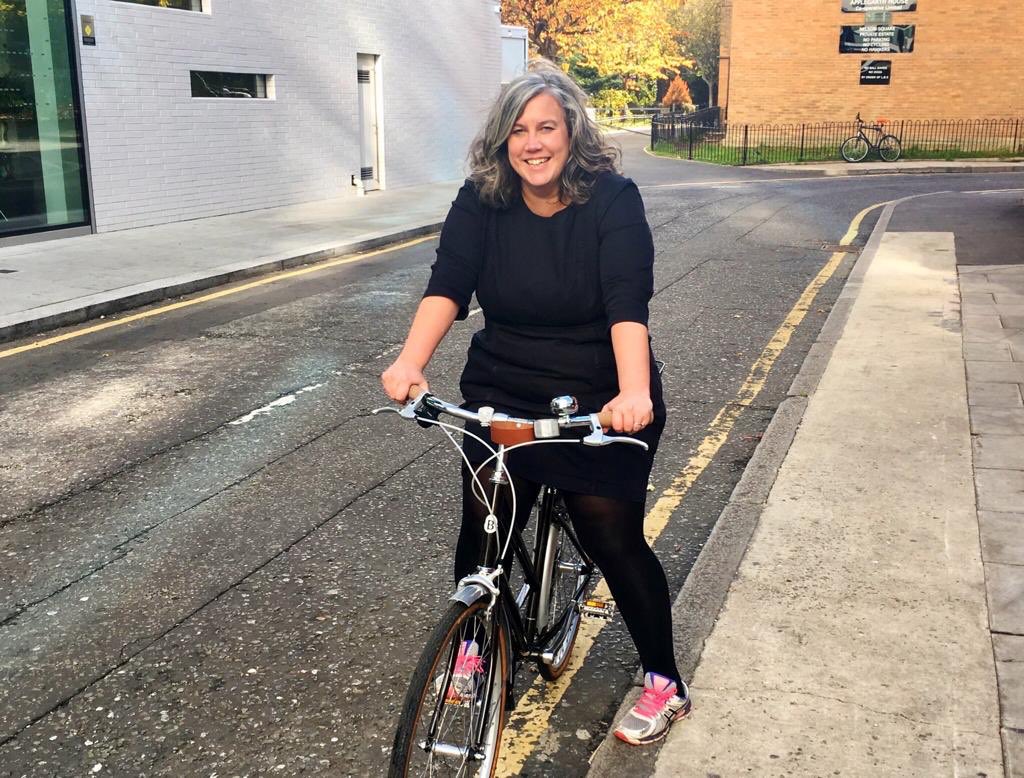
Referring to the government’s funding plans, Alexander said: “The vision is simple: safe, easy, accessible choices for more people in more places. Taken together, billions will be invested in active travel by 2030. Most of that will be devolved to local government, meaning record multi-year funding to make good on their long-term plans.
“And we must be ambitious. At least 60 per cent of children should be walking and cycling to school by 2035 – building on the landmark agreement we’ve signed with mayors to deliver 3,500 miles of footways, safer crossings, and cycle lanes.
“It’s why we are supporting local pilots, including for wayfinding, as we move towards a consistent national Active Travel Network.
“And finally, it’s why, today, I can announce £104 million to transform the National Cycle Network. That means maintaining and expanding the 12,000-mile network. Fixing bridges and updating signage. As well as developing new routes around the High Speed Two (HS2) line.
“I can think of few better ways to deliver on the Prime Minister’s vision than by going hell for leather on active travel.”












18 thoughts on ““The equivalent of upgrading a single A-road junction”: National Cycle Network set for £104m investment as transport secretary promises to go “hell for leather on active travel” – but campaigners are unimpressed”
I love that picture of Heidi Alexander – a cyclist, on a ‘normal’ bike, in normal clothes. That’s what everyday cycling should look like.
I despise the Notional [sic] Cycle Network with an absolute passion. It’s just a jumble of blue signs, rather than meaningful connected infrastructure that facilitates the kind of everyday cycling embodied in that picture. There are sections near me that go along muddy fields, that have stairs in it, that go along unlit canal towpaths with plenty of hiding places for rapists and muggers.
Don’t give a single penny to the NCN, unless it commits to being the kind of infrastructure which can be easily used by an old lady on a ‘normal’ bike or 11 year old kid on a rainy Tuesday evening in February.
@the little onion I often go past the signs that literally feel like they are a joke pointing at a hedge.
This is a bit of a Catch-22, though, as they can’t possibly commit to that currently because… they don’t have the funding (as well as other restraints, like the ability to acquire land to close gaps). And, as pointed out in the article, what’s being provided isn’t nearly enough to close that gap.
And on the flip side, while it is hugely frustratingly fragmentary, and contains sections that are certainly rubbish, there are also odd sections near me that are genuinely useful and do see plenty of ‘ordinary cyclist’ use, and it would be a real shame if those fell into disrepair for want of funds.
@mdavidford
I get your argument, but why spread it thinly on stuff that plainly doesn’t work, rather than concentrating it on good stuff which does, in the right place?
If given the choice of a national network of rubbish, or small localised patches of well-maintained excellence that does a great job within individual towns and cities, I’d go for the latter every time.
@the little onion Yes. One of the many great features of cycling-as-transport is that you can start local. Then concentration (of money, then infra and cyclists) is effective.
That’s how eg. Seville did it. And (I think) Paris. And much of how NL has got there I suspect.
OTOH there are some potential blockers at bigger scales. Perhaps a Reform regional mayor decides they *will* implement the national policies – win the war *for* the motorist?
Or good infra or transport reorganisation gets tangled up in national legal regulation. Or the money is suddenly shut off (or redirected to fill half-a-mile of potholes for motorists for a year).
@the little onion AFAICS the notional cycling network is best seen as a “national sign network”. An impressive mapping effort to catalog what infra there is and *suggest* places for cycling.
But no guarantee it will be suitable for all cyclists. Or even any specific cycling purpose. Unless possibly you’re into a kind of “adventure racing”.
It certainly bears little resemblance to the numbered junction network (“knooppunt”) in NL. *That* is a genuine “help you navigate” system – but that goes everywhere, on at least “good enough” infra.
@the little onion I’d agree that would be a sensible way to go. I don’t think it’s currently feasible for Sustrans / NCN, though, because they don’t have the necessary powers to make it happen. It needs a local authority, who can drive the planning, land acquisition, etc.
And actually there are much larger sums earmarked for local and regional authorities to improve provision. (Whether they actually end up using that effectively is, of course, another question.)
@mdavidford indeed – while the charity formerly known as Sustrans went through a “get cosy with the councils” effort, they are still just a charity.
A maintaining some distance from councils would be a good idea also…
(Yes, we do have some very tightly integrated charities – RNLI / mountain rescue spring to mind).
@the little onion and others, don’t know where ye live but sense you have had a ‘First impression’ reaction to what is an enormous, historical and very varied network. Your comments do sadly hold truth, but your comments are very skewed and slightly ignorant of what the NCN is. Considering Sustrans /WWCT only owns a tiny percentage of it , sections they maintain very well on small resources. They have dedicated volunteers who have signed and checked and cleaned miles of greenway and trafficked routes. Their work and should be respected and lauded as keeping a fragmented system together during decades of no funding.I also want well lit perfectly smooth routes. But hey they come at a modest cost. Please do not disparage these exceptional efforts of passion and graft which have kept the NCN dream alive for many decades. Many of the routes are ingenious and imaginative, good for more than just a commute. They bring more than a rapid transit route. Some are indeed slick, and sadly some are sketchy; which is one of the joys and real experiences of following the NCN. Give it a break and applaud the dream which John Grimshaw brought along and inspired many many folk with. That drive is the only reason there is any NCN at all, good or bad. Come and volunteer and help build the next section, or clear the shit, glass and needles from those fab inner city links which have existed for years but not properly maintained by public purse. Contribute before writing them off. Takes effort to achieve and these many ugly ducklings of muddy routes are only a funding step away from being better. But it is a wonderful concept with much excellence within its mileage. I have surveyed and audited much of it and understand your frustration. But take a closer look at what keeps it going. No thanks to paltry Govt involvement. The design standards of WWCT / Sustrans are excellent, the only lack is funds, not engineering skill.
I do hope the new routes around HS2 do go ahead. Would be an ideal opportunity to create a very good cycling corridor along the haul roads that have been created during construction.
I fear that this won’t happen as a cost saving exercise when the reality is that it’ll cost more to put the land back to how it was before! They’ve already done some of that near us rather than leaving the Greenway connected as it was for a short time in Berkswell
2.31% of the ‘summer’ £4.5b cycling ‘Strategy aims to deliver’, for England
vs
£27b ‘will fund major schemes to upgrade and future-proof England’s roads’ over the next 5 years
‘aims’ vs ‘will’. – let’s see
Maybe this is a naive question. But why does it cost £26m to upgrade an A road junction? There must be so much waste and bureaucracy in publicly funded projects
@Mr Blackbird I’m not expert in highway design, but I have some knowledge of public procurement of construction work and my tuppance is that in addition to the work being more complicated than most people realise, there are two main reasons modern projects cost more than we feel it ought to:
1. Health & Safety. Construction remains one of the leading cause of occupational injury and death in the UK. It’s come a long, long way from where it used to be, but doing things right so people don’t die, or just injure their backs, lose fingers or their hearing means things take longer and cost more than they used to do. In particular, there’s a lot of extra admin to ensure that people don’t cut the kind of corners that result in a corporate manslaughter charge.
2. Procurement. Ironically efforts to ensure fairness and good value for money by opening up competition so jobs no longer go to the company the official knows will do a decent job, or comes with a brown envelope means the procurement process is now incredibly long-winded and torturous. Everything requires the kind of rigid specification that prevents fly-by-nights bidding low and doing it on the cheap, but also discourages innovation.
@FionaJJ I worked for most of my career in Engineering Project Management within the private sector food manufacturing industry.
This has the same H&S requirements, although procurement is more streamlined.
You could build a factory for £26m, including processing machinery.
I do wonder if public contract suppliers inflate prices because they can get away with it in a public project, or money gets wasted because of political meddling and lobbying.
I appreciate that extra costs are incurred because of the need to keep a junction in operation during operation, leading to a lengthened complicated programme, but the costs do seem excessive.
@Mr Blackbird I’m sure lots of people would struggle to work out where those costs are going too.
Not that I’m defending any specific spending on any specific new roundabout. But while private sector procurement still needs to comply with CDM regulations, if a director of a company knows that contractor A is good at building factories, and they liked what they did last time they can simply phone them up and ask for a quote. The public sector cannot do that, even if they know full well that’s the best firm for the job who will give best value for money. Not to mention all of the other stuff that is required before you can do certain work for the public sector, like demonstrating that you don’t use slave labour, or blacklisting. And because tenders are open to all, they have to include questions that rule out everyone that isn’t competent in a way that can’t be challenged by their lawyers.
A lot of the work that goes into setting up a new factory is indoor work that can be done at any time of the year, and any time of day once you’ve got the lights installed. Some civil engineering works will never be scheduled for the winter months, and those that are will be subject to short working days and inevitable weather delays. Contractors have to factor all of that into their costs.
I think you are right that the costs of public consultation are relevant. Not just the costs of the actual consultation, but multiple design iterations and the delays that come with it.
Someone on my local Facebook couldn’t understand why the council wasn’t installing the replacement pedestrian/cycle bridge over a river entering an exposed and tidal bit of the coast during the winter when there would be less disruption for the fair weather dog walkers. When it was suggested that you can’t set concrete below a certain temperature the response was ‘that’s just a rule of thumb as any decent builder can tell you’.
@FionaJJ That is a fair point about reusing a contractor that has performed well in the past. Some companies I have worked for have required two or three quotations for work. However for processing machinery, selection is usually based on the best (or sometimes only) technical solution.
Presumably lawyers get involved in approving public tender specifications and the contract awarding procedure? That would certainly add significant costs!
I think another factor is that public officials are sometimes out of their depth. Several major projects executed by my local council have gone badly wrong, resulting in poor end results and or huge losses of money. It is not a good idea to expect multi £m projects to managed by officials whose competency ceiling is perhaps deciding what colour to paint a bus shelter!
@FionaJJ I’d add construction costs in themselves. That might sound obvious, but costs have risen significantly in recent years. I won’t disturb anyone sleeping under a bridge, but a number of political decisions have factored into this state of affairs. Needless to say, everything is much more expensive than it was.
“The funding, described by Active Travel England as a “record investment””
Which is true, but also very, very sad.
If £105m is ‘hell for leather’ what is the billions for widening and building roads? Super ultra faster than light, perhaps? Ironic that a phrase from horse riding is used to praise cycling investment.