


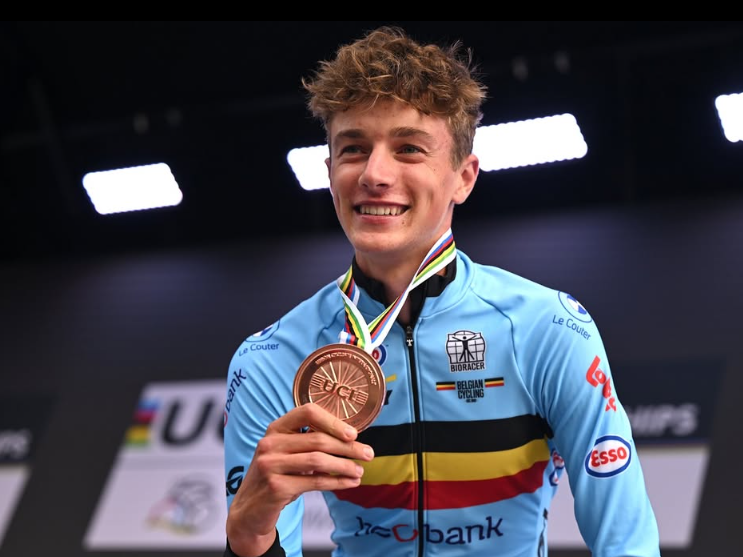

One of the big favourites for the junior men’s world time trial championships has been forced to withdraw from this week’s races in Montreal after being struck by a driver who cut across him during a training ride in the Canadian city.
Seff Van Kerckhove, who rides for Decathlon CMA CGM’s U19 development team, was expected to contend for the rainbow jersey during Tuesday’s time trial, after taking bronze as a first-year junior in the same event last year in Kigali.
The 18-year-old was training on his time trial bike with his brother Matisse and Belgian teammates Jasper Schoofs and Vic De Smet near their team hotel on Sunday, when the four riders split up to carry out individual efforts on a straight stretch of road.
View this post on Instagram
According to Matisse, as Van Kerckhove rode in his aero time trial tuck, a motorist cut across his path to turn into a driveway, hitting the young Belgian.
Van Kerckhove was also reportedly unable to stand up in the aftermath of the crash and was immediately taken to hospital, after his teammates, who didn’t witness the incident, discovered him lying on the ground.
The Belgian Cycling Federation has since stated that he sustained “severe impact” to his upper body, but did not provide further details. The federation also did not respond to questions related to why the riders were training on their own, without the support of a coach travelling in a following vehicle.
“From what I understand, a car suddenly drove across the street, presumably to turn onto a driveway,” Matisse, who didn’t see the collision, told Het Laatste Nieuws.
“The driver of that car didn’t see Seff coming, and because Seff was in his time trial handlebars at that moment, he couldn’t brake in time and crashed head-on into that car.
“It didn’t look good right away. Seff was taken to the hospital, where various scans are being performed to determine how serious his injuries are.”
In a statement, Belgian Cycling said: “Seff Van Kerckhove was hit during a training ride [on Sunday afternoon]. He was taken to hospital for further examinations. The collision had a severe impact on his upper body. Tomorrow more examinations will follow.
“Seff will now take time for his recovery. The rehab has already started. We wish him a speedy recovery. There will be no replacement for the Men Junior Time Trial nor Road Race.”
As noted by Belgian Cycling, Van Kerckhove’s injuries mean he will not be able to compete in Tuesday’s junior time trial or Thursday’s road race in Montreal, where he was expected to compete for gold following an impressive 2026 campaign.
The 18-year-old Belgian has won 11 times this year from just 31 race days, including dominant victories in junior stage races in Spain and Italy, as well as a number of one-day wins in France. He finished third in last year’s junior time trial in Rwanda, at 17, just eight seconds behind winner Michiel Mouris.
His brother Matisse, who finished 12th in Monday’s U23 time trial and will ride for Visma-Lease a Bike’s WorldTour team next year, said: “I was able to hear from Seff briefly from the hospital, and he is naturally very upset. He had really been looking forward to this world championships.”
Sunday’s collision in Montreal is the second time in less than a year that Van Kerckhove has been injured in a crash involving a motorist. Last December, he fractured four vertebrae after being struck by a driver while training at home in Belgium, an injury that delayed the start of his season until April.
The abrupt end to Van Kerckhove’s world championships campaign in Montreal is also the latest in a long line of serious incidents involving elite racers and motorists during training rides in recent months.
At this year’s Tour de France, UAE Team Emirates rider Brandon McNulty was riding to the start of the race’s 26.1km time trial on the shores of Lake Geneva when a member of the public, driving behind him, began blaring his horn. The motorist then overtook McNulty before slamming on his brakes, causing him to crash into the back of his vehicle.
UAE Team Emirates later confirmed that the road rage incident had been reported to the police, but that they would not take legal action against the motorist.
“It was just after the recon of the circuit and he was riding back to the start,” team boss Mauro Gianetti told road.cc. “And one guy with a car was just behind him and he overtook, honking the horn and making bad signals with his hand.
“And then when he was in front, he just slowed down and when he was very close, he stopped immediately to make him crash, and then he drove away.”
Gianetti attributed the incident to a general disdain towards cyclists on the roads, even when they’re professionals getting ready to race a stage of the Tour de France.
“Unfortunately when we ride the bike, we see people like this too many times,” he said.
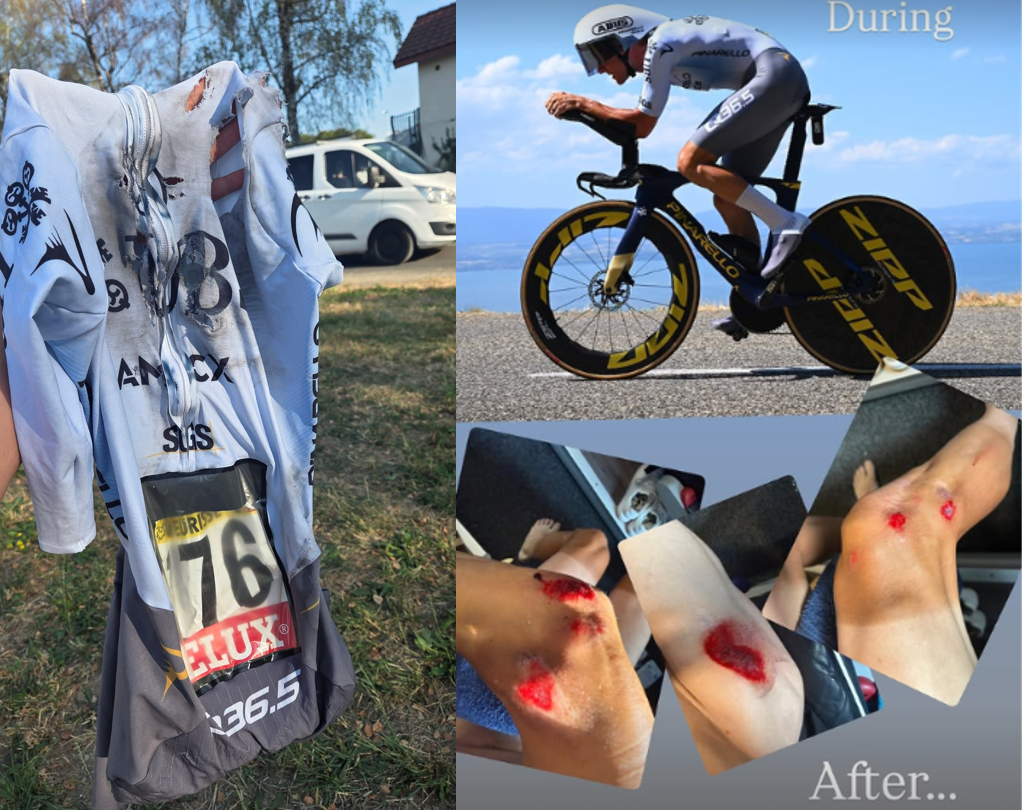
Just over a week later, Primož Roglič was forced to pull out of multiple warm-up races ahead of the Vuelta a España after he was hit by a driver whilst on a training ride, leaving him with severe bruising on his thighs.
Earlier that month, EF Education-EasyPost’s British rider Lukas Nerurkar was seriously injured by a driver in a training crash whilst visiting family, the crash leaving him with a broken collarbone that was also dislocated, a fractured sternum, a fractured vertebra, a broken rib, and a punctured lung.


31 thoughts on ““It didn’t look good right away”: Leading junior racer struck by driver during time trial training, forced out of world championships”
Yet another reason to ban time trial bikes from UCI competition. In addition to them adding a significant expense for young and poor riders (esp significant for aspiring riders from poorer nations – see the senior TT where a number of riders raced on road bikes, so they have no chance of being competitive), they are a safety hazard.
It is ridiculous to have a UCI road category, where the bikes used are _far_ more dangerous than normal road bikes – particularly for training on open roads.
Ban TT bikes. Make the playing field cheaper and more level. Remove the significant risk of having riders on bikes where their hands are far from the brake levers!
@Paul J There’s no good reason to believe that the outcome would have been in the slightest bit different had Van Kerckhove been riding a road bike instead. There are numerous links in the article to stories about other pros who have been injured whilst training on open roads, many of whom were on road bikes at the time and still unable to avoid the collision. The only common factor is motor vehicles being driven dangerously.
@OnYerBike it’s not really true that the only common factor in training injuries being the fault of motorists, is it? Egan Bernal is an obvious one which springs to mind.
In this case his teammate specifically said “Seff was in his time trial handlebars at that moment, he couldn’t brake in time and crashed head-on into that car.” That doesn’t mean it wasn’t the driver’s fault – after all, they should not have swung into his path – but it does undermine your claim that there’s no good reason to think that the outcome would have been different on a road bike.
Egan Bernal’s not referenced in the links in the article, though, so not relevant to OYB’s “only common factor” comment. And there’s still no good reason to think that the rider would have had time to brake in the current case had he been riding a road bike.
@mdavidford True, but why limit the assessment of such incidents to those cherry picked for this article?
@AidanR I think you’ve got the argument back-to-front. The original comment suggested that the fact that this incident happened at all was proof that TT bikes are dangerous. OYB pointed out that that’s nonsense, since (a) there’s no evidence that the type of bike contributed to this particular incident, and (b) there are a plethora of cases cited in the article that demonstrate that such incidents can happen regardless of what type of bike you’re riding. The fact that there’s a case where the rider caused an incident is no rebuttal of that, since no-one’s argued that riders can’t cause crashes.
@OnYerBike From his brother Matisse, as quoted in the article: “because Seff was in his time trial handlebars at that moment, he couldn’t brake in time and crashed head-on into that car.”
TT bikes are definitely a bit more dangerous than road bikes, saying that as someone who participates a little in the local TT scene.
@Paul J Whats dangerous about the bike Paul? I can’t see anything about the bike thats ‘dangerous’.
Or do you mean drivers being the danger since they are the cause of the incident not a person riding a bike?
@Smoggysteve From his brother Matisse, as quoted in the article: “because Seff was in his time trial handlebars at that moment, he couldn’t brake in time and crashed head-on into that car.”
@Paul J His brother who didn’t actually witness the collision…
@OnYerBike His brother, who must have some reason for stating that – I assume because he spoke to Seff!
@Paul J That’s not making the BIKE dangerous, that is the rider adopting a position on it. And as is mentioned, his brother didn’t witness is so its hearsay.
A rider could be on a regular road bike and take their hands off the bars, sit up, or even lay their arms in puppy paws (its a training ride after all no UCI peaking over their shoulders) and potentially not be in full control or reach of the brakes. Does that make the BIKE dangerous?
@Smoggysteve The raison d’etre of a TT bike is the squashed in position on the skis, and riders are going to train in the position they race generally.
If that position is banned, and puppy paws are banned, riders will generally not use them in training… cause… they’re training to be able to hold their race position. For a road bike position they’ll be training to hold a position with their hands on the hoods just above the levers, and arms level – the fastest position on a road bike and UCI legal competition.
@Paul J I have to disagree. I suspect you have never ridden a T T bike.
It sounds as though the driver was at fault and the collision could just as easily happened on a road bike.
However I also think that pro and elite riders are so used to riding on tracks and closed circuits, that they sometimes forget that they are training on open roads – something that all club riders are reminded whenever they sign on for a race.
I make a point of training out in the countryside on my TT bike and avoid riding it (or my road bike for that matter) hard in built up areas.
I also make sure that I keep my head in a position that allows good forward vision to watch out for potholes, overtaking cars etc. Many pros adopt a track position with the head looking down at the front wheel, which is not suitable for open roads.
Thousands and thousands of miles are ridden each week by club riders on TT bikes in training and racing with no mishap.
With regard to cost of TT bikes, I suggest you have a look at some of the road bikes that get used for racing in club and open TTs. They certainly aren’t cheaper than a TT bike.
@Mr Blackbird I have ridden road bikes with TT bars, yes, but I generally stick to a road bike when doing TTs in the local scene here.
Your hands are further from the brakes, your reaction time before you can get on the brakes in response to some event is higher. As Seff’s brother, Matisse, is quoted in the article: “because Seff was in his time trial handlebars at that moment, he couldn’t brake in time and crashed head-on into that car.”
You also less control over the front in windy conditions – a danger I’ve heard some of my fellow testers remark upon on days when we’ve had a lot of cross-wind.
> I suggest you have a look at some of the road bikes that get used for racing in club and open TTs. They certainly aren’t cheaper than a TT bike.
That some people choose to spend loads of money on a road bike is irrelevant here. That money is largely to show off, it’s not buying any significant extra performance over a low-mid range road bike. Whereas even a lower end TT bike is a significant benefit over any road bike.
I use a pretty cheap road bike in competition. Around €1300 for the bike, and another €450 for the wheels (I could have gone a lot cheaper on the bike TBH, a Chinese no-name frame would have halved that cost).
Requiring *2* bikes for people to be competitive in UCI road cycling, where 1 of those bikes is pretty specialist and niche (in general market terms) and hence always more expensive, is just wrong.
@Paul J Yes. Your hands are further from the brakes. That is why it is important to train in places where you are less likely to encounter pedestrians and erratic traffic movements, with the head in a position that gives maximum visual warning of any impending problems.
I think pros sometimes forget these points.
With regard to crosswinds, it depends more on the depth of your front wheel rim. Don’t forget that there is more body weight on the front wheel in a TT position.
Most club and open TTs have road and TT bike categories, so if you choose to race a road bike good for you. It’s a free country. In fact our club TTs are typically a 50/50 split between road and TT bikes and open TTs are around 25 – 30%road bikes.
You don’t automatically get a huge performance benefit from a TT bike. Training in the position and the extra core strength required is something that has to be worked on. Riding a TT bike is an art in itself.
And my last point, some of the road bikes I see cost more than my road and TT bikes combined.
@Mr Blackbird
> “With regard to crosswinds, it depends more on the depth of your front wheel rim. Don’t forget that there is more body weight on the front wheel in a TT position.”
I run an aerofoil shaped tri-spoke on my road-bike in TTs where the organiser allows. The front is /very/ snatchy in cross-wind (I imagine cause the aerofoil spokes generate a significant “lift”/side-force as the AoA increases in cross-wind, and then stalls in the gusts as crosswind and AoA increase – which would suddenly “release” the lift/side-force). I also have a pretty low / over the front position on my competition bike – my position is more extreme than a few of the guys on TT bikes.
So on those factors, my bike is little to no different to the TT bikes (indeed, my front wheel is probably more prone to sidewinds than deep section normal-spoke wheels that many T bikes are using). But.. cause I have road bars, my hands are out from the pivot point, I have more leverage over the bars and more stability and control in cross-winds.
@Paul J So if you – by your own admission – put TT bars on your road bike, is that now a dangerous bike?
@Smoggysteve Yes, I definitely have less control.
So, for that reason and the other reasons why I think TT bikes should just be banned from UCI comp, I ride with normal road bars, in the road bike category.
@Paul J – Can you point to any evidence – not anecdotal, that suggests TT bikes are involved in a higher amount of incidents than regular bikes per capita?
@Smoggysteve Without taking any sides in the argument, that’s pretty much asking the impossible, you might as well ask are Dutch bikes more likely to be involved in collisions than mountain bikes – official statistics can’t even differentiate between crashes involving legal ebikes and those involving illegal electric motorcycles so there’s no way they are going to keep a record of TT bikes versus road bikes.
@Rendel Harris Well, in that case its impossible to say TT bikes are more dangerous. And that is my point entirely.
But you could use times where TT bikes are used on open roads like Club 10s. There is a very commonly used one near me in Renfrewshire that’s used by a whole manner of clubs. I can see on many Wednesday evenings dozens of riders – some on TT bikes , some on road bikes competing. I see no statistic from my time wathcing and competing in theses events that the TT bikes are involved in more incidents than the non TT bikes. And that is anecdotal but I have watched many event and I don’t see a highly elevated danger at all. if there were they would be banned or discouraged. but they aint and that probably speaks more than someone who has very little experience riding them (in the case of Paul J) to decide what is dangerous and what isnt.
@Smoggysteve I think anyone who’s ridden a TT bike or a bike with TT skis knows a degree of control is sacrificed. It is inherent to the physical facts that a) your hands are far away from the brake levers, and your body is positioned with elbows over the stem, so it takes a lot longer to get your hands to the brakes and b) your arms are much closer to the centre-line, so you have far less steering leverage, plus you’re not even properly holding the steering controls either.
Even those pushing back against me in these comments acknowledge that fact (e.g. Mr Blackbird’s comment above, “Yes. Your hands are further from the brakes. That is why it is important to train in places where you are less likely to encounter pedestrians and erratic traffic movements”). I think it is entirely uncontroversial to say that TT bikes are harder to control and slower to brake (inc reaction and repositioning time) and that no reasonable, informed person would claim otherwise. Hence why TT bikes and TT bars are not permitted in UCI bunch racing (there are 1 or 2 other mad associations that permit it, triathlon notably, and some non-UCI affiliated gravel events).
You are asking for specific statistics that you know do not exist, to try dispute a truth (TT bikes are harder to control, handle and brake more poorly when ridden in the intended position that is their raison d’etre) that no reasonable person would dispute.
@Paul J You need to READ whay I am saying cos you clearly do not get it.
There is nothing inherently dangerous about a bike of any kind. Its 2 wheels, a frame, bars, groupset etc. There is nothing that makes that bike dangerous. A road bike in the wrong hands could be more likely involved in an incident than a TT bike in the hands of an experienced rider. The BIKE is not dangerous. The persons ability to handle it may make it appear more or less, but the inanimate object is not the danger.
But tell me what is more dangerous:
a road bike with no clip on skis but the rider is not holding the bars close to the brakes, maybe resting their hands on the top of the bars (like people used to do) and have their hands nowhere near the brake levers or a TT bike where the rider has their hands near the brakes not out front but actually on the bar ends near the brake levers? which is more dangerous?
And I don’t care what Mr Blackbird says, he’s not the authority on bike safety and neither are you or I.
I would even suggest that a rider on the TT bike with thier hands on the skis can still reach the brakes as quickly as a rider on a regular road bike with their hand on the top of the bars. In neother case are they covering the brakes with either hand and both would require a movement to cover it in a split second. So the bike is not in question, its the rider and their skill level.
“I would even suggest that a rider on the TT bike with thier hands on the skis can still reach the brakes as quickly as a rider on a regular road bike with their hand on the top of the bars. In neother case are they covering the brakes with either hand and both would require a movement to cover it in a split second. So the bike is not in question, its the rider and their skill level.”
I think this statement is probably correct, but what it ignores is that riders usually use the top of the bars for riding uphill so the speed is a lot slower than when on a tt bike so the rider will have more reaction time for a given situation.
Although you are correct to say that no bike is inherently dangerous we are really discussing bikes with riders on them and for the same rider a tt bike is more difficult to control in anything other than a straight line with no sidewind.
@Backladder Don’t fall into the trap of the speed of the rider. thats irrelevant if you need to reach the brake in a split second.
And you’re assuming that person is racing or climbing as fast as they can. You never seen a person riding on the flat with their hands on the bars even just recreationally?
@Smoggysteve Unless the danger is coming from behind you in which case you will never even attempt to go for the brakes, the speed of the rider is always relevant, the faster you go the quicker the scenario will develop and the greater the consequences. Recreational riders with their hands on the tops will also probably be going slower unless they are doing it downhill which would make them idiots.
@Paul J Those trispoke wheels sound absolutely lethal. I think their use and sales should be banned.
The point you are missing here is that just because an aspect of bike design is perceived, without any context, as being more dangerous, it doesn’t automatically follow that it should be banned.
My argument is that the bike has to be ridden appropriately for the road conditions. Excessive speed in the wrong place is far more dangerous than TT bike geometry or trispoke wheels.
@mdavidford
For some reason I can’t directly reply to your response above, so I’ll quote it here:
“I think you’ve got the argument back-to-front. The original comment suggested that the fact that this incident happened at all was proof that TT bikes are dangerous. OYB pointed out that that’s nonsense, since (a) there’s no evidence that the type of bike contributed to this particular incident, and (b) there are a plethora of cases cited in the article that demonstrate that such incidents can happen regardless of what type of bike you’re riding. The fact that there’s a case where the rider caused an incident is no rebuttal of that, since no-one’s argued that riders can’t cause crashes.”
OYB may have claimed that there’s evidence that the type of bike contributed to this particular incident, but that’s contradicted by the rider’s own teammate.
Of course riders of road bikes are also struck by motorists, but it does not follow that TT bikes are not more dangerous to ride than road bikes. It seems pretty obvious to me that if you can’t brake without having to significantly change your position on the bike, it becomes more difficult for the rider to avoid the actions of errant drivers.
@AidanR
But again, no-one said that it did. They said that it does not follow from the fact that there was an incident that TT bikes *are* more dangerous. Because an incident can occur to a rider on any type of bike. And this is evidenced by the fact that there’s a whole list of incidents happening to people on road bikes.
I assume you mean the quotes from his brother, rather than teammate. They don’t actually contradict that claim. It says that he wasn’t able to brake, but it doesn’t follow that if he had been then he would have been able to avoid the incident. In any case, the danger still didn’t come from the bike here – it came from the two tonne box that suddenly swung into its path.
[NB – the trick to the missing reply link is to go back up the thread to the last post that has one and reply to that. Then you can either delete the @ tag or, if you think it may not be clear who you’re replying to, replace it with the username of the person you’re replying to.]
@mdavidford thanks for the tip on replying to the thread!
It would seem odd for his brother (thank you for the correction) to mention that he wasn’t able “to brake in time” because he was in the TT position if he otherwise would have been able to apply the brakes. Perhaps it wouldn’t have avoided the crash entirely, but it seems likely that it would have at least lessened the impact.
It therefore seems entirely reasonable to conclude from this that TT bikes are more dangerous. That takes no blame away from the driver, as a rider should not be forced to brake to avoid a collision caused by a driver turning into their path.