



When Giant introduced the TCR way back in 1997, few would have predicted that it would still be influencing road bike design well over a quarter of a century later, but that’s exactly what has happened. It’s hard to overstate the influence of this bike.
The 1997 TCR might not look radical by today’s standards, but that’s largely because so many other bikes have taken inspiration from aspects of its design and made them mainstream. That first TCR, the invention of the late British designer Mike Burrows – best known for his collaborative work on the Lotus 108 bike made by Lotus for Chris Boardman and used to win the 4,000m individual pursuit at the Barcelona Olympics – was unlike any other bike in professional racing at the time.
> “We shall never see his like again”: Remembering Mike Burrows
How come? TCR stands for Total Compact Road, and that’s a clue to what this bike is all about. Previously, the vast majority of road bikes were designed with horizontal top tubes and short seatposts. Okay, there was certainly a degree of variation between brands/models, but the basic silhouette had remained essentially unaltered for decades.
However, the first-generation TCR changed all that. Its most striking feature was its top tube, which sloped downward from the head tube to the seat tube. This design made the bike look very different from all others in the pro peloton at the time.
Mike Burrows and Giant argued that the Compact Road geometry offered a number of benefits. For a start, the sloping top tube led to a shorter seat tube and a smaller front triangle. The idea was that this resulted in a lighter and stiffer frame.
The shorter seat tube also meant that the rear triangle was smaller. This saved more frame weight and also, Giant said, improved power transfer and efficiency.
Granted, the TCR had a longer seatpost than rivals of the time, so a little weight was added back in there, but that’s a relatively light component. Plus, longer seatposts could be aero-shaped to reduce drag and made from carbon fibre to add a little give.
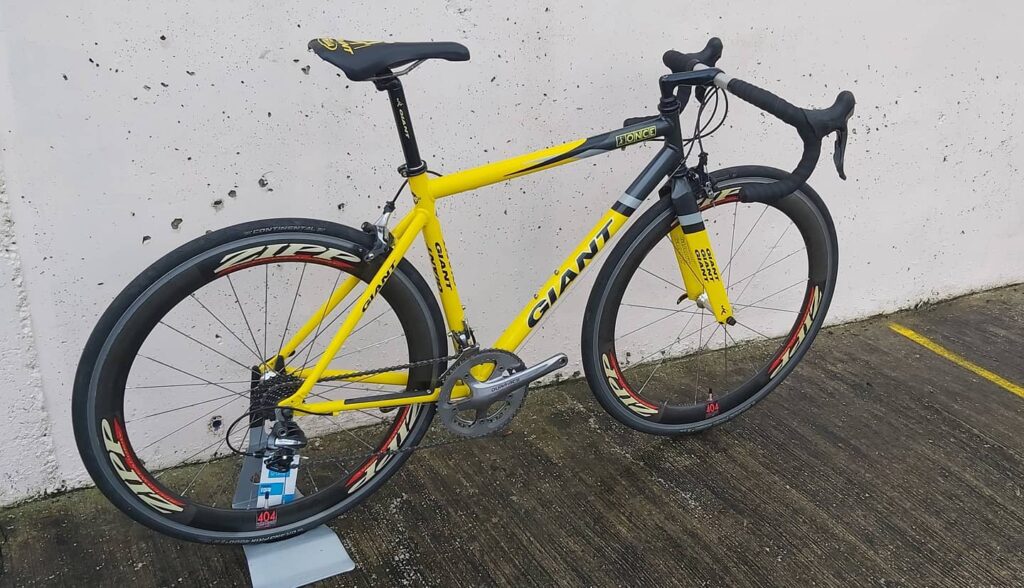
Like most road bikes of its era, the original TCR, created for the pro racers of Spain’s ONCE team, was made from aluminium alloy. Carbon-fibre bikes certainly existed at that time, but alu was still the frame material of choice for most.
The TCR was also unusual in terms of fit. One of the ideas behind Compact Road geometry was that the low standover height meant a wide range of rider heights could be accommodated by the same frame. You would fine-tune your position by adjusting seatpost and stem lengths.
The first TCR was available in just three frame sizes (small, medium, and large) and had an angle-adjustable quill stem that also came in three lengths (105mm, 120mm, and 135mm). This meant that Giant could reduce the cost of developing different frame sizes, and lower inventory/SKUs (stock keeping units). It also allowed local bike shops to cover a wider range of rider heights with fewer frame sizes. From their point of view, that’s a result!
Of course, the Giant TCR wasn’t the first bike ever to feature a sloping top tube – not by a long way – but it was probably the most influential, with loads of brands following suit with their own models in the years since 1997. Glance through our guide to the bikes of the men’s WorldTour 2025, for example, and you’ll see sloping top tubes all over the place and plenty of small rear triangles which, brands say, lead to improved comfort and reduced drag.
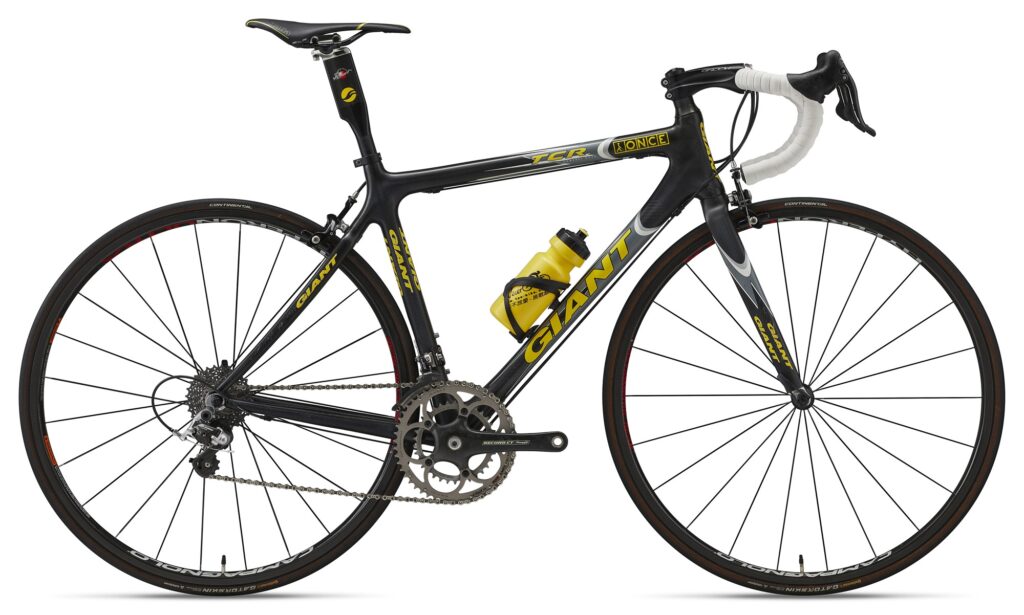
Naturally, the Giant TCR has evolved massively over the years. The second-generation TCR (above), introduced in 2002, was the first with a full-composite frameset; Giant’s 2005 fourth-generation model was the first to be available in five sizes (the same as today); integrated cable routing came with the 5th generation (2008); and disc brakes were introduced on the eighth generation in 2016.

Giant unveiled what it calls the “lightest, most efficient TCR ever” last year (naturally; those are pretty standard claims for any brand to make when launching a new road bike). Although a lot has changed, the most modern version is still recognisably a descendant of that original TCR with a focus on lightweight and stiffness. The Propel is the aero road bike in the range, but Giant claims the TCR saves 4.19 watts over its predecessor at 40km/h (24.9 mph).
We reviewed the £6,699 TCR Advanced Pro 0 AXS (above) here on road.cc last year and were massively impressed, to the point that we awarded it the road.cc Recommends Road Bikes of the Year 2024/25 title, and made it our overall Bike of the Year too. Ten generations in and it’s better than ever.









15 thoughts on “Why the original Giant TCR from 1997 was one of the most influential road bikes ever”
fully agree,
fully agree,
raced on the original, recently restored it and still a rocket of a bike….if you dump the twisted creaky stem
Compact geometry was nothing
Compact geometry was nothing more than a guise to reduce inventory/SKU’s, as it indirectly changed the face of road bikes forever. It’s no coincidence that the world’s largest high-end manufacturer was the originator of Burrows’ compact design.
Instead of manufacturers needing to build a dozen different frame sizes for each model, they cut it down to five with compact geometry. It had a chain reaction effect from distribution and inventory all the way to local bike shops being able to cover a wider range of rider heights with fewer frame sizes.
I working for a Giant dealer when the TCR came out and this was by far the most important sales pitch made to us by Giant. Maybe in the long run it made sense from a business standpoint, but prices never really seemed to reflect any savings.
Sloping top tubes reach the
Sloping top tubes reach the consumer as a benefit as it is easier to find a used bicycle at your size. Any step towards less customization, is a good thing sooner or later.
cyclisto wrote:
They also allow you to change frame size more easily, suffering with arthritis in my wrists I’ve just switched from a 56 cm frame to a 58 cm for a slightly more upright position (yes it’s not as aerodynamic but what are the drops for?) and have never felt more comfortable on a pure road bike; I wouldn’t be able to ride a 58 cm frame with a straight top tube without severe risk of crushing the essentials when stopping!
Agreed, most bikes are too
Agreed, most bikes are too low for most of users. There are solutions (17 or 30 degree stems, even steerer tube extensions), but they are not the most elegant ones.
@festina any additional customization sooner or later you will have to pay it, so it is good to have flexible products.
Agree this was pushed by the
Agree this was pushed by the industry to reduce the number of frames they had to build but as someone who is often on the cusp of 2 sizes I miss the old range of frame sizes.
Aero seat posts never added
Aero seat posts never added compliance no matter how long they were.
“Plus, longer seatposts could
“Plus, longer seatposts could be aero-shaped to reduce drag or made from carbon fibre to add a little give”
I had 10 days in Taipei City
I had 10 days in Taipei City in 1998 for work. While I was there I bought a Giant TCR and here’s a photo of it in its native country. This is the absolute OG edition complete with all the Mike Burrows flourishes, eg the (heavy) carbon spoke wheels, aero seatpost, adjustable stem. I do think it immediately made all other bikes look dated. The bike pictured at the top of the article is a later version produced as tie-in with the Spanish ONCE team.
I did a few rides around Taipei on this, discovering that once outside Taipei City all road signs were in Chinese and both paper maps I had were approximate at best. Excellent bike but this Medium copy was too small. On return I sold it to a friend who rode it for many years and then replaced it with the carbon version. I bought this same silver frame as a frame-only deal in Large and built it up with Chorus 9-speed and rode that for many years.
Reminds me of this beautiful
Reminds me of this beautiful one off ti frame made for Jalabert. 650cc wheels and super thin tubing made it a big climbing stage bike only. It was reported that the down tube walls were so thin that they were easily dinged by stone chips kicked up by the tyres.
Jalabert the sprinter who
Jalabert the sprinter who became a climber – hmm. Odd now to see them without helmets, this would have pre Kivilev in Paris-nice which forced the issue.
Nice-looking machine but I
Nice-looking machine but I wouldn’t fancy “a big climbing stage” with those gear ratios! Maybe Jalabert was slightly better at that sort of thing than me though…
I wouldn’t fancy “a big
I wouldn’t fancy “a big climbing stage” with those gear ratios!
I think it involves also having ‘those muscles’
Classy bike from an amazing
Classy bike from an amazing engineer.
In 2000, 3 years after it was
In 2000, 3 years after it was introduced, they produced a limited edition of 35 with all the yellow being actual gold. I actually saw 2 of them, one at that year’s Etape du Tour, the other, amazingly, being in Beiciau Hobbes in Carmarthen – the latter was number 3 in the series I believe.