


Forum Replies Created
-
AuthorReplies
-
February 11, 2026 at 8:39 pm in reply to: road.cc, off.road.cc and ebiketips website migrations – let us know about any issues you spot here #1196281
 andystow
andystow
andystow
Actually no, but hair
Actually no, but hair coverings, gowns, and shoe coverings are. Fortunately the woman who does most of the weighing has no beard, and I’m hardly ever required to go in there.
andystow
Who?
Who?
andystow
mdavidford wrote:You forgot to include thaum variance.We’re not amateurs.
Our weighing room is an isolated, environmentally controlled, properly warded clean room.
andystow
We have some seven place
We have some seven place scales here, will weigh tens of grams to 0.0001 mg.
andystow
Ooh, did someone ask for a
Ooh, did someone ask for a measurement engineer/metrologist?
As others have mentioned, precision and accuracy are not the same. Going further down the rabbit hole, high quality measurement devices will specify at least:
Readability (or precision)
Zero offset
Non-linearity
Non-repeatability
Hysteresis
Temperature driftThe total uncertainty is generally calculated via the RMS (root mean square) of these.
Zero offset can often be ignored if you zero the instrument before use. That’s what “tare” does on a scale.
Non-linearity tells you how far it can wiggle around. For instance, if you calibrated the scale to read within 0.1 g at 10, 20, 30, 40, 50 g, that doesn’t mean it’s within 0.1 g at 25 g.
Non-repeatability would be how much the measurement would vary if you repeatedly made the same measurement in the same way.
Hysteresis is really related to what you’re seeing. The way it’s defined, though, is how much the reading can vary depending on the direction it’s approached from. If I tare the scale, then add a 20 g weight and see 19.8 g, then add another 20 g weight and immediately remove it, I may see 20.2 g, which means the hysteresis at that point is 0.4 g.
Temperature drift is just how much the reading could differ if the scale is not used at calibration conditions, usually 20 °C or 25 °C.
With scales, you also have errors due to buoyancy and local gravity, but those won’t matter for what you’re doing.
I believe what you’re seeing, since the scale has a mechanical component (something is moving a tiny bit) is stiction, but there’s a chance it’s purely electronic. You may be able to eliminate it by giving the scale a little shake before reading it. See how repeatable it is then. We have one model of dynamometer (engine torque measurement) that we calibrate where the procedure says to hit certain spots with a mallet before taking each point.
All this, and we also specify a coverage factor, generally 2σ which means two standard deviations. That gives us a 95% confidence interval, meaning even if I experiment with the scale and do all this math. and tell you the total uncertainty is ±0.35 g, it could still be expected to read outside of that interval 5% of the time.
I hope this brief, non-mathematical summary helps.
andystow
David9694 wrote:If your road safety campaign doesn’t follow this basic rule, you don’t really care about road safety that much.(#SimpleRules No. 341)
(by Heroes for Zero Brussels)
Urban Cycling Institute
The giant protective hand is a good start, but there are much better ideas in these videos.
andystow
As I wrote in my LeJOG
As I wrote in my LeJOG journal:
The next stretch of road, the A836 from Thurso to Castletown was by far the worst, busiest stretch of road on the whole trip. I would not do that again. There aren’t a lot of other road choices, and maybe being a Friday afternoon made it worse, but I’d add twenty miles if I needed to just to avoid it. No shoulder, and a constant stream of caravans.
andystow
levestane wrote:https://www.bbc.co.uk/news/articles/cp34nyenqpkoI like the way the headline blames the bridge.
Odd, it seems adequately posted.
andystow
That would be useful if I
That would be useful if I regularly used a trainer or a power meter, and I do neither.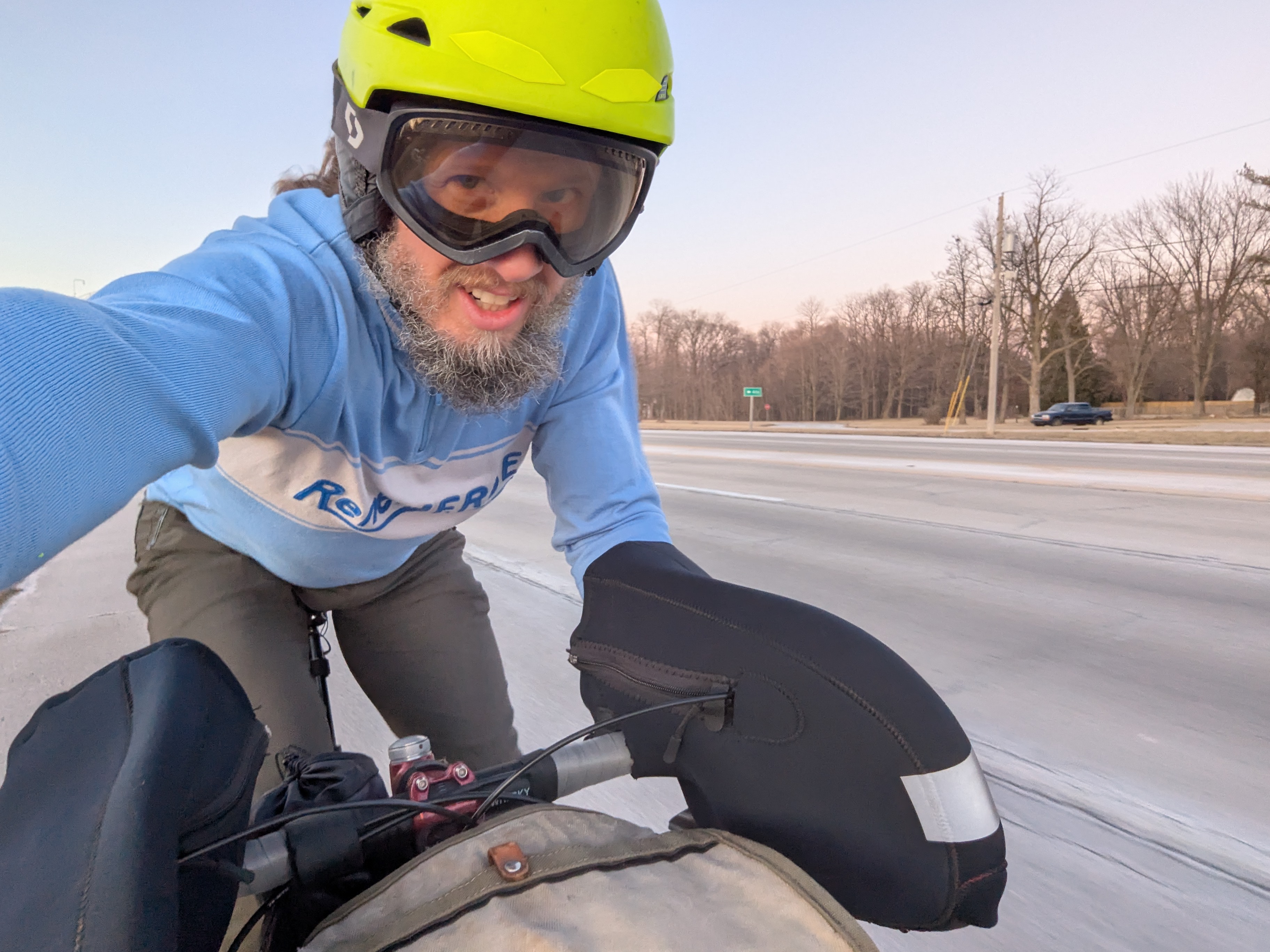 andystow
thax1 wrote:Answering my own question now 🙂
andystow
thax1 wrote:Answering my own question now 🙂Apparently there are two FTP Ramp tests on Zwift, and the ‘Lite’ version caps out at 250w (60sec), so is only intended for very light or beginner cyclists.
If your FTP is >200, you’ll need to do the ‘proper’ test to get a meaningful result.
This is correct. I should have done the non-lite version, but I didn’t think my FTP would be over 200.
November 26, 2025 at 8:06 pm in reply to: The Reform Party and the UK’s lurch towards fascism #1183155andystow
“are we the baddies?”
“are we the baddies?”
 andystow
I don’t have a power meter on
I don’t have a power meter on any of my bikes, and Strava’s estimates don’t correlate at all with my heart rate or perceived effort.
andystow
Looks like I’m right around
Looks like I’m right around the top of the bell curve, meaning average, for men 50-60 years old, or even 40-50, based on the numbers from Trainer Road.
That curve will skew high, because it will be a self-selected group of cyclists “serious” enough to use Trainer Road.
andystow
I wouldn’t mind doing it once
I wouldn’t mind doing it once a year, as long as I can go home and shower afterwards.
-
AuthorReplies