


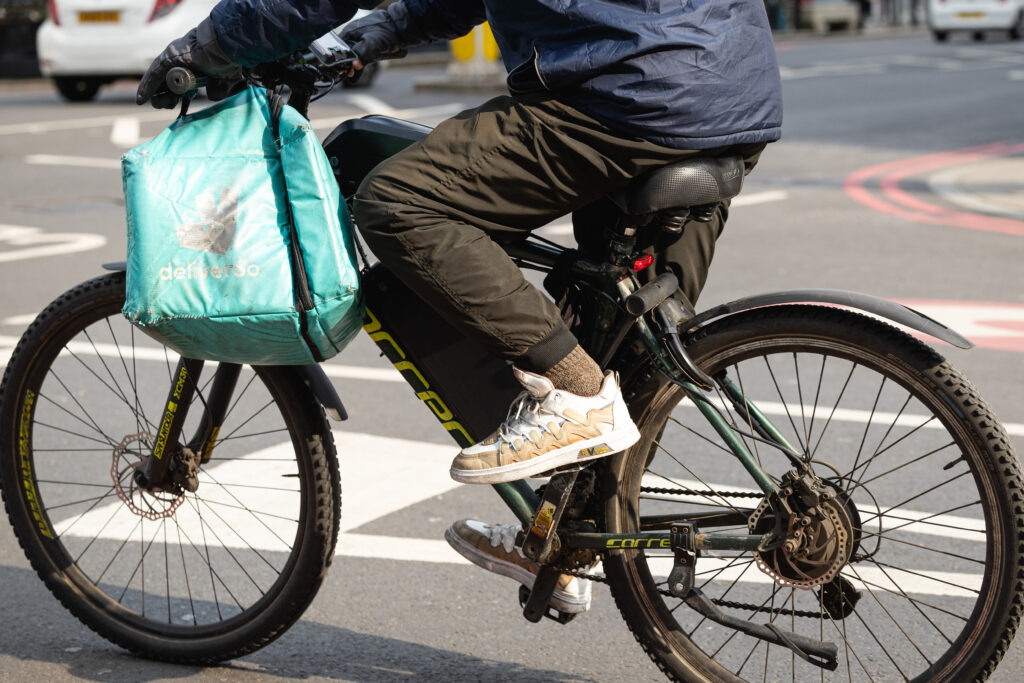

The government’s failure to tackle the unsafe and illegal use of e-motorbikes threatens to irrevocably damage the reputation of the UK’s legal e-bike industry, as well as undermine its efforts to promote cycling and active travel as a whole, the All-Party Parliamentary Group for Cycling and Walking (APPGCW) has warned.
A new report published this morning by the cross-party group of MPs and peers has called for stricter laws to prevent online retailers from selling potentially dangerous electric bikes and conversion kits, including closing a loophole which enables sellers to list illegal e-motorbikes under the pretence that they should only be used off-road.
The group has also urged the government to give the police new powers to seize unsafe “fake” e-bikes and introduce a scrappage scheme, to be funded by food delivery companies, for dangerous bikes used by their couriers.
Focusing on the gig economy, and its widespread use of high-powered, illegal e-motorbikes, the APPGCW says couriers should be given wider guaranteed rights and protections, while their employers should be required to carry out safety and compliance checks on their bikes.

The APPGCW’s report, titled ‘Unregulated and Unsafe: The Threat of Illegal E-Bikes’, is the result of a detailed inquiry which took written and oral evidence from fire services, police officers, industry bodies, gig economy workers, academics, and regulators, as part of the group’s attempt to understand “what’s really going on” amid safety complaints
Under UK law, it is legal to ride electrically assisted pedal cycles (EAPCs), which are restricted to a maximum power output of 250 watts and cut-off assist speed of 15.5mph, on the roads.
However, the increasing use of high-powered bikes, which can easily exceed the legal limit – and therefore are classified as electric motorcycles – and cheap conversion kits have led to growing concerns about dangerous riding and the sharp rise in fires caused by cheaply made, poor-quality batteries which fail to comply with UK fire safety standards.
In May, Labour MP Tom Hayes urged the government to introduce stricter e-bike and e-scooter laws, arguing that the current “situation is unsafe” and that “battery safety, speeding, and enforcement” needs to be addressed “before more people are hurt”.
During the APPGCW’s inquiry, the group was able to “easily” find e-bikes capable of 40mph speeds being sold by major online retailers and marketed “for city commutes”, as well as a 2,000-watt bike with a throttle pictured being used on city streets – both of which are illegal.
Another search on Amazon found an unsafe charger with an unfused clover leaf plug and multiple charging cables supplied, both of which are considered a fire risk by experts, the group said.

Last year, the CEO of folding bike manufacturer Brompton also called for a crackdown on “poor quality” e-bike batteries before public perception “snowballs into a world of fear” around e-bikes in general.
As part of their report, the APPGCW noted that stories about illegal e-bikes – including this year’s BBC Panorama special, which was widely criticised for its failure to properly distinguish between legitimate electric bikes and their illegal counterparts – have led to confusion for the public, as well as landlords, insurers, and transport operators.
Last week, a study by the Electric Bike Alliance found that only 63 per cent of people aged 25 to 34 – the demographic mostly likely to purchase an e-bike – indicated they would be able to determine if an e-bike was road-legal, and nearly one in four current e-bike owners felt unable to distinguish between road-legal e-bike products and non-legal, potentially hazardous aftermarket alternatives.
This confusion has therefore helped instigate a rise in blanket bans on e-bikes in some workplaces and travel networks, while cyclists with legal e-bikes have been refused insurance, affecting legitimate users as well as disabled people who rely on electric bikes to get around.

According to the APPGCW, this confusing, potentially discriminatory situation could be addressed by creating a government-backed “e-bike safety kitemark”, which would enable transport authorities and insurance companies to confidently lift e-bike bans.
Meanwhile, the lack of regulation and enforcement around e-bike safety in the UK is “putting lives at risk”, the group says, particularly among delivery riders “operating in low-paid, high-pressure environments” and incentivised to use faster illegal bikes to meet delivery targets.
The report heard evidence which compared the current food delivery industry are comparable to the “sweated labour” of the nineteenth-century industrial revolution, with witnesses claiming they had “never seen people on a daily basis as badly exploited as food delivery riders”.
As part of its recommendations, the APPGCW called on the government to enforce compliance from these delivery companies, requiring them to run real-time compliance checks on the bikes used by couriers, while also calling more broadly for gig economy riders to be classified as ‘workers’, guaranteeing them rights and protections.
It also said delivery companies should help fund a scrappage scheme for dangerous bikes, with police given “new, simpler powers” to seize illegal machines.

“Electric bikes have the power to reshape how we move, opening up cycling to more people, reducing reliance on cars, and helping our towns and cities become cleaner, healthier and more connected,” the APPGCW’s chair Fabian Hamilton said in the report.
“Unfortunately, as this report shows, that potential is now under threat. Over recent months, we’ve seen mounting concern about e-bike safety, from a sharp rise in battery fires to increasing numbers of illegally modified bikes on our roads.
“Behind these headlines is a deeper problem: a lack of oversight, accountability, and protection for some of the most vulnerable people using these vehicles – gig economy workers trying to make a living under intense pressure.
“This inquiry set out to understand what’s really going on. We heard from fire services attending dangerous blazes, police officers frustrated by unclear powers, unions representing gig economy riders, and industry bodies committed to responsible manufacturing. What emerged was a regulatory system failing to keep pace; with technology, with work, and with the needs of people trying to get by.”
Elsewhere in the report, the group called for online retailers to immediately withdraw unsafe e-bike items from sale, for the government to make these retailers legally accountable for unsafe listings, and for an end to the ‘off-road only’ loophole frequently exploited by sellers.
“The APPGCW is proud to champion active travel in all its forms,” the report continued. “But we must also be honest: when reputation lags, bad faith actors profit from loopholes, and when vulnerable workers are left without support or safety, the consequences are real and undermine active travel as a whole.
“This report makes clear that the vast majority of e-bike users and businesses are doing the right thing. It is the failure to tackle a growing minority of unsafe and illegal practices that is now putting the whole sector at risk. Bans on legal e-bikes, rising public concern, and reputational damage to a critical mode of transport must be addressed with urgency and clarity.
“We are calling for stronger product regulation, fairer working conditions, better enforcement, and support for those on the front lines; whether they are riders, firefighters, retailers, or regulators. The solutions are within reach, but they require urgent and coordinated action across government, industry, and platforms alike.”
In a statement released this morning, Labour MP Hamilton described the furore surrounding illegal e-bikes as a “crisis hiding in plain sight”.
“While responsible cycling businesses continue to meet high safety standards, the rise of illegal and unsafe e-bikes, often bought online and used in the gig economy, has created serious risks for riders, the public, and the future of active travel,” he said.
“We need urgent action from government and industry to stop unsafe products entering the UK and to protect those being exploited while trying to earn a living.”
Last week, in an interview with road.cc, Active Travel England commissioner Chris Boardman also called for government action to crack down on the sale of illegal e-motorbikes and dangerous batteries.
“In a sense these are all great problems to have,” Boardman said. “Because suddenly you’re swamped in them because of popularity. So, I’d much rather be coming in that direction. But because it’s happened really quickly, we haven’t kept up.
“Some of it is a trading standards problem, that we have got illegal and non-certified products coming into our market and people have said that they will buy batteries, chargers, bikes online if it’s cheaper, and they don’t mind if it’s non-brand.
“There’s a lot of risks associated with that, so I think there’s a government aspect to this, to legislate and properly police trading standards, so those products that are illegal don’t reach our market.

“Lithium battery fires are horrendous, and they make headlines – but there are 50,000 fires that the fire brigade attend each year at the moment, and lithium batteries of e-bikes are responsible for 0.07 per cent, so it’s a tiny fraction, but it will grow with popularity,” Boardman notes.
“And if you’ve ever seen a lithium fire, it is pretty horrific. You cannot put them out, you just have to wait until it’s spent. So, we need education around that.
“The simplest way around it is to go to a reputable bike shop and you buy a brand that you recognise. But when it comes to the difference between an e-bike and an e-motorbike, over half of people are saying ‘I don’t know what you’re talking about’. In its simplest terms, any bike which has an engine that cuts out at 15 miles an hour and you have to pedal is a pedal-assisted bike.
“If you see somebody who’s not pedalling and they’re going over 15 miles an hour, that’s an e-motorbike and if it hasn’t got a registration on it and the driver hasn’t got a licence, then it’s illegal.
“And we’re seeing a lot of that in delivery riders, the gig economy, and they just want the cheapest thing they can get, or they gaffer tape extra batteries to the bike. They just need to work and that’s the problem. I think that they need to address it.”
However, Boardman also warned against diverting too much attention to e-bikes when, statistically, other road safety issues are much more pressing.
“We shouldn’t lose sight of the fact that 99.5 per cent of the deaths and serious injuries on our roads are caused by people in motor vehicles, so it is not a massive problem and that context is really important,” he said.




















25 thoughts on “Dangerous “fake” e-bikes undermining UK’s cycling efforts and putting industry at risk, say MPs calling for clampdown”
As with the traffic laws,
As with the traffic laws, shoplifting, rape and several other kinds of crime, it’ll be no good having laws about dangerous pseudo “e-bikes” et al unless they’re enforced, requiring policemen, inspectors and similar to detect law breaking as well as a host of other legal services to prosecute or otherwise stop the miscreants from repeating their crimes.
What chance of that in Blightedland?
In addition, such laws will need to be resilent, without the 1001 loopholes that, effectively, allow those making profits from the sale of dangerous stuff to go on making those profits despite the immense harms done by what they sell. The authorities have allowed harmful food, drink, “lesisure pursuits” such as gambling and all sorts of other seriously damaging stuff to be sold “‘cos its business” and the basis of “growth”.
So who do they think they are kidding that this report will change anything whatsoever?.
I’m not sure the APPGCW are
I’m not sure the APPGCW are anything other than saguine about their reports bringing radical change! I suspect it’s just concerned MPs doing what they feel is their part. (MPs of course may have several interests beyond their day job of keeping / gaining more power).
I hope you’re wrong but I also feel this is one where a bit more early and vigorous action might have steered things in a better direction. On the other hand that presupposes all kinds of things like government interest in transport other than motor vehicles and large scale public transport. And better funded Trading Standards and probably police who “get it”.
Then again – e-bikes aren’t ushering in the apocalypse * – at least where I am. For me they’re another “let’s add an ‘e’ to things and upsell it **!” trend and a symptom of the problems created by our transport policies prioritising the motorist – often to the exclusion of all else.
* That’s not to say they couldn’t become an impediment to unpowered walking and cycling – or “only-single-extra-human-power-assistance” EAPCs. Haven’t read the APPGCW report yet but hope they also took a look at how things have changed in places that already have mass cycling NL as electric conveyances become more popular.
** “Shamen-isation” maybe?
I suppose they think they’re
I suppose they think they’re trying their best! However, their reports from years ago identified close passing as an impediment to mass cycling- and now we have the police encouraging this widespread offence by openly declaring “everybody does it, what can we do?” accompanied by hand-wringing and bewailing their lack of resources; resources such as the slightest understanding of, or empathy with, cyclists and cycling
You can outsource a lot of
You can outsource a lot of the enforcement by a kite marking scheme or a similar British Standards. Once the sellers know there will be a finanicial penalty the supply drys up and the police can pick the remaining population off at thier leisure.
Nothing is going to happen right now though – because the current Govt is terrified of doing anything “anti-growth” which includes facing up to Amazon and a dozen VC funded delivery companies.
Secret_squirrel wrote:
Absolutely – and the fact that these VC tech bullies have had some success in courts (though not always, everywhere) is further disincentive.
Given some of their business practices I’m not sure these concerns are in fact great for “growth” either. (Though no doubt challenging them would lead to the other side framing it as an attack on business / the working poor etc.) They are allegedly good for lobbying money (dinners, events, “fact finding trips”, perhaps funding some staff?) though.
I imagine the previous government or any future one influenced by the Reform side of things were / would be ideologically disinclined to interfere also * so it’s hard to see how this would change.
I think the APPGCW are spot on with “What emerged was a regulatory system failing to keep pace; with technology, with work, and with the needs of people trying to get by”.
* Except perhaps to send the immigration police round to check the riders!
Try one of these:
Try one of these:
“The 2025 Surron Ultra Bee HP
Dominate any terrain with the 2025 Surron Ultra Bee HP, a revolutionary electric trail bike engineered for ultimate performance. This 88.5kg powerhouse packs a blistering 21kW of peak power and an astonishing 511 N-m of torque, propelling you to a top speed of 95 km/h. Experience instant acceleration, surging from 0 to 50 km/h in a mere 2 seconds, thanks to the new Turbo riding mode. The Ultra Bee HP isn’t just a ride; it’s a raw, untamed force ready to conquer any challenge.”
or this:
“THE ROAD LEGAL STREET FIGHTER.
The Light Bee (L1E) utilizes the same powerful system as the Light Bee X (LBX), but with a design that conforms to all European driving laws, allowing you to legally ride on streets. This electric vehicle comes equipped with an array of features, including an LCD dashboard, LED headlights, front and rear mudguards, indicators, and brake lights, as standard. With the Light Bee (L1E), exploring your town, cities, and countryside has never been easier”
By comparison , apparently my motorbike is only:
Max. Power:106.4PS (105bhp – 78.3kW) @ 9200rpm
Max. Torque:96.9Nm (71.5ft-lbs) @ 6200rpm
Cugel wrote:
I agree – police traffic enforcement is the answer though I still think that car drivers are more of an issue than illegal e-motorbikes as the riders have “skin in the game” and have a strong disincentive to ride dangerously.
I don’t think that trying to prevent their sale is practical as it’s fairly easy to retro-fit a motor and batteries to an ordinary MTB with possibly worse results than just selling a pre-made e-motorbike. There’s also the fact that off-road motorbikes (ICE variety) have been freely sold since forever.
They’re everywhere now. Only
They’re everywhere now. Only yesterday PM, I was riding home at 16mph+ and got easily overtaken by a guy on one these who wasn’t pedalling. Happens most rides so was hardly remarkable.
I largely applaud this – it
I largely applaud this – it is important that these rogue and dangerous machines (as in, risk of fire etc, not referring to how their are ridden!) are cracked down upon. But as others have indicated, this is all worthless without enforcement.
The elephant in the room is the very large companies like deliveroo whose entire business model is dependant on these kinds of machines, incentivising risky and dangerous behaviour, whilst at the same time claiming that their hands are clean because the delivery riders are freelance, not employees. These companies are guilty, because they cannot survive without other people taking all kinds of risks, and using illegal machines. Time for them to take some responsibility!
the little onion wrote:
The elephant in the room is the very large companies like deliveroo whose entire business model is dependant on these kinds of machines, incentivising risky and dangerous behaviour, whilst at the same time claiming that their hands are clean because the delivery riders are freelance, not employees. These companies are guilty, because they cannot survive without other people taking all kinds of risks, and using illegal machines. Time for them to take some responsibility!— the little onion
Yup wholly complicit.
BikingBud wrote:
Unfortunately we are all complicit as well because we nearly all of us (including me) use bike delivery services at some point – during Covid when confined to the house they were a lifeline and I admit I didn’t stop to think about what vehicles they were using. It seems unlikely that legislators are going to take the unpopular decisive action required that would result in takeaways and shopping deliveries becoming more expensive, and the chances of any organised consumer pressure being brought to bear also seem slim. I know of a lot of people who have a cognitive dissonance in this area, simultaneously complaining about the dangers delivery riders pose but regularly using their services.
the little onion wrote:
It does appear that some of these business models rely more than accidentally on outsourcing risk and responsibility on the public.
I think you are correct – but there’s a blocker in the “food delivery app company” case in the form of a UK legal judgement about their relationship with those who work for them e.g. here (with link to judgement). Although perhaps things could be challenged from different angles? That was in the context of forming a union.
OTOH Uber have lost cases about their relationship with their “partners” and I think food delivery companies have been challenged in Europe.
The All Parliamentary Group
The All Parliamentary Group do point that out quite clearly – it is the unregulated gig economy model that ‘encourages’ and permits unlawful practices. It’s no different to work practice decades ago – before the much derided ‘elf and safety’ acts of the post ww2 period. The problem for these riders are they are completely unregulated. And I’m sure it’s not very different for people who use their vans to deliver parcels etc. are their vehicles regularly checked for compliance by the logistics company? Or are they just given a load of parcels and told to get on with it – pronto, or there will be less work in the future?
Rome73 wrote:
If we can’t rely on the employing company to check compliance of their employees/sub-contractors then the simple answer is to get police to police traffic and perform random spot checks.
hawkinspeter wrote:
That would be a good general (slight) improvement – a little bit more actual road policing in general.
OTOH why isn’t it happening currently? Is that because any of:
a) “Police are too busy policing ‘hurty words’ on the internet”?
b) A section of the public are very sensitive to anything that looks like “police interference” e.g. random checks = “police state”. (Although most of these are still very in favour of some kinds of strong policing apparently… Maybe the police should only come when you call, or when they “know” there’s something “serious”).
c) A much greater number would be outraged because a few people will be stopped from driving for a minute or two while being checked. And very probably there would be general delays for all.
d) Such measures require police to stop doing whatever they’re doing currently and do the new thing. We genuinely have fewer police per head of population than some time back. Actual police on the streets cost a lot of money…
e) What is the cost-benefit analysis of this? How much more police time per actual harm prevented / crime detected? (And detecting extra crimes can actually be a negative as that then means either dealing with it – more costs – or a massive PR fail where we admit we know about crimes but aren’t actually acting on it – crime stats and all that …)
f) Our lawmakers think the public don’t see this as a priority or are actively against more road policing, see above. That leads to reluctance to make what looks like an unforced error / spend political capital on what “nobody was asking for”.
g) The police themselves aren’t that fussed because like everyone they understand the world through our current filter of motonormativity. (And … perhaps a bit more that some? The police vehicle is where many police spend a lot of their time / extension of their office).
Might seem a bit pernickety,
Might seem a bit pernickety, but calling these things “illegal e-bikes” is like calling shoplifters “illegal shoppers”. These things are not ebikes, they are e-motobikes or 2-wheeled BEVs. Whether or not they are legal depends on whether they comply with laws governing motor vehicles.
This is a motor vehicle issue, but it gets framed in such a way as to cast aspersions on cyclists. It makes headlines and feeds the public perception of the general menace of ebikes.
Sriracha wrote:
Their legallity relates to where they are used and in theory they could be registered for use on public roads.
S isn’t taking issue with the
S isn’t taking issue with the ‘illegal’ bit, but with the ‘ebikes’ bit. They’re ‘illegally used emotorbikes’.
mdavidford wrote:
I get that – I maybe should have been more specific in what I quoted from them as I was just clarifying that they’re not inherently illegal, but their usage can be illegal.
But you could generally say
But you could generally say that any without a registration plate on the back are illegal.
I do agree the idea is worth
I do agree the idea is worth pursuing, though I suspect the legal detail may be vexed (and political will to address that without leaving more large loopholes entirely absent).
Certainly when you look at all the hoops you have to jump through to legally ride a non-EAPC “cycle” on the roads… I’d say it’s about as likely that someone buying one of these will comply with all the regulations as it is that someone’s car is parked on the footway because a passing cyclone lifted it there (rather than them having driven it there). But legally proving it…
Backladder wrote:
Only when used on public roads (or pavements). They can be used anywhere that off-road vehicles are allowed. They’re not in themselves illegal, but their usage can be (c.f. hunting rifle).
The rifle v example is
The rifle example is interesting in that it does show more “control measures”. For instance I don’t have a gun licence nor approved storage. Can I buy one? Would I be in trouble if found with one in the house?
Obviously guns are a bigger deal. But eg. I think it’s hard to buy a car with no licence plates.
(As a current non-car owner I’m hazy here but I think even if it has none on it at that point – because eg. a previous owner had private plates and kept them – it will still have been registered with some originally and if i appear with it on public roads it will need to be wearing them?)
chrisonabike wrote:
Obviously guns have quite stringent controls. I don’t think there’s any restrictions on buying (or indeed making in the case of kit-cars) cars whether or not they’ve ever been licensed for road use. Most forklifts aren’t ever registered for road use and there’s a lot of safety requirements for driving one in warehouses etc.
My point is that cracking down on illegal usage is a policing issue. It’s pointless to introduce more legislation, especially when it’s trivial to build a franken-e-motorbike from readily available parts.
Somebody, over there, is
Somebody, over there, is really struggling to somehow mandate by law that the only means allowed of travel shall be by a proper, registered and taxed petrol motorcar.