



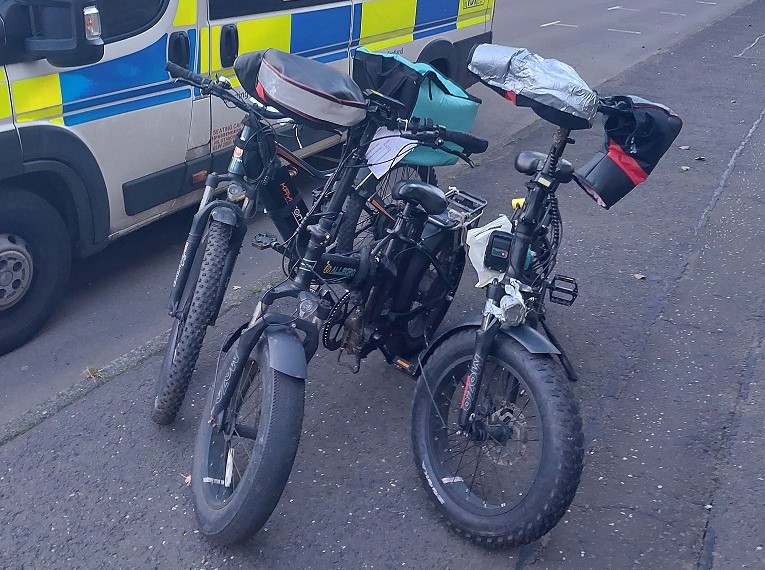

He jumps up, shaken but unfortunately not hurt, adjusts his balaclava, and tries to straighten the bar with desperate haste. People are watching.
“Are you OK?” I shout, with as much concern as I can muster for someone who’s just been the nail to an illegal e-bike hammer. People are watching me, too.
“I’m OK,” he replies, shakily. Then: “Come round the corner, and we’ll sort it out.”
Some of the cockiness is returning to his voice.
He’s wearing the full uniform: an all-black tracksuit and bally to match, and those black trainers the cast of Top Boy favour. I’m not too keen to join him, but I know it’s not really an option.
Sure enough, after I’ve carried my now non-rolling bike a few paces and sheepishly peeped round the hedge, there’s no sign of him. This has been coming for a long time, and I’m just glad it happened to me and not one of my kids.
A bike crash is always loud, and it’s something I’ve never become used to hearing or seeing. I’ve spent most of my life riding mountain bikes and, like most MTBers, have experienced more crashes than I’ve had bikes. And I’ve had a lot of bikes.
I’ve seen and heard quite a few too, and the sound of metal and carbon thumping into the ground is unforgettable. This kid – a teenager he almost certainly was – made a sound like you’d get throwing a TV out of a top-floor window.
In my 40 years of riding, this is the first time I’ve ever been hit by someone else on a bike of any kind. Car? Sure. Pedestrian? Once. But never by a fellow bike rider.
Of course, he wasn’t really a ‘cyclist’ or bike rider in the way you or I might be. And, although there still exists some snobbery about e-bikers – on the road and trails – they’re generally just interested in riding some steep inclines or having a more relaxed commute rather than being idiots. There’s no difference between someone who rides a proper, street legal e-bike and the rider of a non-electric bike.
This guy was different. Technically, it wasn’t actually an e-bike he was riding; it was a modified electric motorbike that could exceed speeds well beyond 15.5mph. He saw me coming, deliberately jumped a red light, and passed as close as possible. Too close – he clipped my back wheel and catapulted 20 feet down the road.
It’s a game of intimidation I’ve increasingly seen played out in the town I live in, with kids on illegal e-bikes increasingly becoming emboldened by the seeming lack of consequences. This time, he lost the round, but I fear they’re winning the game.
I saw them first back in September. They’d meet outside the local shops shortly after school, before suiting up. From what I saw, the next couple of hours were devoted to wheelies through traffic and doing skids on rugby pitches. All mostly innocent, and honestly, something I did as a kid too.
It didn’t last. A few months later, another dad on the school run reported that his kids were chased, and then more local residents reported rude, intimidating and downright dangerous behaviour.
And what of the police? As a community, we’ve been advised to report any sightings in the hope of building a picture of their movements. But I’m not encouraged. When I reported my hit-and-run, the police told me they would “keep a lookout for him”, and that was that. Would a hit-and-run by a car driver on a pedestrian have been treated in the same way? This is more than just anti-social behaviour; these are serious traffic crimes.
Illegal e-bikes have created an unregulated parallel mobility market, where regular, legal scooters and motorbikes are being replaced by illegal e-bikes – registrations of new L1 mopeds have fallen by more than 40% since 2022, according to the Motorcycle Industry Association (MCIA).
Time could soon be up for illegal e-bikes, though. The Electrically Assisted Pedal Cycles (EAPC) Bill is lumbering its way through Parliament, and its purpose is to ban the supply of e-bikes that exceed the 250W of continuous power threshold and 15.5 mph speed limit that defines them.
It’s a divisive issue for cyclists, and me personally. My e-bike delivers over 700W of peak power, and while its continuous power is rated at 200W, we all know this is really just a fudge. Can I really be that critical of others while my wheels are dangerously close to the line? Is it one rule for me and another for them? I can reconcile the two with the old trail user advice from Cycling UK that advised us to ‘be nice, say hi’. I think then, that I’m on the right side of the line.















18 thoughts on “I was hit by an illegal e-biker who ran a red light. Tougher regulation can’t come soon enough”
Presumably your bike has the legal restriction to 25 km/h, in which case you’re not dangerously close to the line at all, it’s the high speed achievable by illegal electric motorcycles (there is a plague of them at the moment in my area of London that, I would estimate, are capable of at least 45 mph) that’s causing the collisions, the actual power is fairly irrelevant.
I agree there’s a clear legal line * but I do see something here. Like much tech it’s entirely opaque from the outside (without even invoking things like the VW emissions cheating).**
I know in NL they have trialled semi-portable “test stations” to check max motor speeds. However with the latest “but there’s no money” crisis I can’t see that over here. Indeed it’s hard to see the police being motivated to do any more roads policing, with this even further down the priority list. Hope I’m wrong…
While I guess many of us *would* be fine with EAPCs as a means to attract “non-cyclists” … perhaps there’s an “attractive nuisance” element to this? We’re ushering people into an apparently effortless, easy and minimal consequence mobility mode without the “learning experience” of managing a lighter, unpowered machine on roads.
And it’s still (busy) *roads* where the new power-assisted riders will often find themselves. Not like in more advanced countries where people usually cycle in much safer and more controlled environments.
OTOH we should always balance such concerns against “but cars and full-power ICE motorbikes now” though! Number plates, licences and insurance aren’t necessarily mitigating that well…
* As soon as there are laws games will be played. How long can you be above the “continuous rate power” for? Can we have *multiple* legal motors on one machine?
** Is the power / speed actually regulated by software, and how long will that keep a child armed with the internet from unlocking it?
We have enough regulation. They’re running a motorbike without insurance/registration and possibly without a licence, and the punishment for being caught with all that is pretty severe already. The problem is lack of enforcement.
Chrisonabike
There are a number of police forces in England and Wales that are using portable testing equipment already… How effective it is another matter, I haven’t looked into the results of failing (I would hope they just seize and crush the motorbike without any faff but I am sure there are appeal processes, promises not to use them on public roads etc).
I think everybody (media, Cyclists and the general public) should stop calling these things E-bikes! They are as you say illegal electric motorbikes. Easy to spot the difference between a genuine E-bike, if they are on a flat road or going uphill and are moving without the pedals going round it’s not classed as a cycle.
“We have enough regulation.”
I agree with the exception being legally allowed to sell something which is virtually illegal to use. How many purchasers own a suitably large piece of private land?
Ds2025: where they are going wrong is that they are crushing the motorbike rather than the person sat on top of it.
If they did the latter this issue would be solved in less than 24 hours.
The EAPC Bill is welcome, but full of holes. What’s to stop an overpowered but temporarily limited e-bike being sold and subsequently delimited? This is often a trivial process.
This has nothing to do with the type of bike – it’s the type of behaviour that’s the problem.
Banning the sale of such bikes will not curtail the behaviour. They’ll just find another type of vehicle and continue to drive dangerously as there’s such a lack of enforcement.
I’d sooner see them ban the bally. But really, all that’s required is an improvement to roads policing.
“All that’s required is an to roads policing” – that’s a big all…
Although no doubt the “idiots just keep coming” aspect does apply:
https://www.bbc.co.uk/news/articles/cz9lel2wz93o
“Man charged after car crashes through bowling alley” – luckily they only skittled over skittles.
Of course it will help. Theres a reason these are so widespread, they are cheap and east to get hold of. Oiks have always been bashing about on either scooters, dirtbikes etc but these are far more expensive, heavy and unwieldy along with requiring trickier storage than illegal ebikes. There is a reason this has only become more of an issue since cheap, powerful ebikes have become so available.
Adding regulations on the sale of e-bikes simply adds to the enforcement requirement. Meanwhile, increasing (or starting) traffic policing also works to catch a lot of criminal/distracted drivers as well as finding cloned plates etc. If police catch and confiscate a lot of illegal e-motorbikes, then people are going to be less confident of riding them on the roads – it’s the current situation of next to no enforcement that creates the environment where people can get away with dangerous riding/driving.
To be honest, the bigger problem is still drivers and congestion, so illegal e-motorbikes can be seen as harm reduction, despite the collisions.
@mctrials23 I agree, these illegal electric motorcycles have considerable advantages for the ne’er-do-well over there more traditional weapon of two-stroke dirt bikes, as you say, easier to store, you could get one up to a flat in a high-rise building easily which you couldn’t do with a petrol-powered motorcycle, easy and much cheaper to fuel from any home power socket, no going down the petrol station and risking being caught, way less maintenance, if you can look after a pushbike you can look after one of these, and they are even silent so you can smash them around the woods and recreation grounds without people calling the police having heard the noise. Personally I would say a ban on sales of full-on electric motorcycles like Surrons to anyone who can’t provide justification for use, e.g. farmers and other people who demonstrably have enough private land to use them, would be perfectly appropriate.
“I know in NL they have trialled semi-portable “test stations” to check max motor speeds.”
Worth noting, the dutch police have long had dynos to test mopeds for power/speed limits. Maybe generally kept at the station usually. But the newer portable ones do not look very different from the one my own moped got tested on at a station in the 90s.
What “tougher regulation”? The clue is in the name: these things are illegal (and, I agree, an absolute menace).
I mean, they could probably just only sell them to people with legitimate licenses for the ebike they are selling them. ie. they have passed their motorbike test. Worrying about private land proof etc just sounds like a nightmare and a huge amount of work. People would be saying “oh yeah, this ebike is just to ride at my local dirt bike track”.
Link the purchase to the buyers license and if they want to sell it, they have to sell it to another licensed rider.
I think the core issue is perhaps the delivery riders however. I see a tiny proportion of them with what I would think is a legal ebike. Most of them are going way over 15.5mph and many of them don’t even have to pedal to work them.
The problem with testing is it would be trivial to have someone, perhaps an ex-Volkswagen engineer, create a “test mode” which could be easily engaged, and stealthy.
@ hawkinspeter you are absolutely right. But of course there is little enforcement, the police don’t have the resources etc etc.