



This year’s Paris-Roubaix was a thrilling spectacle over two days. On Saturday, we saw Canadian Alison Jackson (EF Education-TIBCO-SVB) make history as the first-ever North American to win Paris-Roubaix Femmes. On Sunday, the men raced over the cobbles faster than ever before, with the winner Mathieu Van der Poel (Alpecin-Deceuninck) averaging nearly 48km/h over the 256km route. But what made the races so quick?
There’s no question that the strong legs, good weather and race tactics can be attributed to some of the astonishing performances at this year’s Paris-Roubaix, but at no other race has equipment played such a big part in years gone by… and a bit of luck, of course, because you can do well just managing to stay upright on your bike at Paris-Roubaix.
Because of the demanding cobbled sectors, bike choices are also more varied. Before the race, our bets might be on the ones that offer more dampening – the likes of the Specialized Roubaix and Trek Domane – but then, those are not the bikes we see on the podiums…
Which bikes did the winners use?

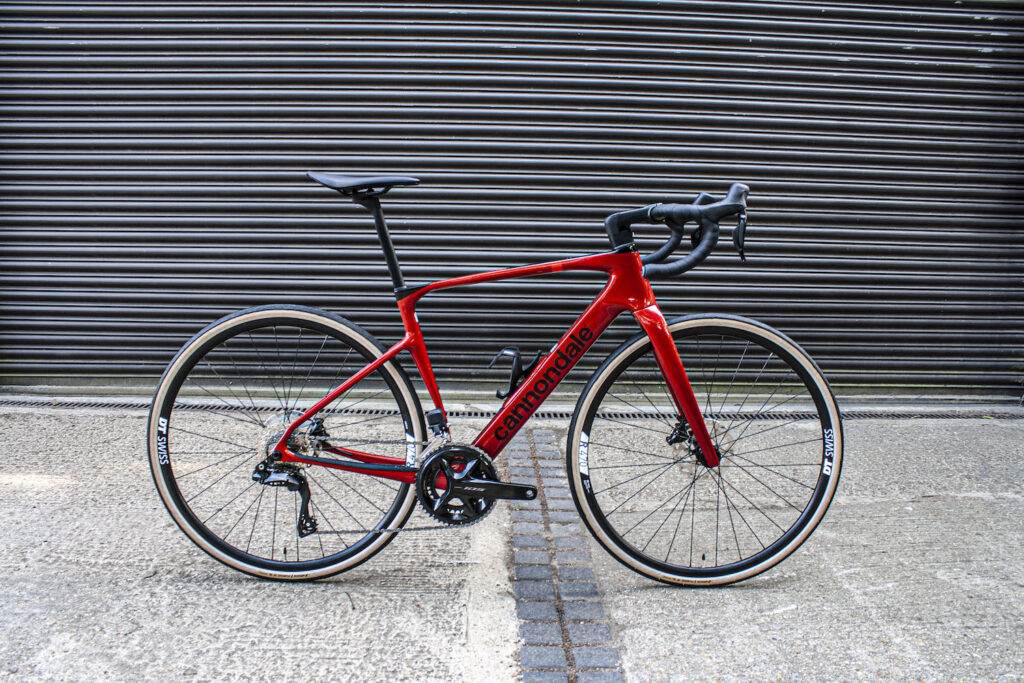
Alison Jackson sprinted to victory at Paris-Roubaix Femmes on an aero-optimised Cannondale SuperSix Evo 4 Lab71. Following Jackson were Katia Ragusa (LIV Racing TeqFind) on a Liv Langma – a climbing bike – and Marthe Truyen (Fenix-Deceuninck) on a Canyon Aeroad.

The very same Canyon Aeroad powered Van der Poel to win the men’s race on Sunday. He was followed by teammate Jasper Philipsen and Jumbo Visma’s Wout van Aert on his Cervelo Soloist. Trek-Segafredo, a team that has a very strong reputation for excelling at Paris-Roubaix, equipped their men’s team with the Madone aero bike, and the women with the IsoSpeed-infused Domane.

For mere mortals, it’d make sense to opt for comfort over aerodynamics when riding the cobbles, but perhaps with the average speeds that we witnessed this year, and with cobbles still only accounting for just over 20% of the race, an aero bike could offer a more competitive edge overall. We did see plenty of the Specialized Roubaix at this year’s men’s race, although none of the riders on that bike actually made the top 20.
It does seem as if aerodynamics are becoming the leading driver for conquering the cobbles. Last year’s men’s race was won by Dylan van Baarle on a Pinarello Dogma F, and the year before it was Sonny Colbrelli on a Merida Reacto Team-E. Both bikes are designed primarily for speed rather than damping.
Did the tyre-pressure adjusting hubs deliver?

On Sunday we saw what the harsh cobbles can do when Derek Gee’s (Israel – Premier Tech) front tyre popped off in front of our eyes – something that brought up memories of what happened to Christophe Laporte’s (Jumbo-Visma) wheel at Paris- Roubaix 2022.
Tyre pressures and tyres are core to succeeding at the brutal Hell of the North, and hence most of the advanced tech is visible there. We already had a look at some of the tech that made its debut for Sunday’s Paris-Roubaix – specifically the Scope Atmoz hubs – and now or never would be the time to check how the riders trialling the tyre pressure system fared, essentially giving them the ability to play with the psi in their tyres while riding.
The Scope Atmoz hub was used by the men’s Team DSM riders, while the women continued to race without the new tech because of “low supply and [a] different race profile”.
Nils Eekhoff and Pavel Bittner were the two DSM riders to take on the cobbles together with the tyre pressure system; but Bittner’s race ended with a DNF, and Eekhoff placed 86th. According to Scope Atmoz, its system allowed Eekhoff “to increase his tire pressure on the asphalt and make up valuable time in his attempt to catch the head of the race” after he was forced back to the peloton.
John Degenkolb, the leader of DSM, saw himself in a very strong position at the head of the race, but a crash meant that he ultimately finished seventh.

Jumbo-Visma were also testing out their own tyre pressure system, Gravaa KAPS, and one of the test pilots Christophe Laporte secured 10th place.
Wout Van Aert wasn’t using the newest technology, but bagged a third place on the podium after losing the race lead due to a puncture. Overall, the Jumbo-Visma men’s team suffered huge losses in the race with perhaps the most punctures, whereas Alpecin-Fenix secured two podium spots. Both teams used Vittoria tyres.
No more front derailleurs?

Increasingly, we’re also seeing the winning teams racing Paris-Roubaix with a 1x setup, rocking a single, large chainring at the front. This is something we already saw Lizzy Deignan have on her race-winning Domane in 2021.
This year, both Jumbo-Visma and Trek Segafredo were taking advantage of this setup, with Van Aert reportedly riding a 54T chainring with a 10-26 cassette. Pre-race favourite (and last year’s winner) Elisa Longo Borghini had a single 52T chain ring on her Trek Domane.
The reasons for this are two-fold. Paris-Roubaix is a relatively flat course, so there is not so much need for a smaller ring at the front. But even more crucially, using a front derailleur when literally everything is rattling on the cobbles… it’s likely going to end up badly! That’s why we saw many dinner-plate-size single chain rings paired with a chain catcher, minimising the risk of dropping a chain when shifting.
Recent innovations like on-the-fly tyre pressure adjustment and numerous 1x set-up variants mean that while we’re not seeing some of the super-specific modifications in years gone by, Paris-Roubaix bike tech ain’t dead yet and is still evolving.
Aerodynamics and reliability appear to be the main two things that make for a winning recipe on the hellish cobbles in the 2020s, with comfort taking a bit of a back seat (for now). Garnish that with a sprinkle of luck and a lot of watts, this is what appears to be bringing home the best results.
What were your tech takeaways from this year’s Paris-Roubaix races? Let us know in the comments!







14 thoughts on “This year’s Paris-Roubaix was the fastest ever — is it all because of aero bikes?”
I think fatter tyres will
I think fatter tyres will also be a major factor in increased speeds, but for me, the biggest difference is the way the races are being ridden currently.
There is seemingly less ‘professionalism’ in professional cycling these days. By that I mean the stuff that goes on behind the scenes, to control racing in a way that benefits those that have cycling as their profession. i.e. less danger, risk, speed, fatigue etc. MVP said it himself, they were racing like juniors from the start.
Going hell for leather all day every day, makes racing faster.
It’s because the doping
It’s because the doping regimens are better than ever. The heavy unaerodynamic disc brake bikes are overcome by more advanced and doping, along with a UCI that turns a blind eye to it all (TUEs left right and centre) because they know that if they get another scandal like Lance Armstrong, they’ll never recover as a business and all sponsors will abandon the sport permanently.
Feel free to cite your
Feel free to cite your evidence.
Also, I’ll leave this here as a reminder that you can’t even remember which side you’re trolling for half the time:
Reasonable proposition to put
Reasonable proposition to put though… and asking for evidence is a bit disingenuous. I’d like to believe it’s above board but can’t be sure.
Do explain how asking for
Do explain how asking for evidence to support an explosive claim is “disingenuous”.
Also, let’s be clear: he wasn’t putting it through as a “proposition” but as a definitive assertion.
The speed of the peloton
The speed of the peloton dropped after the major EPOs busts in 00s. But then started to rise and rise again and exceed the heavy-doping era – and that was /before/ aero frames and disc brakes.
I think it’d be daft to think “the peloton is doping” is the extra-ordinary claim. The opposite is the case.
What point are you trying to
What point are you trying to make Lookahead? Chuck’s latest post said that discs were unaerodynamic and heavy but the post you suggest contradicts this makes no reference to either of those factors. As for doping evidence I think that if you knew anything about the Lance Armstrong scandal he refers to you would know that providing evidence is difficult and can take a long time to collect
Welsh boy wrote:
Indeed, even if the doping claim is true (and it may be), proving it would be difficult. But “it would be difficult to prove X” doesn’t mean “and therefore X is true” or “and therefore no evidence is needed when definitively asserting X”. So what is your point?
You’re putting words in my mouth; I didn’t say the screenshot directly contradicted the claims in his current comment. I’m just pointing out that Chuck is an obnoxious troll who pretends to be a principled sage but actually just likes to swim upstream for the lulz.
I assume Laporte lost his
I assume Laporte lost his variable tyre pressure system when he got a new wheel after puncturing?
Did they have a tailwind?
Did they have a tailwind?
By the way from the pictures
By the way from the pictures and according to his Strava Van Aert was on a Cervelo Soloist all round bike not the Caledonia 5
Bikeradar also reported that
Bikeradar also reported that it was a Soloist
Nope. Tailwind plus
Nope. Tailwind plus aggressive racing from a long way out.
lesterama wrote:
Plus dry, plus (as mentioned last week) tubeless tyres for the vast majority, with Zipp’s research on the Arenberg showing tubeless offering a 45W saving over tubulars for the same speed.