


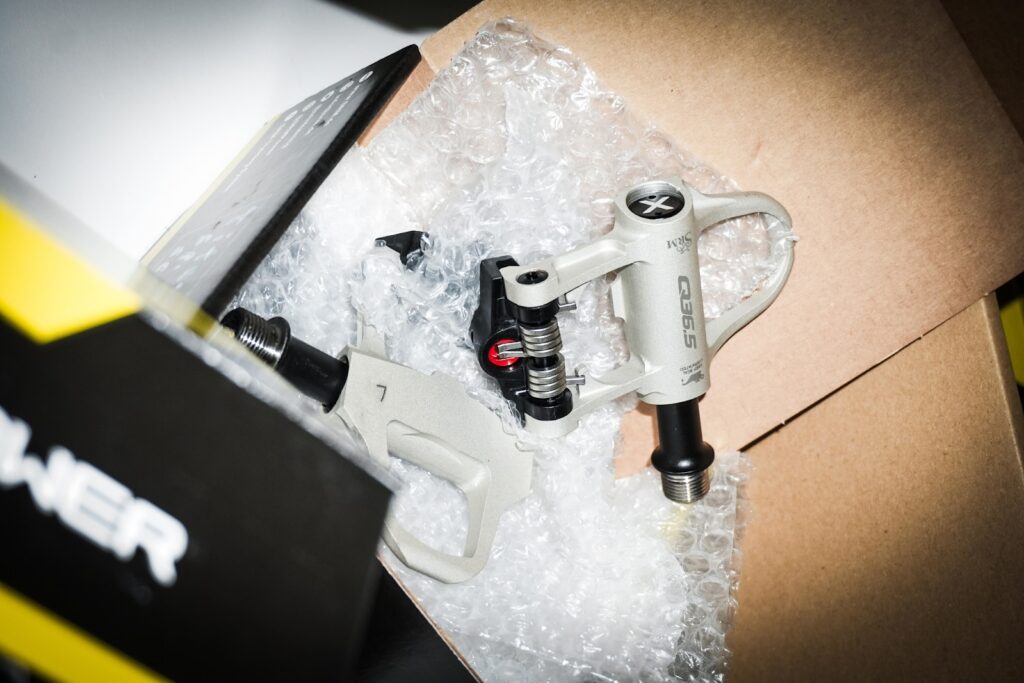

Italian cycle clothing brand Q36.5 is set to move into new territory with the introduction of a pedal and shoe developed with SRM, which “offers the most direct and efficient power transfer on the market”. The new system “reduces pedalling stack height by over 8mm relative to existing systems”, although, despite SRM’s involvement, there’s no power measuring capability.
Pedal stack height is the distance from the centre of the pedal axle to the surface where your cleat contacts the pedal. Above that, there’s the stack height from the bottom of the cleat to your foot – determined by the thickness of the cleat and the sole of your shoe.
What’s the importance of stack height? It’s often argued that a low pedal/shoe stack height increases efficiency and improves stability. It also allows you to drop the saddle a little for lower drag, although we’re talking millimetres here.
The project was apparently begun through a late-night conversation between Q36.5 founder Luigi Bergamo and Ulrich Schoberer, founder of SRM and inventor of its power meter.
Bergamo says that he discovered the performance advantages of reducing pedal stack height during testing, achieved through the use of an ultra-thin sole and “the re-engineering of cleat attachment components”.
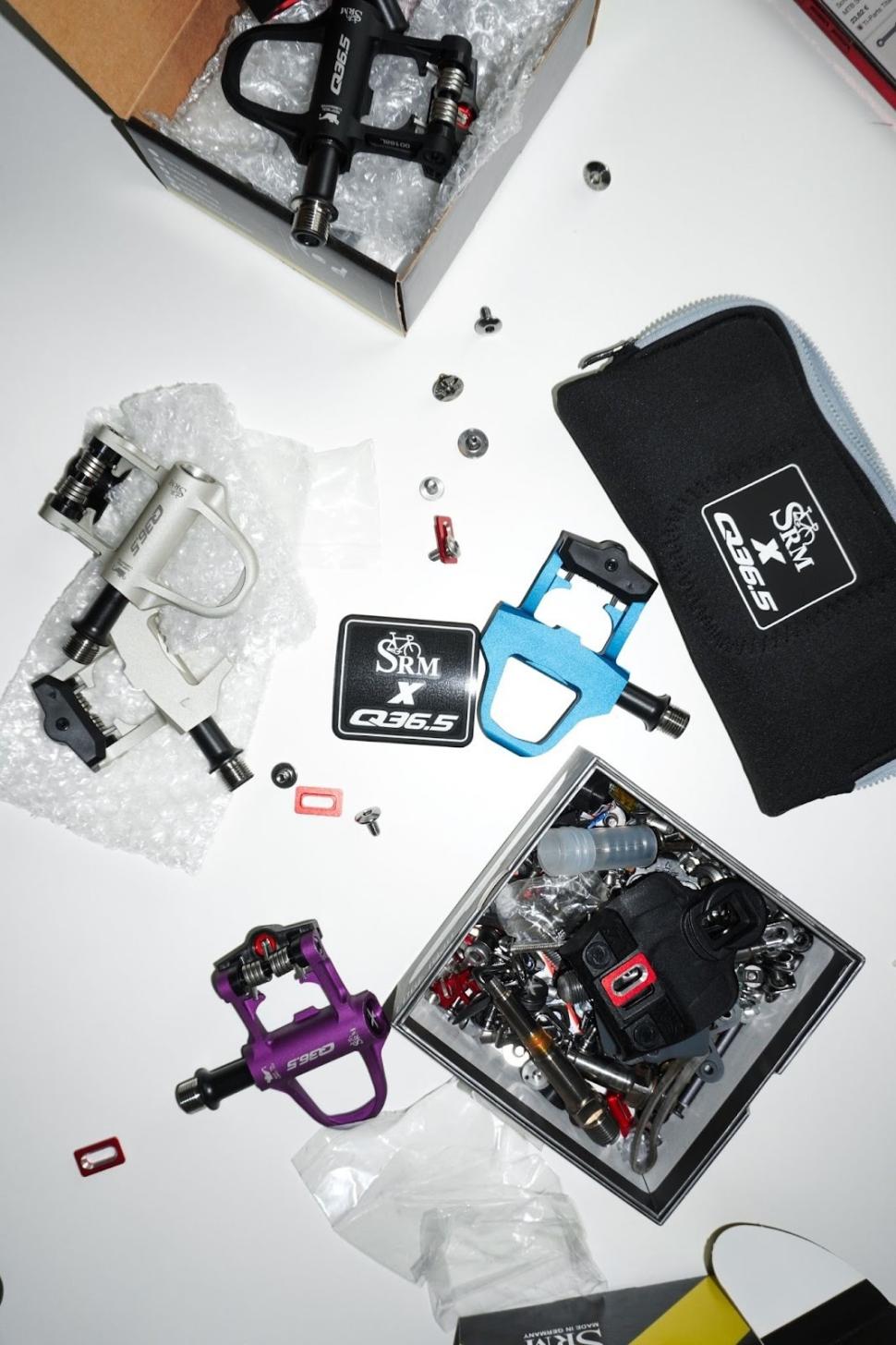
He asked SRM’s Schoberer, who has a history of tweaking existing pedal designs, whether it would be possible to design a pedal that reduced stack height even further.
Q36.5 says, “Other manufacturers – with the notable exception of Speedplay – were totally ignoring the possible performance gains that could be achieved in this area.”
Schoberer provided Q36.5 with the first working prototype of the product in just over six months.
“Built for riders looking to make an evolutionary leap in pedalling performance and race feel, the new game-changing pedal and shoe system reduces pedalling stack height by over 8mm relative to existing systems, offering the most direct and efficient power transfer on the market,” says SRM.
“The all-new SRM pedal will come in one version, without a power meter, and will be available commercially exclusively with the Q36.5 Unique Pro Shoes, offering a seamless system for unmatched performance.”
The lack of power measurement on pedals developed by SRM might surprise you. Maybe that’ll come along at some stage, who knows?
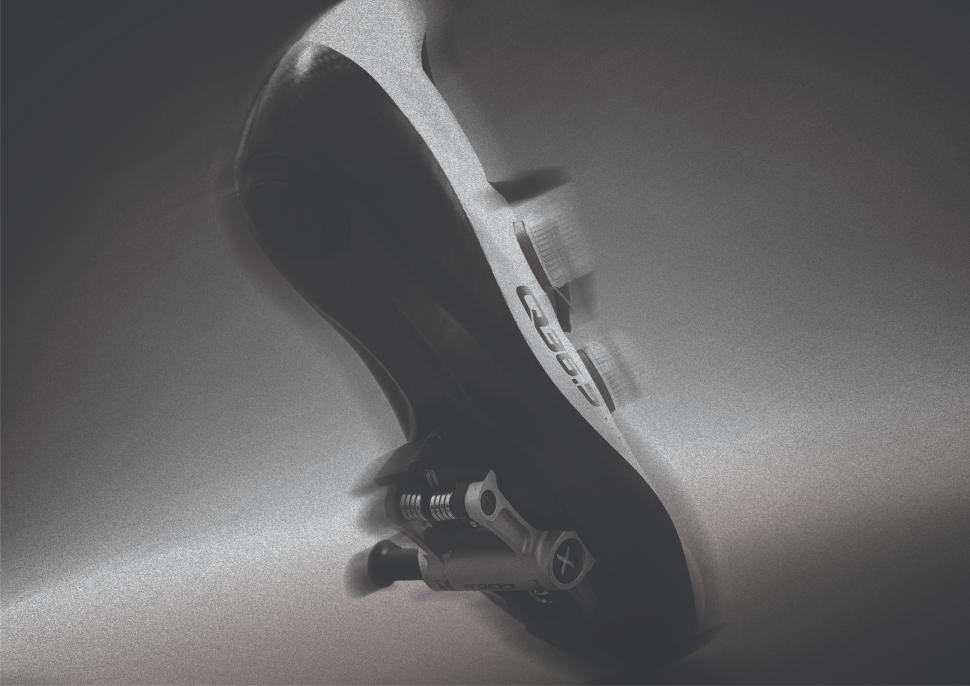
The Q36.5 Unique Pro Shoes? We’ve got no details on those. Or maybe we have, and we’re not allowed to tell you yet. It amounts to the same thing. Prices? It’s the same deal there.
All we’ll say is this: reducing pedalling stack height (the pedal plus the shoe) by 8mm might not sound like a great deal, but proportionately it’s a lot. You can’t achieve that by just using a skinnier pedal axle and slimming down the shoe’s outsole. As Luigi Bergamo mentioned (above), you need to think about “the re-engineering of cleat attachment components”. We’ve already said too much.
When will the new Q36.5/SRM pedal and shoe system be available? You guessed it: we can’t tell you. If you’re interested, stay tuned and we’ll update you as soon as we can.











36 thoughts on ““The most direct and efficient power transfer on the market”: Q36.5 and SRM to launch pedal and shoe combo with ultra-low stack height”
Bring back Dyna Drive for
Bring back Dyna Drive for stack heights lower than the pedal centre!
lesterama wrote:
Given that the foot goes in a circle regardless of stack height, isn’t all of this talk of efficiency just another bit of technobabble to burn on the pyre together with L-shaped cranks?
Unlike PMP cranks, sitting
Unlike PMP cranks, sitting 20mm lower made a huge and positive difference to how a bike felt. But it was never going to catch on unless others adopted the standard.
lesterama wrote:
Not sure what that has to do with efficiency. Actually, I’m being kind. I do know.
No, because the supposed
No, because the supposed efficiency is not from that (the movement the pedals make) but from the fact that that movement is now 80mm lower, so your seat can go 80mm lower, and thus you are more aerodynamic.
Sredlums wrote:
Places head in hand and rocks back and forth slowly.
Interesting that they are so
Interesting that they are so focused on the performance claims of pedal interfacing but not about then measuring power at that point – something I prefer for its ability to transfer onto other bikes easily. I guess it would be foolhardy of SRM to promote a system that would be in direct competition with their major product lines. But now they have sowed the seeds, what is there to stop rival brands taking advantage of this?
I am speculating here, but I
I am speculating here, but I imagine SRM have realised that their system is simply becoming obsolete.
OK, it is precise (and it used to leave their competition far behind), but other than that it only has disadvantages. It’s harder to move between bikes, uber-expensive to adjust to different gear ratios (which is a must for the target market, which is pros and serious amateurs) and super expensive.
Back in the day the crankset was the only place to hide a device as big as PM, so it was a necessity. But nowadays, who would voluntarily go down that road? They can’t pretend forever they’re the only company making proper PM’s, everybody sees competiion is not lagging behind anymore.
Considering that, SRM simply know very well their days would be over if they hadn’t transferred their expertise to a new area.
On the contrary, the pros
On the contrary, the pros and their teams will always prefer crank based since its less likely to be damaged in a crash. PM pedals are great but they are very vulnerable. I wouldnt race with them.
Smoggysteve wrote:
I’d be impressed to see you racing without pedals.
I great downhill on a balance
Im great downhill on a balance bike ill have you know, stopping isnt easy mind
tomlew wrote:
Yes, pedals is a new-ish area for SRM, but bear in mind these particular pedals don’t have power meters built in, despite them making both pedal and spider based systems.
I think SRM will just remain
I think SRM will just remain as a premium, small scale option. Also there are plenty of people (me included) who would much rather have a crank based system than a pedal one. Cranks are easier to swap between bikes (in previously did this every few days between my TT bike and road racing bike, took well under a minute), more reliable and most importantly gives you more control over the import biomechanical aspects of the shoe-pedal interface.
Sorry, but that’s just not
Sorry, but that’s just not true. Pedals will fit on any bike of any type of any age.
a crank based meter is still restricted to the group set type. If you have a sram chainset meter it’s not easily portable to another bike what may have shimano or Campag. The bottom bracket would need swapping too for a start. Then there is the issue with gear compatibility. If you have lots of bikes all with the same system that’s one thing. I have a bike with sram rival and another with dura ace. They ain’t in any way shape of form compatible without a fiddle about with other components.
Actually, there are a number
Actually, there are a number of pedal fitting standards that have been used other then the currrent – e..g A French std used on Peuguots with French components. Nothing modern and metric will fit those chainsets. I think there were some limited Look Delta pedals for it, but nothing new. The French standard was IIRC, 14mm, slightly smaller than the “std” 9/16″ which is just enough larger to make you swear.
Yes, I got caught by that
Yes, I got caught by that idiotic French std…
Bigfoz wrote:
Many a young man used to come back from a weekend in Paris saying the same thing…
Well let’s say – Anything
Well let’s say – Anything sold in the UK in the last 20 years that can be classed as an adults bicycle. That would cover 99.9% of anything that people would be looking at putting a power meter on and many that they wouldn’t.
webbierwrex wrote:
So you used the same gear ratio on your road bike and TT bike? What’s the point of a TT bike if you can’t go faster then?
This example only shows how poor a choce a crank-based PM is – you sacrifice the right gear ratio for the use of PM, which would’ve never happened with a pedal-based system.
There are plenty of options
There are plenty of options for cranks which are separate components to the chainrings, and so it’s perfectly possible to swap cranks between bikes with different gear ratios.
Not saying I agree it’s the best solution, but just your particular objection is fallacious.
OnYerBike wrote:
I never said it was impossible. But you must admit it is more problematic than just moving a pair of pedals between bikes.
Look ? #ohno
Look ? #ohno
someone should adapt the
someone should adapt the cannondale lefty fork design to put a pedal axle perfectly in-line with the first metatarsophalangeal joint – for a true zero stack height. if it (lefty fork axle) can handle the forces of front wheel use then pedalling forces should be trivial in comparison
someone should adapt the
someone should adapt the cannondale lefty fork design … into the bin
Because it’s one of the stupidest fashion statements in the history of cycling
It isn’t.
It isn’t.
Your mind just has trouble grasping the notion that such a system can be strong enough, because it feels unlogical, and because it’s uncommon, so ‘it must be bad if no one else is doing it’.
But all cars, trucks, busses, caterpillars etc. have one sided setups, from F1 to the heaviest of machinery. Also many motorcysles have it, and have had it for years.
There’s advantages and disadvantages to everything, but Cannondale (and the results of their racers) have been proving it’s a viable system for decades now.
Sredlums wrote:
Which does not mean that it is the optimal solution.
A system supposed to transfer vertical loads, but supported on just one side, is never as strong for the same weight as a system supported on both/all sides. If that was not the case, houses would only have their foundations along one wall and hang above the ground on the other sides.
But in their case it is a necessity, not the optimal choice.
A car wheel cannot have an outside support strut as it would interfere with its handling and dimensions as well as with clearance from other vehicles. Also it would make changing a wheel a nightmare. Structurally this kind of solution is far from optimal.
Just because you can make it does not mean it is the optimal choice.
tomlew wrote:
And what exactly does it
And what exactly does it prove? Clearly it only proves the “can be done” statement, with no hint of optimality.
Who said it proved anything?
Who said it proved anything? It’s just a picture I thought some people might like.
Here’s some more for everyone to enjoy.
In your responses to me you
In your responses to me you keep talking about it not being ‘the optimal choice’, and that’s fine, but I never claimed it is.
What I said was two things: the system has long proven itself, and the concept is widely used in other vehicles.
You say ‘Structurally this kind of solution is far from optimal’, but that’s a moot point. Every type of system has it pros and cons. Telescopic forks have several drawbacks, like stiction, torsional deflection, diving when braking etc.
Leftys have alsmost no stiction and are very stiff. They are also pretty light, have proven to be reliable, and are totally race proven.
All that makes calling them a stupid fashion statement kinda silly.
See my comment on Shimano’s
See my comment on Shimano’s Dyna Drive below.
Maybe, but not AS stupid as
Maybe, but not AS stupid as thinking that a ‘one-sided’ system we’re told is suitable for wide, heavy 4+ wheeled or tracked vehicles is therefore reasonable for lightweight vehicles with 2 inline wheels.
Shimano did that in 1980 –
Shimano did that in 1980 – have a look at Shimano Dura Ace AX pedals and cranks. Shimano Dura Ace AX Crankset with Pedals 170mm – Cicli Berlinetta
Quite why we don’t have an equivalent now is surprising, given the usual optimisation trends, but it mainly revolves around practicalities.
For me the most annoying thing about most pedals is that te spindles are very rarely perfectly true and perpendicular to the thread in the crank, even expensive pedals usually describe a slight circle at the end of the spindle outer edge of the pedal when wound in and this contributes to knee injuries. I would not be surprised if Tadej Pogacars knee problem during the tour was as a result of them not replacing a pedal/spindle after his spill the day before the Hautacam stage.
If you understood anything
If you understood anything about bike fitting then everything you suggest would be blown out of the water.
Bikes, cars, busses etc can be engineered to be exact and act in the same predicable way.
human beings cannot.
Smoggysteve wrote:
it would probably be very aero.
Just potentially not
Just potentially not particulary confortable