


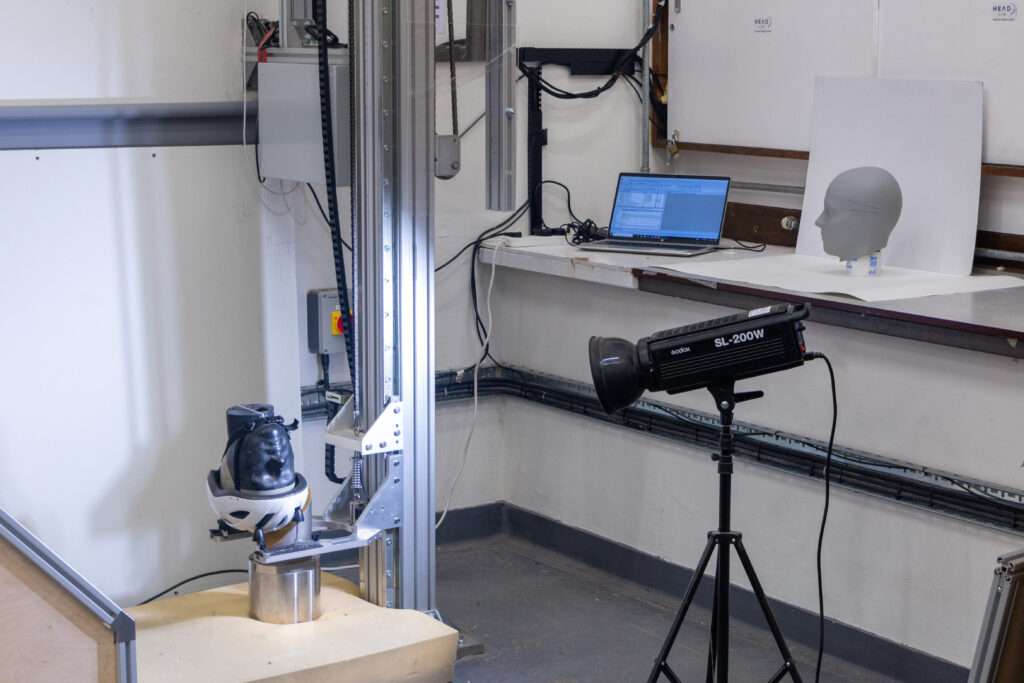

In a study funded by the Road Safety Trust and Innovate UK, researchers from Imperial College London have developed a new cycling helmet safety rating system called ‘Hiper’ (helmet impact protection effectiveness rating) to help consumers decide which helmet might be best for them based on how much impact protection it provides.
The new safety rating system uses scores between 0 for lower protection to 5 for the best performing helmets. 30 of the “most popular adult helmets on the market” were tested in a lab, and the results show that a higher price does not necessarily mean a higher-performing helmet in terms of protection alone.
Why are bike helmets tested for safety?
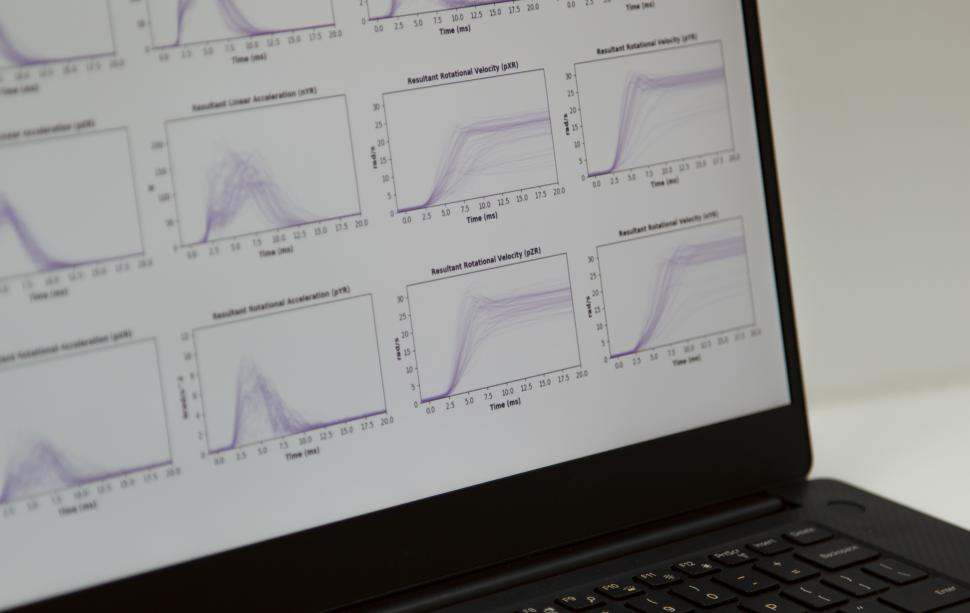
In the UK and Europe, helmets have to be be tested to the minimum safety standard of EN1078. This specifies certain tests and requirements that helmets must meet before they can be sold, including impact energy criteria, retention system strength tests and more.
But, as researchers have discovered, it is head rotation that is most associated with brain injuries and loss of consciousness. This is something that in-helmet protection systems such as MIPS and Kask’s WG11 aims to reduce, by spreading the absorption of the impact throughout the helmet.
There is already an independent testing facility that provides independent helmet ratings in the US, at Virginia Tech. They use a similar scale of 1-5 for each test the helmets undergo, resulting in an overall star rating between 1 and 5 so consumers can understand the relative safety the helmet may offer.
What does HIPER show?
> All you need to know about MIPS
An interesting point this new research has shown is that paying more for a helmet doesn’t necessarily mean better impact protection, and in some cases you may get less. That may not surprise some cyclists, who may be just as motivated to invest in a helmet for its claimed aerodynamic performance, aesthetics or lightweight construction, but it’s information worth considering before you buy.
Dr Claire Baker, the lead author on the study said: “Interestingly, we found no correlation between price and protection, with the highest-performing helmet being one of the less expensive, retailing at around £50. Our new ratings give consumers objective, evidence-based data to support their buying decisions.”
The overall risk of head rotation and the chance of injury was calculated as an “average of the linear and rotational risk”, with the hope that this offers some weight in real-world experiences.
Dr Mazdak Ghajari, senior author on the research added, “Thanks to funding from the Road Safety Trust, our research can now help consumers to make an informed choice when they buy a helmet. We believe these ratings will lead to further improvements in helmet designs, providing better protection against a range of head and brain injuries if a cyclist is involved in a fall or collision.”
So should you buy a cheaper helmet?
It’s important to remember that this is a small sample size of just 30 helmets on the market today. The researchers have also only tested size mediums in each, so we should perhaps take the results with a pinch of salt until further research has been done. I
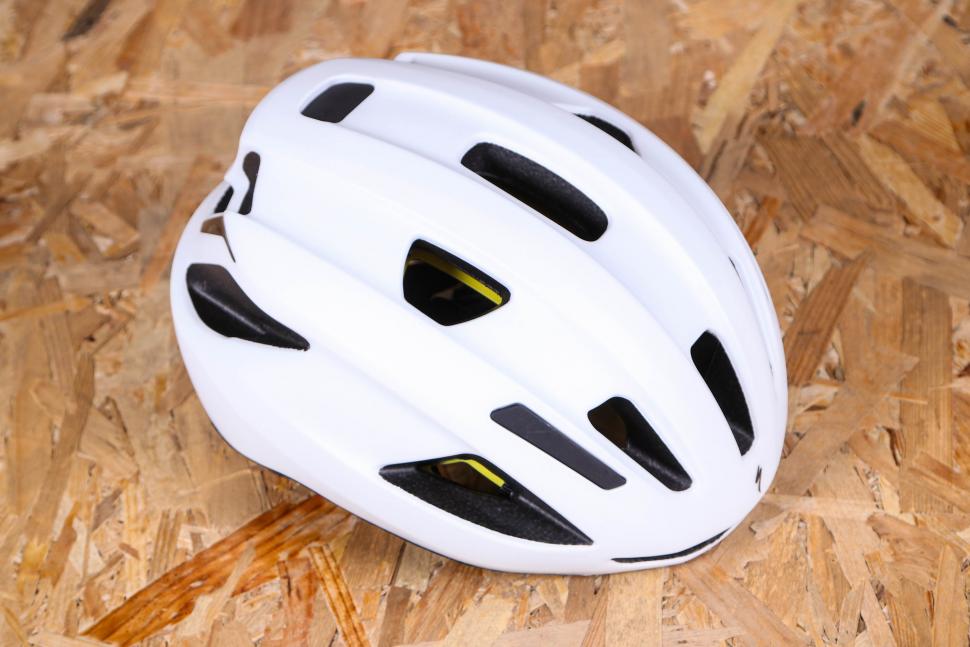
That being said, which road helmet that came out on top? None other than the Specialized Align MIPS, which retails at £45. Interestingly, this helmet was also recommended back in 2021 by the Research Institutes of Sweden (RISE) in research also funded by the Road Safety Trust.
And the best performing helmet overall? Another win for Specialized, with its Tactic MIPS mountain bike helmet picking up a score of 4.84/5. And the worst performing road helmet? The Lazer Compact, with a score of just 1.34/5.
You can have a look through all the helmets yourself, and each page offers insight into why each rating was given, including videos of some of the tests as well.
Will this rating become universal?
It’s too early to tell at the moment, but the researchers have been given three more years of funding from the Road Safety Trust so that the team can “apply their testing and rating techniques to children’s helmets as well as continuing to test the wide range of adult helmets available to buy”.
Although it’s early days, Hiper could be a pretty useful tool for people who value this type of information when buying a helmet. You can check it out for yourself on the Hiper Helmets website.


58 thoughts on “Are cheaper cycling helmets better than expensive ones? New test and rating system from Imperial College London ranks £45 Specialized lid as safest”
Illustrating that helmets,
Illustrating that helmets, like so many other cycling items, are rarely bought (or sold) to meet a function but rather to meet a fashion.
Put another way, buyers tend to the ignorant when making buying decisions, prefering the glamour to the actual performance. Of course, it’s difficult to differentiate glamour from performance when things are described only by adverts (including the faux-reviews here) rather than by any sort of objective or disinterested investigation.
Still, Road.CC has reported this particular testing approach so +1 to journalism rather than advert-proxyism, for a change. 🙂
It’s great to have this
It’s great to have this simple, useful research on helmets.
But we shouldn’t forget that helmets are also bought for comfort, for cooling (or sometimes, warming), for insect protection, for aerodynamics (hard to assess!), for visibility, for low weight, for storing goggles and, often enough, style. For a product, that is probably (and hopefully) never needed, these criteria are also important and may well compensate a slightly lower safety rating.
anke2 wrote:
Especially when you consider that most of the time, helmets aren’t doing their protection job (unless you’re falling off a LOT).
Are they not?
Edit: I wrote the following text after I had misread the message of hawkinspeter (who points out that most of the time, the helmet is not in a crash – which I read as “most of the time, helmets fail to protect”). My mistake – sorry, hawkinspeter.
Are they not?
There’s a strong observer bias: In most cases, where a helmet has protected from worse injury or major harm, only the wearer will ever know. The successful “work” by the helmet will not show in any statistics. You fall but you don’t bost about your clumsiness or close call. You don’t go to the police, you don’t inform the insurance companies, you don’t post on (anti-)social media. You just go on with your life – and the poor little helmet will never get much credit.
Obviously, a bicycle helmet cannot protect from a fast car on the opposite lane – but even a car cannot.
No, they are not. Because
No, they are not. Because most of the time you are out on your ride, your head is not constantly smacking off large solid objects.
They are, what is known in the safety industry as, a low demand protection system. Therefore they spend nearly all of their time doing nothing, trying to be as unobtrusive as possible.
The more comfortable, cooler, less draggy, the more likely they are going to be present when required.
You also seem to have misinterpreted people’s comments in other parts of this discussion on the hierarchy of protections. Being PPE, it should be the last thought when it comes to improving safety, therefore removing the most common hazards that make people crash before mitigating the severity of those collisions.
I can’t tell if you’re actively trolling, playing devil’s advocate, or just misguided in the logic of your arguments.
I think they’ve missed a side
I think they’ve missed a side of the “observer bias” – which is it is far from a given that “where a helmet has protected from worse injury or major harm, only the wearer will ever know”.
I’d say mostly the wearer cannot know if a helmet has protected from very much at all – unless one is riding around with accellerometers on one’s bonce and can go back and model the dynamics of the collision etc. However I think it’s very likely the wearer emerges with the impression that the helmet deserves a lot of credit. That is apparently sometimes even reinforced by the medical profession (“the doctor said I’d be dead if not for…”). Medics will likely be experts at knowing what could have happened injury-wise, but not the chance of it having happened in a particular case with vs. without helmet (again without those accellerometers).
I think it’s the salience of the catastrophic potential of head injuries which skews things here. Given the terrible things which – while very unlikely – could happen, surely we should do almost anything that might guard against that? Particularly if it isn’t particularly onerous.
OTOH the more you examine that the more conflicts appear. In fact few people have researched exactly what’s best to protect us – nor do most “do our utmost” in this regard. People provide cycle helmets, we see cyclists wearing them, ergo we put one on. We don’t wear mostly full-face MTB helmets on the roads, never mind motorcycle helmets (obviously they come with down sides but the level of protection is much higher). Most people are happy riding upright bikes whereas a recumbent potentially offers benefits in terms of lower head height and having your legs to absorb impacts in front. Or – given that quite a lot of injury is just “falling off” – especially as we age – perhaps a step-through design or even a tricycle would be safer etc.
However I think it’s fair to point out that while they do nothing to reduce the chance of a crash *, once you’ve put one on (assuming correct fitting etc) it should do at least what it is rated to do. That’s with no further thought or effort (barring sweat-removal) from the wearer – like safety footwear.
* As far as I’m aware – there could be other effects (risk compensation, or certain drivers aiming for the racers etc.) so we should always check…
If you mean by “most of the
If you mean by “most of the time, helmets aren’t doing their protection job” that “most of the time, the helmet is not involved in a crash”, I certainly agree. If, however, you mean that “during most crashes, helmets aren’t doing their protection job”, then I do object.
Regarding helmets compared to other PPE: I would certainly assume that most people have good breaks, reliable handlebars, cranks, forks and frames, that they use a light at night (or with poor light, e.g. riding into the sunset), are capable of turning to see behind, don’t wear dark (low viz) clothing (unless compensated by good lights) and have learned to predict dangerous behaviour by other road (and bike-lane) users. And then, a helmet seems to be the next good thing to add. Not necessarily for the 300m to the bakery, but for the daily commute (2x25km a day in my case) between cities, for leisure, for racing, for exercise, … (or when starting to use clipless pedals 😉
If you think that’s actively trolling, feel free to.
EDIT: i (ROOTminus1), I’m sorry – I had misread hawkinspeters message – my response must have made you think I was trolling. No, I was not – but it might have seemed that way after I had misunderstood his message.
anke2 wrote:
If anyone is subject to observer bias, it’s the wearer, and confirmation bias too, so they know very little, if anything.
— anke2Absurd. If helmets were effective it would definitely show up in death statistics. In Australia, where the wearing rate more than doubled overnight, there was no corresponding death rate reduction, if anything, it went up.
I appreciate your very polite
I appreciate your very polite, well informed and case-specific responses.
Would you really expect helmets to be effective in the scenarios where a cyclist is killed? Being run over by a truck? When hitting oncoming traffic head first? When breaking the neck? Bicycle helmets are great for avoiding (serious) injury – but death or paraplegia?
I’m personally fine with protecting my head and brain from (non-lethal) damage – feel free to expose yours to the elements, roads, tree-branches, roots, curbs – you’re well within your rights.
anke2 wrote:
— anke2Yes, because for thirty years helmet zealots told us they did save lives, but since it has irrefutably been shown that they don’t, they’ve shifted to claiming that they prevent serious brain injury, which, entirely coincidentally, is very difficult to prove.
If cycle helmets did prevent serious head injuries, then it would show up in the death statistics, because some cyclists, a small proportion, die solely from a head injury, so it seems unlikely that they do prevent serious head injury.
eburtthebike wrote:
I don’t think that thirty year old, too positive expectations about saving lives should imply that todays expectations on avoiding serious injury must also be wrong.
Indeed, its impossible to prove that helmets prevent brain injury (unless you have twins, doing the same crash with and without helmets), but there is evidence, there are confirmations by models – and there is plain old common sense. There certainly are few arguments against wearing a helmet.
Would the effect of cycle helmets show up in death statistics? Only if you had very good statistics (i.e. a huge number of deaths by brain damage in a country with a huge population) combined with a sudden change (like the introduction of a helmet law). Such statistics would have to show an almost constant number of fatalities before the law and again after the law. As far as I know, fatality numbers are relatively small (fortunately!) and fluctuate heavily from year to year – so, no, a helmet effect is unlikely to be visible in death statistics.
Here again, people can choose if they like to wear a helmet (outside sports events). Advising to wear one won’t cause any damage (apart from the money spent), advising against wearing one, however, may well do.
anke2 wrote:
People banging on about cycle helmets do indeed cause damage as they increase the public perception of the danger of cycling and thus less people cycle which leads to a whole host of sedentary diseases (e.g. heart disease, diabetes etc).
There’s also the problem that public discussion of traffic danger ends up spending far too much time discussing helmets rather than the many better ways of increasing safety. As St Boardman once said, helmets aren’t even in the top ten of things that make cycling safer and yet helmets dominate discussions and thus actual safety improvements are not considered.
I agree with your observation
hawkinspeter, I totally agree with your observation when discussing helmets in the public media – which may make people decide against using a bike (with all the negative consequences) and may distract from the other dangers imposed on cyclists by others (drivers, road developers, dog owners, people leaving cars, …)
But I would not agree when discussing helmets amongst cyclists – and I’m fairly confident we won’t find many non-cyclists here…
anke2 wrote:
Yes – I wouldn’t include comments on Road.cc as harmful as most readers would already have a strong opinion about helmets and their effectiveness. Also, there’s plenty of space and time here for discussion of things such as separated infrastructure, driving standards, junction design etc.
anke2]I don’t think that
Oh, but it does! If people have maintained a position for thirty years when it was demonstrably wrong, why should anyone have any confidence in what they say now? They don’t even admit they were wrong, they just ignore the data that shows it.
[quote=anke2]
Indeed, its impossible to prove that helmets prevent brain injury (unless you have twins, doing the same crash with and without helmets), but there is evidence, there are confirmations by models – and there is plain old common sense. There certainly are few arguments against wearing a helmet.[quote]
According to you, it’s impossible to prove the efficacy of any safety equipment, and then you go on to confirmation by models and the old canard, plain old common sense. Models aren’t real life, and I don’t know about you, but when it comes to picking a winner, I’ll go with real life every time: it’s a bit more reliable than models. As for “plain common sense” that’s just ridiculous.
[quote=anke2]
Would the effect of cycle helmets show up in death statistics? Only if you had very good statistics (i.e. a huge number of deaths by brain damage in a country with a huge population) combined with a sudden change (like the introduction of a helmet law).[quote]
You appear to be new to the great helmet debate, because what you describe is basically what happened in Australia, although why you think you need huge numbers of deaths I don’t understand, unless it’s because you know such evidence doesn’t exist and therefore you clutch at the straw of the actual data showing that you are wrong, so you move the goalposts.
[quote=anke2]
Such statistics would have to show an almost constant number of fatalities before the law and again after the law. As far as I know, fatality numbers are relatively small (fortunately!) and fluctuate heavily from year to year – so, no, a helmet effect is unlikely to be visible in death statistics.[quote]
The data from Australia showed that the death rate of cyclists, within reasonable variation, did not change after the helmet law, and if anything got worse. They fluctuate, but not to the extent you assume. If helmets were effective, there would have been a noticeble effect when the wearing rate doubled overnight.
[quote=anke2]
Here again, people can choose if they like to wear a helmet (outside sports events). Advising to wear one won’t cause any damage (apart from the money spent), advising against wearing one, however, may well do.
— anke2Advising people to wear a helmet does cause damage, in confirming that cycling is a dangerous activity, when it is as safe as many other common activities for which no PPE is required e.g. walking. People are deterred from the activity and lose the overwhelming health benefits (regular cyclists live two years longer than average and suffer less from all forms of morbidity) so they develop chronic, life-changing illnesses and lose many years of active life.
You appear unable to post any evidence that cycle helmets have any benefits, while the disbenefits have been clearly shown.
Eburthebike, I find it
Eburthebike, I find it interesting how you a) seem to only mention disbenefits that will actually not affect the cyclists that are wearing a helmet but only others, b) how you seem to assume that the communiction in this forum could possibly deter people from cycling and c) how you claim that disbenefits of helmets have been shown that seem to outweigh the benefits.
Regarding benefits of helmets, a quick google scholar search may help – there’s a lot of (even open access) material.
https://www.ncbi.nlm.nih.gov/pmc/articles/PMC1332376/pdf/brjsmed00006-0053.pdf
https://www.wiwi.uni-muenster.de/ivm/sites/ivm/files/documents/forschung/diskussionspapiere/workingpaper21final.pdf
https://www.mja.com.au/system/files/issues/205_02/10.5694mja16.00193.pdf
The last article concludes: “In summary, there are reports indicating a decline in cycling based on convenience sampling data following the introduction of helmet legislation in Australia. However, there is also evidence based on better quality data which shows no significant impact on cycling participation.” (Note, however, that this article also argues for primary safety measures. It’s also worth noting that most of these sources seem to argue against helmet legislation.)
Sorry, I had completely
@hawkinspeter: Sorry, I had completely misunderstood your reply – my mistake.
(I had thought you meant that they were not protecting in a crash – but you meant that most of the time, there is no crash.)
It’s still not measuring the
It’s still not measuring the helmet’s primary protective effect, though, which is, how well does it protect you from people complaining about you not wearing a helmet?
mdavidford wrote:
That should be captured in the “noise reduction” score
Yet another metric which
Yet another metric which points to the superior effectiveness of the Great Helm / jousting helmet over modern designs.
And if complaints still reach you, just tilt at them.
mdavidford wrote:
Cheaper and easier simply to tell them to do one, surely? Or just to ignore them? It would never have occurred to me to wear a lid for any reason other than to protect my head in the event of a crash or because the rules said I had to.
john_smith wrote:
Both tend to be somewhat damaging to future relationships.
I’m all for objective testing
I’m all for objective testing of helmets that enables customers to make an informed choice – I’m a big proponent of the VT Helmets website. Yes it’s not perfect, but I see it as a hell of a lot better than no information beyond having passed the basic certification tests.
That said, I have some reservations.
Firstly, is this intended to be different from the VT ratings? The test protocol looks broadly similar, but not quite identical. So far, the results seem broadly consistent (e.g. Specialized Tactic and Specialized Align II also score well on VT) so I’d see them as complementary. It’s frustrating this doesn’t appear to have been considered. I’d have like to see this new study adopt the same methodology as VT and therefore allow scores to be directly compared (Hiper includes various helmets only sold in UK and so unlikely to make it into VT testing). Or else clearly identify why they felt a different testing protocol was required and what the pros/cons are over the VT method.
Secondly, there are currently only 30 helmets listed, which is a small fraction of the helmets available for sale. Sigma Sports alone currently lists 203 different helmets for sale. Given the number of other factors that go into choosing a helmet (appearance, weight, aerodynamics, price, availability etc.), ratings like these only add value if they capture a large part of the market.
Finally, they need to be clear on exactly what helmet they are testing. For example, the Specialized Align is mentioned in the article – is that the original Specialized Align? Or the Specialized Align II? Given the test picture has the MIPS logo on it, I would presume it is in fact the Specialized Align II, as the original did not include MIPS. In other cases, they may have in fact tested an old version – for example they include the Abus Gamechanger, and from the pictures it does appear to be the original rather than the newer Abus Gamechanger 2.0. Details like that need to be clear and correct in order for people to trust the results.
?
?
These super light helmets
These super light helmets would unlikely be that safe as the heavier ones, we all know what bears do in the woods.
IMO Specialized helmets, (just like saddles) they have the best fitting, so this may matter too.
Have lots of copious xxx with
Have lots of copious xxx with bears of the opposite xxx ?
I would imagine fit is very
I would imagine fit is very important in how a helmet performs, but again this introduces another variable into the reliability and applicability of testing like this.
What this says is, if your head is exactly the same size and shape as the model they use, this score is relevant, otherwise who knows?
FWIW I have never found a Specialized helmet that fits me well (same goes for Bell and Giro) whereas I find Kask helmets really comfortable. Does this mean I should switch to a helemt based on this score even though when I have tried them in the past I have always had noticeable pressure points and gaps which I assume are bad things?
I am with you on saddles, although I don’t know what I am going to get when I need a replacement as they have discontinued the Toupe.
Fornicate? Toast marshmallows
Fornicate? Toast marshmallows?
Build MTB trails.
Build MTB trails.
I bought the Align MIPS last
I bought the Align MIPS last year, as my general use lid, and I am really happy with my choice. Although being between sizes I went with the smaller option, which fits nicely but I can’t wear a casquette underneath during inclement weather as my head is on the wide rounded side and the helmet is slightly ovalised in the cradle.
Whilst I may use another helmet in race applications, I will happily use the align for commuting, shopping and social club rides. Good to know I bought wisely.
Matthew Acton-Varian wrote:
If you only “bought wisely” after the fact, what was the basis of your buying before you read this article?
A serious question as it surely matters that buyers of a safety or protection article should be self-aware of what is causing them to buy that article, if not knowledge concerning its primary functional ability to provide added safety or protection.
Another poster mentions “protection from insects” and a number of other buying considerations nothing to do with reducing the force of head-blows. These seem something of another after-the-fact rationalisation as there are far better ways to protect against insects, cold and those other “reasons” for buying than using a cycling helmet.
I don’t assume the word
I don’t assume the word “wisely” was used in its precise meaning, which seems OK in a forum.
Protection against insects: Some helmets feature little nets, to keep flies, bees and wasps out. For (unfortunately) bold people like me, this is a reason to prefer helmets with nets over helmets without – as insects trapped between skull and helmet tend to panic and may sting…
I have one too. I chose it
I have one too. I chose it because it was rated highly by Virginia Tech at least a couple of years ago, and the only one IIRC in their top 10 that was not £silly or hard to find. So I like to think I bought it wisely too.
On the other hand, sweat pools on the forehead pad in a most annoying way. I spend quite a bit of time squeezing it against my head when on longer rides. No doubt the main reason I have 0 KOM.
I had pretty much zero budget
I had pretty much zero budget so my remit was to find what I could for under £50. I wanted visibility (I bought the flouro yellow version), and if possible, MIPS owing to Virginia Tech stating that in their impact reduction tests every MIPS or equivalent tech-equipped helmet out-performed every single one that didn’t. The Align was the only MIPS fitted option at my budget so I went for it. I hadn’t seen any hard data on specific testing of this model, nor some of the others I was considering at the time, so my purchase was based on an educated guess on overall average findings as opposed to exact specifics. Virginia Tech do not quantify their data into a simple-to-understand score as the new HIPER ratings do. I am also surprised it has outperformed its more expensive cousins and I am glad that the results reaffirmed my decision to buy the Align over other similarly priced helmets, or buy a more expensive unit on finance which I wasn’t prepared to do.
Matthew Acton-Varian wrote:
— Matthew Acton-VarianSensible choice IMHO. I bought an Align (pre-MIPS, £35) for my son because it was in the LBS and it fitted him better than the others on display. I knew about various standards a long time ago and knew that it probably had the same degree of protection as a £150 helmet. The CPSC standard was considered more stringent than CE EN1078 (I don’t know if that is still accurate) so I looked for brands with CPSC.
Kask don’t seem too keen to fit MIPS. These road.cc and 2023 CW articles may be relevant for anyone interested in that topic:
https://road.cc/content/feature/kask-wg11-vs-mips-which-cycling-helmet-technology-best-296877
https://www.cyclingweekly.com/products/tech-question-is-mips-the-safest-helmet-impact-technology-available
Kask and MIPS each has its
Kask and MIPS each has its own PR machine. So, I’ve more trust in Virginia Tech testing because it’s independent.
Disappointedly, Kask helmets score low down the protection league in Virginia Tech’s tests. Kask’s latest Elemento—despite costing £335—came a lowly eighty-first among road helmets.
Matthew Acton-Varian wrote:
Important point here. Helmets, like heads, come in different shapes as well as sizes.
Ultimately, I could have
Ultimately, I could have sized up as I have done for gloves, shorts etc which would have eliminated the issue. However as I wasn’t buying in person I was going off reviews stating on how it fits between sizes.
Without a cap, the helmet fits great and the cradle does not dig in. But as I bought the helmet in Spring, by which time I was no longer wearing caps under my helmet, it was several months before I realised the problem I had
“But, as researchers have
“But, as researchers have discovered, it is head rotation that is most associated with brain injuries and loss of consciousness.”
Those researchers must have been slow on the uptake: it’s been known for over fifty years.
To be honest, this kind of secondary safety approach is a distraction, when it is the primary safety we should be aiming for: controlling the source of the danger, not ameliorating the effects.
Helmet laws were brought in with the promise of an 85% drop in cyclists’ deaths, but no such effect was observed, so we should be wary of unsubstantiated claims. While this research claims that the helmets it recommends are safer, unless real world results prove that, it remains speculation.
This post seems slightly off
This post seems slightly off-topic (details below).
– Nobody wrote which researchers discovered the dangers of head rotation or when – if this was 50 years ago, fine.
– Helmets are considered a secondary safety approach? So which primary safety measures would be more effective and efficint? Prohibit cycling for leisure (certainly mountainbiking, BMX, track cycling, road racing) and to encourage everybody to use cars for transport?
– Why are helmet laws relevant if they exist in only very few places in the world? And in which of these places was a claim of 85% reduction made? And why would you just focus on deaths, instead of also considering pain, traumata, minor injuries, need for cosmetic surgery, major injuries, or even lasting brain damage?
Currently looking at a reddit
Currently looking at a reddit thread of someone asking what equipment they should get as a new cyclist.
Its scary how many people rate helmets above bike lights. And pretty much get abusive if you suggest helmets aren’t the top answer – showing how wide the issue of helmets as a distraction from more effective measures.
We have consistent, reproducible research for bike lights reducing accidents, including during the day (n.b. mainly because at some point you will get caught out by bad weather) and especially at night (statistically road riding at night with lights is safer than road riding in the day!).
This benefit applies to all severities of incidents and protects everything (can’t damage bike + body if the collision doesn’t happen) and is achieved with basically any bike light, so cheap £5 sets are enough for safety benefit.
VS cycle helmets that should only reduce head injuries and research on them is inconsistent because other factors outweigh helmets and helmets have a limit in the severity of incidents they can protect against (no helmet will help if crushed by a truck, while a light can prevent you being crushed in the first place…)
The answer is certainly
The answer is certainly lights AND a helmet.
Lights will help with the truck, the helmet with slipping on a root. In busy places with poor visibility, lights are far more important, in calm/safe places with good visibility or off road, at daytime, helmets.
I never understand why some people seem to hate helmets (this is not aimed at qwerty360), even if worn by others. It seems unreasonable and very one-sided – and trying to convince others to not wear a helmet might have tragic results.
anke2 wrote:
Depending on your bike / when and wear you ride / your mobility etc. I’d suggest acquiring things in order of priority: mirrors (if any doubt about your ability to quickly and safely look behind), a suite of reflectives for night (most of your “visibility” to motorists will be via their very effective lights!), lights (may be mostly to see by for your own safety in dark areas, or mostly to be seen – probably by pedestrians as again most of the seeing by drivers will be via their / other drivers lights), helmets.
Helmets are in a different category of PPE to the others. All the other things can help prevent or prepare for collisions – which is a more effective way of avoiding or lessening injury.
OTOH you don’t have to have a collision with another road user to fall off your bike (you don’t even have to be on a bike to fall over and hit your head). And you may not be able to prevent a collision in which case your helmet may be a backup.
Wear what you like say I. In the last decade I might have been best-served by adopting MTB+ body armour when riding my regular hack bike on regular errands – but (reasonably) no-one is advocating for that and I didn’t and picked up a broken bone and some other injuries (not to the head)… perhaps my example suggests rugby and martial arts training (or other “falling practice”) should be suggested to new cyclists as a sensible protection against head injuries (also works off the bike, like a cycling helmet)?
As to “why would anyone say anything against helmets” as someone always says when this comes up this is generally because the vast majority of those proposing are not those wearing and cycling. It’s ultimately “it’s your own fault your teeth were broken when someone punched you in the mouth – you didn’t wear a gumshield”. Because this view is so pervasive a fair proportion of cyclists have also accepted the common wisdom that a) it’s on cyclists to protect themselves from others (not the others to pay more attention) and b) helmets offer far better protection than they actually do – thus not wearing one is somewhere on the scale of “asking to be run over”. Which it’s pretty unlikely a helmet will help, or help much, with.
Of course we can’t personally address individual cases of (a) (we can campaign more generally of course) so in trying to answer “there must be something I do – but what?” the “answer” seems to have become “helmets and hi-vis”.
I’m rather dubious of “trying to convince others to not wear a helmet might have tragic results”. Well … in that case by the same logic trying to convince someone to get on a bike at all (or go for a jog) might have tragic results, surely?
FWIW (it seems the rule is you have to state your own “position”) for years I was “always helmet” but now I wear one less and less. I think it does rather come down to feelings and fashion rather than any “science” (contended) or sober evaluation of probability.
chrisonabike wrote:
Agreed, mirror(s) should be a priority; many riders cannot look behind them without veering into traffic, including me. The Berthoud is expensive but excellent and unobtrusive on drop bars.
Yup! As you note it’s not
Yup! As you note it’s not even “I can’t turn my head” – it has to be something you can do quickly, easily and without e.g. losing your balance / coming off your line!
Wasn’t convinced until I turned to the Dark Side – they make instant sense on most recumbents, even though I can just about see behind without. After a while I realised I missed them on the upright, although ATM it’s probably still evens which is most convenient for me. Haven’t tried helmet- or glasses- mounted ones yet though…
(Aside – quite a few people driving would do well to consider just how mobile their necks are, despite mirrors you do need to be able to move your head).
Possibly some training
Possibly some training instead though.
Quoting: “As to “why would
Quoting: “As to “why would anyone say anything against helmets” as someone always says when this comes up this is generally because the vast majority of those proposing are not those wearing and cycling. … Because this view is so pervasive a fair proportion of cyclists have also accepted the common wisdom that a) it’s on cyclists to protect themselves from others (not the others to pay more attention) and b) helmets offer far better protection than they actually do – thus not wearing one is somewhere on the scale of “asking to be run over”. Which it’s pretty unlikely a helmet will help, or help much, with.”
Well, I know that readers here are unlikely to not be cycling (and probably, unlikely to not wear a helmet). They are also unlikly to blame a cyclist endangered by traffic for not wearing a helmet.
a) Wearing a helmet, I very much protect myself from my own mistakes – slipping on a greasy, wet road surface or on roots, getting stuck in a deep mud puddle or a gap filled with soft tarmac, hitting my head at a low hanging branch of a tree… I’d estimate that I spent 200km a week on paths with no danger from others (gravel roads in forrests, separate bike-paths, very low traffic roads with good visibility, farm roads, single trails) and less than 20km in “dense” urban traffic. Nevertheless, I also use bright lights at daytime, have stuck (almost invisible but effective) reflector tape on all bikes and wheels, obviously maintain the bikes in good technical condition and try to expect stupid, dangerous behaviour from other users of the road/bikelane/path.
b) Knowing that helmets can’t do magic, I still try to be save, and have only had one (inconsequential) fall over the last 25.000km. But should this make me choose to not wear a helmet any longer? (After all, I don’t have any reliable statistics over several sampling periods over 100.000 km for my own, current riding style…)
anke2 wrote:
I’m not (I hope) advising for or against. Just interested to see what people’s reasons are (well – and query some things which seem unlikely).
I’m quite inconsistent in my particular set of “safety” choices. While I could give reasons, if I’m honest I’ve neither really sat down and thought about it nor worked through the literature and stats. Like most people probably it’s feeling, what others do and then habit.
* Added reflective tape or bands to both bikes and self, especially moving things. But… wear hi-vis stuff less now. Lights – all bikes have dynamo ones so essentially no chance of not having, added chargeables for longer / planned night trips. But not running them during the day. Generally don’t wear a helmet now (a change over last decade) – indeed only use it for more “sporty” and social occasions (fewer comments). FWIW i tend to be “always PPE” in non-cycling contexts. Dunno if that makes the best logical sense in terms of my riding (now mostly in busy, visually cluttered urban environments BUT a lot of the time on motor traffic free paths. All of the above pretty well lit).
anke2 wrote:
Find me a single case of someone ‘hate helmets … even if worn by others’.
Its extraordinarily rare if not non-existant.
I have seen plenty of cases of people objecting to being told to wear a helmet.
If you are telling me to wear a helmet because ‘cycling is dangerous’ then you should be wearing one for every activity with a comparable or higher risk profile. Which for a healthy adult and road cycling includes walking, getting dressed, getting out of bed, taking a shower, most other sports, etc… Basically if cycling is dangerous enough to justify a helmet then you should be wearing a helmet unless in bed or doing an activity where the helmet creates its own risk (strangulation by getting caught on something…)
anke2 wrote:
It’s blinkered opinions like this that get people mad. You seem to have assumed that cycle helmets have value in preventing deaths and injuries but the facts do not show that. The topic is repeatedly debated at great length and the pro-helmet people who believe the marketing hype just don’t want to listen to reason.
I’m not anti-helmet per se but after many years of reading the arguments I cannot find any convincing evidence that cycle helmets actually offer the kind of protection many people assume they do.
Feel free to wear one if you wish, I genuinely don’t mind, but for general road riding they are not a way to make cycling safer; as Chris Boardman said, “they are not even in top 10 of things that keep cycling safe.”
https://www.chrisboardman.com/content/if_you_think_helmets.php
£45 is cheap? News to me.
£45 is cheap? News to me.
I thought that since the cheapest are around a tenner, £20 would be about the average.
Premium helmets are going for
Premium helmets are going for £200-300. So on that scale, mid price is about £100-£150.
In fact, the current most expensive road helmet on Merlin Cycles is the Kask Nirvana (the brand new one which half-covers the ears) retails for £320 (currently “on offer” at £310) A Kask TT helmet is £50 cheaper.
Only supermarket brands are selling helmets that cheap now. In-house brands from major bike retailers (Pinnacle, Van Rysel etc) helmets start from £35 nowadays.
I’m sure your prices are true
I’m sure your prices are true. But in terms of the most useful number, maybe the median would be more useful than a simple average of the outliers at either end. Or the modal range (most commonly purchased price band).
Seems to be what the study
Seems to be what the study did – they apparently looked at 30 “most popular” helmets priced between £9.99 and £135.
Still another source of
Still another source of independent testing is https://www.certimoov.com
“each page offers insight
“each page offers insight into why each rating was given”. Well, maybe I have some filter blocking these, because I could not find any insights into the ratings when clicking at some of the helmet pages. Also, to me at least, the videos don’t give any insights into the ratings either – just dummy heads bouncing like I am watching some bizarre powerball video. In other words I dispute the claim about “an overall star rating between 1 and 5 so consumers can understand the relative safety the helmet may offer.” For example, will a 5 star rating really save from some head injury while 1 does not?
The “Our methodology” page
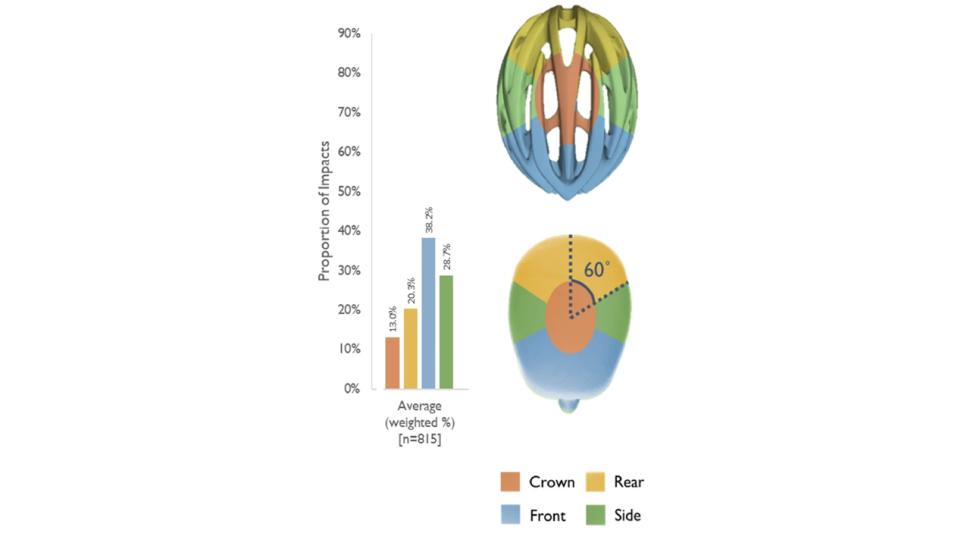
The method is quite interesting, it’s evaluating the severity of injuries found across 90,000 incidents, with the likelihood of impact by zone found from 1800 cases, multiplied by the performance fraction of the helmet in those zones.
My concerns is if the zonal likelihood is tailored to different intended use cases of different helmets.
I also take umbrage with the only real-world datum-ing of the 1-5 scale with 1 being equal to the theoretically worst performing EN 1078 compliant helmet.
By their scaling no helmet would not be 0 as would be intuitive, but would it be a negative number, or a tiny fraction? Can it even be evaluated?
Maybe I’m just being a pedantic nerd and it’s akin to asking an average American what the value of absolute 0 in F?
I can foresee Kask’s PR
I can foresee Kask’s PR department getting busy in response to this….