



Ah, the Friday afternoon press release – the PR equivalent of ‘nothing to see here folks, let’s move on, shall we?’
Because, after a week of at-times ferocious criticism following its decision to introduce a series of revamped tech rules, including controversial new restrictions on handlebar and fork width, the UCI has decided to send out a press release at clocking-off time on Friday… doubling down on its proposed changes. Oh, and with a few diagrams thrown in for good measure.
Last Friday, buried within an interminably long statement detailing its recent management committee meeting in France, cycling’s governing body announced an overhaul of its equipment standards, ostensibly to deal with the “safety implications” of the increasing speed of professional races.
The new rules – most of which are set to come into effect from next January – will see time trial helmets banned in road races, a maximum rim height set, and a new fork width limit introduced, putting Factor’s radical track-inspired bike in danger before our eyes have even adjusted to its super-wide forks.
The most controversial change, however, involved plans to implement a minimum width for all riders’ handlebars, regardless of rider height or gender. This would mean a minimum width of handlebars (outside to outside) for mass start road and cyclocross events of 400mm, with a minimum inner width of 320mm between brake levers.

Over the past week, riders, fans, bike fitters, teams, and brands have questioned the decision to force riders to use bars that are at least 40cm wide, the consensus being that the change will disproportionately impact smaller riders and the women’s peloton, many of whom use bars narrower than 40cm, not for aerodynamic gains, but simply to ride a bike set-up that fits properly.
A petition launched online by Dana Galley from My Velo Fit, an online bike-fitting company, urging the UCI to rethink the handlebar width regulations, has already attracted almost 4,500 signatures within a week.
So, following seven days of backlash, what has the UCI done? Well, it’s simply decided to publish a rehashed version of its original statement, complete with some useful if rather obvious diagrams, while doubling down on its claims that the changes were made to promote safety, and were developed with the support of riders, teams, and race organisers.
According to the governing body, the new rules will ensure “ever safer and fairer competition conditions” in an era marked by rapid technological change, while the handlebar restrictions will – it claims – allow all athletes to “compete with equipment that is both high-performance and safe”.
The UCI’s statement also officially confirmed its plans to trial a new maximum gearing rule later this year, in a bid to reduce race speeds, after the proposals for a junior gear-style restriction were distributed to select media earlier this week.
“The Union Cycliste Internationale (UCI) would like to provide further clarification on the recent amendments to its Regulations regarding equipment design, which were announced following decisions taken in this area by its Management Committee,” the governing body said in its statement.
“These changes are part of an overall approach aimed at ensuring ever safer and fairer competition conditions, in a context marked by rapid technological advances and a significant increase in racing speeds that could have an impact on rider safety.

“Several of these measures respond to recommendations made by SafeR, the organisation dedicated to improving safety in men’s and women’s professional road cycling. They were developed following extensive consultation with riders, teams, and organisers, including through the distribution of questionnaires to the entire peloton.”
According to the UCI, the decision to introduce a new minimum handlebar width of 400mm, measured between the two outer edges of the bar, is “in line with this approach” to safety.
The governing body claimed that the 400mm outer width and 320mm width between the brake levers “corresponds to a minimum width of 380 mm from centre to centre, a standard commonly used in the cycling industry”.
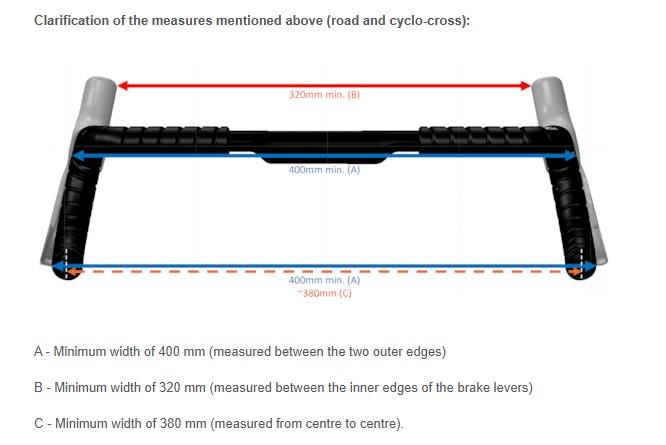
“These changes, defined in consultation with stakeholders, aim to ensure that all athletes, regardless of their body type, can compete with equipment that is both high-performance and safe,” the statement said.
“In addition, the new rule includes another maximum dimension regulating the flare design of the handlebar for road and cyclo-cross bikes: there must be a maximum distance of 50mm between the internal extremity of the handlebar and the outer edge of the handlebar on the same side. For track, the distance will be 80mm.”
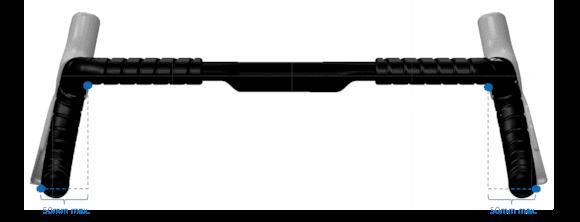
The UCI then clarified its plans to introduce a clear distinction between road and time trial helmets, as well as the impending changes to rim heights (which will be limited to 65mm) and maximum internal fork widths, which will be restricted to 115mm at the front and 145mm at the rear triangle.
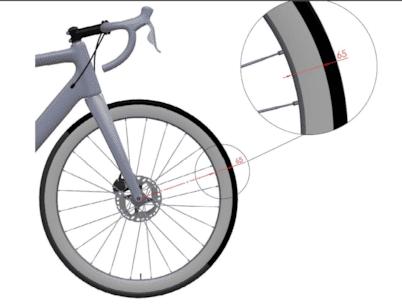
“This measure will apply to the entire length of the elements,” the governing body said.
Finally, the governing body confirmed its intention to test a new maximum gear ratio during the second half of the 2025 season.

This junior-style restriction will cap riders at a 54×11 gear ratio on 700c wheels (which equates to 1.46m per revolution of the crank), and forms part of the UCI’s attempts to improve safety by limiting top speeds.
“It has been proven that the very high speeds reached by riders today are a risk factor for their safety. The events during which the tests will be carried out will be announced at a later date,” the UCI said of the plans, which look set to hit SRAM-sponsored teams hardest, as their 10-tooth cog setup will exceed the new limit.


















19 thoughts on “UCI issues “further clarification” on new tech rules including controversial 40cm handlebar width… by printing the same changes again, with some diagrams”
Wait, does the 65mm rim depth
Wait, does the 65mm rim depth include the tyre?!
It appears to include the rim
It appears to include the rim, the tyre, and an unspecified little bit of air either side. 🤔
Crappy resolution image, it’s
Crappy resolution image, it’s clearer on the UCI site, which isn’t linked for some reason, it’s the rim only.
https://www.uci.org/pressrelease/uci-statement-on-its-recent-decisions-regarding-changes-to-equipment/39bHGV3T3d3sNHKNe2Rvbx
On the min width between hoods, that just way way too small. I’m using 38c-c bars for comfort not aero, and a very mild tilt on the hoods, and it’s 31cm min. I would have to have the hoods dead straight or maybe an outwards kink to be UCI legal, which I don’t really care about as I don’t race , but I can imagine the headache this is going to cause the more slight male pros, and a lot of women.
Exactly. I am 6’2″ with 40cm
Exactly. I am 6’2″ with 40cm bars and a slight angle on my shifters because thats way more comfortable on my wrists. Shifter to shifter is 27cm.
Stick your arms out in front of yourself and put your hands in the shape they will be on the hoods. Which is more comfortable: thumb in line with your forearm (straight hoods) or thumb pointed in more (angled hoods)?
For me it makes a huge difference. Its mad that they are going to be applying this rule to anyone let alone tiny women with slim shoulders.
Yes, so this is very limiting
Yes, so this is very limiting. They limited wheel depth years ago so Zipp 808s weren’t allowed. This even keeps you from using a 404 depth wheel with big tires.
This is insane. I’m a short
This is insane. I’m a short-arsed (1.69m) bloke with relatively broad shoulders and I ride 40cm drop bars. For women, who generally have narrower shoulders, this will be a real problem. Handlebar width is one of those things that is really important for a comfortable bike fit.
My wife (a fair bit shorter than me) got a mountain bike a few years ago. The bike fitted pretty well, apart from the handlebars. Despite the difference in our heights, her bars were only 2cm shorter than mine. The LBS cut them down and she couldn’t believe the difference it made.
Eton Rifle wrote:
Don’t exaggerate! This whole topic has been blown up to a ridiculous degree.
My 38cm non-flared Bontager bars are 41cm outside-to-outside and 34cm between the hoods (which are straight, not angled in like a copycat-wannabe). And I’m shorter than you.
Does your wife compete at UCI level on the road? Thought not. Most of the people making a fuss about this don’t even race. Get a f*king life!
For someone complaining about
For someone complaining about overreaction, that seems a bit of an overreaction.
So obviously part of a
This is so obviously part of a conspiracy to silence dissenting voices.
Bike fitter here. I’ve
Bike fitter here. I’ve absolutely fit women that need road bars narrower then what’s allowed to avoid shoulder pain. And yes, I’ve fit men and women doing UCI races.
THe problem with aboslutes
The problem with absolutes rather than relatives.
A better regualtion might be “no narrower than shoulder width -25mm“.
I mean they have a bizarre system for measuring sock length so why not for bar width. Simples.
I’m never doing a UCI road
I’m never doing a UCI road race again due to concussions but I would be if it weren’t for those concussions. But I’d absolutely have shoulder problems from a rule limiting my bars in this manner.
Pfff, what a load of whining
Pfff, what a load of whining in the comments.
They’re trying to limit speeds. I’m not going to cry about someone that’s already very aero (due to very narrow shoulders) not being even more aero.
Having bars too narrow restricts the chest, but having them “too wide” at 40cm doesn’t cause injury… it just causes a loss of aero *which is the f-ing point!*. (If it’s about greater control, then those with narrower shoulders likely have less power…. so defo shouldn’t get dispensation to be even narrower).
Those wanting fewer/less restrictive rules sound like team owners from the early days of F1.
Yes, safety is boring and unfair, however I don’t find career-ending injuries exciting. Neither does the UCI – good on ’em because the sponsors and many of the viewers love the excitement caused by danger and crashes.
I don’t mean to sound dismissive – it’s more of a contemptuous tone I’m going for. Contempt for those that don’t prioritise the safety of competitors.
The rule needs to be
The rule needs to be different for height. I’ve absolutely done bike fits for women(no reason it couldn’t be for small men too) where that 32cm would result in shoulder pain. I’m 6’1″ myself. I don’t road race anymore but my messed up shoulders are much more comfortable with narrow hoods and my elbows slightly flared out. They don’t need to be 32cm but if I were sat 5’9″ with my same shoulder problems, 32cm would give me problems.
*I absolutely used to race at UCI events and possibly still will for masters events but only TTs.
Mark Thompson wrote:
Opinions may vary.
I think people aren’t arguing
I think people aren’t arguing about the loss aerodynamic performance as the rules will be the same for everyone. They’re saying riding bars that are too wide cause pain/discomfort. That’s why a petition was launched by a bike fitter. I had shoulder pain for years on a bike before moving to 38 cms bars.
“54×11 gear ratio on 700c
“54×11 gear ratio on 700c wheels (which equates to 1.46m per revolution of the crank)”
Going to have to ask you to show your working on that one…
The article calls the UCI
The article calls the UCI diagrams “rather obvious” but apparently the author hasn’t been talking to all of the people who only half-read the first announcements and/or don’t know how handlebars are measured. Many people therefore wrongfully assumed that any bars below 40cm center-center at the hoods (which is very common) was going to be banned. In fact, even 38cm c-c bars will be fine when adding in tube sizes and bar tape. Only 37cm c-c and lower are going to have a problem, which many brands don’t even offer on most models. I’m not saying this is a good idea; I just want to say that the diagrams are VERY necessary for the majority of people who have no idea how bars are measured.
I ride 36s and 38s – male and
I ride 36s and 38s – male and have reasonably broad (if skinny) shoulders. Large handle-bars get uncomfortable quickly. One reason I dislike renting bike on holidays, always end up with 40+ cm bull-horns. 40 cm min is insane.