



Through its comparatively short history, mountain biking has gone from being a rebellious hippie-like sport to a finely tuned and highly organised corporate sporting entity. Along the way, this evolution has taken many a twist: from the plain weird and wacky to the wonderful and the controversial. Some elements are sorely missed, and others best forgotten. It’s been a wild ride!
Events and disciplines have come and gone over this time, and there are far too many to detail in one story. Here are 10 events and disciplines from over the years that many will never have heard of, and they all played a part in shaping the sport we have today.
Bog Snorkeling
Llanwrtyd Wells pub landlord, entrepreneur, and champion for local mountain biking and wacky sports, Gordon Green (RIP) launched the World Bog Snorkelling Championships back in 1988, although the bike version didn’t come along until the mid-late 90s.
In the middle of a local bog, a 60-meter trench is dug, which fills up with unholy murky water. Riders strap on a snorkel and mount a standard-issue bike, with water-filled tyres, and then blindly ‘race’ individually on timed runs through the bog for the title.
The event attracts crazies from the world over, and having ridden the second edition, and having swallowed a fair bit of that freezing murk, I can attest that it’s truly bonkers. The winner that particular year (for the second time) was none other than road.cc’s Dave Atkinson.
Chariot racing
The annual World Mountain Bike Chariot Racing Championships is another quirky masterpiece from Green Events in Llanwrtyd Wells. Teams of three – two riders and a chariot driver – race both against the clock and against each other on a short loop around town. The chariots are made from oil drums with special harness/clamping mechanisms out front. These are attached to the two bikes, and from there you unleash your inner Ben Hur, for the sheer hell of it – and, of course, to try and become World Champions.
This year’s race takes place on the 15th of August, so you still have time to enter and sort out your body armour and helmet.
Mountain bike orienteering
Mountain bike orienteering (MBO) has been around in one form or another since the early 1990s, with the pioneering national Trailquest series really kicking things into shape at that time.
There are varying forms of MBO, though the format is generally based on the running orienteering format of navigating between set checkpoints (using paper maps) to score points in the fastest time. These events were (and are) great fun to ride, and a flashback to good old school riding and map reading.
Although MBO events slip under the mainstream MTB and media radar, there is still a thriving scene in the UK and elsewhere, and the BMBO (British MBO) organisation has a pretty full schedule of events around the country. Give one a go; it may well offer a fresh twist on your riding.
The Polaris Challenge
Riding a Polaris Challenge was considered a rite of passage in 1990s British mountain biking. This was a two-day orienteering-based mountain bike challenge for teams of two, with the aim being to reach the set checkpoints and the finish line in the fastest time – meaning for around seven or so hours of wild riding on Saturday, and around five or so hours on Sunday.
Teams planned their own route on paper maps, and had to carry all of the camping and survival gear needed for the obligatory group ‘wild camp’.
The first edition was in 1991, but sadly the event faded out of its original format during the 2000s-10s. There was a spring and an autumn edition, all held in great mountain biking regions of Britain, and having suffered through a couple of them I can attest that rite of passage was hard earned.
Man vs Horse vs Bike
The famous Man vs Horse vs Bike race is held on the trails around Llanwrtyd Wells in Mid Wales, and was also the brainchild of Gordon Green (RIP). Things started in 1980, when runners raced against horse riders over the tough 21-mile loop, and in 1985 mountain bikers were invited along for the first time.
That first edition was won by American pioneer Jacqui Phelan. From then on, the race became a true classic of early British mountain biking – and also globally. In 1989 Tim Gould became the first biker to beat the horse. Sadly, the mountain bike element was removed from the race in 1993.
Four cross
For 17 years, between 2002 and 2019, four cross was a staple of the sport at World Championship level. Many a top racer of the era based much of their career around the discipline, and had the rug somewhat pulled from beneath them when it came to an end.
Although there are still 4X style races around, their mainstream viability and glory days are sorely lost, which is a real shame for the sport, the riders – and the fans.
Riders went head-to-head in a mix of BMX and short track style downhill racing; these heat and finals-based formats lit up the crowds and TV screens at the time, and it’d be great to see them out there again.
Racing down the Cresta Run
If you’ve ever seen a bobsled or luge in full flight down an iced bobsled run and thought it looked terrifying, then just imagine doing it on a mountain bike; this is exactly what a select bunch of the world’s top downhillers, extreme athletes, and err, me got to do back in 1995.
The Olympic Cresta Run in Saint Moritz, Switzerland, is the oldest, and perhaps most famous ice chute in the world. Hand-bodge-screwed tyres, a hardtail XC bike and a brakeless sense of fear were all I had when hurling myself down the 1,700-meter twisted funnel, which was just over 90s bar width wide in places, and had corners topping six feet high; what a wonderfully terrifying experience it was.
As far as I’m aware, this was a one-off race, which I survived to tell the tale of, despite getting my bars jammed in the start channel.
Dual slalom
Arguably the first mountain bike dual slalom races came around in the late 1980s with the legendary Mammoth Kamikaze races in California. These were high-speed epics of the finest order, and the Kamikaze was considered the unofficial downhill World Champs before the UCI stepped in to the arena.
Short dual slalom racing on double channel courses was quite popular for a while, and they still do exist – but not as an official UCI World Championships. That title bout only happened twice, in 2000 and 2001, after which the powers that be pulled the plug on the discipline.
Hill climbing
Racing uphill was quite the thing in the early days of mountain biking, but it soon faded from the mainstream. There have been several uphill races over the years, both massed start and individually timed. In the very first 1990 UCI World MTB Championships in Durango, USA, there was indeed a hill climb race – though it didn’t carry official world title status.
Even so, the biggest XC names of the era all lined up for that race – which was won by Britain’s early MTB icon Tim Gould, ahead of Ned Overend, who took the first official XC World title that same week.
For a while during the 1990s there was also a British Championship hill climb race, which was held along with the other championship races and ridden by most of the same XC riders.
Eliminator
Although there have been various kinds of MTB eliminator races over the years, they still largely sit outside of the mainstream mountain bike scene – even though they do have an official (XCE) UCI World Championships and World Series, which is broadcast on the UCI’s YouTube channel.
The format now is mostly urban-based and on short circuits, which have plenty of jumps and obstacles along the way. These races just last minutes and are contested through heats and finals. They may not be to the taste of an offroad purist, but they are really entertaining to watch.














3 thoughts on “10 weird, wacky and wonderful mountain bike events and disciplines you’ve probably never heard of”
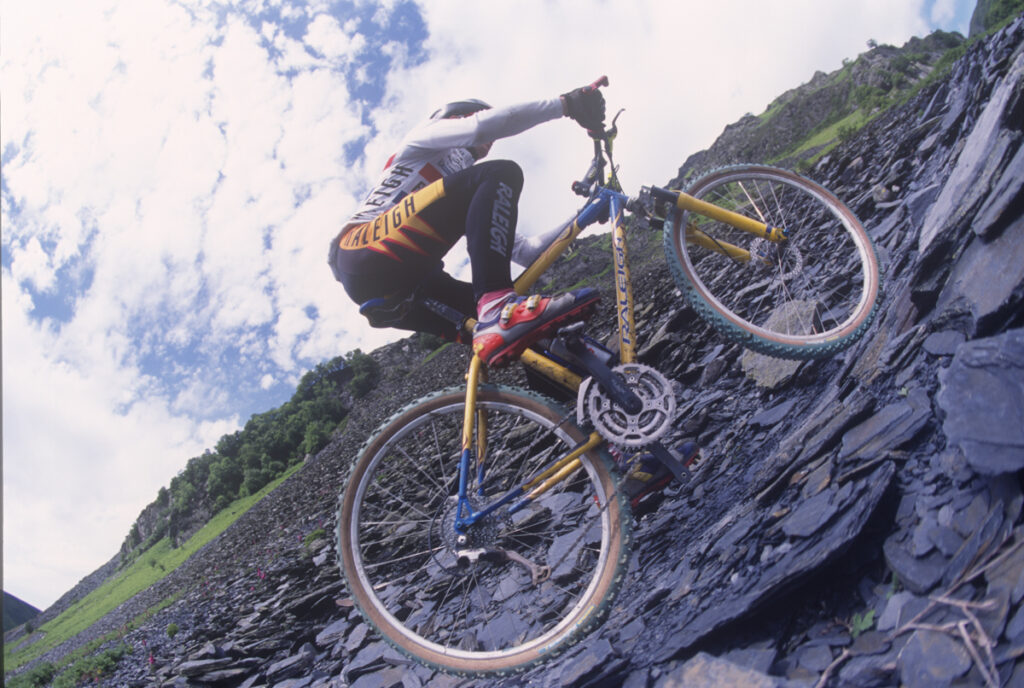
Mountain Biking, Berwyn Mountains, Snowdonia, North West Wales (Image Credit: Steve Thomas)
The Berwyn range are hills in north east Wales not Eryri (Snowdonia)
@lemonenema Sorry about that and thanks for the spot… fixed!
Keep up the good work Jack