



The UCI has released a mid-season update on race safety measures — but while it highlighted new interventions such as a gear ratio limit trial and extended time gap rules, its framing of crash data has sparked criticism from team managers and journalists, while its silence on the increasingly controversial 40cm minimum handlebar width rule has not gone unnoticed.
In its statement, the UCI said that since the start of the 2025 season, 297 race incidents have been analysed by the SafeR Case Management Committee across UCI WorldTour, Women’s WorldTour and ProSeries events. Of the 203 causes identified, the UCI reported that “the most common cause – or main contributing factor – is the riders’ own mistake (29 per cent).”
The sports’ governing body added: “Upcoming points of interest, where teams and riders are positioning to be at the front (such as cobbles, sprints and climbs), are at the root of 12% of incidents, as are wet or slippery roads. Other incidents stem from descents, traffic infrastructure, sprints, road configuration and conditions, feed zones and other riders’ mistakes.”

At the same time, it confirmed that a new gear ratio limit will be tested at the men’s Tour of Guangxi in October. Riders will be limited to a 54×11 gear — capping crank revolution to 10.46 metres — as part of an attempt to limit top-end speeds. The UCI says this initiative, originally suggested by Wout van Aert, will be reviewed via a rider survey before any possible adoption in 2026. SRAM-sponsored teams are expected to be the most affected, due to their 10-tooth cog setups.
> UCI to trial maximum gearing rule — but will it really make racing safer?
The UCI also announced that the three-kilometre rule, which neutralises GC time for riders delayed by crashes or mechanicals in sprint finishes, will be extended to five kilometres on seven Tour de France stages, including the opener in Lille and the final stage on the Champs-Élysées, as well as stages 4, 9, 15, and 17.
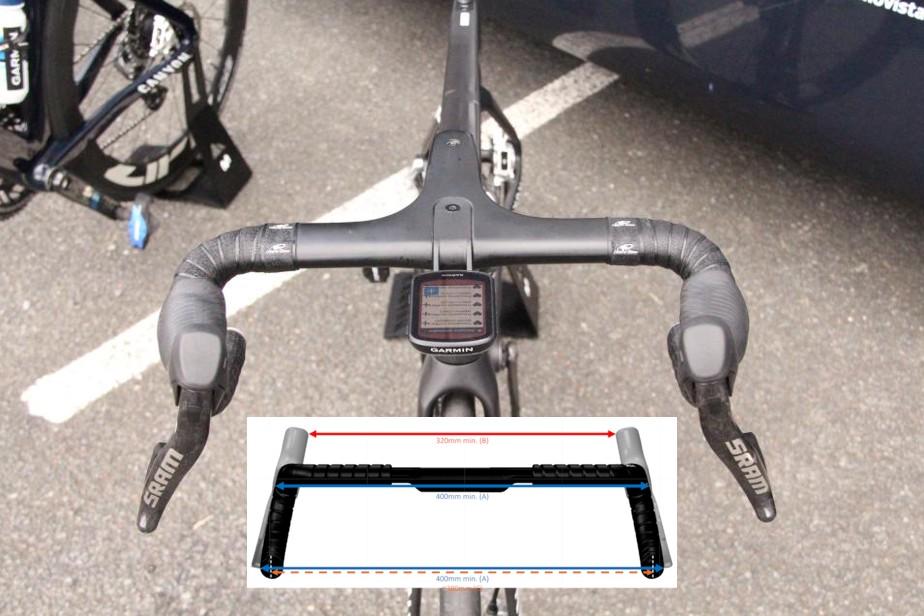
What the press release did not mention is arguably the most hotly debated regulation the UCI has introduced in years: a new minimum 400mm handlebar width rule, set to take effect in January 2026. Announced just over a week earlier, the rule was framed as a safety measure based on SafeR recommendations — but has since come under fire for ignoring fundamental principles of bike fit and biomechanics, especially for smaller riders and the women’s peloton.

Every rider on Coop-Hitec Products and 14 of Visma-Lease a Bike’s 18-rider squad currently use bars narrower than 400mm. Critics say many riders use such bars not for aero gain but because they fit their physiology.
A petition launched by My Velo Fit two weeks ago has now garnered more than 6,000 signatures — having doubled since we published our report — warning that the regulation could lead to injury, reduced control, and decreased participation.
Despite that growing backlash — and a “clarification” statement issued by the UCI last Friday, which merely reiterated the original rules with diagrams — the latest safety update offered no further comment on the bar width controversy.
At the same time, the UCI’s handling of both the crash data and the handlebars issue has drawn increasingly direct criticism. Visma–Lease a Bike general manager Richard Plugge wrote on social media: “Fixed: ‘The most common cause – or main contributing factor — is the race environment (71 per cent). While riders’ own mistake counts for 29% of the incidents.’”
Dutch sports journalist Thijs Zonneveld added: “You are framing safety, again, as a rider’s responsibility. What about the 71%, what about the role and responsibility of organisers and the governing federation itself?”
Meanwhile, The Cyclists’ Alliance, representing pro women riders, issued a formal statement opposing the handlebar rule last week: “Riders who cannot use properly fitted equipment will experience pain, reduced control, and increased injury risk… If riders are forced to use ill-fitting bikes, they will be at risk of compromised bike control and confidence using oversized handlebars.”
Lorena Wiebes, speaking after winning the much-criticised Copenhagen Sprint last weekend, said: “The UCI is doing things differently with the handlebars and stuff and not really thinking about our safety… It was a bit dangerous sometimes, with nobody signalling the central reservations. I hope next time the UCI takes a bit more care of our safety.”
Former Garmin pro Tom Danielson also described the bar rule as “nonsense”, writing: “I cringe when I think of the insane crashes I have been involved in, and how they could have easily been avoided.”
He argued that proper road inspections, descent cleaning, and early neutralisation of GC times would do far more to prevent crashes than forcing riders to adopt wider bars. On the gear rule, his take was: “If you are removing gears to make sprint finishes safe, well, you are going to have to remove a lot more… Let’s make the streets safer so our heroes can rumble in confidence.”
















5 thoughts on “UCI claims riders’ own mistakes are “most common cause” of crashes and outlines plan to trial gear ratio limit, but remains silent on controversial 40cm handlebar proposal”
By some basic math, 54/11 = x
By some basic math, 54/11 = x/10 -> x = 54*10/11 -> x = 49.091, a 49 tooth front with a 10 at the back will be equivalent to a 54/11. The proposed rule doesn’t mandate specific sprockets/rings, it only limits development. SRAM can easily make it work, if it ends up a rule. Come on… how are you pushing this nonsensical angle road.cc? 🙂
Probably because SRAM don’t
Probably because SRAM don’t currently make 49/other chainrings right now (I’m pretty sure you have to buy both together as one unit). SRAM will need to produce new chainrings or an 11-up cassette.
I have full confidence that
I have full confidence that SRAM will be able to make a 49T chainring. It’s not like a 49T chainring is pushing the boundaries of ultra-violet lithography…
UCI: “Are we so out of touch?
UCI: “Are we so out of touch? No, it’s the riders who’re wrong.”
The UCI cant back up theses
The UCI cant back up theses claims in the real world. Most crashes are either in the peloton where they are never going full tilt. Its mostly a clipping of wheels – not speed related, descending and overcooking a turn – speed related but nothing to do with the max gear and tbh something that Disc brakes should have helped but havent, Sprints – most crashes are people crossing / blocking oter riders line. Non of these issues are down to the overall top speed. So where do they expect reducing gears will actually be safer?