


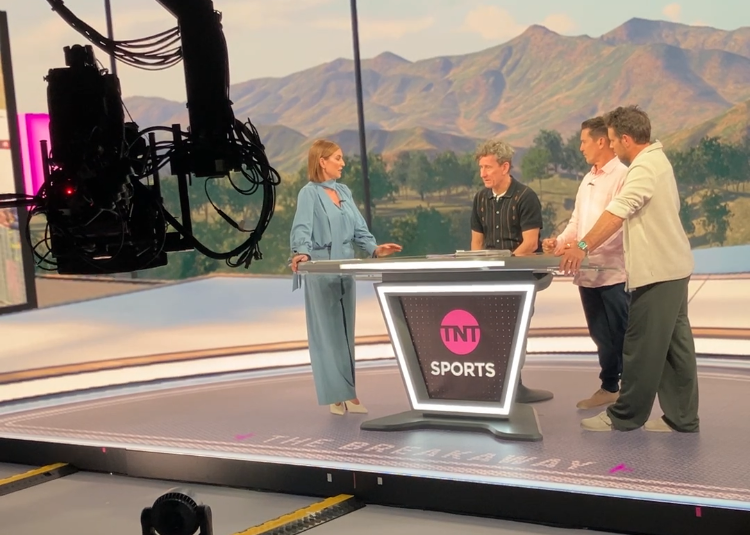

TNT Sports presenter Orla Chennaoui has criticised the limited television coverage of this year’s Tour de France Femmes, which she argues is a “disservice to women’s racing”, after Sigrid Haugset’s stage-winning attack, which propelled her into the yellow jersey, was missed by the TV cameras.
Just three stages of the 2026 Tour de France Femmes, stages one, five, and nine, are being broadcast from start to finish, a decision made by race organisers ASO and host broadcaster France Télévisions. Other stages are limited to two to three hours of live coverage, with Tuesday’s crucial time trial hitting our TV screens at 2.45pm UK time, just as the 55th rider rolls down the start ramp.
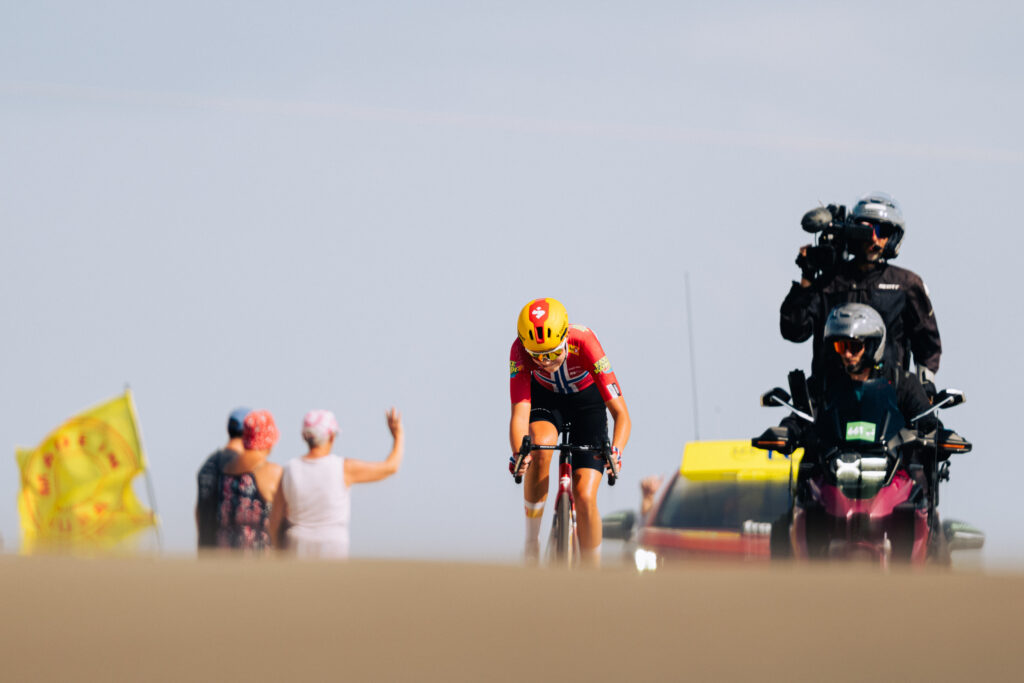
Coverage of Monday’s third stage, from Geneva to Poligny, only began with around 80km to go, seven minutes after Uno-X’s Haugset made her move on the Col de la Savine, an audacious long-range break which she held to the finish, securing her the stage win and the yellow jersey.
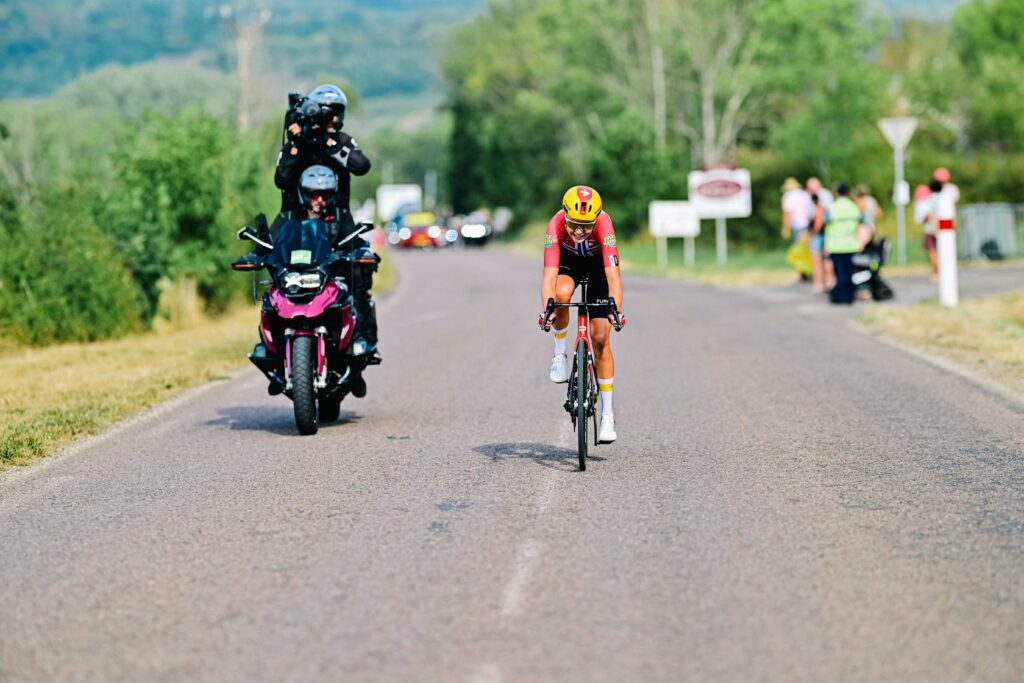
The latent TV coverage also missed a crash involving one of the pre-race favourites Demi Vollering, which took place with 143km to go, over an hour before the cameras started rolling. The incident was thus relegated to the race’s social media channels, though the former Tour winner was able to regain contact with the bunch.
Nevertheless, that missing action has reignited the debate concerning television coverage of women’s racing, especially in the wake of the men’s Tour de France, where every moment of every stage was shown live.
Ahead of this year’s Tour, The Cyclists’ Alliance (TCA), the group which represents the women’s peloton, said the lack of full live coverage would mean fans will miss “the attacks, the tactics, and the moments that could define the race”.
“For the biggest race in women’s cycling, partial coverage is no longer enough,” TCA wrote. “The demand is undeniable and we are asking for the coverage to catch up.”
That sentiment was echoed by TNT Sports’ main presenter Chennaoui, who made an impassioned plea for more coverage of women’s bike racing in an Instagram post on Monday.
“I’m getting really annoyed, I’m getting really, really pissed off. Excuse my language, but what the heck?” Chennaoui said.
“There is so much excitement and interest in the Tour de France Femmes avec Zwift. The riders, the race has proven over and over again how dynamic and dramatic this sport is. I have never seen my algorithm so flooded with excitement, with joy, with celebration for this race.
“I mean, it’s everywhere on Instagram, podcasts popping up all over the place. YouTube videos, more written articles than I would ever have imagined when I started covering women’s cycling 10 years ago. And we still, despite this, despite how proven the interest is, we cannot get live TV coverage.
View this post on Instagram
“ASO, what are you doing? What are you doing? I’m going to get into trouble here, you’re getting so much deserved credit for the growth of this race, for the instigation of this race. It’s a different audience now, it’s a different excitement, it’s a different vibe, it’s a different colour, it’s a different flavour.
“Why can we not get to watch all stages live? Every stage, of all stages live. Why are we watching Demi Vollering crash on somebody’s mobile phone before the live TV cameras have a chance to cover this race? Former winner, one of the big favourites, and she could have crashed out of the race. And we wouldn’t have seen it.”
The criticism of ASO’s partial approach to the Tour de France Femmes on TV comes after the race organisers made the decision to move Paris-Roubaix Femmes to the same day as the men’s race, cutting its television time to just an hour and a half in the process.
The move prompted a furious reaction online, with fans accusing ASO of paying “lip service” to women’s cycling.
And according to Chennaoui, who points out that TNT Sports has no say on when the racing goes live, that reduction in television coverage at cycling’s biggest one-day race represented a “step backwards” for the sport.
“I get that everyone’s angry with broadcasters, let me say it again – it’s the race organisers, it’s the host broadcaster,” she said.
“There is a huge will to broadcast this race from start to finish, as there is with every women’s bike race. We need ASO to put it on. We need France Télévisions to put it on. I’m sorry, but Paris-Roubaix this year, regardless of what they’re going to say about TV numbers, was a step backwards.
“They’re still doing a disservice to women’s racing. And we can’t then say that the audience isn’t there, we can’t. It is there, the will of other broadcasters is there. We want to watch this race and see what’s going to happen to Demi Vollering, and all the other contenders, and all the other riders in this race.
“Because if a tree falls in the woods and there’s no-one there to hear it, what’s the point? The wood just rots, nobody notices. And wood’s important! I don’t want to waste my energy getting annoyed, we just have to watch it. I might get myself cancelled here…”
Despite Chennaoui’s criticism of the host broadcaster’s approach to the Tour de France Femmes, earlier this year her boss Guy Voisin, the Vice President of Cycling at Warner Bros. Discovery Sports, told road.cc that the same-day approach (and limited coverage) of one-day classics such as Paris-Roubaix has paid off for TV companies.
“During COVID, they moved the women’s Omloop [het Nieuwsblad] and Tour of Flanders to finish an hour, an hour and a half after the men’s race, for strictly organisational purposes,” Voisin told road.cc.
“And we watched the numbers on our broadcasts and said, ‘wow, okay, wait a second. This is the highest rated women’s race we’ve ever had!’ Like, it just, the numbers just blew out of us.
“We called up Flanders [Classics – race organisers] and said, “can we do this again because the numbers are great and it’s giving exposure to the women’s racing and women’s racing is exploding, it’s getting much bigger, right? But we still need to, we still need to help it. We still need to grow that sport, right? Because it’s a sport worth growing.”
Voisin also played down the control and influence TNT Sports has compared to local race organisers, whilst reiterating the extent to which their £30.99 a month subscription service exceeds the offerings of a free-to-air broadcaster.
“We have some influence… if I call up ASO and say, ‘no, no, you have to cover from the beginning of the race’, they’ll just say, ‘yeah, okay, how much are you going to pay?’ But we do make heavy suggestions,” he said.
“If you look at the broadcasting history of cycling in this market on free-to-air, it was never complete. It was a very limited story. You’d see the Tour de France, maybe Paris-Nice, once in a while the Criterium [du Dauphine], and that was it.
“Apart from the Women’s Tour of Britain, you didn’t see anything else of the Women’s Tour, right? This is where we’ve really dug our heels in and said we’re going to be the home of cycling and we have to stand behind that phrase. And we’ve got everything.”









10 thoughts on ““ASO, what are you doing?” TNT Sports host Orla Chennaoui “pissed off” at Tour de France Femmes organisers over TV coverage branded a “disservice to women’s racing””
Eh?
Is this just meant to be ‘late’?
I think it makes sense in the ‘present but not visible ‘ meaning, it’s the coverage that’s available for broadcasters to use?
Possibly, but (a) it’s a weird and unclear way to describe that, and (b) that coverage didn’t miss it, otherwise they wouldn’t have been able to put it out on social media.
(a) agree
(b) I’ve not seen it but assume the social media coverage is from other sources eg phones?
Marketing b/s
By ‘marketing b/s’ I meant Voisin
@mdavidford Latent can mean present but not active, so perhaps that’s just a slightly convoluted way of saying the cameras etc were in situ but not rolling.
Given the source, though, I’m going with Occam’s Razor and assuming it was just a fancy-sounding word used without really having a clear idea what they meant by it. It seems like the cameras were recording, because they had clips of the incident that were posted on social media.
I question the comment from TNT that they can request coverage but be asked to pay for it. What’s th£30.99 a month for then?
Its for those 100 other sports they show as ‘great value ‘ even if ,like me, you have no interest in 95 of them. Their subscription model stinķs. I’m not a great Orla fan but shes absolutely right on this.