


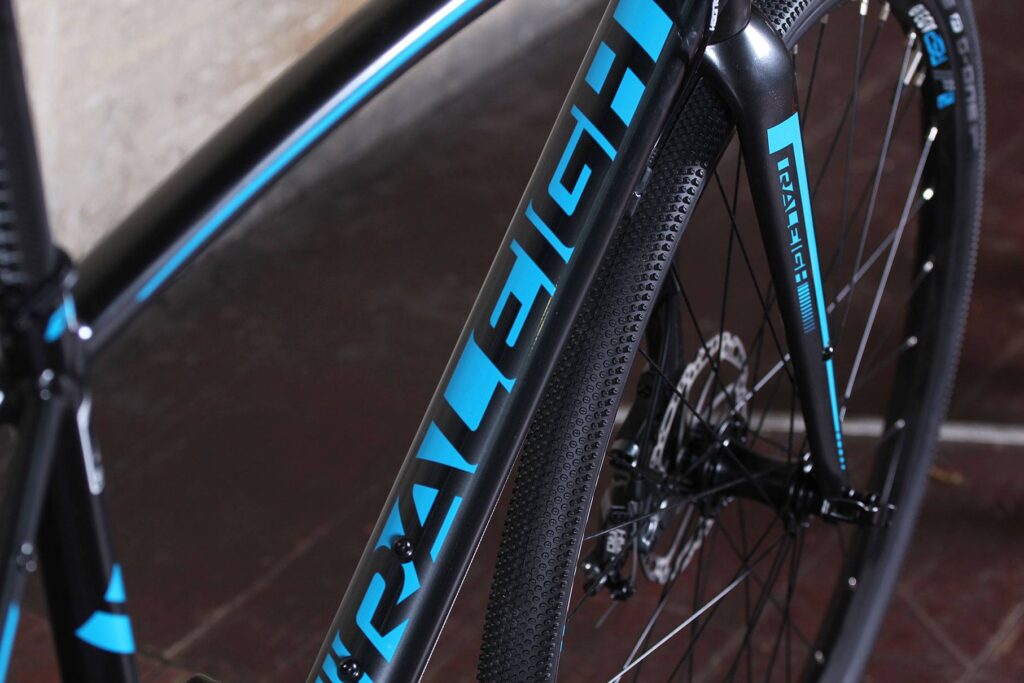

Iconic British bike brand Raleigh could be set to enter administration after its parent company began insolvency proceedings this week, following a turbulent few years for the historic Nottingham-based company and its owners.
On Wednesday, Accell Group, the Dutch parent company of Raleigh, Babboe, Lapierre, and a host of other cycling brands, announced that it was granted a “suspension of payments” under Dutch law, after determining that it could no longer meet its financial commitments and following an “exhaustive review” of all possible alternatives.
In February, Accell underwent a major restructuring process after US-based private equity giant KKR announced that it was stepping away from the Dutch company and handing its remaining equity to the group’s biggest lenders, four years on from investing $1.8 billion, encouraged by the cycling industry’s healthy Covid-era landscape.
That decision meant the global investment firm and its backers haemorrhaged well over a £1bn since backing Accell in 2022, a huge loss described by one industry insider as “the biggest figure I’ve seen in all this mess”.
KKR effectively lost all of the €1.1bn equity used to purchase Accell in 2022, along with the additional hundreds of millions they pumped into the company to help stabilise it amid the industry’s post-Covid downturn.
That development marked Accell’s second debt restructuring in just over a year, and saw most of its lenders agree to a new deal that would “significantly reduce Accell’s total debt” and provide it with additional funding, enabling it to the avoid insolvency or liquidation.
However, this week, the Amsterdam-based company announced that “despite these extensive efforts”, it was “not possible to reach a viable solution for Accell to continue operations in their current form”.

“Having exhausted all the available options, the directors of the Group have concluded that it is no longer able to meet its financial obligations as they fall due and that initiating local insolvency proceedings of the relevant Group subsidiaries is the necessary next step,” Accell said in a statement.
“This is a deeply sad and frustrating situation given all the hard work and everything we have achieved, with the support of shareholders and lenders, to restructure Accell’s operations and finances,” Accell CEO Jonas Nilsson said.
“It is an especially difficult moment for our employees, creditors, customers, suppliers, and partners. Every realistic option for the future of the business has been tirelessly explored, and none have resulted in a solution to continue the Group in its current form.
“Our immediate focus is to support an orderly process, provide clarity wherever possible, and work with the relevant court-appointed administrators to preserve viable activities and employment where circumstances allow.”
While this suspension of payments in theory gives Accell some room to work out their next steps, it means that the future of the group, and its range of bike brands, is now in the hands of the Dutch courts.
According to reports, Accell UK and Ireland, the Nottingham-based company known as Raleigh UK until last year, has also filed a notice of intention to appoint administrators, though that development has not yet appeared on Companies House.
That notice of intention means Raleigh has around 10 business days to restructure or sell up before entering full administration.
This week’s insolvency proceedings for Accell appear to have brought to an end a turbulent four years for the Amsterdam-based company, which owns bike brands such as Raleigh, Babboe, Winora, Sparta, Lapierre, and Ghost, since it was taken over by KKR in a €1.8bn deal in 2022.
Despite KKR’s hopes for a continued surge in e-bike sales after the pandemic, Accell’s growth was slow, while supply chain disruptions led to shortages of some components. Meanwhile, like many other bike brands in the early 2020s, KKR underestimated the Covid-era overstock of other parts, leading to heavy discounting and falling revenues.
Last year, we reported that Accell had suffered a loss of €390 million (£325 million) in 2023, after posting a €27 million profit the previous year. Its net sales in 2023 were €1,294 million, down 10.1 per cent compared with €1,439 million in 2022.

Historic British bike manufacturer Raleigh, meanwhile, recorded a loss of £30.1 million before taxes during the first year of KKR’s ownership, with an independent audit claiming that “material uncertainty may cast significant doubt on the company’s ability to continue as a going concern”.
In November 2023, Raleigh also announced a series of job cuts and major restructuring plans, which included completely shutting down its Parts and Accessories department and contracting out its warehousing and logistics to a third party, the brand stating that the move reflected a “challenging market”.
Earlier that year, KKR was forced to loan Accell €300m, before the company’s first restructuring, which took place last February, saw €600m cut from the company’s €1.4bn debt load, enabling KKR and its shareholder, Teslin, to retain control.
However, financial uncertainty continued to plague the company, which earlier this year sold its titanium frame brand Van Nicholas to Italian cargo bike company Velo-ce, and its Nishiki bike brand to Turkey-based Kron Bicycle.
In August 2025, Accell was reported to have closed a factory in Heerenveen, which produced around 20 per cent of the company’s total bikes, moving that facility’s production to Hungary, leading to 160 jobs lost.
In July, it was reported that Singapore-based DuTech Group had agreed to buy Accell, with competition authorities in Germany, Austria and Poland signing off on the deal. However, that takeover fell through, for reasons still unknown, leaving Accell – and one of the most historic bike brands in the world – on the brink.

















15 thoughts on “Raleigh faces administration after parent company starts insolvency proceedings”
I think its fair to say, Raleigh’s best days are long behind them and as sad as it is to see the brand in trouble its not unexpected. But the news that Lapierre are also in the same trouble is more surprising. They are a well respected and still ridden on the world tour. Ive always liked their innovation. They not be a common sight on UK roads but they are in Europe, especially (quite obviously) France and Belgium.
Maybe another buyer can pick them up. Id hate to see them go bust.
@Smoggysteve The group as a whole is struggling, that doesn’t necessarily mean that every subsidiary in the group is. From the number of Babboe cargo bikes I see in well-heeled areas I’d imagine they might be doing OK, and the same might well go for Lapierre. They have an agreement to act as supplier to Picnic-Post NL through 2028 which might attract investors. I should imagine as the fairy godmother company has handed their shares back to the creditors there will be a fair bit of asset stripping going on and some of the more successful brands will continue, though I fear poor old Raleigh hasn’t got much cachet. Hopefully someone will at least buy up the name and keep it alive in some fashion. If they fancy going back to 531 steel and making a modern version of the Road Ace I had in 1986 I’d certainly consider buying one!
@Rendel Harris Let’s not forget Babboe have recently faced major trouble with customer-rights regulators around their quality issues. Not only did they fail to meet quality standards, but were also caught red-handed blatantly lying to both customers and – AFAIK, can’t confirm personally – the regulators.
They were recently desperately selling out stocks of Babboe accesories, which indicates struggles with overstocking and/or poor production line and/or warranty service management. And considering how long these items have been available, they must have mountains of non-cashable stock there.
Also, despite Accell’s attempts, Lapierre remains a non-brand in road cycling. It’s effectively a money pit.
@tomlew I was only going on the number of Babboes I see around, so maybe they are losing money, I don’t know. They certainly don’t seem to have lost popularity. As for Lapierre being a “non brand”, as SS says, they are popular on the continent and are used by a major World Tour team, so they’re not that invisible.
@Rendel Harris As a subsidiary company, unless there is a buyer then they all die. I would hope there is a buyer but the bike industry is difficult to predict. Lapierre are neither a budget brand or a full on marquis brand either. That makes it a lot more dangerous for them as a brand. The shift towards people buying Chinese bikes is contributing and these are the brands which are hit hardest. Cheaper chinese bikes are not going to effect Colnago or Pinarello, the attract a different market. Lapierre could easily go and if no one sees them as a viable worthwhile brand to rescue.
Not sure being a marquis brand is a good strategy – even though most of them probably have a fair bit of disposable cash to chuck away on a bike, there can’t be that many of them around, and the subset of them that are interested in cycling must be vanishingly small.
@Smoggysteve It needn’t be the case at all that all arms of the company will fold if there’s no overall buyer, and I’m sure it won’t be. The creditors will most likely split the company assets up to maximize returns; some, like sadly Raleigh, might well die but a standalone popular brand with three factories making 90,000 bikes a year and a WT supply contract is unlikely not to attract a buyer.
@Rendel Harris Given the state of the bike industry I fear that Raleigh will become yet another brand in the Frasers Group portfolio, they’ll buy the IP and nothing else like they did with Wiggle CRC.
@Rendel Harris
Be careful what you wish for – we know where a lot of historic British sporting brands have wound up and there are things worse than non-existence.
@The_Ewan Exactly, I’m thinking Motobecane and Serotta, just to name two brands that should have been allowed to die with dignity.
Long-time Accell b2b partner here.
I’ve never seen a company so full of idiots on each and every level, from customer service workers all the way to managers and policymakers.
A company which can’t respect its 15-year-long VIP partnership, and whose warehouse can’t see the difference between a chanring and a grease, does not deserve to exist on a competitive market.
It’s not just about tough times for the industry. Accell failed miserably to reap the benefits of the covid era wisely, or to understand the post-covid world, and now are paying the price for it.
Couldn’t agree more ,had my account 6 years and my last order arrived on Monday, 2 dats before the announcement .The whole set up was a mess and their b2b website is a shambles.
It’s not surprising to me at all they are where they are
Another bunch or corporate dickheads who are cycling enthusiasts first and business people second, who are now all amazed after being overpaid and underworked for making stupid overbuying decisions, that they dont have a job. Being paid to spend other peoples money and duplicating so many jobs , well what could possibly go wrong. Over valued by up to 10 times its real value, who on earth is going to buy a brand that is in a market flooded by bikes that all look the same with different labels on them. These morons were paying 110 000 euros a week a few years ago to warehouse all the bikes they over ordered and couldnt pay for after the covid boom. The industry needs pricks like this like it needs a hole in the head. There are companies failing everyday right now in the bike business and its what is called evoloution of dick heads in the bike business. Let this continue until only the strong survive and dont be surprised when you see some of the top 10 brands in the world vanishing up their own arse.
Sooo the whole Accell Group has gone from insolvency to total bankruptcy overnight.
No shipped orders since 04.08, nobody on the phone, no sign of life anywhere in the company.
The situation must be shockingly dynamic, though, as the website is still operating and they even launched a new discount on some products while being unable to ship any goods from their warehouse!
What a mess.
It’s September and Accell have… resumed shipping b2b orders without any notification.
There’s only a one-line-long newspiece on their b2b website about that, but the company still hasn’t sent pre-order forms , which are normally sent around this time of year.
Anyway, considering that the pre-order is a strategic decision each year for a bike shop, I don’t think in the current situation many people would consider placing one with such an uncertain partner.
The situation also casts huge doubt about whether the current situation is an actual resumption of operations or just an ad-hoc sellout to liquidate some stock. Time will tell.