


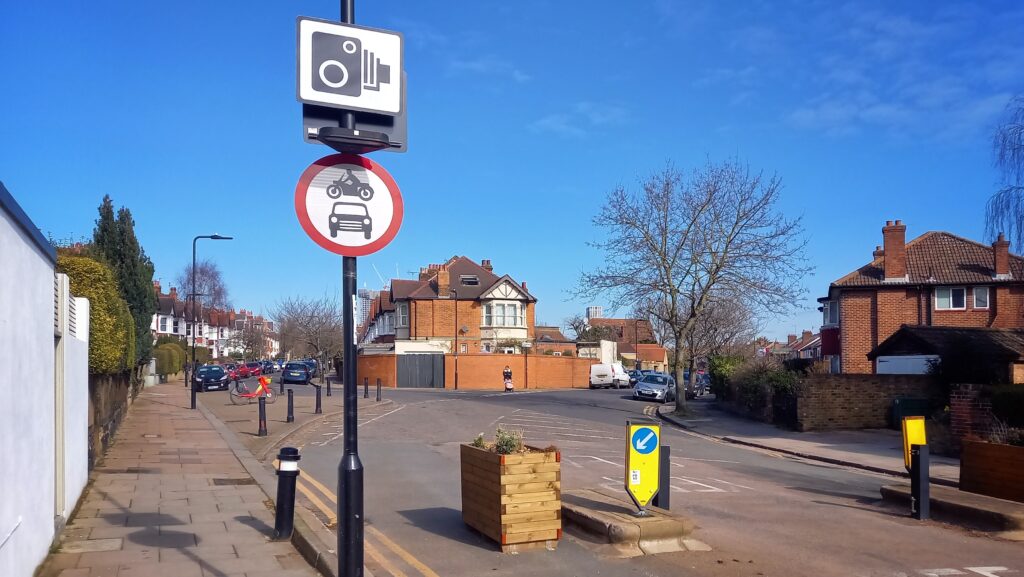

Prime Minister Rishi Sunak has been urged not to use low traffic neighbourhoods (LTNs) as a “political football” after he ordered the Department for Transport (DfT) to undertake a review of them, a pledge he first made while bidding to become Tory leader last year, with the schemes now highly likely to be a key campaigning issue ahead of the next general election.
The charity Cycling UK accused Sunak of seeking to sow division between motorists, cyclists and pedestrians after the Sunday Telegraph published an interview with the Prime Minister in which he said he is on the side of drivers, and claimed that “the vast majority of people in the country use their cars to get around and are dependent on their cars.”
In response, Cycling UK CEO Sarah Mitchell insisted that people want to reduce their dependency on motor vehicles and that interventions such as LTNs enable to do just that, and that it was “lazy to label LTNs as anti-car.”
She said: “Rather than attempting to pit drivers, cyclists and pedestrians against one other through divisive rhetoric, and turning low traffic neighbourhoods (LTNs) into a political football, the government should be celebrating their popularity and success.
“Evidence shows LTNs are overwhelmingly popular, and their support only increases once they’ve been implemented and people see the benefits.
“It’s lazy to label LTNs anti-car, people want to be less car dependent. Liveable neighbourhoods give people the opportunity to drive less and cycle more, consequently enjoying cleaner air, safer streets and less traffic and congestion.”
During his interview, conducted during a visit to a distribution centre in North Wales, Sunak also hinted that he plans to push back the date that sales of new petrol and diesel-powered cars will be banned, currently set for 2030.
Sunak, who is MP for Richmond in North Yorkshire, said that his rural constituency is “more representative of how most of the country is living, where cars are important.
“I just want to make sure people know that I’m on their side in supporting them to use their cars to do all the things that matter to them,” he added.
> ‘The War on the Motorist’ deconstructed — looking at the truth behind the myths
Schemes aimed at excluding through traffic from residential areas are nothing new – pretty much every housing scheme built since World War 2 adopts that model within its street design, and there are many towns and cities across the country that over the years have restricted access on older streets through using bollards and other infrastructure.
LTNs entered the public consciousness in 2020 as councils rolled them out with the help of emergency government funding at the height of the COVID-19 crisis, encouraged to do so by then Prime Minister Boris Johnson and former Transport Secretary Grant Shapps as active travel was put at the heart of their plans for post-pandemic recovery.
One reason behind the implementation of those more recent LTNs is to prevent rat-running drivers from using residential streets as short cuts to avoid congestion on major roads, something that has become increasingly prevalent due to real-time routing provided by navigational aids such as Google Maps and Waze.
The Sunday Telegraph quoted a government source as saying that on the topic of LTNs, Sunak is “concerned by the levels of congestion outside the roads in which they are implemented”, although research from the University of Westminster has established that is not the case.
> Levels of motor traffic nearly halved within London LTNs, new study finds
“Of course we want better air quality,” the source added. “But people have to consent and be happy to live in areas where, to varying degrees, cars and vans are blocked.”
That final point touches on one claim regularly made by opponents of LTNs who claim that they ban motorists from certain streets, whereas in reality they restrict access through blocking routes to through traffic, making the streets within the area safer and less polluted for the people who live there.
Mitchell accepted that there is a need for consultation with local residents ahead of LTNs being installed, but maintained that if done properly in conjunction with other measures aimed at reducing traffic, their positive impact can be “enormous.”
“LTNs are not always a magic bullet on their own,” she said. “They need to be designed in consultation with communities and may need additional measures, such as investment in healthy and sustainable alternatives. This will ensure they reduce traffic overall rather than simply sending it elsewhere.
“If done well, their benefits are enormous. That’s why Cycling UK is urging the government to encourage their take up – for the benefit of everyone in our communities, and for the planet.”
The review, ordered by Sunak, which in line with the DfT’s responsibilities would cover England outside London, would presumably assess those more recent interventions rather than what are termed ‘historic LTNs’ that pre-date the coronavirus pandemic.
It is not the first time that the former Chancellor of the Exchequer has sought to establish his credentials as being on the side of drivers. During his unsuccessful campaign against Liz Truss for the Conservative Party leadership last year, he pledged to end what he claimed was a “war on the motorist” and to review LTNs, with his supporters describing him as the “most pro-driving Chancellor in history.”
> Rishi Sunak pledges to “stop war on motorists” and review LTNs
At the time, his opposition to LTNs was reportedly due to his belief that
His plans to review LTNs are said to be based on his belief that they impede police, fire and ambulance vehicles, despite what Cycling UK has described as “clear evidence” to the contrary and the fact they are supported by the emergency services themselves.
> “Clear evidence” does not support “flat earther” LTN 999 delay headlines, says Cycling UK
Earlier this month, the forthcoming expansion of ULEZ to cover the whole of Greater London was the key issue in the by-election of Johnson’s former seat, Uxbridge and South Ruislip, which the Conservatives held with a much-reduced majority, and amid reports that some voters were misled into believing that the £12.50 daily charge would apply to all motor vehicles, not just the most polluting ones.
> Whose ULEZ is it anyway? Political chicanery as clean air zone set to expand to outer London
That result – albeit on a low turnout of just 47 per cent – appears to have emboldened Sunak, who replaced Truss as party leader and Prime Minister in October last year, to use opposition to measures aimed at reducing or restricting traffic and its associated pollution as a key campaigning area ahead of the next general election, which needs to take place no later than January 2025 and will most likely happen some time next year.










53 thoughts on “Rishi Sunak accused of seeking to exploit division over LTNs as he orders review of schemes”
Desperate man looking down
Desperate man looking down the barrel of an upcoming election.
The annoying thing is that it
The annoying thing is that it seems to be working.
Going by Electoral Calculus’ predictions they’re going to lose the next election, but back when he got the job they looked like they wouldn’t be running in the election after.
He is proving himself to be
He is proving himself to be an absolute pr1ck, if he is falling for the loudmouth fair fuel UK argument. Next up, I expect him to denounce jabs as mind control injections for Gates and global warming as a hoax perpetuated by WEF in order to confine us to 15 minute prison environments. Why does he think that only motorists are suffering from the cost of living crisis? Are motorists the only ones that go to work?
Muddy Ford wrote:
He’s not falling for any of it. The Times leaked the news that all the Tory party have as a strategy, to win the next election, is divide and rule. They plan to pick on all the toxic areas of conflict to sow discontent between the public. Never forget there was no apetite for Brexit until Cameron offered a referendum and the extremists succesfully focused on that which divides us, not that which unites us. Scumbag Sunak will do the same. He’ll be happy if there is rioting in the streets.
Sunak seems an unlikely Trump
Sunak seems an unlikely Trump-lite, but he is very rich so there’s that!
I doubt he’s up for street riots *. I bet plenty in his party would be delighted if there were though – a good bit of police vs. protestors on the news while you’re manifesting being the defenders of law and order!
* unlike Trump who came oddly close to channeling Chairman Mao with his “bombard the headquarters” at the start of the cultural revolution.
It’s encouraging that the
It’s encouraging that the major political parties are seeing votes in environmental issues. It will be interesting to see what voters think.
levestane wrote:
.
.
“I am on motorists’ side”,
“I am on motorists’ side”, says Sunak. He tells us “how important cars are for families to live their lives”.
Shurely “tragic and extremely
Shurely “tragic and extremely salient as are the deaths of a few children (or even adults) from crashes, or a few more from respiritory illnesses and the effects of particulate pollution, surely we would all agree that this a price worth paying for the vast number of visits to the hospital in an emergency / trips to see their grandparents / access to a better violin teacher / collecting food on the way back from our busy work lives / runs to school or the park or a Burger King a few hundred metres away (not safe otherwise because cars) / visiting Peppa Pig World?”
Our (bigger) cars (mostly) keep our precious cargo safe.
Hirsute wrote:
Wow – that is very low!
Gimpl wrote:
Shocking – yes. Of course mature people – the authorities! – would never put out e.g. a campaign which shows the deadly consequences of human behaviours. Or if you want an example featuring an actual victim (real dead person) – from a different context – Rachel Whitear.
If this is not a consequence of mass motoring with few restrictions (albeit a rare one) what is it? Just a “bad apple” behind the wheel? Or is it just “one of those things”?
An isolated, tragic accident … of the kind which regularly happens.
Mr. Sunak is certainly trying to gain political capital by reassuring people he’s behind them, against any restrictions on their right to drive. How does that not put him in the “we really wish this wouldn’t happen, but … so sad” category?
Of course most of us are in that category! Until we have reason to have an emotional connection to the subject. Perhaps instead we could re-think the system that’s supposed to make us safe when travelling – but is actually primarily tasked with providing the highest motor vehicle capacity? Maybe there’s a middle way?
I’m fed up with decades of
I’m fed up with decades of car centred living.
I’m fed up with the number of KSIs for road traffic per day where it’s just accepted as collateral damage.
I’m fed up with powerful lobbies stopping change.
I’m fed up with no review of motoring offences ( see 13 year old killed by speeding, uninsured driver).
So when sunak says he’s on the side of motorists he isn’t really wanting to think of the consequences of not restricting motor vehicles.
Forgive us if we think that
Forgive us if we think that preventing this horror from happening again takes precedence over you being offended.
This has to be seen in the
This has to be seen in the context of Starmer also significantly rowing back on support for green policies.
Sunak is now shifting further to create space between the two parties.
The era of bi-partisan support for crucial net zero policies appears to be coming to an end.
I’m not entirely convinced
I’m not entirely convinced that the Uxbridge election was all about ULEZ for several reasons (some enumerated e.g. here). Sadly Starmer and team look like they’re so terrified of muffing their chance at office they’ll try to follow the Conservatives around.
Perhaps the noise about this simply provides a demonstration of the power of “alternative facts” (AKA lies and misdirection) with a receptive audience? Seems that even outer Londoners are fairly evenly split on ULEZ expansion (with overall London support). However there are a significant minority quite happy to believe if told that they’ll have to pay to travel regardless of having e.g. a Tesla, or that LTNs will trap them in their homes or make main streets impassable.
Anyway – hopefully a temporary (year-ish) wobble; otherwise it looks more like a flip to a bi-partisan lack of support!
The problem with the UK FPTP
The problem with the UK FPTP system is that a tiny number of swing voters essentially decide each GE.
It doesn’t take a huge number of voters who care enough about ULEZ to turn up and vote to alter the result significantly.
I’m anticipating lots of ‘Core Vote’ policies to be rolled out between now and the GE, unfortunately it looks like Net Zero is in the firing line on both sides.
Rich_cb wrote:
I just realised an even tinier number of Conservative party members decided that we got Liz Truss (who certainly changed the political direction), then an electorate of zero Conservative MPs got us Rishi!
The overall London numbers (not got figures for other ULEZ locations) suggest this would have support there. As you suggest though that isn’t the only political calculation.
It was smart politics when Cameron managed to blindside Clegg on the Alternative Vote – also not helped by Labour sitting on the fence of course. It was unfortunate however; having a more proportional system might at least reduce one source of quibbles.
AV referendum was biggest
AV referendum was biggest missed opportunity for British politics in my lifetime.
ULEZ might broadly achieve majority support but if the opponents are more motivated than the supporters and hence turn out in greater number that broad support won’t necessarily translate to electoral success for politicians who support it.
This is particularly pertinent in the outer boroughs of London where support for ULEZ is lower and the seats are more marginal.
The political timescale is
The political timescale is totally unsuited to undoing 200+ years of ecological damage. This gives some idea of what might be coming, but of course the probablistic approach is easy to dismiss.
It would seem he’s got It in
It would seem he’s got It in for 20s plenty too…
The coverage of this in the
The coverage of this in the Grauniad reckons he also wants to stop councils being able to declare 20mph zones willy nilly. He appears to want a small State, but one with ULTIMATE POWER (none of yer localism or devolution).
Sunak etc don’t actually care
Sunak etc don’t actually care whether or not this changes any LTNs or not. It isn’t about a policy to create change. It’s just another salvo in the culture wars.
that’s not say it won’t have any impact on LTNs, but rather, change isn’t the primary objective.
While Mr Sunak is shouting:
While Mr Sunak is shouting: “Look over here,” please look elsewhere as the Nat-C party tend to slip out nasty stuff when no one is looking.
the little onion wrote:
Agreed – like the trumpeted KPMG inquiry into TfL’s finances (unpublished after 3 years), it may die quietly once its unspoken partisan purpose has been served.
After 13 years, and with the country in poor shape, it’s hard for the government to sell hope. So, with a close contest in prospect, division and fear are the fallbacks – especially if the scares can be attached to a Labour mayor also facing an election.
Yes there is one hope they’re
Yes there is one hope they’re selling (inadvertently) – the hope that we all vote them out of power and they stay out for a long time. I don’t care who takes over – they can’t be worse than this lot.
Hang on – maybe we’ve got
Hang on – maybe we’ve got this wrong. Maybe Mr. Sunak wants this reviewed to standardise best practice before rolling out
cul-de-sacsleafy village streetsLTNs across the land?Look at these people, trapped in their houses / neighbourhoods. Look how frustrated and angry they are!
Meanwhile as we debate whether we want to start to put out the fire in our boat (at all, or merely “at an appropriate time, in an appropriate way”) the state of the art moves onward…
I think this is close to the
I think this is close to the truth. If Sunak orders a review of existing LTNs we all know that review (if done thoroughly) will identify massive benefits for relatively little driver inconveniance. However, he’ll make sure that we won’t get the report until after the next election so the rhetoric will have worked.
BTW, when I checked last night Gear Change still appears to be DfT policy. It’s incredible that the Tories, that have been in power for over a decade, will run on a platform of knocking their own policies. Even funnier if those policies are still effectively in place.
It’s Conservative democracy.
It’s Conservative democracy.
100 people live on a street wich is used as a rat run.
1000 motorists want to speed down the street.
Having sat through a five
Having sat through a five minute justification of yet another bypass* at the council meeting last week, from a tory, it is clear that they have decided that the next election will be won by the pro-car party. I have no doubt that there will be all kinds of articles in the msm extolling the virtues of cars and denying the benefits of any other means of travel, essentially paid for by the supporters of the right-wing caricature of the tory party.
*It’s in Wales, which is not building any more roads, so we wasted 20 minutes talking about something that can’t happen, we over-ran the time limit and have to have another meeting.
Wales is still building
Wales is still building plenty of roads.
They’re just reclassifying a lot of the projects.
I don’t think the Welsh
I don’t think the Welsh Government ever claimed they would not be building any new roads; they just introduced tests for new schemes to meet: https://www.gov.wales/welsh-government-response-roads-review-html#116839
Search Valent Projects on
Search Valent Projects on Twitter for their review of a project to understand how much money had been spent on an online effort to undermine support for ULEZ. Close to 1/2 of the Accounts they analysed were inauthentic.
(For the benefit of the brave
(For the benefit of the brave couple of posters here who are frightened by the implications of these things). Sustrans have a nice reassuring summary of what LTNs are. (They’ve a longer series with details also). The Guardian cover the myths – although sadly it would need to be replicated in different news sources to reach those who need the info.
Since this has been made a “thing” I’m not sure 3rd party evidence helps those who’ve been convinced this is an unfounded assault on their “rights” or part of something much bigger and sinister now.
It’s definitely change however – and that will … change things!
However perhaps the following would help? a) Maps and pictures showing that these are a normal, historic part of the UK and b) that this in no way “traps people in their homes” (you can still reach everywhere by car) and c) some videos of before and after!
My offering is the work of Ranty Highwayman documenting the history of LTNs (he’s got others) and also exploring some (mostly in London) – he has videos of some.
facts have nothing to do with
facts have nothing to do with these culture wars….
My favourite LTN is in Italy. Specifically, the 2,000 year old bollarded one way system in the ancient Roman city of Pompeii
the little onion wrote:
Well that proves it. That’s quite literally the evil empire there*, seeking to control the world (and dominate the plebs). The original fascists!
* And pertinently – since lots of the naysayers seem to be of some kind of Christian bent – in some interpretations the “Babylon” the writers of Revelation were having a pop at under cover of symbolic language.
Unfortunately this is what
Unfortunately this is what happens in reaction to Khans tax grab that was dressed up as an environmental policy.
We need to take the public with us and in supporting the way Khan has done it has now led us to this situation….
You know that expanding the
You know that expanding the ULEZ was a requirement by then Transport Secretary Grant Shapps right? He said he’d only provide funding to offset TfL’s pandemic debts if the ULEZ was expanded. You’ve been reading the Daily Hate if you think the ULEZ is a tax grab.
Just trying to explain – dont
Just trying to explain – dont shoot the messenger. Some times it seems to me that both the fundamental ends of the disagreement just want to argue
Zjtm231 wrote:
I know right? I mean here’s you trying to find a conciliatory middle ground with moderate and sensible language – “Khan’s tax grab” – and people want to argue with you! Unbelievable!
You miss-spelt everyone who
You miss-spelt everyone who disagrees with me is a Nazi
Shurely you misspelt “no
Shurely you misspelt “no change to our (subsidised) ability to drive polluting, noisy, dangerous vehicles around causing casualties, damage to the built environment, a suppression of walking / wheeling / cycling, homes, jobs and amenities being sited where they require the use of a motor vehicle, vast areas of public space being devoted to use or storage of motor vehicles…” (etc.)
“Take the public with us” has little meaning if we are not actually going anywhere. Remember this article was about Sunak apparently reversing his party’s commitment to make some changes (rather slowly). I don’t underestimate – changing our transport patterns slightly is still a massive undertaking. It’s not easy at all – but for lots of reasons we need to do so. It’s a delicate business but at the same time it needs much more than “what do we want? Gradual change! When do we want it? In due course!“.
Down with LTNs
Down with LTNs
https://twitter.com/RM_Leeming/status/1685909438735998976
“As one of the local councillors, I can tell you how Dulwich works. It is NOT TRUE that there are traffic jams on main roads 24/7. @jonburkeUK is correct and @NickFerrariLBC is talking unmitigated horse manure.”
Worth the 2 minute listen if you have ‘er’ or X or whatever it is now.
TBF, Downing Street was
TBF, Downing Street was always built as a cul de sac as i wondered if it did used to be a through street up to a point. But I suspect most Cul-de-sacs residences do have a premium as they are normally quieter due to no through traffic. Maybe someone living in a Cul de sac on a new build in say Essex can tell me if there was some differences in price, or the reason they chose that house rather then one on the main thoroughfare in the estate.
Has there been a pruning here
Has there been a pruning here ?
Sure this was over 90 posts at lunchtime.
That’s what I thought. Has
That’s what I thought. Has their been a doin’s a transpirin’?
One of them is still here…
One of them is still here…
Well that’s a shame.
Well that’s a shame.
Looks like Rendel Harriz has
Looks like Rendel Harriz has been banhammered, thank you mods. Not only was he quite clearly a PBU but I have sufficient existential crisis in my life already…
Shame that don’t action on
Shame that don’t action on the other clearly obvious PBU who lives in Essex but also knows lots about Lancaster because he used to live there, works in Economics, has all the same mannerisms of the PBU including intimate knowledge of previous posts made by the PBU.
Obvious Clicks override the banning.
Quite ironic really, he was
Quite ironic really, he was only just saying he’d never been banned.
Didn’t take long for “the
Didn’t take long for “the Public” to change their minds did it? So bloody fickle eh.
“No 10 backtracks on low traffic neighbourhood review saying it is only a ‘fact-finding mission”
Tories gonna Tory. Divide and
Tories gonna Tory. Divide and conquer is their current MO.