


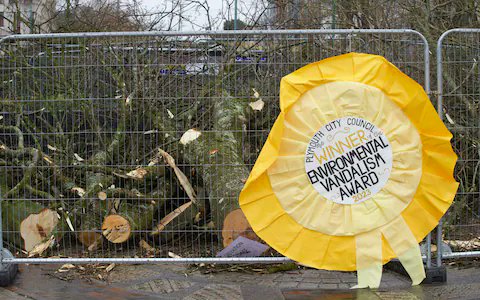

Plans to install a new city centre cycle path on Plymouth’s Armada Way – where over 100 trees were felled by the local authority in March this year, prompting a High Court injunction and widespread protests – have been opposed by local campaigners, who have described the council’s proposal to relocate six trees that survived the so-called “midnight massacre”, to make way for the lane and a new drainage system, as a “shame”, claiming that they are unlikely to survive the relocation attempt.
Save the Trees of Armada Way (STRAW), the group opposing the plans, has nevertheless emphasised that they are not against the installation of the city centre bike lane – pointing out that there is “room for both” cycling infrastructure and the trees – and that the proposals should be “modified, not scrapped”.
The Plymouth Cycling Campaign has also criticised the potential “problematic” removal of the trees.
However, Plymouth City Council has insisted that the trees’ relocation is a “vital part of the overall design” of the city centre scheme and cycle lane, and that the local authority has commissioned experts to ensure that the work is carried out safely and successfully.
The Labour-run council’s plans to rejuvenate and modernise the pedestrianised Armada Way – which it claims will provide a “greener, safer, more family friendly city centre” and “bring life back to the heart of Plymouth” – include creating a gateway to the city centre, adding more trees and greenery, helping wildlife and nature, designing a play village and places to sit for families, and installing a new cycle path for “people of all abilities”, with bike racks and Beryl hire bike hubs.
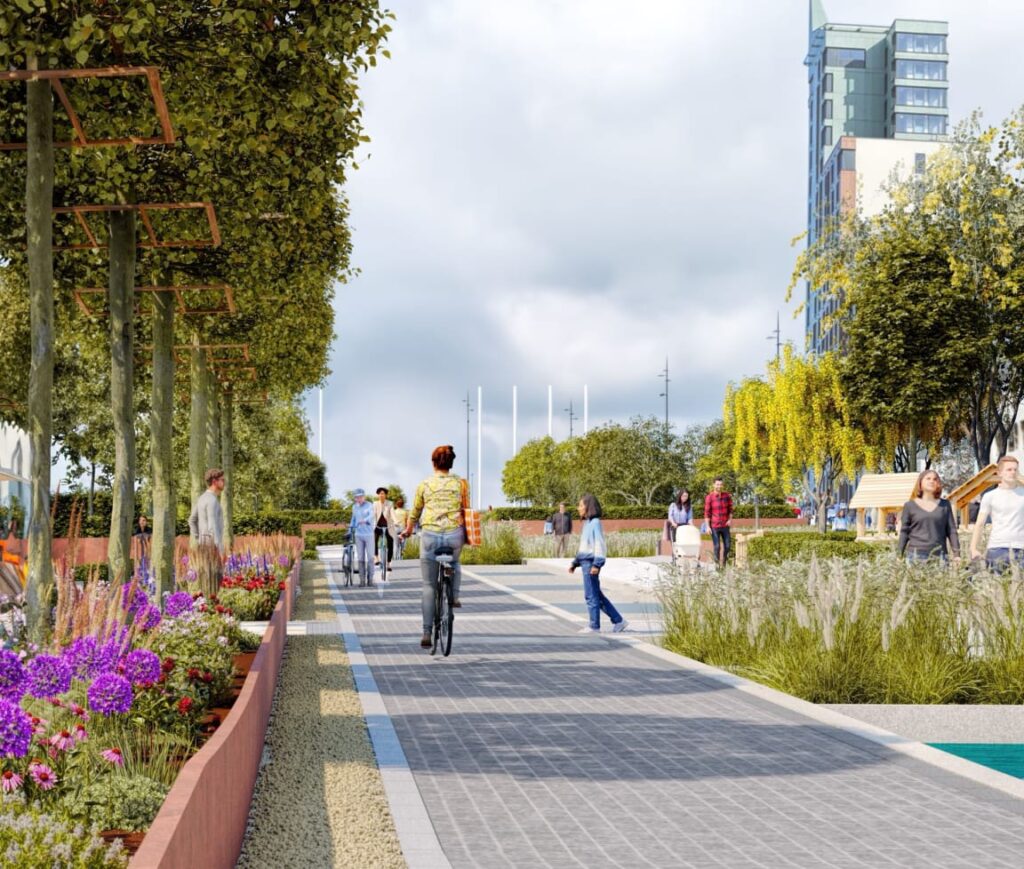
However, the proposals also involve the translocation of six trees to allow for the creation of the cycle path, as well as the installation of a sustainable, solar-powered urban drainage system to deal with the city’s rainwater and prevent flooding.
According to the plans, the trees will be dug up and moved to a different, green site, where the local authority says they will be planted in high quality soil and continue to grow, away from the “harsh urban environment”.
The proposed relocation of the trees comes just eight months after the previous Conservative administration caused a huge controversy after contractors – despite widespread opposition from residents – cut down over 100 of Armada Way’s 129 trees in March, an action local activists branded a “chainsaw massacre” and which was described by environmental campaigner Chris Packham as “despicable vandalism”.
> Plan to cut down 140 trees for cycle lane to new housing development sparks debate
The work was stopped by a midnight injunction, secured by members of STRAW, saving 22 trees and leading to a High Court ruling that the removal of the felled trees could only be carried out following an ecological assessment.
And today, following the controversy in Plymouth, the Conservative government has introduced new powers to ensure that any plans by councils to rip up trees will be subject to public consultation.
While Labour MP Luke Pollard derided the local authority’s decision in March as “nothing short of environmental vandalism”, the then-Conservative council leader said the removal of the trees was necessary to secure the rejuvenation of the city centre and accused the new Labour administration – which took power in Plymouth following May’s local elections – as “kowtowing to a tiny minority of extremist environmental protesters”.
> Angry residents threaten to chain themselves to trees over cycle lane
But now, those very protesters have taken aim at Labour for rowing back on previous assurances that the council would keep the remaining trees in place with “no caveats”.
STRAW leader Ali White has claimed that Labour council leader Tudor Evans “has been saying over and over again” that the local authority would not remove the trees, and that the new Armada Way plans are a “shame”.
“It probably helped them at the May elections. Now they want to translocate six now which will almost certainly result in them dying. In January the council ruled out translocation of the trees because they are ‘unlikely to survive’. It certainly seemed like Plymouth Labour didn’t lift a finger to save the trees but instead used the situation to their advantage politically,” she told the Telegraph.
“One councillor said in a meeting that they had been told by their experts and the Woodland Trust that they would die. No mincing his words. The reason they want them moved appears to be due to a design which could presumably be modified,” she said.
“It is a shame, that even now, the council do not see that these mature trees are an asset which should be incorporated into the new design.”
The group has also told road.cc that it is not opposed to cyclists or a cycle lane being installed on Armada Way and that, at 45 metres wide, “there is room for both” cycling infrastructure and the trees – and that the plans for the cycle lane should simply be “modified, not scrapped”.
Meanwhile, Plymouth Cycling Campaign, a stakeholder during the consultation period, has also criticised the plans to remove the trees, noting that “environmental considerations can’t be ignored and the felling of any remaining trees to create the cycle route would be ‘problematic’.
“In fact trees are increasingly recognised as a useful form of soft segregation,” the group said.
> Jeremy Clarkson claims cyclists responsible for London trees getting cut down … and gets schooled
Responding to STRAW’s objections, council leader Evans said: “We are proposing to translocate six trees to enable the installation of the new sustainable urban drainage system, which is much needed to deal with the city centre’s rainwater, prevent flooding incidents, and help keep our sea cleaner.
“Some of the trees are also situated on the route of the proposed 12-metre-wide cycling and pedestrian route through the centre, which plays a critical role in opening up the vista to the Hoe.”
He added: “We need to find the right balance between creating a modern-day city centre and one that has strong environmental credentials.
“We have spent lot of time over the past few months looking at how we can make it work. Moving these six trees is a vital aspect of the overall design and therefore we have commissioned experts in translocation to outline all the options and recommend how they think we can do it successfully.
“We have not only looked at how we move them, but crucially we have considered their new home, and what we need to do ensure their survival and we are prepared to invest money in giving these six trees a chance.”




















16 thoughts on “Environmental activists oppose “problematic” new cycle lane plans due to proposed relocation of trees that survived “chainsaw massacre””
I read the headline and
I read the headline and thought this was all a bit stupid, but then I read the article about where it was and realised that the protesters on this one maybe have a point.
(Does Plymouth council have any money for this project, after paying the overtime on ‘cutting a million trees down overnight so nobody notices’?)
This article is extremely
This article is extremely disappointing and appears to want to brand our campaign anti-bike which we are not.
Had Ryan done some research he will have found that the Plymouth Cycling Campaign are also against the removal of any more trees and have never endorsed the design of the proposed cycle path.
Very poor journalism on display here with an obvious agenda.
Don’t know Plymouth at all,
Don’t know Plymouth at all, so I had a look. I was surprised initially to see bits of cycle infra marked on the map (granted, all dotted here and there…) And even a grade-separated roundabout!
But then I realised this is because this whole area seems to be marooned within a sea of asphalt, four lanes or more of inner ring…
Looks like they’ve already
Looks like they’ve already achieved the “UK standard” for infra provision here… (it’s a bit faded but that is indeed a cycle lane dumping you onto that “urban motorway” and road furniture blocking most of the footway anyway…)
(Beware vitual safaris…)
(Beware virtual safaris…) Hmm… if I wanted to get to the station there, what mode would I use? Is there one that it seems to be especially convenient for? Could it be buses? No. Walking? Nope…
(Sorry Plymouth – I don’t know the place. I can see there are lots of bits of “infra” marked on the map and I’m sure there are nice places to ride… but I just keep seeming to hit on places where I’d feel like I was an afterthought on a bike. Or indeed on foot.
Protecting the green spaces is important – but there seems to be a lot of mechanical elephants in the room – or street – here, like much of the UK.)
Let’s not forget that this is
Let’s not forget that this is the same incompetency of successive councils that brought this piece of accessibility infra into the world.
They clearly care so much about cycling in this city, it’s a wonder we’ve even got the Beryl hire bikes
What the last Tory council
What the last Tory council did was abhorrent, but this move from the Labour council is dumb. I’d guess about 80% of active travel traffic into Plymouth city centre wants to go E-W so the council would do much better making the Charles cross and Union st junctions more pedestrian and cycle friendly.
The North cross junction at the top of town is great apart from most cyclists (excluding the fast food courier bikes on their LiIon UXBs) go past the Uni and merge onto Cobourg st
This article is extremely
This article is extremely disappointing and appears to have been written with the agenda of wanting to brand our campaign anti-bike which we are not.
Had Ryan done some research he will have found that the Plymouth Cycling Campaign are also against the removal of any more trees and have never endorsed the design of the proposed cycle path.
Armada Way is 45m wide and the proposed trees could easily be worked around. We are proposing they modify the scheme slightly to incorpoate more or all of the trees by moving the path. We did say that it was a “shame” that the council are proposing to remove more but that was due to the anger and hurt caused in March which the council have obviously not learned from.
Plymouth City Council told the PCyC that the design (which has multiple corners, is not very wide and runs alongside a ‘river’ and a large children’s park) was more for recreation than commuting. And on the new design it ends right outside a busy restaurant with lots of outside seating. Down both sides of Armada Way (which is on a hill) will be 2 six metre wide paths. Where do you suppose people will be cycling?
Looks like their comments on
Looks like PCC’s comments on the scheme are here, for anyone interested:
https://plymouthcyclingcampaign.co.uk/armada-way-consultation/
The tree campaign group’s site:
https://strawplymouth.com/
Link to the scheme consultation:
https://letstalkarmadaway.co.uk/
Looking at the roads around the centre of Plymouth I’d say that “lungs” were certainly needed for the city! And possibly ear defenders.
Apropos of nothing but
Apropos of nothing but noticed an interesting quote on their website by the mayor of a Spanish city that’s cut down car use in the city centre drastically over the last 20 odd years:
I think your view may be
I think your view may be skewed on this one… the article does not come across as stating STRAW are anti-bike at all. Well, not to me anyway.
As for the trees, this is simple economics at play; maintaining urban trees is expensive, any opportunity to remove them will be grabbed by the council.
I applaud the efforts of those calling out the translocation for what it is… namely the death of those trees.
As someone who has spent a
As someone who has spent a considerable amount of time moving trees, I can say it can be done with a good chance of survival. It need some care and a lot of maintenance but I suspect that PCC would be very keen to get this right.
Get rid of cars on the road
Get rid of cars on the road and give space to bikes there… Win-win-win.
It’s a pedestrianised road in
It’s a pedestrianised road in the city centre. There are no cars
ROOTminus1 wrote:
Correct. If you want to get there though (or by the looks of it, anywhere in Plymouth)… (Have never been – from Streetview it looks like “possible but certainly not convenient on a bike, because we’ve made massive roads for motor vehicles everywhere” – is that fair? )
It’s fair to say that
It’s fair to say that cyclists here have been gaslit into thinking bus lanes are the highest quality infra we’re going to get.
Sure, they do have diesel fume spewing behemoths, reckless taxi drivers and suicidal delivery mopeds, but unlike all other bits of painted road, they almost link up into a usable network. Except where it doesn’t *swears profusely at Outland road*