


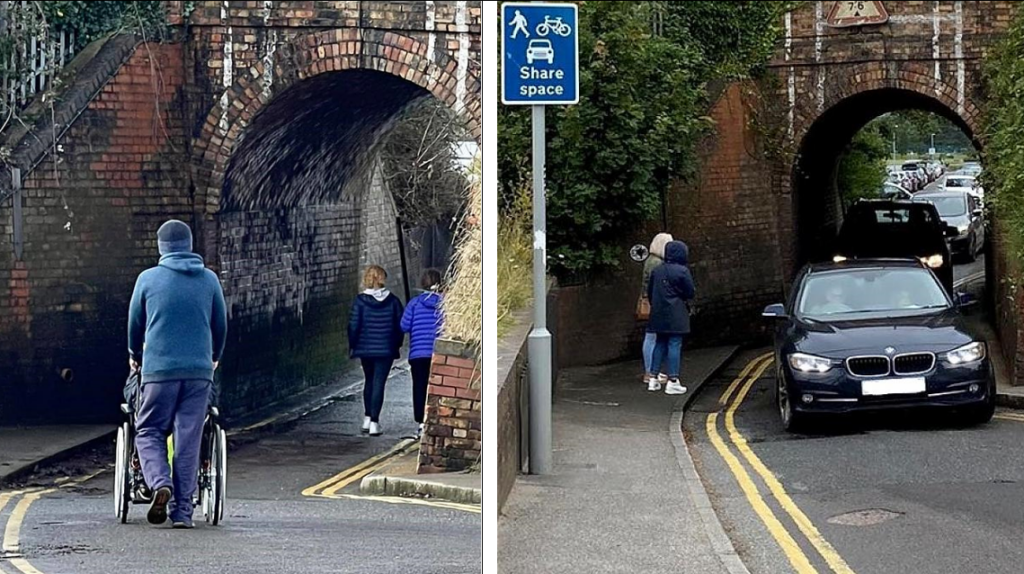

Cycling UK has won a legal challenge against Bournemouth, Christchurch and Poole (BCP) Council over the latter’s decision to keep a narrow road underneath a railway bridge in Poole open to motor vehicles – and says that the decision underlines the need for local authorities to properly evaluate the benefits of temporary restrictions on motor traffic before removing them.
Earlier this year, the charity applied for a judicial review of the council keeping Keyhole Bridge in Poole Park open to motor vehicles, with drivers regularly using it as a rat-run, thereby posing a danger to vulnerable road users due to the narrowness of the road.
> Cycling UK takes council to court over “unlawful” decision to keep rat-run open
The council has now accepted that it acted unlawfully, since it failed to sufficiently follow statutory guidance to highway authorities, and furthermore has agreed to pay Cycling UK’s legal costs, with the action funded by donations to the Cyclists’ Defence Fund, which the charity runs.
During the early months of the coronavirus pandemic in 2020, BCP Council banned motor vehicles from using the road under an experimental traffic restriction order, with the aim of providing a safe, traffic-free route for people on bikes or on foot.
However, despite the opposition of many people living locally, the route was reopened to cars and vans in March 2021.
According to Cycling UK, statutory guidance obliged the local authority to “take account of a presumption in favour of retaining any traffic schemes reallocating road space to people walking and cycling.”
The charity’s chief executive, Sarah Mitchell, said: “This is a victory for the people of Poole, who will be able to breathe clean air and enjoy their neighbourhood with quieter, more peaceful streets.
“The reopening of Keyhole Bridge was a legacy decision the current administration inherited, so Cycling UK is pleased it’s adopted a more pragmatic approach to resolve the case.
“This isn’t the first time a local authority has failed to consider the relevant government guidance before removing schemes designed to get more people walking and cycling by reallocating road space,” she continued.
“It’s crucial all councils realise they need to evaluate how active travel schemes have worked and consider the relevant guidance, and not rush to remove schemes because a minority of people object.”
Commenting on the support, financial and otherwise, that the legal challenge to the council’s decision had received, she added: “I also want to thank all of Cycling UK’s members and supporters whose donations to the Cyclists’ Defence Fund makes it possible for our charity to fight cases like these in the courts.
“While the immediate benefits of this case will be felt locally, we know other councils will take note of this outcome and think twice before restricting people’s opportunities to cycle.”

















13 thoughts on “Victory for cyclists and walkers in legal challenge to council decision to reopen narrow bridge to motor traffic”
(Never been to Poole, maybe
(Never been to Poole, maybe never will, but this sets an excellent precedent, I think…)
And that’s another reason why
And that’s another reason why I’m happy to be a CyclingUK member.
Abslutely, our subscriptions
Abslutely, our subscriptions are obviously being well spent.
Supporting victories for
Supporting victories for ordinary people or shilling and greenwashing for a Petrol Company.
Tough choice. ?
These undead anti-cycling
These undead anti-cycling people seem to be reborn with different names! First it was called Kensington and Chelsea, then its malign spirit returned as Bournemouth, Christchurch and Poole. I am racking my brains and leveraging the power of Big Data to see if there is any pattern or common factor to explain this hostility to cyclists and active travel in general
“This isn’t the first time a
“This isn’t the first time a local authority has failed to consider the relevant government guidance before removing schemes designed to get more people walking and cycling by reallocating road space,” she continued.
Sadly the rule rather than the exception, and huge congratulations to CUK for taking this on and winning. We can only hope that it sets a precedent and other councils will think long and hard before summarily ripping out cycling and walking infra because the new lead councillor for highways is an inveterate petrolhead.
I know a couple of BCP-it’s
I know a couple of BCP-ite’s read theses forums.
The bit I don’t get is that the CUK article says the new council are supportive of the reinstatement. Which begs the question how did it need to get this far?
Better explanation here :
Better explanation here :
https://www.bournemouthecho.co.uk/news/23960371.keyhole-bridge-stay-open-despite-cycling-group-claiming-victory/
I thought CUK’s press release was pretty misleading compared to the above.
Whilst I applaud the victory I’m not sure I particularly like the tone or the content of the CUK PR piece.
The current BCP leader was
The current BCP leader was ousted for a short period by a bunch of pirates using the familiar Tory tool ‘vote of no confidence’ (i.e. public not involved). When the public got a chance to vote, they ousted the pirates and reinstated the original leader. She is quite supportive of active travel, so it’s a shame that her council have had to pay out (It was the current leader who had originally installed the no through, that was reopened by the pirates).
How is this a victory for
How is this a victory for anyone other than drivers? Lawyers, yes.
Another space where are allowed through – everyone else gets to dice with death/injury or not bother.
I had high hopes that Keyhole
I had high hopes that Keyhole Bridge would be closed again after reading the CUK release. Disappointed after reading the councils response this morning that it does not seem to be the case, that it will be closed again.
https://www.bournemouthecho.co.uk/news/23960371.keyhole-bridge-stay-open-despite-cycling-group-claiming-victory/
Just looking on the map,
Just looking on the map, there is absolutely no reason why this bridge should be open to motor vehicles. It’s clearly just used as a rat-run, otherwise you’d go through Sandbanks road or Salterns road. To be honest Sandbanks road also looks awful to walk through, with a narrow pavement on ine side only. The “shared space” sign, above just looks laughable. Accident waiting to happen.
I know that road well.
I know that road well. Absolutely amazing that it should be shut to all motorised traffic. Lorries yes but local house holders, nope. This just adds to mileage and thus ecologicial damage. It is absolutely fine as it is and this is a classic case of taking the easy way out. Slapping several zeros on all motoring offence fines would be far more effective.