



Cycling UK says that Cumberland Council’s assertion that the A591 is “a suitable alternative route” for cyclists following the permanent closure of a section of the National Cycle Network (NCN) is “beyond credulity” and has invited councillors at the local authority for a bike ride to experience conditions there first-hand.
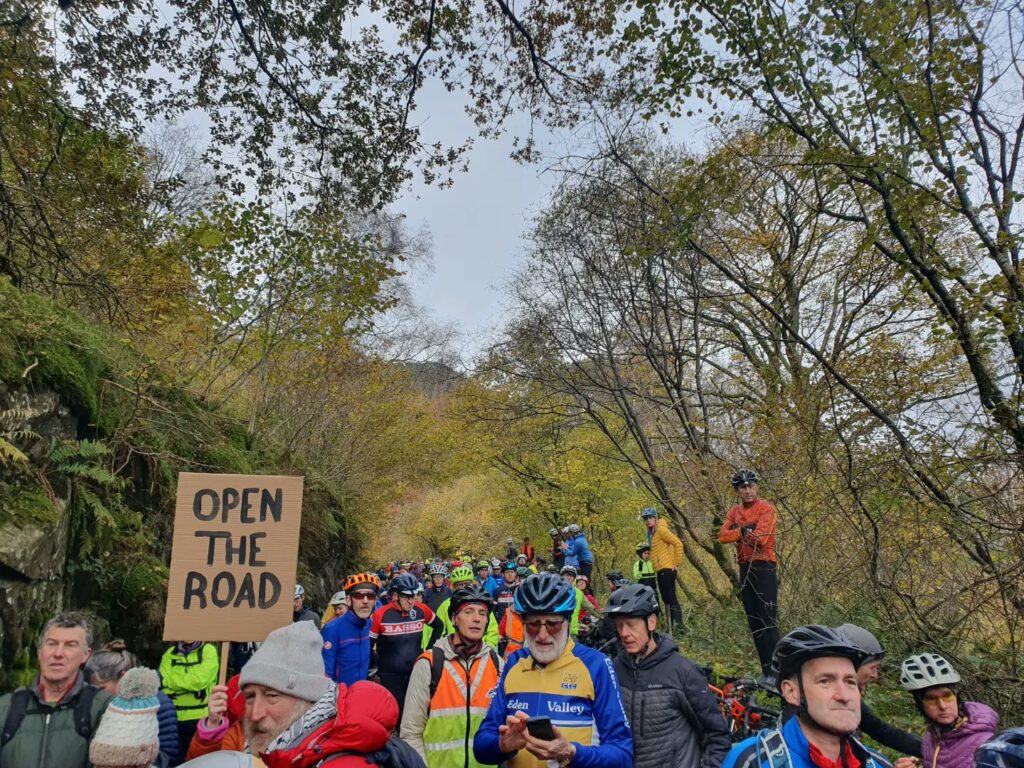
Last weekend, an estimated 1,000 cyclists and walkers staged a protest against plans to permanently close the road, which forms part of NCN 6 and runs along the western shore of Thirlmere Reservoir, which is owned by United Utilities.
The route has already been closed for the past two years due to storm damage, with the utility company failing to have carried out the necessary works to repair it, and Cumberland Council has said it is implementing a Traffic Regulation Order from tomorrow to make the closure, which affects all users including cyclists and pedestrians, permanent.
Sunday’s protest aimed to highlight to the utility company and the council that the road “needs to be reopened to allow a safe, enjoyable and important route for locals and visitors to use.”
Cycling UK says that the road closure means that anyone heading north towards Keswick will be forced instead to use the “dangerous” A951, putting lives at risk, and in a letter to Cumberland Council, a copy of which has been seen by road.cc, is urging the council to reconsider its decision.
The charity said that Cumberland Council’s assertion that the A951 provided “a suitable alternative route” was “beyond credulity.”
The council had said that “Cyclists are not being directed or forced to use the A591 and individuals will make their own decisions on which road to use.
“Whilst the closed road would have less vehicular traffic and would no doubt be more pleasant to cycle, the A591 is a suitable alternative.
“Criminal law and the Highway Code govern the standards of driving and consideration for others of vehicular traffic and all road users owe each other a duty of care,” the local authority insisted.
Cycling UK said that Cumberland Council’s assertion that the A951 provided “a suitable alternative route” was “beyond credulity.”
In response, Cycling UK pointed out that the A591 is “a main road with significant HGV use, and no margins or footway,” and one with a poor safety record in recent years, including five fatal road traffic collisions, and another 16 resulting in serious injury and 30 that led to slight injury being sustained; by contrast, no collisions resulting in death or injury were recorded on the route that is being closed.
“To comment that cyclists and other users are ‘not being directed or forced to use the A591’ is quite remarkable given that no other practical alternative exists – particularly given that the closed route is an established part of the National Cycle Network,” the charity said.
“The removal of this link and dismissive attitude that ‘all road users owe each other a duty of care’ ignores entirely the role of the highway authority in ensuring road safety for vulnerable road users (including their specific legal duties regarding the provision of adequate, safe, footways and cycle routes, neither of which exist along the A591).
“We therefore wish to invite elected members to come and join us on a ride along the A591, which the authority feels is a ‘suitable alternative’, in order for us to assess together the validity of this claim, and the pressing need to reopen the closed route,” Cycling UK said.
The charity also said that there was no need for the road to be closed permanently, maintaining that there was still time for United Utilities to make the necessary repairs and that it should be fined if it failed to do so, and that such works could be carried out under a Temporary Traffic Regulation Order (TRO).
“We continue to believe that such an approach would be more appropriate than the proposed permanent TRO, which fails to reflect the authority’s legal duty to assert and protect the rights of the public to use and enjoyment of the highway, and has no effective ‘sunset clause’ embedded that requires it to be revoked once works are complete,” Cycling UK wrote.
“The lack of such a sunset clause risks the road remaining closed for many years, without any real motivation to resolve the issues and complete the works,” the charity added.
A petition calling for the road along the reservoir to be repaired and reopened has to date gathered more than 10,000 signatures and can be found here.



















19 thoughts on ““Beyond credulity” – Cycling UK slams council’s assertion that busy Lake District road is safe alternative to closed National Cycle Network route”
Simple solution: whoever at
Simple solution: whoever at the council is saying the A-road is safe should prove it by commuting to work by bike along that road every day next week, at peak rush hour, which at this time of year means in the dark in the evenings. I estimate they’d change their tune by Tuesday.
I agree fully with this – but
I agree fully with this – but I’d ask them to take their kids on the ride with them. It should also be mandatory for any new cycle lanes, that the planners and councillors ride on it in winter rush hour, with their kids, before it is officially openend.
Apparently China’s way of dealing with millenium bug fears and aircraft safety was to insist that all airline executives were on a flight, in the air, at the stroke of midnight at new year.
The Chinese do have the
The Chinese do have the redeeming tendency to populate their version of the game of corporate ladders with sharp toothed snakes, or maybe dragons in their case.
Robert Hardy wrote:
Unfortunately China notably favours Monopoly… and I believe their application of the rules of the game is more to do with the “red” player (now a formal, historic term) trumping all.
This should be a standard
This should be a standard approach to many things of this nature – Water Company bosses should be made to swim in their local rivers/ seas once per week, council members responsible for roads should have to cycle and walk in rush hour along any routes that they are advocating as safe, Rail bosses should be obliged to commute on their services etc etc.
A good principle – and I
A good principle – and I doubt that many who commission such schemes cycle or walk on them outside of the special low-traffic conditions of an opening ceremony.
In humanitarian mine action it’s sometimes customary for the deminers to demonstrate safety by walking over the cleared land before handing it back.
Unfortunately those who are ultimately responsible by setting the “direction of travel” / overall budgets – the local government leaders / politicians – will of course remain insulated from the logical outcomes of their choices. “On the side of the motorist” did you say…?
I’m nosey.
I’m nosey.
What is the legal status of this road and who owns it?
Can a council override an Act
Can a council override an Act of Parliament with a TRO? Are the Council acting ‘ultra vires’?
I sadly suspect that that
I sadly suspect that that duty to maintain the road in perpetuity was lost in the legislative history of nationalisation, reorganisation of the public water supply in the 1970s and then privatisation.
Calling the road.cc
Calling the road.cc proofreaders: is this alternative route along the A591 or the A951? 😉
Quote:
Does CUK imagine that any councillor will actually take them up on this??
Nobody has yet explained the
Nobody has yet explained the strange attitude of the council, supporting a profit-obsessed private company in closing a road which both the company and the council have a duty to keep open. Why is the council not only agreeing to this closure solely to save the company money, but they are also providing a legally enforceable Traffic Regulation Order, which costs them quite a lot in admin.
From what I’ve read, the cost of keeping the road open falls on the private company, so why is the council effectively subsidising that company by paying for the TRO and even agreeing to the closure in the first place?
I suspect the answer to that
I suspect the answer to that question can be found by asking another question: why do so many councillors live in nice houses, take fancy holidays, and drive posh cars, when it is officially an unpaid position?
Like others i simply chucked
Like others i simply chucked my bike over the fence.However, since switching to an ebike, I simply do not stay in Grasmere any more.
A complete and utter farce, from well before 2021 too !
Madness. The A591 along
Madness. The A591 along Thirlmere is a road I would never ride on. It is bad enough to have to ride up Dunmail raise with drivers hurtling up inches from you, but at least I knew I could turn left at the top and take the lovely scenic route along the quiet side of Thirlmere. This decision needs reversing.
https://www.newsandstar.co.uk
https://www.newsandstar.co.uk/news/23892604.united-utilities-supports-reopening-thirlmere-road-closure/
IanMunro wrote:
“UNITED Utilities has confirmed that it supports the calls for the re-opening of the controversial Thirlmere Road – but has also offered up an ‘alternative solution’.”
Someone is telling porkies, but who? Why is the council introducing a TRO to close it?
The A591 along Thirlmere is
The A591 along Thirlmere is like an unregulated race track at the best of times. Blind bends, crests, narrow, speed limits ignored by a considerable margin, countless crashes and near misses.
Who do the council decision makers really serve when looked at in the context of this decision? They should be ashamed of themselves.
Utter madness.
“`
“`
“Criminal law and the Highway Code govern the standards of driving and consideration for others of vehicular traffic and all road users owe each other a duty of care,” the local authority insisted.
“`
Well chaps, it seems they’ve found an amazing solution to all road safety fears whilst also sparing the need to invest in proper cycle/walking infra: the law says cyclists and pedestrians can’t be run over so the busy road is totally safe to use!