


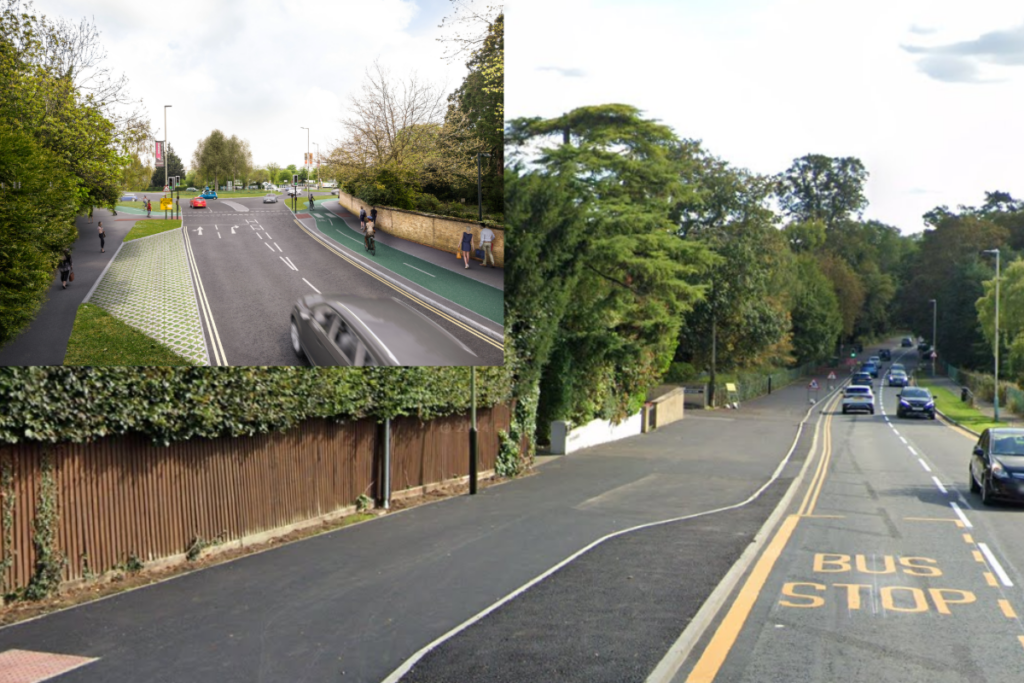

Concerns have been raised about a newly installed cycle lane in Cheltenham, some residents claiming the design has left their driveways hard to access and amounts to a “safety issue” — however, the council responsible has issued an extensive defence of the infrastructure, while some other locals have disagreed with the criticism online and suggested anyone complaining needs driving lessons.
The noise surrounds the Evesham Road stretch of a cycle lane in Cheltenham, a small section of a 26-mile ‘spine’ project that Gloucestershire County Council hopes will link Bishop’s Cleeve to Stroud via Cheltenham and Gloucester. In total, the project is expected to cost £48m and has seen bike lanes, shared-use paths, junction upgrades installed, this section offering users a protected route out of Cheltenham in the direction of the town’s racecourse.
In a piece published by the BBC, some who live on Evesham Road raised complaints that the newly constructed cycle lane has reduced driveway access and made it difficult to get out onto the road. The infrastructure, seen in the image illustrating this article during construction, has since been painted green with additional kerbing added to create a protected barrier between the road and cycle lane.
One resident, Alice Reeve, suggested it is now “a safety issue” that should be addressed.
“We need to get the access wider. It somehow needs markings so that people can see it in the dark,” she said. “I don’t know if there is any way of slowing down the traffic. But the kerbs are too high.”
Likewise, Liberal Democrat councillor Julian Tooke said, “Lots of residents have written to me to tell me that turnings on and off Evesham Road are dangerously sharp since the installation of the cycle lane.”
Another comment online suggested “a five-year-old had a part in the planning” and the design is “a joke”.
However, Gloucestershire County Council has defended the cycle lane in question and pointed out it is designed in line with national highway design standards and has been independently reviewed twice by a road safety team. A spokesperson added that residents had been met “several times” by members of the council and contractors.
“We are confident that there is ample visibility from the driveway when exiting or entering to see pedestrians and oncoming cyclists, but of course all drivers are still expected to be suitably careful of all road users when accessing their property,” they said.
And it seems some others from the area agree with the council, one comment online asking “how fast are these cars going” for these turnings to be “dangerously sharp”?
Another comment said: “There was consultation so they should have said then, not after. Take some driving lessons to ask: ‘How do I approach and exit’.”
On the project’s website, the local authority explains:
There is significant independent and impartial evidence that providing high quality cycle infrastructure increases the number of cyclists. We know that cycling in parts of Gloucestershire is in excess of the national average, particularly in Cheltenham, where good infrastructure exists. In addition, we are following government guidance to deliver better cycling and walking infrastructure found in Gear Change, the Department for Transport (DfT) vision for cycling and walking in England. This highlights that 2020 saw a 46 per cent increase in cycling, evidencing the potential that exists for this mode of travel if low traffic routes and routes segregated from traffic are available.
The new cycleways will be suitable for all users, including the young, elderly, disabled and the less mobile. The route will provide separation from traffic wherever possible, to further attract those who would previously not have considered cycling or did not feel confident to cycle along the road.
The need for a cycle route between Cheltenham and Bishop’s Cleeve has long been recognised. Currently, cyclists have to either navigate a busy A road or use routes through Racecourse land to travel between Cheltenham and Bishop’s Cleeve. There is a real need and desire for a safe and direct cycle link between Cheltenham and Bishop’s Cleeve.
The local authority will hope its conviction and belief in the scheme is paid back in a similar way to the situation Swansea Council enjoyed late in 2024. Despite claims a cycle lane would increase collisions and was “dangerous”, collision figures from South Wales Police showed that there were no “serious” incidents in the three years since the cycle lane built and “slight” incidents were reduced too.
Blocked driveways and cycle lane criticism was also a story that emerged from Dorset in recent times, upset locals claiming they had been “blocked” in their driveways by wands installed to segregate the route from traffic.
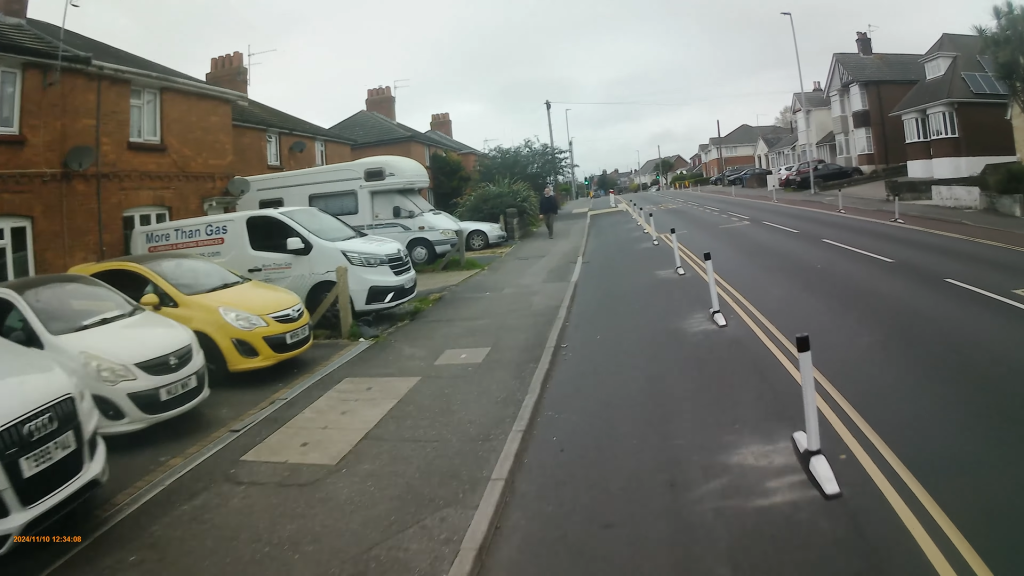
However, as Andy Hadley, cabinet member for roads and cycle lanes at BCP Council, said in his response to the backlash, part of thinking is to prevent drivers from blocking it by parking their cars in the bike lane.
He did however also accept that in certain locations where it had created “most difficulty” the council would “listen to feedback” and “adjust the positions of wands to ensure continued property access”.






17 thoughts on ““It’s a safety issue”: New cycle lane blocks driveways and kerbs are “too high”, residents claim… but council insists “ample visibility” and tells drivers “to be suitably careful of all road users when accessing their property””
Quick reminder that the only
Quick reminder that in the bottom photo the only vehicle whose driver appears to have a reasonable expectation of lawfully accessing to/from their driveway in the vehicle is the motorhome. None of the others appears to have an aligned dropped kerb, or to be able to manoeuvre to the dropped kerb. Any other access in a motor vehicle amounts to the offence described in s72 of the Highways Act 1835, on each occasion of access.
The wands appear to be aligned with the dropped kerb, so the driver should be OK.
Any complaint about a loss of access to those other hard surfaces is null and void, since there was no legitimate access in the first place.
I didn’t know about this law/
I didn’t know about this law/ regulation. Looks like yet another motorist offence the police and councils condone
Councils don’t ignore that
Councils don’t ignore that specific breach. It is not in their gift to enforce. There may be planning and/or highways breaches that may be enforced, for examples:
In practice, enforcement has to pass the test of being expedient and in the public interest before a council should take action. The constraints on councils and their enforcement officers’ time is such that it can be difficult to meet that subjective test.
As for the police: they apparently cannot sustain a prosecution for s72 unless witnesses by an officer/PCSO. When I am ruler, I shall ensure that the presence of a vehicle in the wrong place is taken as prima facae evidence of an offence, with the onus on the defendant to prove the vehicle was placed there legally. A s172 notice could then be served on the owner who will be liable in the absence of a nominated driver.
Thats exactly what I was
Thats exactly what I was thinking. Only one driveway. The others can swivel.
Get proper approval from your council, and get them to install an appropriate drop kerb. Or shut up.
GMBasix wrote:
Excellent point, which is something often forgotten. Motorists now [i]routinely[/i] park four-square on the pavement, to the point where roads with wider pavements are seen as legitimate “off-street” parking for residents. No doubt this is factored in to their property price, so it is embedded in their thinking – they’ve paid for it! So any proposal to use the pavement width for, say, a cycle lane, meets with entrenched opposition.
I still find it utterly
I still find it utterly baffling that people are so hard wired to think that driving is their god given right (obviously because they passed their test 45 years ago therefore are a very good and safe driver) that they will happily admit that they cannot handle even basic hazard perception without the risk of hurting someone with their cars.
In most environments this would raise eyebrows at a minimum and attract mocking most of the time. Apparently when it comes to cars though its perfectly acceptable to suggest that you crashed into someone because you didn’t drive to the conditions or because you don’t actually bother looking when you pull out.
Incompetence paradox, innit?
Incompetence paradox, innit?
Driving is hard! But I’m a responsible driver (can prove it – not ony am I responsible enough to afford a car, I even pay lots of tax for the priveledge, and insurance! I actually bothered to get a licence!) And of course I have to drive.
Ergo you get sympathy if you don’t live up to your own high standards (“accidents happen” and “there but for the grace of god go I”).
If I lived on that road in
If I lived on that road in Dorset with the wands, I’d be more pissed off with the inconsiderate neighbour parking a fucking great daylight blocking campervan in front of the house, than a couple of wands in front of my house. Up and down the country people like this are tarmacing what were probably nice front gardens and dumping their eyesore monster vehicles in front of their houses. That campervan probably only leaves the drive once a year.
What a foul mouthed and
What a foul mouthed and unpleasant post! What business, Muddy Ford, is it of yours – or any one else – if residents of those properties wish to park their campervan on their property?
Surely it’s a matter of ‘live and let live’!
It’s all “share the roads”
It’s all “share the roads” and “it’s public space” until someone else slows you down or parks in your spot.
You might notice the use of a relative clause here also “more … than a … “
Given that the law does in fact have concepts for stuff that people may do in their own space that has (negative) bearing on others, it may well be “someone else’s business” if e.g. someone blocks your light etc.
These folks are of course regularly breaking the law (not a lawyer but I think in section 184- Highways Act 1980 EDIT see other posts, that one is about what happens if / when an offer is made to create a dropped kerb?) and doing something which does in fact increase risk to those on the footway / possibly other drivers, may damage the kerb / footway etc.)… of course the circumstances under which that is actually enforced are (by choice of authorities) incredibly rare!
Advanced Driver wrote:
It would be my business if I happened to live next door. That campervan is an ugly monstrosity that blocks daylight from reaching the house windows. If that ignorant person who clearly doesn’t give a shit about their neighbours wants a van like that they should get a house with a proper parking space for it rather concreting over a garden and blotting out the sun from their neighbours.
How interesting that you are
How interesting that you are more concerned by someone’s choice of language than you are about people selfishly parking enormous vehicles in locations where they can completely cut off their neighbours’ access to natural light in their own homes, something that can have seriously deleterious effects on both physical and mental health. For all the pearl clutching in the world, “bad” language hurts nobody, selfishly restricting access to one of the fundamentals of human life and well-being for your own convenience does.
Point being it’s a garden
Point being it’s a garden ,converted into parking .It was never intended to be that .I know it would irritate me having that parked up 9/10 months a year .1 house in that pic has had proper approval and dropped the kerb as is legally required ,it’s very clear to see ,that caper and all the other cars shouldn’t even be there
There’s a relatively shared
There’s a relatively new shared path in Northants that basically runs along the A508.For some reason after several months they’ve been back along it adding a number of confusing “Cyclists Dismount” signs even though the path continues. They also added some give way lines like this (the giveway on the drive was already there but the ones on the shared path are new). It’s almost like they want the cyclists to use the road.
Funny how so many drivers
Funny how so many drivers bring up the point that they pay for insurance, implying that cyclists should too. One has always been a legal requirement, the other historically not. A bicycle must remain a mode of transport that anyone can use without the need for legal interference, including children. Even the children of drivers, who’ll be the main beneficiaries of carbon free transport in the future when climate change really kicks in.
If cyclists should have the
If cyclists should have the same requirements as cars, then shouldn’t cars have same requirements as HGVs…
So 56mph rev limiter, yearly medical exam, tacho enforced milage limits, etc
Also motorbikes, so suitably designed helmets; note Adelaide university designed a one size fits all car headband that is more effective than cycle or motorcycle helmets because seatbelts + car shell reduces impact forces and types to something head protection can actually be designed to cope with. (N.b. may be less effective now as airbags have improved a lot…)
This default assumption that
This default assumption that “it isn’t compulsory” = “nobody has it” also shows you how many would not pay for motor insurance given the choice, despite the damage they might do to themselves & others.
You get third party liability cover (at a higher limit of liability than under a motor policy) thrown at you as part of CUK membership. Insurers are many things, but they know about risk. Hence CyCliSt InSHuRanCe is so cheap – because we’re not where the risk is.