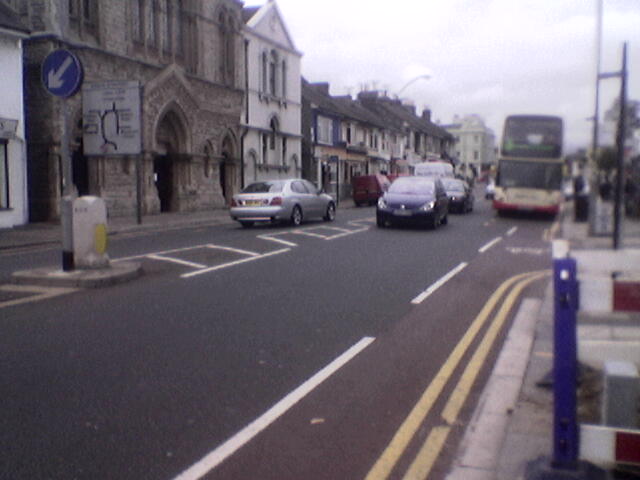
Brighton and Hove, which has been a Cycling Demonstration Town* since 2005 been criticised for plans to tear up a section of cycle lane on one of the busiest routes in to the city. Brighton and Hove Friends of the Earth (BHFOE) are objecting to the plan to remove part of a southbound cycle lane in Lewes Road, Brighton. The cycle lane would be replaced with pavement, extending out into the road with a pelican crossing as part of a council Safer Routes to School scheme. The crossing would be added to Lewes Road just before the junction to Hartington Road. “The new proposals are totally unacceptable and I don’t think we can take the loss of these cycle facilities lying down,” said Chris Todd of BHFOE. “This will force cyclists out of what was the cycle lane into the main stream of traffic with little warning and then squeeze them through an inadequate road width. I believe that this is unacceptable and should be strongly resisted.
“The proposed traffic orders go against local, regional and national transport, health and sustainability policies,” said Chris Todd. “They go against strategies to increase cycling and physical activity, and to reduce reliance on cars and to reduce air pollution and carbon emissions.
“Brighton has to do a lot to prove to its commitment to cyclists. I hope that common sense will prevail but to have even submitted these plans is outrageous and unbelievable.”
Local cycle commuter Gregg Virostek who uses the Lewes Road cycle lane was even more vocal. “The Lewes Road cycle path is a disaster! There is absolutely no continuity of design from the Seafront to the Universities. The council should put everything they have earmarked for cycling in Brighton into designing and building a dedicated and segregated cycle path from the Universities to the Seafront. "I understand why some cyclists feel the need to ride agressively along this route, it is a dangerous and disorganised cycle path with little or no signage and only about 80cm wide. The uneven road surface is littered with grates, cracks and slicks of oil and chemicals. Buses are constantly having to pull out infront of cyclists or waiting for them to clear the slip into the bus stop.
"It’s almost as if the council is trying to discourage cycling to the nearly 50,000 students in this area (not to mention all the support staff at the many locations).” he told road.cc. And the criticism doesn’t end there. National transport charity Sustrans is also not impressed with the council’s plan. Speaking to road.cc a Sustrans spokesman said: “We do support FOE on this and we objected to the Traffic Regulation Order because we believe it is a poorly designed scheme and the public consultation has been inadequate. Lewes Road is an important route for Brighton which should have a continuous cycle lane. This could be put in place alongside a safe route to school for children.” (Sustrans has its own Safe Routes to School initiative not to be confused with Brighton’s Safer Routes to Schools). The City Council is currently looking again at the scheme with the aim of finding a solution that balances the interests of cyclists and users of the local school. Brighton and Hove, which share a single city council, have had government-conferred Cycling Demonstration Town status since 2005, allowing them to develop cycle freeways and amenities. Now they have been selected (together) as one of 12 English cycling towns and cities to receive increased funding for the promotion of cycling from 2009 to 2011. The total amount available is projected to be £100m with £47m coming from Cycling England and the rest made up in matched funding. Brighton and Hove will be in line for a sizeable chunk. Brighton and Hove Council is also seeking to be the first city to be designated as a Biosphere Reserve by Unesco and later this week hosts a conference on sustainability. * Yes, we know Brighton and Hove is a city, but for Cycling England funding purposes it’s a town.
- News

Outrage at cycling demo town’s plans to rip up cycle lane

Add as a preferred source on Google
Help us to bring you the best cycling content
If you’ve enjoyed this article, then please consider subscribing to road.cc from as little as £2.49. Our mission is to bring you all the news that’s relevant to you as a cyclist, independent reviews, impartial buying advice and more. Your subscription will help us to do more.
No Comments
Read more...
Read more...
Read more...
Latest Comments
Interesting counterpoint to the 'hire bike menace' narrative (obviously with the caveat that the report authors have a vested interest in selling the benefits, but...) Appears hire bike schemes go some way to addressing the cycling gender imbalance and, given the point about parking immediately outside the destination, dockless schemes particularly so. https://micromobilitybiz.com/forest-report-finds-shared-e-bikes-are-helping-close-london-cycling-gender-gap/
@chrisonabike True, things went back to normal once the pandemic was over. In this case, however the problems are still ongoing, and aren't likely to be resolved in the near future. If anything, they're going to get worse. Food shortages are predicted because of the effect that the heatwave has had on crops. This is bound to push prices up. The Straits of Hormuz aren't likely to reopen anytime soon and the strategic oil reserves are running low. Russia is having to import petrol because its own refineries have been badly hit, so that's even more competition for an even more scarce resource. I think that more and more people are going to see cycling as a way of cutting household bills.
I think if "grown up" cyclists * are quibbling about ASLs we've very much missed the road safety point anyway. (Not to mention the wider "better transport choices" picture). ASLs are poor-to-useless "cycling infra", even for their design intent. If the idea is "for less confident cyclists" then a design that requires that you re-position in front of the motor traffic - waiting to accelerate - seems unhelpful. Of course they're only designed to help when traffic is stopped, and you can reach the front in time and if vehicles aren't already occupying them. As we're noting here drivers frequently ignore them - whether that be deliberate, a lack of road craft, because they were concentrating on following the vehicle in front, or because the paint has rubbed off. * Aside: shouldn't cycling also be safe and accessible for kids? Or should they only be allowed to do this when accompanied by sufficient qualified adults? Or be limited to parks and otherwise being driven around by their carers? Perhaps there is another way...?
Hi Bungle, I saw you follow-up comment. I can't imaging there's a tolerance of 4 seconds on camera enforced lights, seems an odd decision - an offence is committed if a vehicle starts crossing on a red, any tolerance is discretionary. There does seem to be some odd thinking about 'advanced stop lines' where the rules relating to them are identical to a regular stop line, as explained correctly elsewhere in the Highway Code. It does seem a regular offence. Where I live it doesn't help that some of them are very faint and disappear in rain.
@ktache Not sure he's totally ruled out of the worlds yet (though I think it would be best if he doesn't), normal recovery time is about eight weeks but surgery can halve that...depending on the nature of the break he could be just about fit to ride by the time of the elite men's race, but he'll have missed a lot of training. Hopefully his managers and team will persuade him to wait until Lombardia, if not just to knock it off for the rest of the year.
@Bungle_52 The Met told me a couple of years ago when rejecting a submission that they needed a clear three seconds of red visible before they would consider it for an RLJ prosecution. I pointed out to them that this meant that at 30 mph a driver could see a light change to red from 40 metres away and still get through without sanction, or 55 m if they accelerated to 40 as most do. They just replied "them's our rules..."
@Ben Graham I have just checked the footage from my report. The driver crosses the 1st stop line 4 seconds after the light turns red. All on camera from behind the vehicle. No further action. So I assume the margin is at least 4 seconds.
Oh, and active travel funding per head (in England at least) is laughable compared to other places. Plus it is delivered intermittently. It's more like a Blue Peter contest...
Yup, I see those opportunities being missed all the time in Edinburgh. When it gets really bad, dig it all up and put it back down again how it was. Contrast with what seems to happen in NL - when things are dug up the whole thing seems to get a "let's redo this according to the current standards" treatment. They even coordinate with the utilities, so that after a refurb the street isn't immediately dug up again because of leaking pipes / we suddenly realised the new estate being planned for round the corner will want broadband etc. Pros and cons of course - you may wait longer there for changes as smaller changes may be deferred until a major redo is due. (Though in the UK case you likely wouldn't get them at all...) It seems we "can't have nice things" in the UK in part because a) we have greater motor traffic speeds/volumes spead across "streets" / within urban areas b) the funding and organisational responsibility differs. Are we in the "Sam Vimes boots" territory (being too poor to afford better products which not only save money over time but actually work)? There is long term money pressure on LAs and it seems that due to poor construction and maintenance we have to regularly pour money into (pot-)holes in the road. And it seems there's no budget to check up on or enforce adequate standards from utilities work or even private building.
Shame about the world champs defence. Speedy recovery. https://www.theguardian.com/sport/2026/aug/30/tadej-pogacar-vuelta-a-espana-cycling-crash-hospital-stage-nine