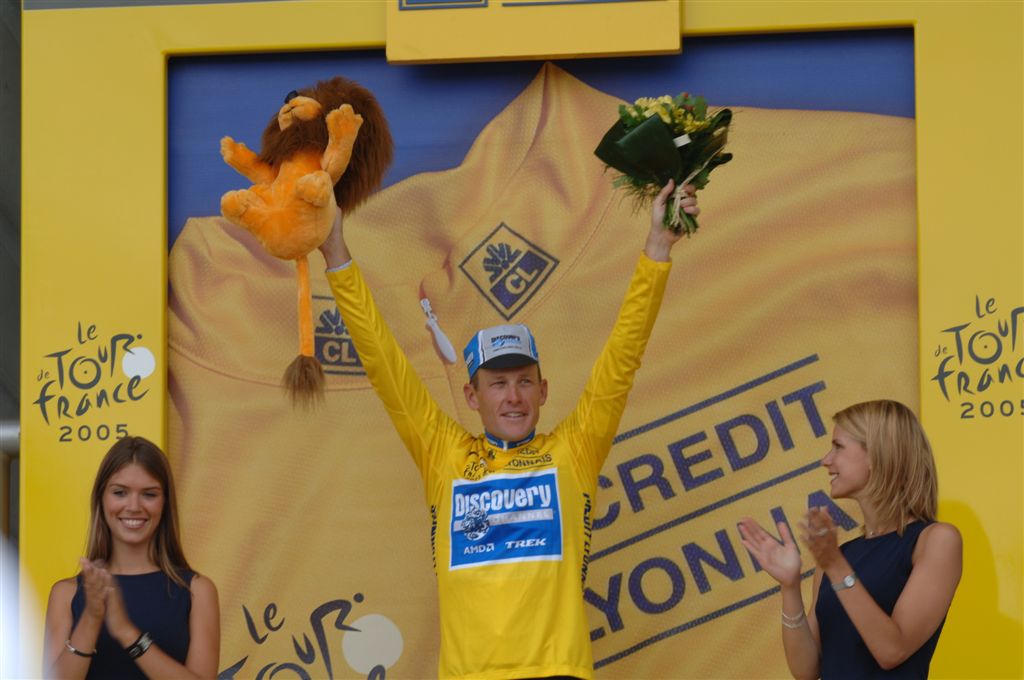

Seven-times Tour de France winner Lance Armstrong will race in next year’s Giro d’Italia according to the news agency Reuters. This would be the firs time he has ever ridden the race. His reason for adding it to his comeback schedule say the organizers is that it fits in with his aim of raising awareness of the fight against Cancer. The 37-year-old, who retired in 2005, will compete in the May 9-31 race before bidding for an eighth Tour title in July. "I will give my utmost, and not only to prepare for the Tour," Armstrong said in a statement from race organizers RCS Sport. "Not having taken part in the Giro was one of my biggest regrets as a rider. Finally I will be able to do it." Armstrong’s first race back will be in January’s Tour Down Under in Australia after he was cleared to compete by the International Cycling Union (UCI) last week. Riders making comebacks have to be in the UCI’s anti-doping program for six months prior to racing but the governing body has made an exception for Armstrong, who announced he was returning to the sport only last month. Armstrong, who fought off cancer and was latterly dogged by unproven doping allegations during his career, is partly making a comeback with the Astana team to promote a global cancer awareness campaign. The Giro will be celebrating its centenary next year. The route has yet to be announced. There is no word yet from the Astana team on who would be the designated team leader Armstrong or 2008 Giro winner Alberto Contador. Given that raising cancer awareness is such a big part of the reason for Lance’s comeback the announcement of his Giro entry also raises the intriguing prospect that he may also enter the Vuelta too.
- News

Armstrong to ride 2009 Giro

Help us to bring you the best cycling content
If you’ve enjoyed this article, then please consider subscribing to road.cc from as little as £2.49. Our mission is to bring you all the news that’s relevant to you as a cyclist, independent reviews, impartial buying advice and more. Your subscription will help us to do more.
No Comments
Read more...
Read more...
Read more...
Latest Comments
@Rendel Harris Just been having a look at that. At first glance it would appear random, but I'm guessing there is a carefully thought out "but we have bus stops" (the south end appears to be a general bus dumping ground, across various years in the Streetview images), "because we have parking" (most places) and "because we have side streets" (which are treated more like other roads joining). I'm not sure I'd take those cycling markings much more seriously than the average driver if I were there regularly, TBH. You'd almost have to memorise where you need to be, and it looks like even if you could get to it that's not always a good place anyway. Also seems to have a major "queueing traffic" issue at the north end - in the 2024 image at least. Since (guessing) it was delivered under Boris, "logic" might not have been enforced from the top. Can't claim things are better "on the roads" here - except the traffic is much less intense (apart from rush hour maybe). And I'm realising my autopilot almost always takes me away from the roads entirely where possible. (In north-west Edinburgh there's an almost-network of off-road shared use which I can use for many common journeys).
@chrisonabike Yes, it's a pretty crap stretch even without the roadworks, Southwark Bridge Road: you get low kerb protection for a little while, then paint, then no protection at all, then paint again until finally some proper balustraded protection on the bridge itself. There doesn't seem to be any logic to this in terms of road or pavement width. Never seen it flooded like that though and we haven't had any rain in London since Thursday, so suspect it may be a burst pipe issue rather than poor drainage.
@Dodonline because the riders cycle them?
Presumably you can get in a good session on your way to the destination if you take your Peloton with you?
@FionaJJ I think Ranty Highwayman has it right. Start from the beginning: why do we need these at all? It's (mostly) the car in the system. For one very often bus stops take more space because we want to "leave the road clear while the bus is stopped" which then means "our street is too narrow" etc. "BUT, some people are @rseholes, and cycling fast through the bypasses, ignoring pedestrians and refusing to slow down or stop for those trying to cross should be condemned." Yes ... and education and people getting used to cyclists is part of it. But I think the real hurdle is accepting this is a perfectly legitimate '3rd mode' of transport on our streets. And that depends on other (major, chicken-and-egg) changes. Such as *having* cyclists in the first place! And making a *place* for cyclists. In the UK we have space for motorists and (mostly...) for pedestrians. Cyclists have some things in common with both but aren't either, so are inevitably in the "someone else's space / way" at some point. As RH points out - our existing rules (on zebra crossings) and feelings about cycling are at odds with how pedestrians and cyclists interact in mass cycling situations. In the UK cyclists are most often seen as "mini motorists". Many pedestrians - through bitter experience - expect cyclists to come to a complete stop before they cross, like cars. (Of course the UK rules are also that they still have to start crossing before anyone is required to yield...) But quite a few pedestrians will just follow "desire lines" and cross wherever also. Not a few cyclists also see themselves as "drivers" and - like motorists - may try to "get in front" of pedestrians waiting to cross. Whereas in the "mass cycling" situation everyone understands that they can "negotiate" visually. Both pedestrians and cyclists understand that they can normally avoid each other with a small adjustment to their speeds. Pedestrians are also cyclists on other occasions, so they appreciate that avoiding making cyclists come to a complete stop makes cycling much more appealing.
RE flood edition - I've not yet tried the London cycling superhypeways but never mind the flood - is that all of 15 metres of vaguely kerb-protected section, before that peters out and then you fall into some roadworks?
@OnYerBike apples and oranges, but good would be a ramp that everyone can use - ticks even more accessibility / health and safety boxes that stairs! Of course that would be serious budget, and probably protracted wrangling about where it would go. But lifts are spendy also, and a ramp will keep working when the lift breaks down.
@mctrials23 IIRC almost all "public space" engineering is remarkably if not wildly expensive. Some is doubtless "it's not my money I'm spending" but a lot of it is "this will save money when it doesn't get trashed in a week / cause some injury". And it might seem very cheap if you find yourself in court, potentially on the hook for hundreds of thousands or more, and can have confidence in stating that all due diligence stuff was covered and you didn't just get your mate to do it for a few beers.
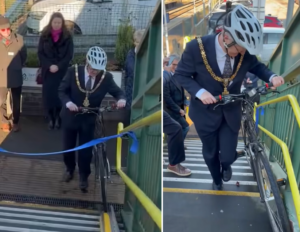
Also - aren't we all supposed to be wearing stair helmets these days (if it saves one life)? Seems consistent!
As you know, no, they aren't. They're mitigation for *some* people where "we should have addressed access concerns in general" applies: - a ramp / underpass could potentially be accessible to *all* - for a retrofit a lift might be preferred (and noting the group are sensibly trying to get one) "because space constraints" (sounds familiar...). Though lifts are more expensive to maintain and sometimes will be out of order. As mdavidford says - these things are not even helpful for everyone on wheels. Although if you do have any kind of adapted cycle / a tandem or recumbent you might be advised not to try to get a train anyway (rail companies vary - will any take these?) And aren't some down on EAPCs also? Unfortunately even ones that are correctly installed are likely to present a trip hazard - more if they're easier for cyclists to use e.g. further from the edge. If someone's done the maths and believes they're on balance less dangerous / costly, then the ones with some kind of brush strips on either side to provide some drag might be advisable?