
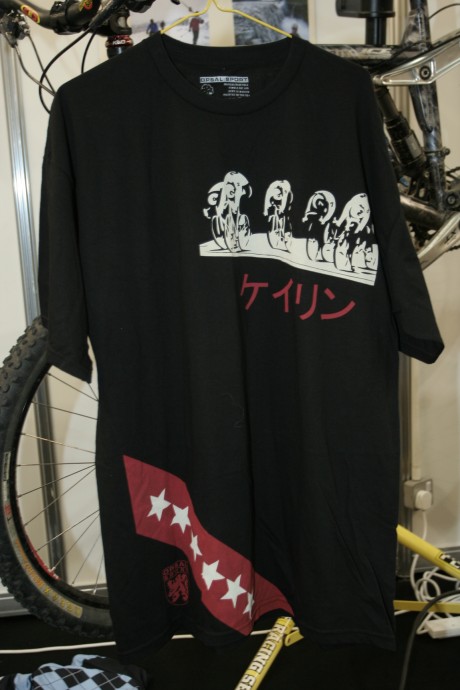
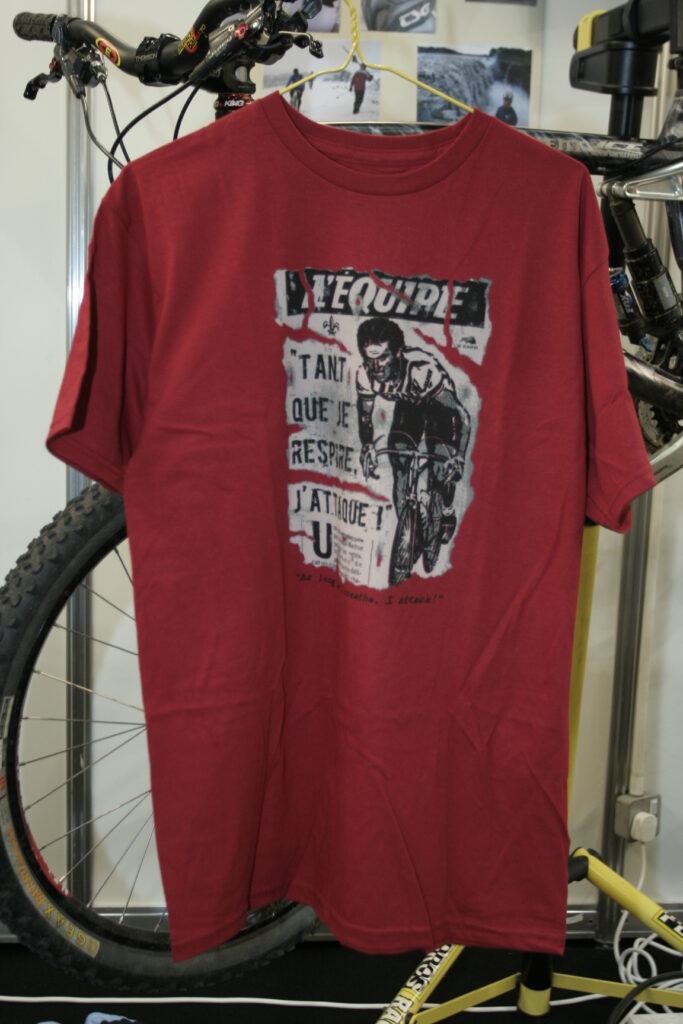
The guys from Opsal Sport popped round to the stand to show us their new range of shirts. All the designs are by cycling artist Brian Opsal, and printed in eco-friendly water based inks on organic cotton shirts. There’s a range of Tour de France and generic cycling imagery. Pictured are a shirt based on a L’Equipe cover featuring Bernard Hinault’s famous quote, ‘Tant que je respire, j’attaque!’ – As long as I breathe, I attack! – and a design inspired by the red stripe worn by elite S-class Keirin racers. For details of the full range, hop over to www.opsalsport.com – there’s more shirts, and posters too. 
- News

Opsal Sport T-shirts

Add as a preferred source on Google
Help us to bring you the best cycling content
If you’ve enjoyed this article, then please consider subscribing to road.cc from as little as £2.49. Our mission is to bring you all the news that’s relevant to you as a cyclist, independent reviews, impartial buying advice and more. Your subscription will help us to do more.
4 Comments
Read more...
Read more...
Read more...
Latest Comments
@Mr Blackbird where can I find photos of this study? Asking for a friend.
@Gd29 I was waiting for the classic "why don't we just ban driving completely by reducing the speed limit to 5mph or 0!" argument and here it is. The statistics are very clear on the benefits of reducing the speed limit from 30-20mph. It doesn't remove bad driving but it mitigates the damage. It also makes fuck all difference to journey times. Everything with driving is risk vs reward. Sure, dropping it to 10mph would save a lot more people but it would make travel by car ridiculous and have minimal benefit vs 20mph. The reward wouldn't be worth the cost.
@Gd29 "Speed limits are an ineffective tool when the problem is drivers not driving in an appropriate manner for the conditions and environment. Those drivers weren’t following the speed limit and/or paying sufficient attention anyway!" That is a question, not an assertion. What are the relative numbers of drivers who are eg. "don't care" criminals who may never have taken a test or are happy to take life, how many are "criminally negligent" eg. may have a licence and not intend to break the law regardless, but just aren't fussed about basic safe driving (maybe regularly drive while tired, never slow down when conditions require), how many are just normal humans (who occasionally make unfathomable mistakes)? What are the relative rates of collisions? What are the casualty outcomes? What effect does simply changing a number on a sign have? If any, why? (There's the psychological "anchoring effect", if 70% of people *are* below the limit does that slow down others, do the "don't cares" maybe just overtake dangerously (but would they anyway? ) ) etc. Reduced speed is a mitigation in that it leads to better outcomes in collisions, that's a known I believe. IIRC there's also agreement that it can mean that fewer collisions happen as there's more time to react. "If that is the problem and you don’t deal with it, but you want to keep reducing injuries/fatalities, you have to keep dropping speed limits until you prohibit road use entirely" "If" (plus as noted other safety measures are available)
@Rendel Harris - I think that driver must live near me.
@Gd29 it's good to "point out potential abuse of stats - and for "keeping it concise for the public" no doubt some measure of "lies, damn lies and statistics" applies. But unless you have your own analysis / evidence, this may sound like a "just asking questions!" rhetorical tactic.
@Gd29 exactly what variables / controlled experiments would suffice to convince you, and then how would you believe that would still hold in "real world" situations? We all know there are excellent ways to stop motoring-related KSIs - one being stop humans operating vehicles) but that isn't normally seen as realistic. Then there's another "remove the hazard" approach eg. completely isolate motorists from vulnerable road users (and "footways" alone might not be sufficient, as more people are killed there most years by drivers than eg. by cyclists in total, although that fact doesn't say much ). Though that by itself doesn't address motorists killing themselves / other motorists. Currently the UK - like many countries - is mostly doing a "remove the vulnerable road users" approach, partly by design but mostly indirectly by prioritising convenience for motoring (including journey time, which is seen to involve higher speeds).
Do you really need an AI tool to tell you that 80% of a cyclist's drag is the rider or that getting in a more streamlined position you'll reduce drag etc.? Fabulous for the professional riders who use this site but for the rest of us our money would be better spent on yoga or pilates classes to help you hold a more streamlined position in the first place.
Of course drivers need to be responsible and take care but we are in danger of getting a bit high and mighty when police raise issues like this. Since the clocks went back last weekend, I have been commuting home this week in the dark for the first time this year. I am gobsmacked by the number of cyclists I see who have no lights and no reflective gear, often with no helmets either. It's common sense to take precautions and we've got our head in the sand if we pretend all cyclists are taking appropriate steps to protect themselves and others.
@mdavidford was about to ask them if they thought the law should also been changed to ban the LAs from doing that, so as to save money...
@Rendel Harris sentencing is Monday. 15 yrs minimum (not premeditated) but multiple aggravating factors. 20+ feels appropriate
4 thoughts on “Opsal Sport T-shirts”
That Hinault shirt…
looks pretty cool
So does this…
http://www.opsalsport.com/modules/gallery/displayImage.php?category=3&id=25
rather topical too
and this one is, well….
http://www.opsalsport.com/modules/gallery/displayImage.php?category=1&id=31
Right on brother
a smack in the face with the firm hand of morality. that’s just what i needed this morning.