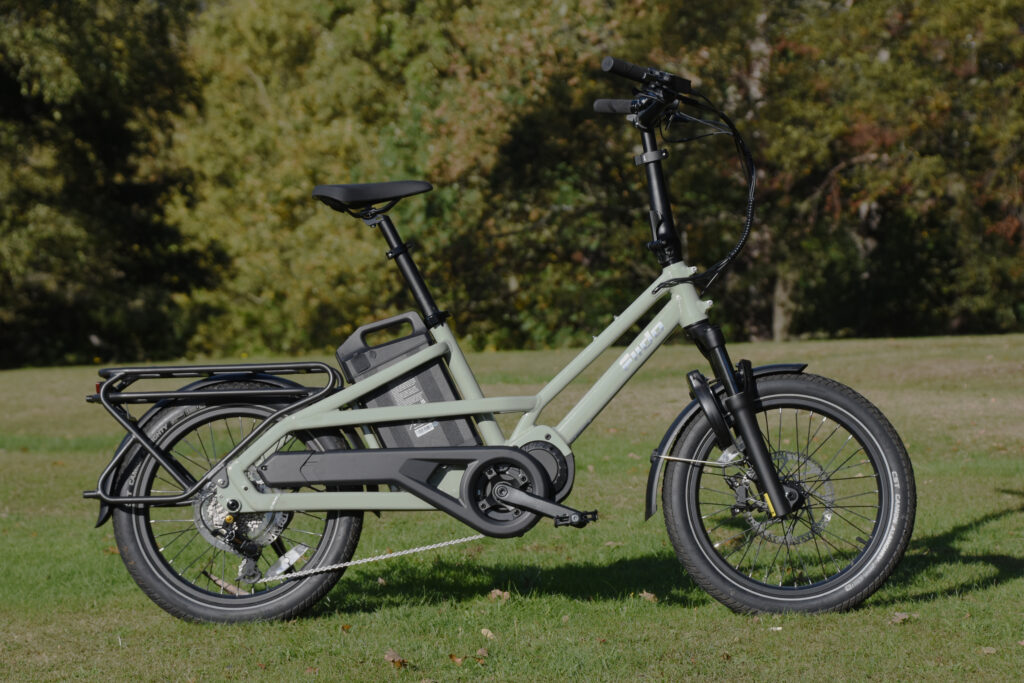
Nick Lobnitz, the designer and creator of the Carry Freedom range of bike trailers, has been turning his hand to bike design after an approach from the Post Office to design a one-size-fits-all utility bike. The resulting steed borrows much from the Dutch bike movement but has plenty of interesting and original touches too. The chain is fully covered and the cover can be printed to order, and at the back Integral lights are planned at the rear where at the moment the bike sports push-in reflectors. The open rear tubes also serve as a sturdy rack mount, and the final bike will be able to carry large loads at the front and the rear. The final version will have a slightly more raked fork which will help the steering to self-centre when it’s carrying a load, so you can push the bike by the saddle even with all your shopping up front. We had a whizz round the show floor on the bike and, when we weren’t getting told off by security, discovered that it’s a more agile beast than you might imagine. It’s not light but the steering is, and the low centre of gravity makes it nice and stable at low speeds. All things being well (not a given, by any stretch…) the finished bikes will rolling off the assembly line in April.
Video: Paper Bicycle
Help us to bring you the best cycling content
If you’ve enjoyed this article, then please consider subscribing to road.cc from as little as £2.49. Our mission is to bring you all the news that’s relevant to you as a cyclist, independent reviews, impartial buying advice and more. Your subscription will help us to do more.
No Comments
Read more...
Read more...
Read more...
Latest Comments
@chrisonabike ...have impersonated Dutch bike shop owners, people with disabilities, and possibly different genders / sexualities. And have gone from broken English to perfect fluency in a week or so Only a few of us remember those hilariously inept impersonations!
@belugabob Unfortunately going down this route is likely to be a missed opportunity. "Safer streets" can be done in a way that allows access to a virtuous circle with whole suite of benefits. But ... that would mean following something like in NL. So "sustainable safety" - a different philosophy of transport, plus gradual infra and organisational changes over decades. Generally opportunities for concentrations of money beat that. So it looks like we'll get "probably safer on average" but with who knows what side effects, while concentrating insane amounts of power (money) in the hands of a very few. And those will be effectively unaccountable, being almost all overseas, and not having to live in the same streets as their products (they may be flying)...
@Fursty Ferret "...regulator" That should be little comfort, because during previous scandals it became clear that in many cases the regulators were easily hoodwinked, or (especially US) they rely on the companies themselves to mark their own homework. (And in the case of SUVs/light trucks, I heard the US government has been hard a-lobbying the likes of Europe and the UK for "reciprocal recognition" e.g. to accept their product as is without further checks). Needing the makers to help / do the checks is even more likely given the complexity of self-driving vehicles. I suspect self-driving vehicles will likely soon be safer on average than human drivers (a low bar). Of course I think other potential consequences are also a matter of concern (not least - in *theory* humans can be held accountable, but holding humans in large companies accountable for their tech is a *lot* harder)...
@mdavidford Celebrity traitors with Lance? Worse - some of these slippery lycrist quislings deceive people that they're a) pedestrians - by getting off their bike and b) drivers - by getting into their cars! It's all on display in this forum, where IIRC such cyclists have appeared under multiple names, have impersonated Dutch bike shop owners, people with disabilities, and possibly different genders / sexualities. And have gone from broken English to perfect fluency in a week or so...
Politician in "fixing things for my mates / companies I have an interest in" shocker!
@mdavidford Could make that shorter - "we’re letting too many people drive" * I would bet to a first approximation the "damage" could be predicted by number of humans times time driven. Most effective way to fix that - without the UK's "just get rid of the vulnerable road users" - is to remove the motorists, to padded individual lanes, far away from vulnerable road users. Though they'll still crash (and into each other). * Should be "we have incentivised people so that most of them see 'driving' as the solution to most of their transport needs, as well as being part of their status as adults, and we could usefully change that *and* it would also improve health, the economy, the environment..."
@This Wreckage The other point is the observation that efforts to fix the transport systems which reduce motoring convenience almost always meet with very noisy opposition. But when a lot of motor (through) traffic has been removed it turns out that people don't want to go back. They don't all necessarily say how much nicer it is or connect that to the lack of motor traffic. But this experiment has been run in many different localities in different countries and the results seem to hold. Caveats as usual - it's always possible for authorities to bungle things terribly - or even deliberately mess things up with ulterior motives. And people have to have enough time to adapt to the new situation, which is probably nearer a year or two.
@This Wreckage And yet - in the poorest parts of where I stay (Edinburgh) it's not uncommon to see bikes with flat tyres rusting in the closes of flats, or on balconies, and they aren't all kids' bikes... I do agree that storage is an issue. IIRC some places (Edinburgh now) are starting to bring in guidance on having some cycle storage for new flats. Nothing like NL though where for decades it's been a part of the building regulations. I think most people who don't own a bike have simply never considered owning a bike as adults, because they're not "cyclists" (e.g. not practicing a sport) and transport cycling isn't "a thing" for most people in the UK currently.
It's really not smart to alienate so many potential buyers by putting hookless rims on a road bike. I personally don't think it's safe, but everyone can agree it greatly limits tire choices and inflation pressures. Both very important things on a road bike.
@This Wreckage I think we've covered that one. (It's the what the young (18-20s) adults are doing on social media isn't it...) You certainly have to engage with people, but if you ask people about something - like transport cycling in the UK - that they don't do (and more importantly *others* don't do) and have probably never thought about doing ... you have to take the answers with a large pinch of salt. Indeed even for things people *do* you might not get immediately helpful answers. Witness people being interviewed in NL about why they cycled to the shops to do the shopping: very few of them mention the infra or motor traffic reduction (or even the bike...). In that case you'd hear the truth e.g. "it's the easiest way" / "I like to go with my friends" - but *why* that is the case would need further investigation.