


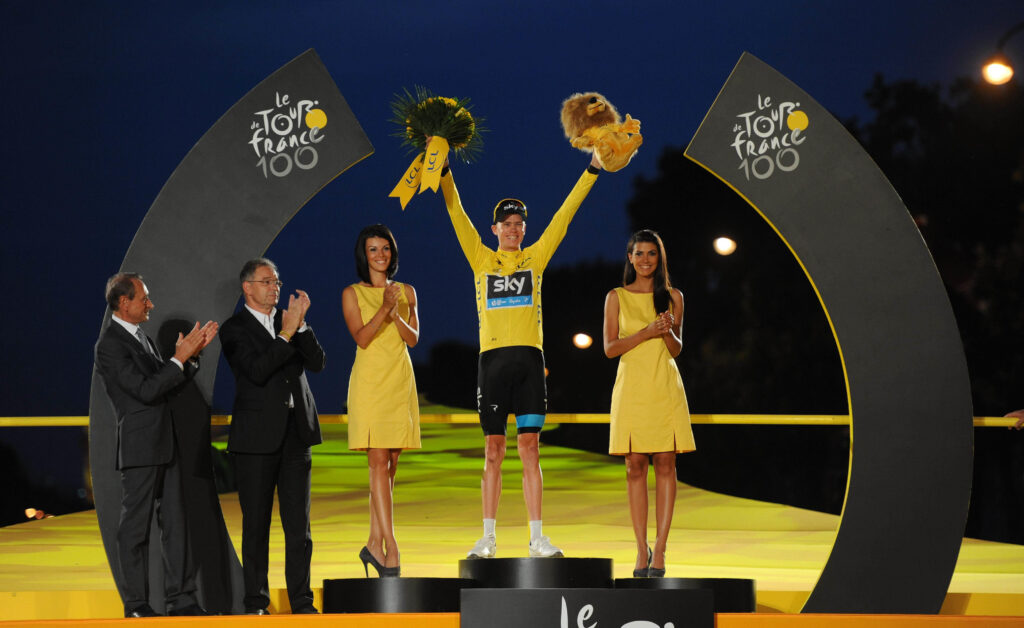

The data arising from the physiological testing carried out on Chris Froome last year have been published in Medicine & Science in Sports & Exercise. The Physiological Profile of a Multiple Tour de France Winning Cyclist reports on a range of physical characteristics likely to play a part in his success.
Peak oxygen uptake (VO2peak) and peak power output (PPO) were among the characteristics considered key to determining the performance of an elite endurance cyclist. These were calculated from data collected in a maximal aerobic test.
Peak was defined as the highest 30-second average recorded in an incremental ramp test. VO2peak was found to be 5.91 L min-1 (84 mL kg-1 min-1) and PPO was 525W.
Power output at 4 mmol L-1 lactate was also measured as this correlates with an effort of around one hour – a key level of effort for a Tour de France contender. As with PPO, this was found to be higher for Froome in hot and humid (HH) conditions versus ambient conditions (429.6W compared to 419W).
Gross efficiency (GE) was another significant factor to be assessed. A measure of effective work, GE is expressed as the percentage of total energy expended that produces external work. In Froome it was found to be 23% and 23.6% for ambient and HH conditions respectively and the study authors noted that while this was not unusually high in itself, it was unusual for it to be allied to such a high VO2peak.
The study authors conclude:
“The aerobic physiology and peak power output values identified are amongst the highest reported for professional road cyclists. Notably, the participant displayed both a high VO2peak and GE, which is uncommon amongst elite cyclists, and may be a contributing factor to their success in elite cycling.
“Additionally, performance in HH conditions was strong, suggesting effective thermoregulatory physiology. In summary, this is the first study to report physiological characteristics of a multiple Tour de France champion in close to peak condition and suggests what may be the prerequisite physiological and thermoregulatory capacities for success at this level.”












15 thoughts on “Froome physiological data published”
Saw this on cyclingtips
Saw this on cyclingtips yesterday, very impressive, but really would love to see the study repeated on more. Sagan, Dumoulin. Some of the women, Armistead, Cromwell etc.
Whatever way you cut it, 430 watts at threshold, that’s Godlike.
unconstituted wrote:
Yep and that’s pretty much why he can stay on his power meter and not worry too much about being attacked in the mountains. He knows if he’s at threshold or slightly beyond then his attackers are so far into the red he’ll reel them back in if there’s still a reasonable amount of uphill left.
That’s why I’d ban power meters in pro road races. They blunt the psychological concern of being attacked.
unconstituted wrote:
None of this data is particularly useful or insightful without a large cohort of comparatives. To really understand it you would need longitudenal testing of vast numbers. Sadly that sort of research is never really likely to happen
I guess spending your
I guess spending your formative years somewhere like Kenya will help to develop that Hot & Humid performance as the organs grow and develop. Sadly my own cycling in Scotland takes place predominantly in cold humid conditions, in fact very often 100% humidity
Griff500 wrote:
Ditto. But you forgot the pissing rain, almost constant 10-30 mph westerly and only about 7 ideal balmy days per year. If it wasn’t too dark and depressing to go outside we would be great!
BeatPoet wrote:
Ditto. But you forgot the pissing rain, almost constant 10-30 mph westerly and only about 7 ideal balmy days per year. If it wasn’t too dark and depressing to go outside we would be great!— Griff500
I’d describe these conditions as “character building”. I’m soon to be moving back to the homeland from the south east of England and am refusing the listen to people who keep telling me that the weather will be atrocious. The level of achievement of having gone for a ride in sideways sleet must surely be higher than a similar ride in 20 degrees of glorious sunshine. No…?
AST1986 wrote:
I wish it were true. I ride in Scotland at the moment now too and love riding in the rain and cool weather. Light rain and 8 to 10 degrees is perfect for me. Just feels amazing whizzing around country lanes with the wheels swishing through the wet.
The wind though ruins a lot of rides. You think it’ll give nice resistance training and it does sometimes, but very often it just stops you from hitting sweet spots that you want to build speed and strength. You come back and average speeds are pants, you know it’s the wind, but the motivation takes a knock.
The best days for training are calm so you can structure your ride, otherwise the guys indoors on Sufferfest are getting fitter while you’re outside being the hero and have to come back and scrub the bike which you’ve just killed a little
Mostly though, it’s get bloody cold here. Get used to 5 to 0 degrees and numb hands and feet if you want to ride November to May. I’ve actually prepared new kit for the winter already after suffering early 2016 here. Better overshoes and jacket this time round.
That said, it does feel rewarding. Definitely wouldn’t go out and do it if it wasn’t still fun. Just that if you get it wrong you will suffer, in the bad way, where you’re shaking uncontrollably, moving at 10mph and the hail stones feel sharp on your nose while cars soak you as they speed past
[Mostly though, it’s get
[Mostly though, it’s get bloody cold here. Get used to 5 to 0 degrees and numb hands and feet if you want to ride November to May. I’ve actually prepared new kit for the winter already after suffering early 2016 here. Better overshoes and jacket this time round.
That said, it does feel rewarding. Definitely wouldn’t go out and do it if it wasn’t still fun. Just that if you get it wrong you will suffer, in the bad way, where you’re shaking uncontrollably, moving at 10mph and the hail stones feel sharp on your nose while cars soak you as they speed past
[/quote]
I have an answer for you – those little tea-bag like hand warmers (‘Hot Hands’, I think – Halfords sell them in packs of 10). Put one over your toes inside each of your overshoes, and bingo – not exactly warm, but not cold either, which is a result in my book. The best thing is, when you’ve finished, wrap them up tight in a plastic bag and they’ll go cold again, and warm up again when they’re reintroduced to the air (or whatever passes for air inside a cyclist’s overshoes….)
Transformed last winter’s riding for me.
unconstituted wrote:
I rode through Scotland on the LEJOG. It was a mixture of highs and lows, and not just because of the topography! On the longest day (138 miles) we had head winds through Glen Coe – 11mph was my max speed on the flat and 15 mph downhill, but then on the way up to Fort William I was doing 27-30 on the flat. But before I got there I was laughing and crying to myself with the prospect of another 50 miles at 10 mph. I’d already done 6hrs on the bike at that stage.
Wind is the only thing I don’t like on the bike.
AST1986 wrote:
Achievement, surely. Enjoyment…?
Having moved the other way in recent years, I’m loving the Sarf East wevva. I also love it when you meet recent immigrants from the likes of Italy and Spain and they tell you that they love living in London but the weather is terrible! Hahahahaha – try 14 years in Glasgow!
I think it’s more a coast (east-west) than north-south thing though. Don’t mind cold, just would rather it wasn’t so dreich on the west…
BeatPoet wrote:
Ditto. But you forgot the pissing rain, almost constant 10-30 mph westerly and only about 7 ideal balmy days per year. If it wasn’t too dark and depressing to go outside we would be great!— Griff500
I’d describe these conditions as “character building”. I’m soon to be moving back to the homeland from the south east of England and am refusing the listen to people who keep telling me that the weather will be atrocious. The level of achievement of having gone for a ride in sideways sleet must surely be higher than a similar ride in 20 degrees of glorious sunshine. No…?
Can that be compared to Lance
Can that be compared to Lance? Not trying to say Anthony ugly, just really interested.
Artem wrote:
Here:
http://sportsscientists.com/2009/07/tour-de-france-2009-power-estimates/
Salient points:
“However, we do know that Lance Armstrong’s power output on Alp d’Huez in 2004 was calculated as 495W – this was presented as a scientific paper at the ACSM congress in Nashville in 2005, and I noticed the power output. It equates to 6.97 W/kg”
Is TheDoctor on holiday? So
Is TheDoctor on holiday? So used to looking for the trolls, I kind of miss them.
Ah but poor weather builds
Ah but poor weather builds the ability to suffer and cope with bad conditions, which in road cycling can be equally (maybe more) important than W/KG or the ability to train in perfect conditions