

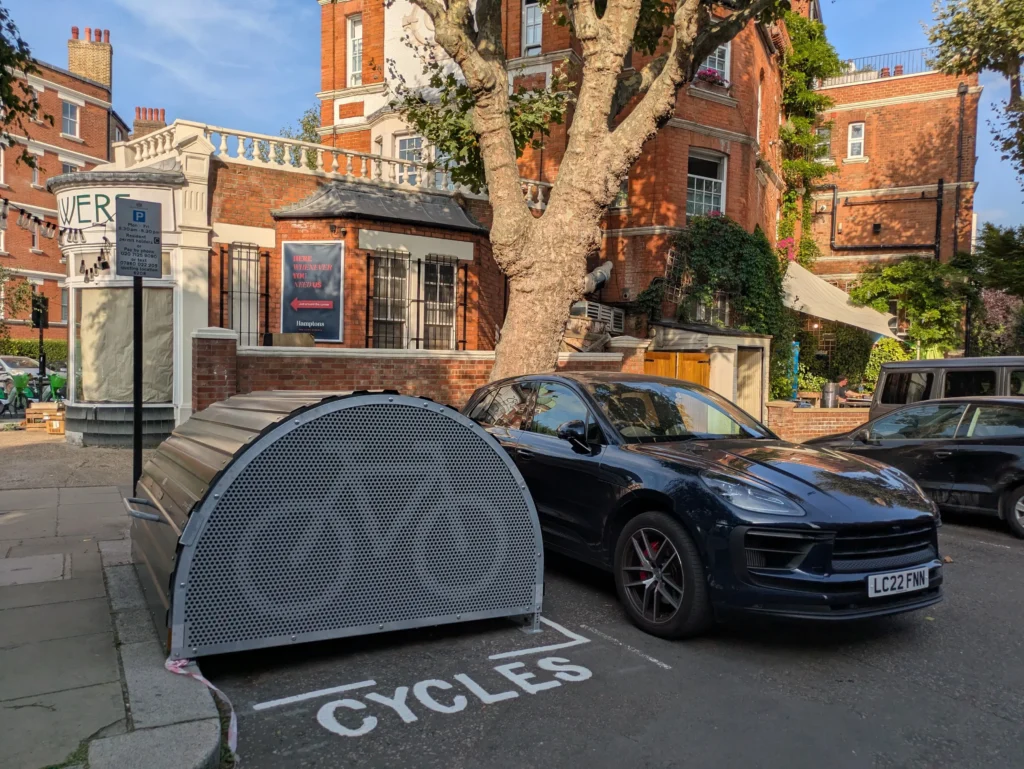

Two Conservative-controlled London boroughs have come in for criticism after they significantly raised the cost of a space in an on-street cycle hangar, despite their annual car parking prices remaining relatively static.
Until this year, to rent one of the six spots in a secure bike hangar in Westminster for the year cost either £40 or £32 if you were a council tenant, with every space taken in the borough’s hangars. The council was also the first local authority in the UK to provide secure on-street cargo bike parking for residents, under the previous Labour administration.
However, from 18 January 2027, that cost will rise to £92 a year, a jump of 130 per cent (according to council documents, this fee had already risen to £89 for some residents in 2026).
On the other hand, the cost of an annual car parking permit in Westminster is set to increase by just 3.5 per cent, with the lowest price of a parking space in the borough now £40.
There are also currently no plans for the council to increase the number of bike hangars in the borough, despite the local Conservatives pledging to “address the growing demand for secure cycle hangar storage” ahead of this year’s council elections.

News of this price hike comes in the same month Westminster Council’s deputy leader claimed that they don’t know where cyclists who used to commute through the newly pedestrianised Oxford Street can now go, despite the local authority previously publishing plans for alternative cycle routes.
“We just don’t know where this level of bike traffic can sensibly go,” Tim Barnes told the BBC, after footage of cyclists continuing to ride on the car-free street attracted criticism in the press. “Cyclists are just one of the many users who are going to lose out in terms of journey times and convenience.”
Responding to the new cycle hangar prices, former Labour councillor Max Sullivan wrote on social media: “Discredit where it’s due, Westminster Council Conservatives are not just intent on making cycling unsafe, they want to make it expensive too.”
Meanwhile, in neighbouring Kensington and Chelsea, annual cycle hangar charges are set to rise in 2027 by 33 per cent, from £72 a year to £96.
A basic car parking permit, on the other hand, will only increase by 14 per cent to £83 a year, again making a car cheaper to park than a bike in London (despite, as many cycling campaigners have pointed out, one car occupying the same space as six bicycles).
Westminster and Kensington and Chelsea won’t, however, be the most expensive places to store your bike in 2027. That accolade still falls to Islington, where one space in a cycle hangar will set you back £107.25 for 12 months.

By contrast, in Lambeth – the London borough with the second highest concentration of bicycle ownership after Islington – the council’s annual fee for a hangar is £30, the local authority subsidising the standard £72 cost set by manufacturers Cyclehoop.
There are currently around 14,000 people on the waiting list for a spot in Lambeth, roughly treble the council’s total bike storage capacity.
But it’s not just London where cycle hangar charges can be eye-watering. A spot in one of Sheffield’s bike storage units (oddly characterised as an alien concept in recent coverage by the BBC) will set you back £72, £13 more expensive than an annual car parking permit in the city.
In April, Cardiff Council also faced criticism after the hangars introduced in the Welsh capital were unveiled at twice the price of the same storage in some of the cheaper parts of London.
The 17 hangars, provided by Cyclehoops, are part of a pilot scheme that began earlier this year to improve cycle storage in neighbourhoods with terraced housing. However, the council’s decision to charge residents £120 for the privilege was widely condemned by cycling campaigners.
Chris Roberts, chair of the Cardiff Cycle City organisation and a former General Secretary of Welsh Labour, said the pricing was an “injustice”, considering that the cost was more than treble that of a residential car parking permit in many of the same locations.
Bike hangars such as the ones provided by Cyclehoop can provide secure shelter for six bikes in half the space normally occupied by a car parking space, giving cyclists outdoor, weather-protected cycle storage near their homes.
However, despite their ability to provide much-needed, affordable storage space for cyclists unable to safely secure their bikes due to a lack of space in their properties, while taking up minimal space on the road, the cycle hangars haven’t been without their detractors.
Over the years, we’ve seen them variously described by residents and drivers as “ugly”, “green measles”, and accidents waiting to happen (thanks to the occasional motorist crashing into them), while they’ve also been accused of “deliberately” blocking car parking spots.
But speaking to the road.cc Podcast last year, Cyclehoop founder Anthony Lau argued that due to the persistent and increasing problem of bike theft in the UK, and the lack of safe, secure storage facilities for cyclists, swapping car parking spaces for bike storage, and receiving some flak in the process, is just “something we need to do”.