


More than four in five residents in Northern Ireland say they are unable, uninterested or afraid to cycle short distances.
The findings, published as part of the Continuous Household Survey of more than 3,500 households by Northern Ireland’s Department for Infrastructure, show satisfaction with local walking and cycling infrastructure has remained static, with 61 per cent of residents happy with walking provisions, and only 51 per cent happy cycling in their area. In the 10 years since the study has been conducted, satisfaction with local cycling has never exceeded 55 per cent.
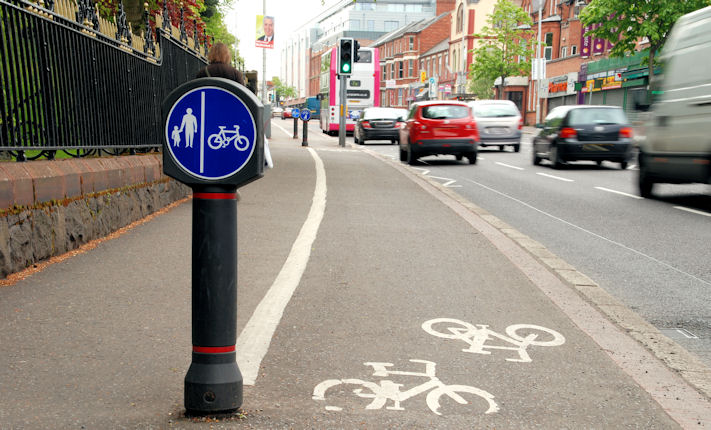
When asked why they were unhappy, 79 per cent of respondents cited a lack of cycle lanes, including 93 and 92 per cent of respondents in Derry City and Mid & East Antrim respectively. A further 51 and 44 percent of total people surveyed blamed cars driving too fast and excess traffic respectively.
The number of people who said they were willing to cycle for short distances of up to three miles (five kilometres) has increased slightly from 16 to 18 per cent compared to last year, though men remain twice as likely as women to do so. However, responses were divided on what would be most needed to encourage people to cycle.
Rural residents markedly favoured safer roads, whereas people in urban areas were also more split between off-road cycle paths, better road surfaces. The study also shone a light on popular misconceptions around the phrase ‘active travel’, typically defined as fully or partially people-powered transportation, such as walking, wheeling or cycling.

However one in five people surveyed consider motor vehicles to be active travel, highlighting some of the difficulties in politically selling policies that encourage people to walk, wheel and cycle. road.cc has contacted the Department for Infrastructure for comment.
Northern Ireland has historically lagged behind the other nations of the United Kingdom in relation to active travel, with Belfast, as of last year, still having only two miles of protected cycle lanes. In contrast Cardiff, a capital with a similar population size and density, has seven miles of protected Cycleways plus extensive off-road routes.
In 2024, following the death of a cyclist from a collision with a driver, Belfast South MP Claire Hanna said in her experience “I get more abuse, week in, week out, on my bike than I do in my work. I don’t know whether people are jealous that the cyclist is moving faster than them but I have taken really serious abuse from people for what they perceive as minor infractions.
“There is a massive congestion issue here [in Belfast]. Basically we’ve got two choices. We can start knocking down buildings to make the roads wider because the city has a finite space or we can get people as far as possible to travel actively.”
More recently, plans for a 1.5 mile protected cycle lane in the north of the city were fiercely criticised by some local residents, due to the proposed removal of 90 year old trees and of parking spaces.