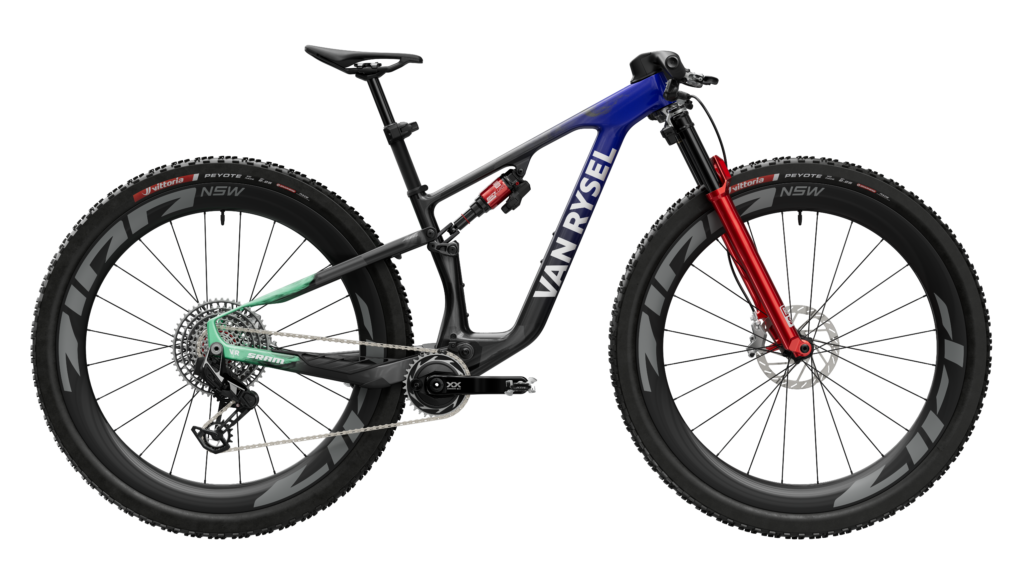
Earlier in the year, Canyon pulled the cover off its concept cross-country bike. With 32-inch wheels, aero features, and even a digital dashboard, it looked set to be the reference point for future cross-country race bikes. And well, the proof is kind of in the Van Rysel-flavoured pudding, as its RCR-XC borrows so many cues.
It’s almost like Van Rysel saw the upset Canyon’s concept bike caused and thought, “yes, that’s the bike we’ll build”. I’m not saying that there are some copycat games being played; rather, perhaps Canyon’s prediction of XC’s future was correct. Because that RCR-XC, too, has 32-inch deep-section wheels and an unfortunately mental-looking handlebar.
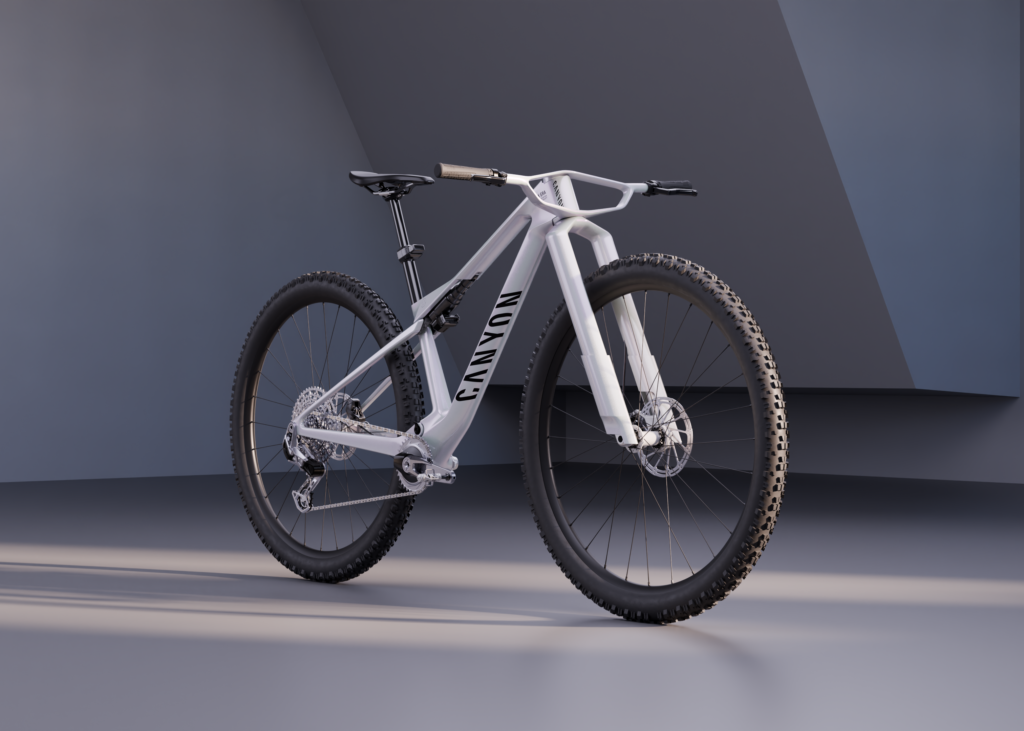
To address that handlebar, as I imagine that’s where most of the upset is being caused, while far from pretty, it makes sense. A bigger front wheel results in a larger axle-to-crown measurement, which raises the bike’s stack. As Revel mentioned upon the launch of its El Jeffe Grande, the longer fork used to fit a 32-inch wheel produces more leverage, which puts loads of stress onto the headtube, so simply throwing on a shorter headtube isn’t a perfect solution – though Revel managed this with some rather sleek-looking 3D-printed wizardry.
Plus, that El Jeffe Grande isn’t exactly a cross-country race bike. Common on most elite riders’ race bikes are negative rise stems, which shift weight further forwards for an easier time on the climbs. This handlebar just offers that low front end, while helping to ensure a headtube that can cope with the excess forces. Of course, there are flat sections too for those aero gainz.
Van Rysel could have probably thought up a more attractive solution, but aesthetics alone doesn’t win races. And there are arguably prettier designs around, but pairing a taller stack with the negative rise stems that racers rely on is no easy feat, especially without thinking outside of the box. Take the system found on BMC’s prototype 32er. That isn’t exactly good-looking, but the stem clamps on the fork steerer above and below the head tube, proving that extra engineering around a dialled stem height isn’t as straightforward as it is with your bog-standard 29er.

Throwing aerodynamics into the mix is likely another reason people are shaking their fists at the sky, but really, it’s just a natural progression of elite-level cross-country racing that’s been on the cards for quite a while now. In fact, racers were experimenting with gravel tyres and deep-section gravel rims in Nove Mesto earlier this year. Is that a setup that’s relevant to the average rider? Absolutely not, but is it an ingredient for potential podiums? Very possibly, and that’s what Van Rysel’s bike is all about.
In its press release, Van Rysel mentioned that the RCR-XC sheds 15.5 watts at 35 km/h compared to the Decathlon Ford team’s current Rockrider bikes. Of course, riders don’t really hit those speeds throughout a race, at least on average. In fact, a study conducted on the influence of environmental factors on Olympic cross-country bike performance found that the average speed during an XCO was under 20km/h.
That doesn’t mean there isn’t an advantage to be had, however. Obviously, the faster you go, the more aerodynamic features can affect things, but components like aerodynamic wheels still pose something of an energy saving at slower speeds, and with cross-country getting faster, more technical, and more viciously fought, any gain is a gain.
Although it’s not pretty, what the RCR-XC marks is progression, and it’s been flipping ages since we’ve seen a bike that does things a little differently. To me, that alone is exciting. I talked about it in another blog a little while ago; bike design has stagnated, and it’s become tough to get properly excited about new bikes and the future they might carve. But Van Rysel’s first take on a mountain bike does that. It might not do so in a way that’s pleasing to the eye, and it’s not a bike I’ll dream of owning, but if this thing wins races, it’s done the job it’s built to do.
I guess the big question is whether or not this kind of technology is going to stick around. I’ve been surprised by how many brands have jumped onto the 32-inch bandwagon, and having ridden a 32-inch wheel, I reckon it has some real applications. Throughout 2026, big wheels have seen success, too, having won a stage at the Cape Epic, Ondřej Cink won a Czech National XC race, while Alessandra Keller and Nino Colombo found themselves a podium spot each. Obviously, these results don’t prove big wheels are the way forward, but they are interesting nonetheless.
As for aerodynamics, that’s where things get a little more interesting. We’ve not seen an awful lot from aero tech on the XC circuit, and although gravel rims and tyres were used at 2026’s Nove Mesto race, Puck Pieterse and Mathis Azza won their respective XCC’s on non-aero kit. The same goes for Tom Pidcock and Laura Stigger in the XCO events.
However, if Van Rysel’s contender is anything to go by, it looks like we’ll see even more 32-inch wheels and aero kit in 2027, and that’s when we’ll see if it’s here to stay, or just another one of those fads that fade as quickly as they turn up.