



More than £100,000 of funding intended to support active travel has been spent by a council deliberating the removal of a major car-free route in Exeter.
Devon County Council has approved a report from the Exeter Highways and Traffic Orders Committee (HATOC) recommending that Dryden Road – which has been permanently closed as a through road to cars since 2022 – be re-opened to motorists with limited active travel infrastructure installed along sections.
Specifically, two advisory cycle lanes are proposed from the west end of the road to Well Oak Park, where the current closure to drivers begins, and where a single cycle lane currently sits.
Where the road is currently closed to cars, to Kipling Drive, the 100m stretch would be re-opened with a 20mph speed limit, with plans to install “an uphill advisory cycle lane, with some localised kerb realignment to support necessary carriageway widening.” Other plans along the road include installing two speed bumps, and retaining existing mini-roundabout layouts and car parking spaces. The proposals will now be opened to a public consultation.
Initially £500,000 had been provided by the Devon and Torbay Combined County Authority for the removal of the car-free route, although the latest update budgets the project at £493,281. A local source told road.cc they believe this budget decrease makes it easier for the council to approve the planned work.
However, the report also notes that, “To date, £107,000 revenue funding has been committed on reconsidering the infrastructure on Dryden Road and the surrounding area. This has been funded by Active Travel England revenue funding.”
Ahead of today’s HATOC meeting, where councillors approved the plans to re-open the road to cars with enhanced cycle infrastructure, a spokesperson for Devon County Council said, “Active Travel England funding can be used to support the development of active travel schemes, including consultation and design work.
“The work on Dryden Road has not simply been about removing active travel infrastructure. It followed concerns about the impact of displaced traffic on surrounding roads and a decision by Exeter Highways and Traffic Orders Committee to consult on possible solutions.
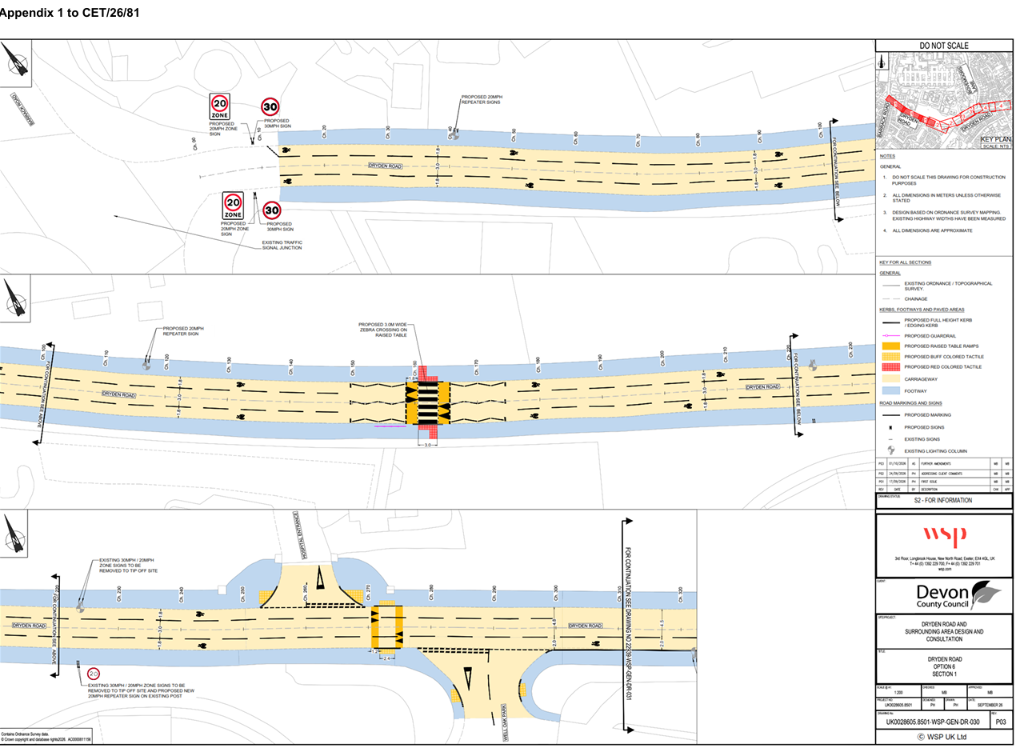
“The consultation showed a strong preference for Dryden Road to return to two-way traffic, and officers have since been exploring how this could be achieved while continuing to provide safe and attractive routes for people walking and cycling. Active Travel England has been closely involved in discussions about both the funding and the design options being considered.”
Active Travel England said they were not able to comment on specific schemes utilising their funds, and that active travel schemes remained the responsibility of local highways authorities. But they also added that local authorities would be assessed for their delivery of active travel schemes, which could impact future funding allocations to the council.
In response to the £107,000 disclosure, a spokesperson for the Exeter Cycling Campaign (ECC) told road.cc, “It is jaw dropping to see that Devon County Council have spent over £100,000 of active travel funding to create a plan to make Exeter less safe for people to cycle.
“They now plan to spend a further half million pounds to implement the plan, which the Council themselves have demonstrated will lead to more collisions and more congestion and punch a hole in Exeter’s safe cycle routes to school, shops and the hospital. All at a time when we are told money is tight for real transport improvements in Exeter.”
The campaign has also previously indicated it will be pursuing legal action against the council’s efforts to fully re-open the road, depending on the outcome of the public consultation. Whilst some local campaigners have argued the road should be re-opened, arguing it would reduce traffic levels on surrounding roads, the ECC say argue the ‘cycle only’ road “has provided a low-conflict and strategically important connection into the city centre, avoiding heavily trafficked routes”, while reducing the number of crashes and improving air quality.”














2 thoughts on ““Jaw-dropping” £107,000 of active travel funding spent on planning removal of major car-free route”
Mind boggling that active travel funding can be used to downgrade a route.
@Secret_squirrel *ought* to be …
But IIRC other enterprising local authorities have found ways to reframe “active travel” to include things like buses * or indeed divert it to (at least partly) help the poor motorist. (Potholes anyone?)
* eg. Not to divert money here but as a fudge to apparently cover up a drop in funding – see Edinburgh campaign group Spokes’ article “ScotGov draft budget 26/27: Active Travel obfuscation”