


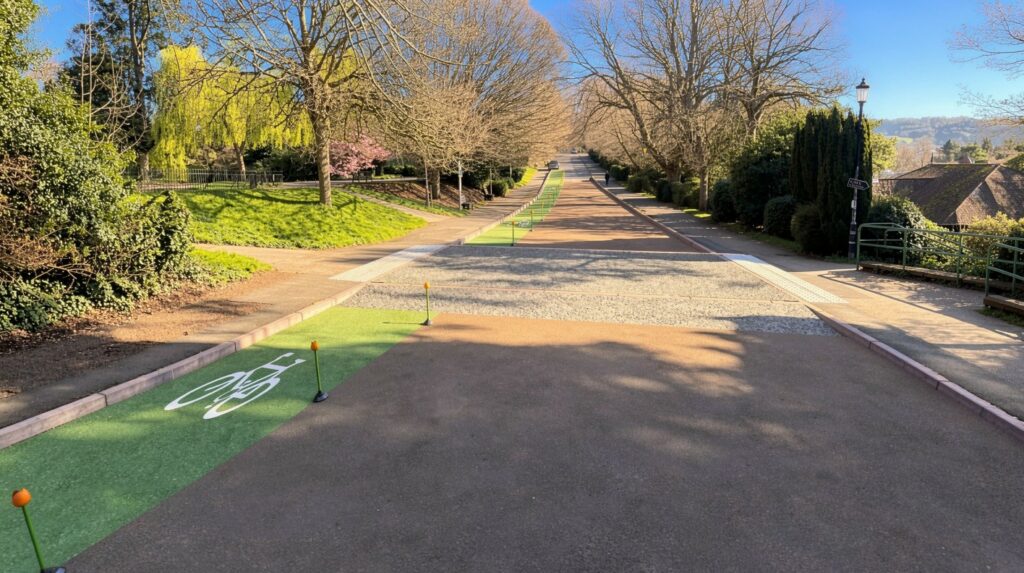
More than £100,000 of funding intended to support active travel has been spent by a council deliberating the removal of a major car-free route in Exeter.
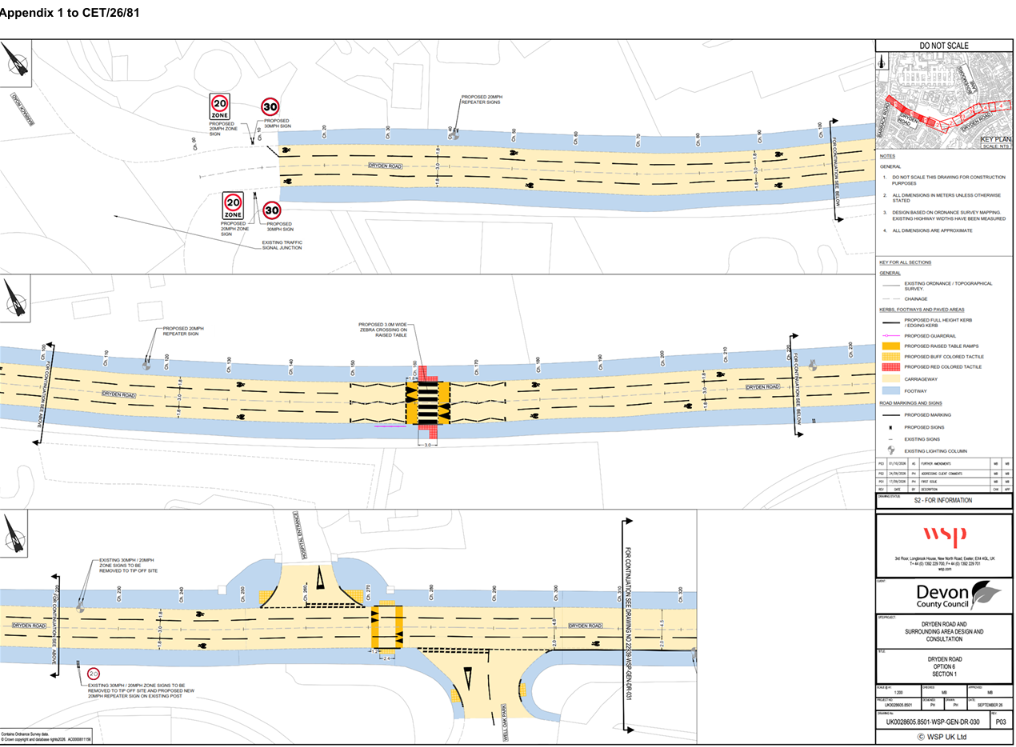
Devon County Council has approved a report from the Exeter Highways and Traffic Orders Committee (HATOC) recommending that Dryden Road – which has been permanently closed as a through road to cars since 2022 – be re-opened to motorists with limited active travel infrastructure installed along sections.
Specifically, two advisory cycle lanes are proposed from the west end of the road to Well Oak Park, where the current closure to drivers begins, and where a single cycle lane currently sits.
Where the road is currently closed to cars, to Kipling Drive, the 100m stretch would be re-opened with a 20mph speed limit, with plans to install “an uphill advisory cycle lane, with some localised kerb realignment to support necessary carriageway widening.” Other plans along the road include installing two speed bumps, and retaining existing mini-roundabout layouts and car parking spaces. The proposals will now be opened to a public consultation.
Initially £500,000 had been provided by the Devon and Torbay Combined County Authority for the removal of the car-free route, although the latest update budgets the project at £493,281. A local source told road.cc they believe this budget decrease makes it easier for the council to approve the planned work.
However, the report also notes that, “To date, £107,000 revenue funding has been committed on reconsidering the infrastructure on Dryden Road and the surrounding area. This has been funded by Active Travel England revenue funding.”
Ahead of today’s HATOC meeting, where councillors approved the plans to re-open the road to cars with enhanced cycle infrastructure, a spokesperson for Devon County Council said, “Active Travel England funding can be used to support the development of active travel schemes, including consultation and design work.
“The work on Dryden Road has not simply been about removing active travel infrastructure. It followed concerns about the impact of displaced traffic on surrounding roads and a decision by Exeter Highways and Traffic Orders Committee to consult on possible solutions.
“The consultation showed a strong preference for Dryden Road to return to two-way traffic, and officers have since been exploring how this could be achieved while continuing to provide safe and attractive routes for people walking and cycling. Active Travel England has been closely involved in discussions about both the funding and the design options being considered.”
Active Travel England said they were not able to comment on specific schemes utilising their funds, and that active travel schemes remained the responsibility of local highways authorities. But they also added that local authorities would be assessed for their delivery of active travel schemes, which could impact future funding allocations to the council.
In response to the £107,000 disclosure, a spokesperson for the Exeter Cycling Campaign (ECC) told road.cc, “It is jaw dropping to see that Devon County Council have spent over £100,000 of active travel funding to create a plan to make Exeter less safe for people to cycle.
“They now plan to spend a further half million pounds to implement the plan, which the Council themselves have demonstrated will lead to more collisions and more congestion and punch a hole in Exeter’s safe cycle routes to school, shops and the hospital. All at a time when we are told money is tight for real transport improvements in Exeter.”
The campaign has also previously indicated it will be pursuing legal action against the council’s efforts to fully re-open the road, depending on the outcome of the public consultation. Whilst some local campaigners have argued the road should be re-opened, arguing it would reduce traffic levels on surrounding roads, the ECC say argue the ‘cycle only’ road “has provided a low-conflict and strategically important connection into the city centre, avoiding heavily trafficked routes”, while reducing the number of crashes and improving air quality.”










46 thoughts on ““Jaw-dropping” £107,000 of active travel funding spent on planning removal of major car-free route”
Mind boggling that active travel funding can be used to downgrade a route.
@Secret_squirrel *ought* to be …
But IIRC other enterprising local authorities have found ways to reframe “active travel” to include things like buses * or indeed divert it to (at least partly) help the poor motorist. (Potholes anyone?)
* eg. Not to divert money here but as a fudge to apparently cover up a drop in funding – see Edinburgh campaign group Spokes’ article “ScotGov draft budget 26/27: Active Travel obfuscation”
Hopefully Active Travel England take a very careful look at what they apply for in the future.
Unfortunately this is a “hurts us more than it hurts you” as AFAICS all they can do is not approve future funding, which of course will likely mean cycle infra doesn’t happen.
Or it does – but via a “council inventing it here” version of “ineffective or dangerous stuff, spread thin”. On which “advisory cycle lane” sounds like they’re already on it…
@chrisonabike
Yep.
A big chunk of the issue is screwing up funding like this needs penalties beyond not getting active travel funding (given that will then be used as an excuse not to do active travel projects).
AFAIK they have made it stick in bits of London (removing active travel infra = obligation to repay TFL for its contribution;
Would also argue that there needs to be wider penalties (e.g. people who designed and implemented new infra need to be documented and at risk of being banned from being involved in grant funded projects – I suspect that consultants would stop recommending awful designs, and/or contractors would stop building awful designs (ignoring/modifying plans) if doing so risked them not being able to be involved in future projects because their involvement would block funding…
@qwerty360 it’s all tricky in the UK – even ignoring “popular” outpourings about “but my route / parking space!” – since much of the government machine is still set up to work effectively “for” more driving. So “mixed messages”…
I think Chris Boardman has been doing a very savvy job. However there are some difficult barriers to this in the UK. There’s having “capacity” to make stuff eg. enough people who can avoid getting the details plain wrong / enough financial and political capital to get a project all the way to the end, mostly intact.
In the UK with all the “but this local detail, but that requirement” and over 100 years of building in “transport is drive” it’s not even simple for those *with* the knowledge to come up with a “good enough” solution that isn’t “take up all the roads and let’s rethink”. (Not a bad idea but not practical).
@qwerty360 Things the Dutch did/do which are not often hailed but are probably crucial:
a) many years of recategorising all the roads in the country in terms of a single function. Is this a through-route (which they’ve also spent years diverting *around* urban areas not through them)? Is it a distributor, or is this a street / place? If like so often in the UK “all of the above” that was fixed.
b) The way the various parts of government (and the legal system) work together to deliver all this, and crucially the feedback mechanisms. Apparently they are remarkably light on regulating exactly what can be built, BUT if people are injured using it / there are environmental consequences (including noise!) then people can be held accountable. That means that there is some flexibility to eg. innovate but motivation to voluntarily adopt the (centrally maintained) best practice guidelines. Presimably there is at least a belief that they may have to defend their actions in court.
Eh? Does it make it 1.35% easier?
@mdavidford You’ve made me curious so checked: in Devon and Torbay (in common with many councils, apparently), any project under £500,000 can be internally approved by the Corporate Director for Strategy, Performance, and Sustainability, whereas any project costing in excess of £500,000 needs a full cabinet vote. So it looks suspiciously as though there’s been a bit of jiggery-pokery with the numbers to avoid full cabinet scrutiny.
Yes – that does look sneaky – feels like the article could do with an update to make that clearer.
@mdavidford It gets it below the £500K grant of authority level / avoids proper scrutiny and will almost certainly cost more than £500K when implemented due to “unforeseen construction challenges”
In other words, it’s a done deal.
Meanwhile the councils complain about not having enough money.
The UK car-addicted culture is perpetuated by council officers and councillors as well as the baying hoards of drivers who demand more public highway to be designed to their wants, while everyone outside the car can get stuffed. #motornormativity
@polainm The UK car-addicted culture is perpetuated by council officers and councillors as well as the baying hoards of drivers…
Yes, hence the cheering crowds when cycle facilities are removed in Middlesbrough and elsewhere, all affecting to believe that this welcome change will bring an end to all traffic problems. When it doesn’t, all the mentalists think of some cause, any cause, to blame, other than the correct one which is far too many idlers driving everywhere: immigrants, Europe, unfair price of petrol, war on the motorist- it doesn’t matter how stupid.
@wtjs
I propose something like this…
“A lack of cyclists will not cure any of the problems faced by motorists…
Today’s episode of Sesame Street was brought to you by the letter ‘M’ and the number ’25’
“
@belugabob ah but isn’t it those cyclists / cycle lanes just *off* the motorway that are causing the backlog?
Or “not building enough multi-lane roads through town centres”…
@chrisonabike only in the brains of the hard of thinking
@belugabob I think anyone who’s thinking about traffic jams and getting hard of thing has bigger problems.
@mdavidford “That’s not actually the sort of congestion to which we were referring, sir…”
@Rendel Harris perhaps a Germanic literary allusion – didn’t Kafka pun on that in a couple of stories (“Verkehr” – “traffic” but slang for intercourse)? At the end of “The Judgement” IIRC?
@chrisonabike Yes! The traffic rushing over the bridge as Georg throws himself into the river. Good knowledge sir.
@wtjs Of course, it can be argued that this is democracy in action. We have many very stupid people in the UK (see Brexit referendum) and I think it’s quite possible that a referendum seeking to ban cyclists from roads would receive majority support.
@wtjs And the death penalty. So many wrongly convicted people would have been killed if it still existed, including the almost certainly wrongly convicted Lucy Letby.
@eburtthebike including the almost certainly wrongly convicted Lucy Letby
I’ll go for: ‘the very likely correctly convicted Lucy Letby’
@wtjs I’d go for: “The very definitely wrongly convicted Lucy Letby who may or may not be guilty of the offences charged but certainly should not have been convicted on the basis of the evidence presented at trial.” In my opinion she should be retried with the evidence properly presented and critiqued, including the fact that one of her senior colleagues who testified against her definitely perjured himself giving evidence and the fact that the doctor whose work was central to the prosecution case has said that they applied his findings wrongly. I can’t say if she is guilty or not and that’s not my call to make, thank goodness, but I am certain that she should not have been convicted on the basis of the evidence presented at trial.
Motornormativity, does a lot of heavy lifting. Windshield bias sounds less staccato to me. Anyway, I asked google how to reduce human bias and its conclusions seem bad for cyclists mixing with drivers. One solution states removing bias in a human being requires a pause before a decision is made.
Imagine Dave or Claire or Mohammed or Misra on the school run, internet delivery or rush to work morning…a cyclist appears…a corner is up ahead…”I’ll just squeeze….”the driver remembers they are meant to pause, they glance at the speedo….tighter, tighter….”Ooo, got through the gap before the corner, great”.
Conclusion, pausing while entering into a corner with a cyclist cannot be a structural element of windshield bias. The driver may have to consider pausing earlier, or pausing a while afore they enter their vehicle.
Maybe I am way off…I’ll ask google if they know per capita how hard it is for humans to pause whilst approaching a corner in a motorised vehicle.
“Identify the relevant leg, and remove small slices until the bias disappears.”
@mdavidford “let me know which side the bias is on, and I can start automatically fixing it”…
@mark1212123 make sure you instruct it that you need your answer in ternary, starting from 1.
How to avoid conflict on the roads? Don’t travel!
How to reduce that but some travel has to happen? Reduce the number of interactions, reduce mental workload, increase the time to detect and deal with conflicts (your “pause”), work *with* human mental architecture (energy-saving behaviours, emotions, strong feelings about “fairness” and “cheating”, in-group/out-group effects).
What that implies? Don’t mix modes of travel where they have very different speeds/mass/behaviour patterns. Mixing *can* occur where you can ensure that modes are more similar (eg.slow down drivers…) Don’t rely strongly on “rules” or (signed) instructions for safety – because humans.
@chrisonabike “Don’t rely strongly on “rules” great point.
“How to avoid conflict on the roads?” Not possible. Expecting conflict is the daily for me on uk roads.
@mark1212123 “One solution states removing bias in a human being requires a pause before a decision is made.”
Was the other solution to remove their brain and replace it with something more rational, efficient and dependable?
@chrisonabike “more rational, efficient and dependable” The cost will explode across taxpayers.
The administration could’ve used HS2 money as a beginning step, but they chose not to.
Windshield bias will still be whacking the cyclist in 100 years. I don’t see many cyclists bothered by it. I see many possible cyclists put off cycling by it but we know this already.
@mark1212123 “not invented here” (only… it has been, several times in the past…) but here’s an example of someone cycling straight through a city without any dramas:
@mark1212123 pausing before posting on social media would help a lot of folk.
(not you, though)
@belugabob best idea yet. thanks.
Absolutely scandalous waste of taxpayer money that the road was originally shut to cars… A stark throwback to the days just after COVID when the lunatics were briefly left to run the asylum, when activists and agitators ran amok against all rationality and economic sense.
How many (less than) useless LTNs and no-car zones were set up at this time, under a supposed free market Tory government, costing countless hours of congestion and destroying livelihoods and town centres?
Whilst it’s great that the cheque book has been removed, there are yet more brainless initiatives today, such as pointless “20” zones (er, just enforce the existing 30 please).
All people want is a joined up travel experience where cyclists can use the road – along with all other forms of transport – to get from A to B with the least fuss. This country isn’t set up to remove long-established road infrastructure, and as recent figures revealed countries that have spaffed countless millions on cycling infrastructure (such as the Netherlands) actually have *worse* KSIs than the UK, despite our potholed, shoddy roads.
@jackcycles
“a stark throwback to the days just after COVID when the lunatics were briefly left to run the asylum”
You mean the Conservative government of Boris? Not a fan of him or Matt Hancock either, but I thought eg. Jonathan Van-Tam did a pretty good job?
“All people want is a joined up travel experience where cyclists can use the road – along with all other forms of transport – to get from A to B with the least fuss.”
I tried that but I found the canal wet, being held up by rollerskaters vexing, dodging the passing lorries at 60mph scary, before I was run over by the train…
“Absolutely scandalous waste of taxpayer money”…
I quite agree, what on earth are they doing wasting active travel money to make active travel less pleasant (and indeed places less pleasant) and convenient?
@chrisonabike all active travel money should be immediately reallocated to fixing potholes and trimming hedges/vegetation.
A lot of the reason why cycling and/or jogging is so difficult in my area is due to road surface quality and getting artificially narrowed by poor maintenance.
That way, no more terrible, unpopular “active travel”/segregation decisions that need to be overturned
@jackcycles your biggest obstacle is a narrow mind – also caused by poor maintenance.
Just Google “Cycling KSIs netherlands vs uk” to see how wrong you are.(not that you’re open to facts)
@belugabob I’m afraid you’re ignorant of the true data, buying into the misconception that the Netherlands should be emulated.
In fact the Netherlands and the EU (per usual) is falling behind in terms of cycling safety. Please see https://etsc.eu/europes-cyclists-left-behind-as-safety-gap-widens-new-etsc-report-finds/
And attached demonstrates the mismatch between your preconceived opinion and hard cold facts
@Nigel Garage I suppose it’s typical for an accountant to imagine that numbers explain everything. Numerous factors account for the Netherland’s higher death rate per capita, the primary one being that 45% of the population cycles daily and cyclists, as we all know, are more vulnerable than car drivers. You can pretty much guarantee that if nearly 30% of trips made in Britain were made by bike, as they are in the Netherlands, our casualty figures would be higher. The fatality risk for cyclists in the UK is almost ten times that for car drivers/passengers, as it is in the Netherlands. I’m sure a beancounter like yourself can figure out that means that if cycling goes up, fatality numbers go up too. The UK frequently scores well on per capita road deaths because as a population we rely so heavily on cars rather than the more vulnerable forms of transport. You, with your strange autophilia (or is that autoeroticism?), probably imagine that’s a good thing, but anyone with the wellbeing of the populace and the environment at heart does not.
“The consultation showed a strong preference for Dryden Road to return to two-way traffic,……..”
But doesn’t the council have policies which dictate that Active Travel routes should be adopted, preserved and promoted? From Devon CC’s Roads and Traffic webpage:
“Following a 2021 public consultation which showed almost 75% of respondents in favour of permanent changes to reduce traffic,……..”
So 75% of people are in favour of permanent changes to reduce traffic, but another consultation says take it out. Why aren’t they going with the result of the 2021 consultation?
“It followed concerns about the impact of displaced traffic on surrounding roads……” This is always exaggerated, and usually much smaller than the reduction in traffic on the blocked road, and of course, this is no exception:
‘Devon County Council reported that closing Dryden Road to motor vehicles reduced traffic by 574 vehicles in the AM peak on Dryden Road itself, while increasing traffic on Bovemoors Lane by 180 vehicles in the AM peak.
‘Impact on Surrounding Roads
• Bovemoors Lane: Saw an increase of 180 vehicles during the morning peak hours following the modal filter/closure. (Devon CC)
• Parallel Corridors (Heavitree Road and Topsham Road): Experienced no significant change in traffic volumes, with vehicle numbers remaining largely the same before and after the closure. (Devon CC)
• Air Quality & Congestion: Critics and local campaign groups argued that the closure pushed congestion and fumes onto nearby residential streets, though official council data indicated minimal impact on major parallel routes.’ (BBC)
My guess is that some councillor has to drive an extra 500m because of the closure.
My guess is that they *believe* they ‘have to drive’ an extra 500m because they can’t compute any form of travel that doesn’t involve a car.
@eburtthebike this reminds me of a segment of a recent notjustbikes video *. Amsterdam ran a trial modal filtering (“knip”) of a much more major road. And that was also reversed.
Why? “Too soon”. The residents on the road all strongly approved. However traffic *did* increase a bit on neighbouring roads, and those residents were very unhappy.
Conclusions? Most people *really* don’t like sharing their space with lots of motor traffic. As soon as they get long enough to appreciate the difference they aren’t keen to go back.
However … our current transport systems are still strongly “driveogenic”. Where there is a way, people (maybe sent via the algorithms) *will* drive it.
It does take some time for the system to rebalance. Or rather – for people to alter their habits eg. stop trying to “squeeze through” or “I’ll chance the traffic…” Or get used to driving to the main road, along that, then to the shops, rather than cutting through…
There will also always be some “demand” because most traffic we see is “passing through” – on its way from somewhere else to somewhere else. Although apparently a significant amount is people just driving round looking for (free) parking.
* “Amsterdam keeps getting better” – on the progress of the Amsteram “nearly car free” plans (“Amsterdam makes room”)
Oh dear, where to start…
* You brought the Netherlands into it
* I merely corrected your erroneous assertion
* I didn’t say that the Netherlands were to be aspired to
* The chart that you proved is road fatalities in general, per million population, not per billon miles travelled.
* The article that you linked to clearly highlights the fact that the lower drop in casualty rates for cyclists Vs those for drivers is mostly down to the drive for in-car safety and the attendant nonchalance shown by the occupants of vehicles towards the outside world (pedestrians, cyclists, other vehicles and roadside objects)
You are, as ever, desperately clutching at out of context straws.
@belugabob seems the threads have got out of sync (as my browser shows ’em), but yes.
A great way to improve the cycling KSI stats is to have no cyclists. Guaranteed zero cyclist KSIs!
The UK hasn’t got there (yet) of course, but along with reducing cyclist numbers another proven way is to reduce the interactions between cyclists and motorists.
That has happened both in NL and also in most of the UK – but … a bit differently here. The roads have become so uninviting to most that what cycling there is increasingly takes place in parks, along canals, or in people’s garages.
Good for those road safety figures though. And as long as we keep pointing at them (to the exclusion of anything else), we could keep “winning the argument”… all the way to having nobody travelling outside a motor vehicle – or outside at all. And think how many lives will be saved!
Even Uk efforts to *improve* safety for all vulnerable road users neatly feed back to also dissuade vulnerable road users. Again improves those safety numbers…
This happens because these are never allowed to “inconvenience” motoring (or – can’t allocate too many thousands for that because this big road already costs millions).
So rather than reduce and/or move the motor traffic, the “safer infra” becomes uninviting and inconvenient (see “wait 5 minutes at the lights”, “dodgy underpass” and “concrete trenches in the sky” overpasses).
Everyone knows that “advisory” cycle lane just means “residents’ parking spaces. It’s unbelievable that Active Transport cash has been spent on this, but you only have to travel around Exeter to realise how anti-cycling and anti-public-transport it actually is.
Better fix would be to make the bus lanes 24/7 and extend them all the way from the Park and Ride to the city centre / hospitals.