


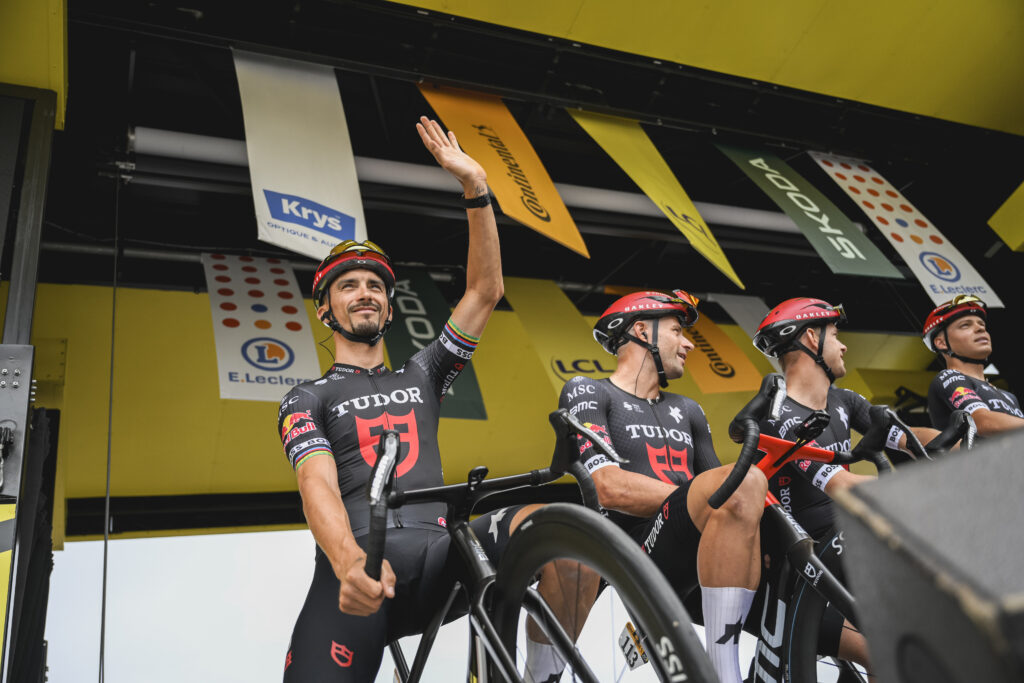

By the time bike racing properly emerged from the coronavirus pandemic, new documentaries were beginning to shine a light on Julian Alaphilippe’s increasingly inconsistent performances. His old manager, in columns and interviews, began repeatedly airing his grievances on the salary of his star rider, and the difficulty of extracting value for money from him.
But how do you bottle and market a feeling as nebulous and ineffable as Alaphilippe out of the saddle?
There is a certain poetry that, on Julian Alaphilippe’s first day as a retired man, the Tour of Britain Women pays its own homage by revisiting the scene of one of the Frenchman’s most spectacular exploits on the bike. It’s perhaps also apt to an extent that the exploit fell short of victory.
On the Great Orme climb, he turned himself inside out to try and drop Wout van Aert, falling short at the line before collapsing beside his rival in Llandudno. Given all Alaphilippe had done, and all Van Aert would subsequently achieve, the attack goes down as one of the most exciting moments in British racing history.
By this point, we were accustomed to Alaphilippe. He emerged as a swashbuckling stage-hunter in a Sky-era of rigid racing. Where money was sunk into a pit of aerodynamic efficiency, here was a young man constantly ranging in and out of the saddle, his racing reactive and seemingly spontaneous. He could climb the occasional mountain with the best, he had a kick that would fit within any lead-out train. And he was French.
Alongside Peter Sagan, he was the continental colour to enliven Grand Tours that otherwise appeared at risk of going stale. Of course he’d win Milan-Sanremo, or repeatedly outpunch others at La Flèche Wallonne. But then in 2019, he awoke a dormant beast of French fervour.
Tours de France are defined by eras. There are years of the big favourites, then there are the fallow years, where the best are deterred, and the new gods are yet to discover themselves. 2019 was to be the year the Sky train finally derails. With favourites ageing, surely if a French rider was to break the long duck since Hinault, Pinot and Bardet were the two to do it.
Yet then came Alaphilippe. A Sanremo-esque victory on stage 3 gave hope and a few days of yellow. A patriotically febrile two-up attack with Pinot on Bastille Eve brought a few more.
#TDF2019 throwback
💛 For the 100 years of the Yellow Jersey, @alafpolak1 delivered a wonderful performance during the ITT in Pau. 💪
💛 Pour les 100 ans du Maillot Jaune, Julian Alaphilippe honore son Maillot avec une performance extraordinaire lors du chrono de Pau. 💪 pic.twitter.com/j7ZpnvwjiW
— Tour de France™ (@LeTour) October 9, 2019
Then came that hill in Pau. And a dramatic final punch to take stage victory in the yellow jersey, sending home-nation hopes into fever pitch. Where Voeckler fell short, would Alaphilippe be the man to hang on?
French romantics point to the stage 19 landslides and stage 20 course shortening as cruelly denying the hell-raising descender the chance to rejoin the group of favourites as he saw the yellow jersey slip off his shoulders. Romantic realists point to the obvious fatigue in each rocking shoulder on the bike, the strains of a face battered by a route that contained a half dozen alps too many.
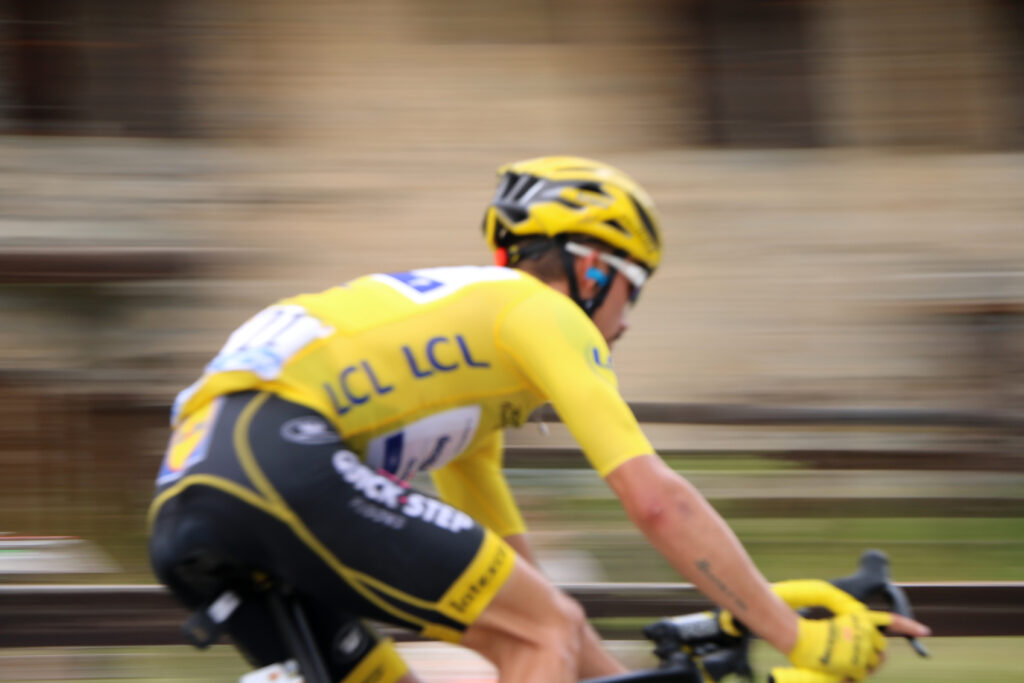
Still, surviving with the GC favourites until stage 19’s Col de l’Iseran wasn’t bad for a man who won the sprinter’s classic earlier that year.
Inevitably, despite the following years seeing Alaphilippe achieve his best results on paper, his reputation slightly cooled. Two world titles and more spells in yellow satisfied the headline writers but didn’t capture France’s willingness to delude themselves into another unlikely belief in the incredible. Still expectations grew. Then came injuries, along with his first child, with Marion Rousse.
As questions of his form grew louder, Alaphilippe also appeared to have lost a slight sense of racing nous, repeatedly attacking earlier and spending himself before the racing crunch points arrived. On occasion this had unintended consequences, most notably spurring Tadej Pogačar to attack too early at last year’s Amstel Gold Race, the Slovenian being caught and beaten for a rare one-day loss.
In more cash-strapped times, the writing was on the wall that his Soudal Quick-Step contract would not be renewed at the end of 2024. Alaphilippe’s omission from the Tour de France that year was diplomatically handled with the Frenchman’s stated aim of completing the trilogy of Grand Tour stage wins at the Giro d’Italia. So ensued one of the great days of racing I have witnessed.
On stage 12, a day of quintessential Alaphilippian-undulations, he attacked to bridge to the breakaway with 138km remaining. 12km later, he went again taking only Italian wildcard rider Mirco Maestri for company. With riders fresh behind, the pair appeared breakaway fodder.
Sports Director Davide Bramati came on the radio, urging Alaphilippe to drop back and conserve his energy but the Frenchman refused. Instead two up front set about defying expectations.
Alaphilippe needed Maestri, the veteran rouleur a windshield and bodyguard on the road to Fano. Maestri needed Alaphilippe, the man who physically and psychologically pushed him to places he had never before felt on the bike. As the chase behind organised, Alaphillipe turned coraller-in-chief for his companion and rival, turning and fist-pumping towards Maestri over each steep climb. They needed one another and each man knew it.
View this post on Instagram
Finally, with 11km remaining and the chasers closing in, Alaphilippe made his move on the final climb, another punchy acceleration fans had recently seen too few of. A technical descent to the finale was enough to ensure a sensational victory, whilst Maestri was caught and eventually finished ninth.
After the stage, Maestri told Italian television the day had been his most beautiful on the bike. Recognising the scale of their endeavour achievement, Alaphilippe celebrated his victory with the Italian, later exchanging a jersey and reminiscing on their shared suffering.
🤩 La 𝐞𝐬𝐩𝐞𝐜𝐢𝐚𝐥 entrega de Alaphilippe a Maestri
🍕 ‘Loulou’ ha tenido un precioso detalle con su compañero de fuga durante la etapa que ganó en Fano.
🎥 @soudalquickstep#GirodItalia | #LaCasadelCiclismo pic.twitter.com/g2zeyP8ieH
— Eurosport.es (@Eurosport_ES) May 19, 2024
Once the cheeky chap who won over the world with raised eyebrows beside the French President, here stood a man who had come of age, winning the warmth and respect from his rivals.
His performances in his contract year were enough for Tudor to make him their marquee signing, and a win in Canada and a third career Tour of Britain podium brought enough UCI points to silence critics, but results this year lacked noteworthiness. His final Tour de France brought only two breakaway appearances, one as part of a doomed quartet on the flattest stage of the race.
Alaphilippe was more notable for the noise he brought to the race, roadside fans cheering for the man whose legs could no longer deliver, but wishing well to the man no doubt now overflowing with goodwill messages towards ‘a next chapter.’
I attended the opening stages of last year’s Tour de France in Lille. At the team presentation, he matched Tadej Pogačar for the crowd’s loudest cheers. It seems poetic that the only roadside footage I captured of him shows a stage 2 attack launched far too early, providing the perfect lead-out for Mathieu van der Poel. The hoarse voice is mine.
Something pretty apt about the only footage I have of Julian Alaphilippe is him launching a vain, awe-inspiring attack that didn’t quite succeed… the hoarse excited voice was mine!
— Callum Devereux (@devereuxcallum.bsky.social) 20 August 2026 at 23:13
If any rider was to bring the hoarseness it was Alaphilippe. His latter years brought a yearning, a willingness to re-appreciate the rider whose panache was taken for granted a little too early in his career, the rider who, beneath the patriotic pride of the Sky era, brought a gut feeling to my racing experience. It was neither a neutral sporting spectacle to flick on, nor an almost other-worldly show of domination that demanded its greatness be witnessed.
He was a character who demanded emotional investment, who sucks you in by the risible effort and courage underpinning each pedal stroke. In retiring now, he leaves on his own terms, with the love and adoration of the masses as high as could be. For that, he deserves every token of appreciation, effable and not.
La dernière image de Julian Alaphilippe a donc été cette ovation dans la rue Lepic, à l’issue d’un Tour de France très compliqué pour lui sportivement.
Une nouvelle page du cyclisme français se tourne avec l’annonce de sa retraite immédiate. pic.twitter.com/1t5uzycnvx
— Le Gruppetto (@LeGruppetto) August 20, 2026








1 thought on “Julian Alaphilippe: the man who made the world yearn”
Brilliant article, sums up how “LouLou” made you feel during his peak, adored by the French “Naturellement” and the wider cycling fan base across the globe,
One of my favourite memories of his was the speedway skid he performed as he crossed the line in yellow at the time trial and celebrated with his team.
Such a cool guy on and off the bike. We need more “louLou’s” in the World of cycling and just in the World overall.