



Karrimor has long since been considered as a household name in the UK, but did you know the famous outdoor brand started out of a small family bike shop in Lancashire? This is the story of Karrimor’s humble rise and eventual fall into outside ownership, as told by Mike Parsons – the son of its founders – and the man who largely took the company from that bike shop to global prominence…
road.cc: Karrimor was known as one of the world’s great outdoor and mountain brands, yet it was firmly rooted in cycling. Can you tell us about how it all came to be?
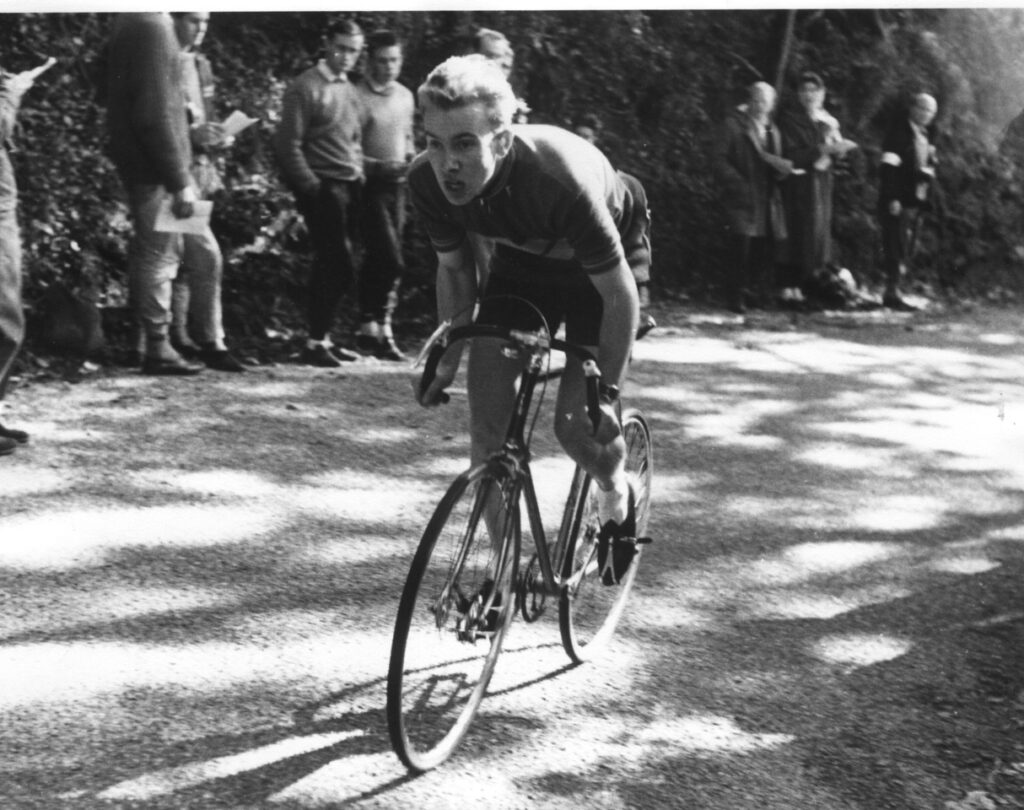
Mike Parsons: My dad [Charles] was a keen racing cyclist in Rossendale. He originally came from the Southwest, and he held the local club record for Rawtenstall to Blackpool.
He was working in the local cotton mill during the late 1930s, the Great Depression. He went into partnership with another guy, and they opened a bike store in Waterfoot. My father would go to the shop at night to do the bike repairs, while his partner was opening the shop during the day.
One day a customer came along and told my father that he went to the store at 10am and the door wasn’t open, and so that was the beginning of the end of that partnership. He opened up on his own a few hundred yards away, and that was the start of the whole thing.
When wartime came my parents were due to go to Germany on their tandem, but with the war rumbling they went to Ireland instead. As the war came the Ministry of Supply came in, and they had complete control of everything, so you couldn’t buy consumer goods or raw materials. My father’s accountant managed to get an appointment with the Ministry and obtain a licence for 12 square yards, a quarter of canvas. They didn’t restrict it to that, but that’s how tight it was.
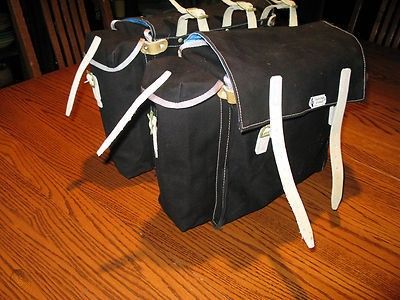
My father asked my mother [Mary] and her sister [Grace]: if he got them a couple of machines, could they make him some bike bags to sell in the shop, because they were very short of items to sell. They weren’t sure, but they were experienced machinists, as Rossendale had quite a strong shoemaking scene as well as the textiles. That’s how the bike bags started.
What led to those early bags going beyond your own family bike shop?
Sometime later a sales rep came along and asked where they came form – as there was no label or anything on them at the time. He said he could sell some of them, and that’s how it started to expand.
You were very young when all of this was happening, and things took a nasty turn for your father. What can you remember of those early days?
My father had an accident while working very late on repairs. He splashed spirits of salts [hydrochloric acid] in his eyes.
Eventually, after a lot of persuasion from my mom, he went into Moorfields Eye Hospital in London. They operated, but at that moment a German bombing raid came through, and they had to move him to cover. When they came back to him, they said: “Sorry Mr Parsons, we have lost it”. He didn’t fully lose his sight at the time, but it got progressively worse.
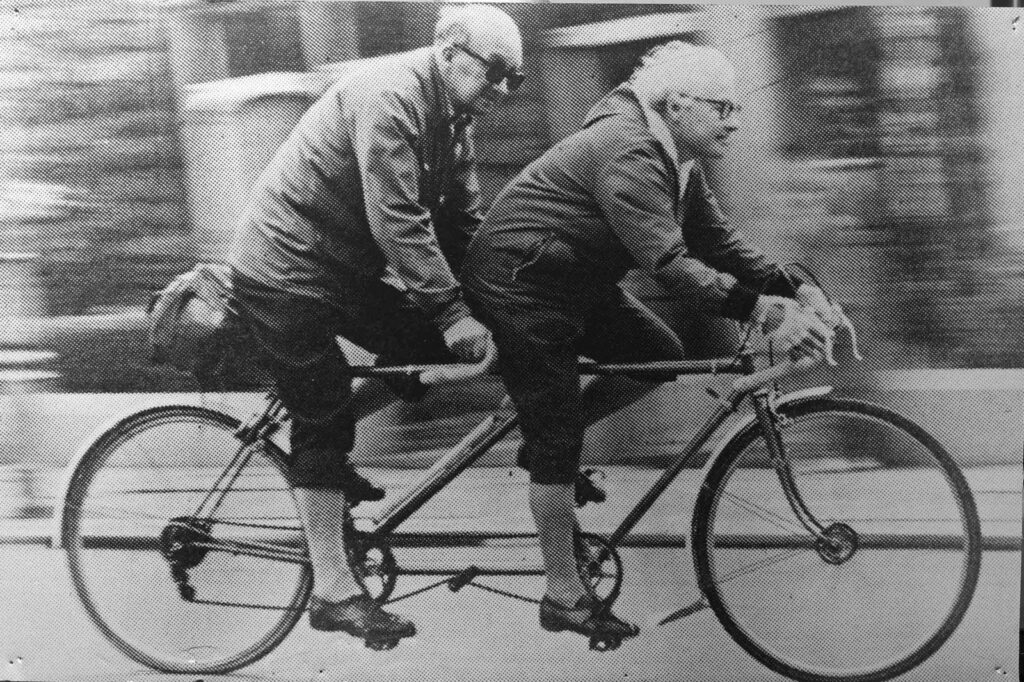
I think I just had one bike ride with him when I was about 8 or 10, then he had to stop riding on his own. Several years later I got him going again. We dug out some tandems that had been left in the bike workshop and never collected, and all cycled as a family for many years. We rode one or two national blind championships. I also came something like 32nd in the Catford Hill Climb, which was the National Championships.
When the mountains beckoned
Karrimor became known globally as an outdoor brand, rather than a cycling brand. How did the shift in direction begin?
In the post-war era, the BMC (British Mountaineering Council) was founded, whereas everybody else in Europe had organisations starting from the 1880s-1890s. But in the elitist society that Britain was we only had one top organisation, the Alpine Club, which was only really open to the elites.
The BMC published a book called Climbing in Britain, and it sold something like 125,000 copies. That was at the time when something like half a million men were coming back from war.
There was also a massive sociological change that happened, and with the bike shop we were becoming extremely conscious of it. As cars came along, and people were into all kinds of motorised transport, if you were still riding a bike you were regarded as a bit of a down and out, or a bit of a peasant. It really was a strong sociological factor.
We were a Raleigh dealer, and at that time Raleigh was a real name. During the war they’d converted to making munitions, and in 1953, the same year as the first ascent of Everest, Raleigh opened a huge factory, and later a second one, expecting there to be a boom. But the bike market collapsed; one factory was shuttered, and the other switched to making white goods.
People shifted from bikes to climbing, walking, and motorised transport. The whole bike market collapsed, as did the bike bag market, although it still existed.
How exactly did you transition from bike shop and bag maker to major outdoor brand?
I left the school sixth form at 18, having done A-level science. I was the only one not going on to university, and so I was rather looked down on.
I started for a year in the bike shop, learned how to build a wheel, deal with cotter pins, and all sorts of things that no longer exist. My aunt was still working with about four or five people in a workshop above the shop, making bags. It was full of leather and canvas, and there was a really pungent smell of the leather.
The bike shop itself would have collapsed, but my mom steadily brought in other things, and it eventually turned into an outdoor shop. When the French reinvented camping there was a camping boom – frame tents and boy scout-style, which was a great help for the shop.
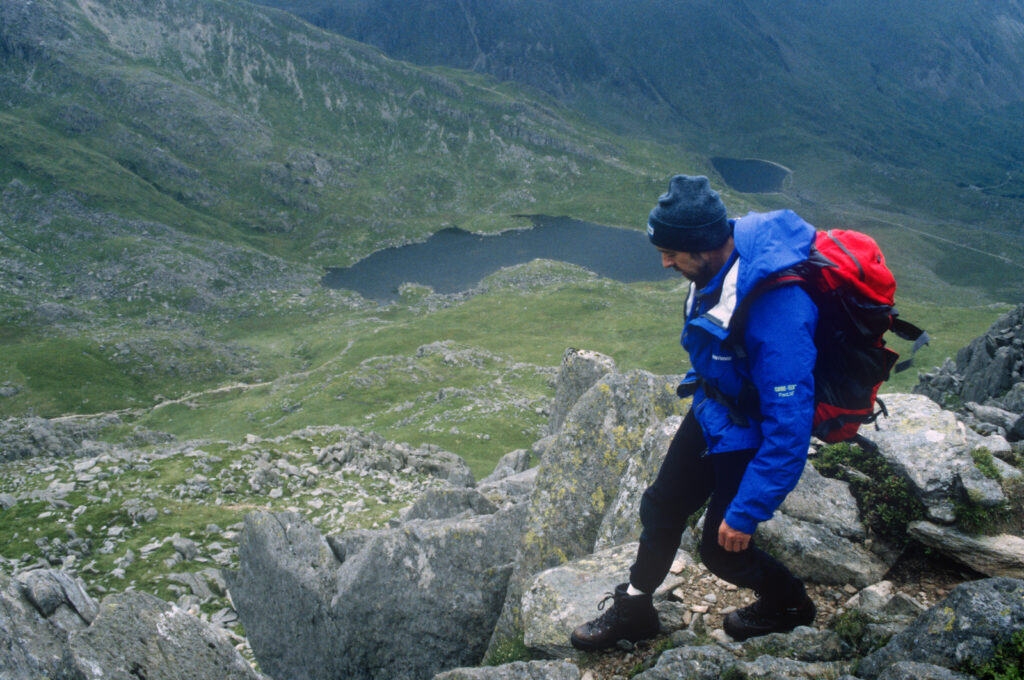
We used to do one-off custom things in the bag workshop, as they were short of work and wanted to keep people employed. There was a known climber who came along (David Thomas), who was going on the 1958 expedition to the Russian Caucuses with John Hunt and Chis Brasher [the famous runner, who was also a climber earlier in life]. There were some beautiful, framed rucksacks from Bergans in Norway around, but they weren’t suitable for climbing. He wanted a long thin bag without a frame, so we made it.
I’d been working in the shop for a year and then switched to the bag workshop, and somebody came in to see me and said: “How do? I’m Don Whillans, you might have heard of me, I live just up the road. You’re making a pack for a mate of mine, Joe Brown, could you make one for me?”
That was the start of the rucksack side.
Throughout this, and with your father going blind, did the family cycling passion and involvement continue?
My mom had an operation and didn’t think she could cycle again. My dad had become very unfit, so I put him on the back of a tandem. On the very first ride we only got 3-4 miles until we hit the first hill, but we kept going a bit further, and several years later we got to the point where we would ride over to York Rally on Saturday night and ride back Sunday – 75 miles each way, and so he got quite fit again
We only had one small Austin van between the whole family and the business. We all worked in the shop on Saturday, even when I was in the manufacturing, and one early Sunday morning me and Eric the shop manager, and sometimes my sister Jen, would drive with our bikes and park near Garstang on the A6, where the TT courses were. My mom and dad would ride there from home on the tandem and drive the van back, while we rode back to get more miles in.
As we got older, I got married and we started going our own ways. Mom decided that she could start riding again, and that she could manage the front of a tandem. We go a small front-end tandem, and she rode for many years with my dad then, and they had lots of great trips.
What made Karrimor become such a major brand during that time?
It was the association with famous mountaineers. Don Whillans was a folk hero, Joe Brown was a folk hero, and we made a Joe Brown pack. Those people were a new generation of climber. It wasn’t just that they were bloody good, it was the fact that they were working class people, whereas climbing had always been something done mainly by the upper classes who had the time to take off for a few weeks in the summer alpine season.
Flares of hope
As Karrimor first rose to mountain and outdoor prominence, did you continue making bike bags?
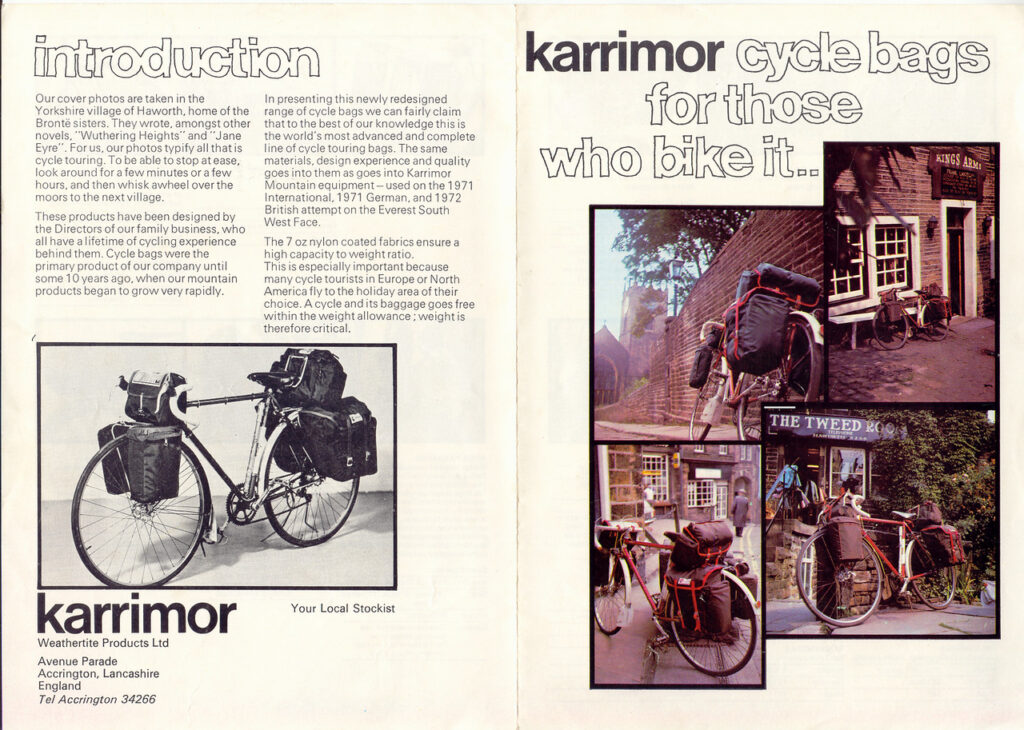
It was the early 1970s, and I’d just finished making some bike bags, but we were about to completely stop making them because they were made using older processes. Then I suddenly noticed in Cycling magazine that a UK frame builder had started to open up some new business.
After the bike business collapsed, people in the UK were obsessed with owning a car, but by the 70s the Americans had got over that – everyone had a car, so it was no big deal. If you were riding a bike, then that was clearly a sport.
That was the first sociological shift back again, and I thought, ahh, we’ve got lots of new materials and fabrics. So my mom and I redesigned the whole bike bag rang in nylon fabrics, and that was very successful.
The fat-tyred revival of Karrimor as a cycling brand
When mountain biking came around, yourself and Karrimor were very involved with the sport. Was it a revival for the cycling side of Karrimor?
Very much so. Around that time I’d been living in Holmfirth after getting divorced, and was doing a lot of climbing. Then I moved to the Lake District, and assumed I’d be doing more climbing. But at this point we’d moved into our new factory as Clayton le Moors, and I’d decided that we’d have a small shop linked to the factory.
I was looking for someone to run the shop, and finally found John North [RIP]. I tracked him down, and he wasn’t very happy where he was, and so he started running the shop and got it open.
It was much more successful than I thought it would be. Simply because John was part of a community, so people popped in to see him and saw what we were doing.
View this post on Instagram
During the 1990s, Karrimor was very much involved with sponsorship of MTB riders, teams, and events – how did that come around?
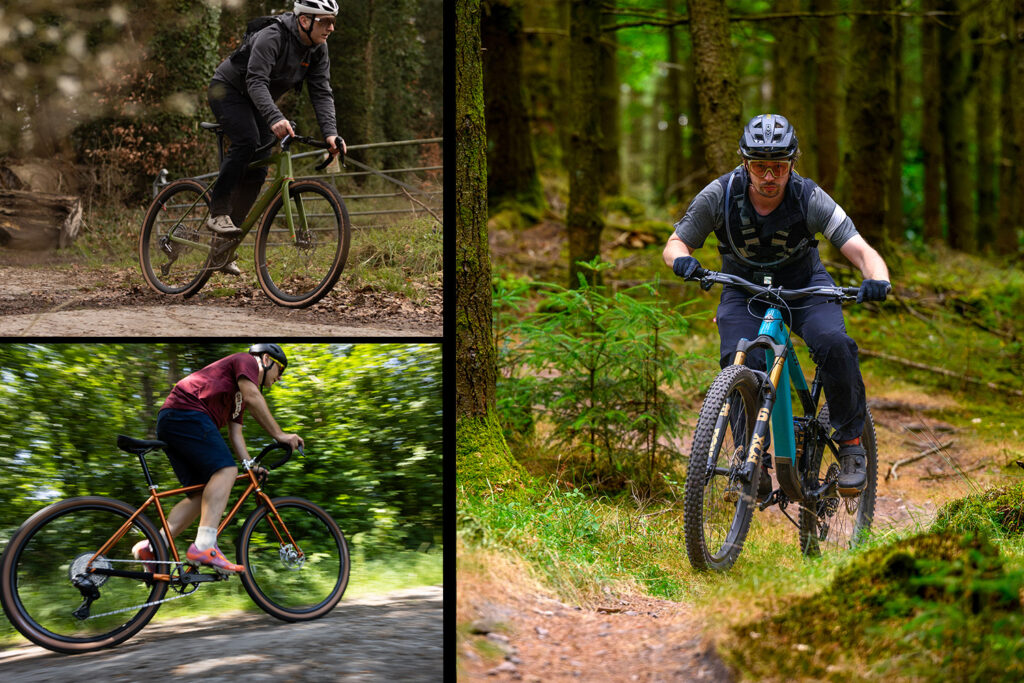
One weekend John called as asked if I wanted to go to a mountain bike race. I think Andy Stevenson from Biketreks was running it. I started riding seriously again then, and Andy’s Tuesday night rides became really renown (you had to be fit). Then I did some NEMBA races, and eventually we took on the sponsorship.
During the 1990s you also went in to the cycling distribution sphere, and distributed many lines for major cycling brands. How did that happen?
We were struggling with the bike bag distribution, so we took over a company (Life Cycle, a distributor of the era) and my sister Jen came out of retirement to operate Karrimor Bike.
We did some of our first cycle clothing, and John North was involved in it, and was working with the pattern makers. He couldn’t get them to understand the shape the garments needed to be, so he took his home trainer in and rode it to show the position, and they got it.
That was probably the first properly designed cycle jacket, which everybody followed: longer back and arms and a raised crotch area.
By the end of the 90s, Karrimor went through a rough patch, which eventually led to takeovers and going into receivership in 2004, by which time you were no longer involved in the company. What would you say was the stumbling block that led to the takeovers?
We overstepped ourselves. I got a Gore licence, which was a difficult decision for them to make as we were direct competitors to Berghaus, but they did it. After a couple of years they asked if there was something to do, and I was persuaded to take on Phoenix [the ski/tent brand], and that was the final crunch. Basically, they were bankrupt, because they owed Gore a lot of money. Gore had been very patient as they made some very good stuff. But Phoenix were clueless about accounting and efficiency.
Unfortunately, taking it on pulled us down.
The Karrimor brand was acquired by Sports Direct/Frasers Group in 2004. Although the Karrimor products we see today are not of the same ilk as the original Karrimor created by Mike and the Parsons family in a tiny workshop above their wartime Lancashire bike shop, the name still lives on.








5 thoughts on “Panniers, peaks and troughs: How Karrimor became one of the biggest outdoor gear brands of the 80s from its humble cycling beginnings”
Still using Karrimor Kalahari, have rear ones with the rucksack conversion, bar bag, seat wedge bag and later front dry bag ones. All made in Byker Grove Lancs.
Even have an original box and paper work.
Truly brilliant kit.
My 1980 Karrimor Karibou rucksack provided decades of service before finally giving up the ghost sometime in the early 2000s. Fabulous, functional kit that didn’t cost the earth. While the Karibou’s no more the fond memories are not.
My hot rock lasted from 90 or 91 until around the millennium when I went to the timbuk 2 courier bag, still got it, has holes in the base, my 75 litre rucksack I got for scouts in 86ish is still going strong.
Karrimore made good stuff back in the day, built to last. Unfortunaely it is no longer a sustainable business model and won’t be until manufactures and retailers are forced to pay for the environmental costs of what they produce.
My Karrimor black and fluorescent yellow panniers are still going, with a couple of patches.