



London has been named among 19 global cities, across nine countries, which have slashed levels of two airway-aggravating pollutants by more than 20 per cent in the last 15 years, a new study has found.
This “remarkable reduction” in air pollution, the report by Breathe Cities says, was driven by policy interventions such as cycling infrastructure, the increased use of electric vehicles, and the implementation of London’s Ultra Low Emission Zone (ULEZ), restricting the use of high-polluting cars.
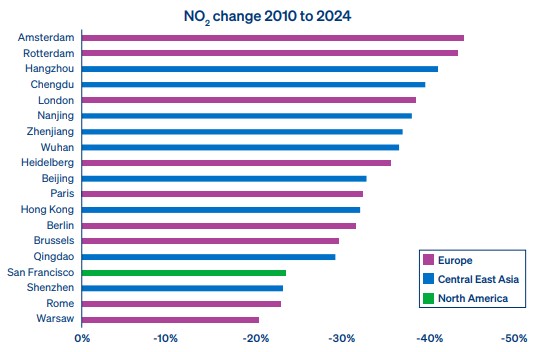
According to the group’s analysis, between 2010 and 2024, London’s nitrogen dioxide (NO2) levels were cut by almost 40 per cent, the fifth largest reduction in the world, and third in Europe, behind the cycle-friendly Dutch cities of Amsterdam and Rotterdam.
Meanwhile, London’s levels of fine particle pollution (PM2.5) fell by around 25 per cent during the same period, ranking it 14th in Breathe Cities’ list in that particular category, topped by Beijing and Warsaw.
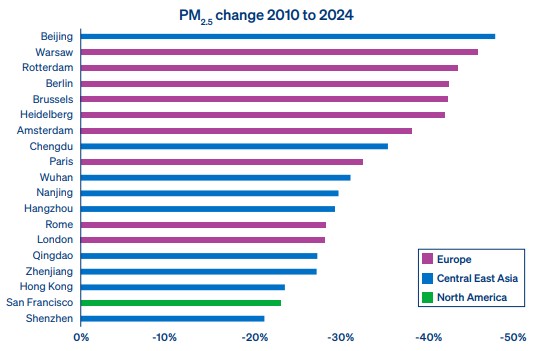
The report examined air quality across almost 100 cities in the C40 Cities Climate Leadership Group, with 19 of those cities found to have reduced their levels of toxic air pollution in both categories by over 20 per cent.
Almost half of the 19 cities highlighted are located in Central and East Asia, with Breathe Cities pointing out that “rapid clean air progress is possible even in fast-growing urban regions” and not confined to places with long-established regulatory systems.
The group says their analysis shows that “substantial reductions” can be achieved in a relatively short period of time thanks to deliberate and “sustained” action by policymakers, “demonstrating that improvements in air quality are not only possible, but achievable at scale”.
According to the report, Breathe Cities’ findings demonstrated that these reductions can be achieved by promoting active travel, the group acknowledging that “most leading cities have taken major steps to reshape urban space in favour of clean mobility” by expanding cycling networks and pedestrianised zones, while “reallocating road space away from private vehicles”.
“These visible changes reinforce long-term behavioural shifts while improving urban quality of life,” said the group.
London was also praised for expanding its “pioneering congestion charge zone in the city centre to a world-leading Ultra Low Emission Zone that now covers the entire city”, successfully targeting high-emitting sources in a dense urban area.
> Will ULEZ get more people on bikes?
Other policy actions, such as modernising and electrifying public transport systems, and accelerating the shift to electric vehicles in general, were also highlighted as crucial to reducing air pollution in cities.
Speaking to the Guardian, Gary Fuller, an air pollution scientist at Imperial College London, said Breathe Cities’ findings emphasise why “bold” actions are key to tackling toxic air.
“Air pollution is often presented as a problem that is too difficult to solve and one that is politically unpopular,” he said. “This report shows that bold policies can improve the air that we breathe.”

The report was published in the same week Transport for London announced that it is investing £94.8m over the next two years to deliver “greener, safer streets” in the capital.
TfL says the latest round of funding will help deliver 147km of new or upgraded cycle routes to strengthen London’s growing Cycleways network, introduce more pedestrian crossings in local neighbourhoods, expand School Streets, allowing children to walk and cycle to school safely, and implement 20mph speed limits on 170km of London’s roads.
“This investment underpins the Mayor’s ambition for 80 per cent of all trips in London to be made by walking, cycling, or public transport by 2041,” TfL said.
In a statement, London’s Walking and Cycling Commissioner Will Norman added: “I am thrilled that another round of funding has been awarded to boroughs as part of our three-year programme to make London’s streets greener and safer.
“We have already seen the transformative impact of new cycleways, expanded School Streets, and lower speed limits helping to reduce road danger across the city.
“This next round of funding will enable boroughs to build on that progress, while supporting the Mayor’s Vision Zero strategy to eliminate all deaths and serious injuries from London’s transport network by 2041.
“Investment in transport infrastructure and safer streets is vital to boosting walking and cycling making London greener, safer, and fairer for everyone.”












11 thoughts on ““Bold” bike lanes and ultra-low emission zones help London slash air pollution by over 20% since 2010, new report finds – as capital aims to double cycle network and deliver “greener, safer streets””
Pandemics and lockdowns also helped to improve air quality, didn’t they? Some major Chinese cities managed to score impressive improvements by electrifying public transport networks, promoting EVs, banning in-city access to unregistered cars and trucks. At the national level, polluting industries were shipped overseas. Atmospheric pollution didn’t disappear, it was moved upstream and abroad.
Which is not the case with London, which is what this article is about, and although the pandemic effected a temporary improvement in air quality in the capital the improvements in this study have nothing to do with that and everything to do with the efforts of Mayor Khan and his administration, to which you seem curiously reluctant to give credit.
Good work London.
Having lived here from birth (nearly sixty years now) I can honestly say that I’ve never known the air so clean, especially in boundary areas like Crystal Palace and Hampton Court now that out-of-towners can no longer bring the most polluting vehicles into London without a hefty charge. It’s a joy and in a world that seems to be heading to hell in a handcart a rare improvement that deserves celebrating.
Well done London. Stick to your guns Sadiq. Those cycle lanes will soon be heaving if things carry on the way they are in the Middle East. As for the ULEZs, there won’t be that many cars anyway. The petrolheads are raving about prices now!
Well done Sadiq Khan!
Let’s hope you’re not replaced by a motor industry-backed right wing candidate who reverses all your good work in the name of ‘freedom’.
The ol’ conservative / economic liberal (to their pals) types just don’t seem to be able to move on from the motor lobby or leave of with the bike hate.
Witness eg. the previous challenger for London mayor. Same seems to be the case for the next challenger for Paris mayor. (And for “far out” exemplars see the Ford brothers over in Canada)
Apparently (per NotJustBikes) it is still slightly the case in NL – where cycling is (mostly) just a normal and very popular means of transport.
OTOH … in the UK bashing cycling and styling yourself as the motorists’ friend is available to all parties – even a few Greens. And perhaps it’s just that all politicians need a grievance to champion / target to fight against? And the vast money and influence from the motoring, construction and fuel lobbies no doubt tempts…
But… that somewhat opportunistic Conservative Boris Johnson is the only one I can think of offhand who managed to get improvements for cycling done. (there must be a *few* others, surely?)
“in NL – where cycling is (mostly) just a normal and very popular means of transport.”
Agreed, I’ve not been for a few years but just finished watching a Dutch series on Ch4s Walter Presents. The cultural differences are stark where well paid lawyers and business people cycle to work or the shops as a matter of course. Here they’d be considered oddball eccentrics in the office or golf club for not driving a BMW or Audi.
“The cultural differences are stark where well paid lawyers and business people cycle to work or the shops as a matter of course. Here they’d be considered oddball eccentrics in the office or golf club for not driving a BMW or Audi.”
That’s not the case in London, certainly the inner city – plenty well-paid people cycle to work (and few drive). What they’re less likely to do is ride at other times, or for other purposes (you wouldn’t leave your £8k Cervelo outside the shops or the restaurant after all). The next challenge is to get more commuters onto ‘normal’ bikes, doing more of their ‘normal’ day-to-day trips.
@Dnnnnnn indeed. From looking at other places (mostly NL, but I think you can see this in parts of Scandinavia) it’s “where are the women and children”?
Currently women are still much more likely to be doing child care / shopping than men (and perhaps also working locally). In many urban places those things are reasonable to do on a bike. Indeed they *could* often be as convenient / pleasurable to do by cycling as driving or taking the bus.
It’s superpowered walking – *private* transport which should be able to take you almost door to door, and not spend most of the time sat at lights in a box, then hunting for a parking space.
Now we’re online more than ever there’s even more reason to campaign to fix it so children * can have independent mobility. I think there’s a good economic case for that also…
* And older people, and those with some kind of disabilities – 8 to 80 active travel…
Regarding London mayors, a lot of what was completed or launched under Johnson was actually a result of work done by Ken Livingstone (the so-called Boris bikes, for instance). The cyclesuperhighways was another (happy to blame Johnson for how poorly some parts were implemented though – remember, Johnson’s attitude towards cycle safety was that Elephant & Castle roundabout was fine “if you keep your wits about you” and the victim-blaming he partook in after some of the awful junctions resulted in deaths in 2013).