


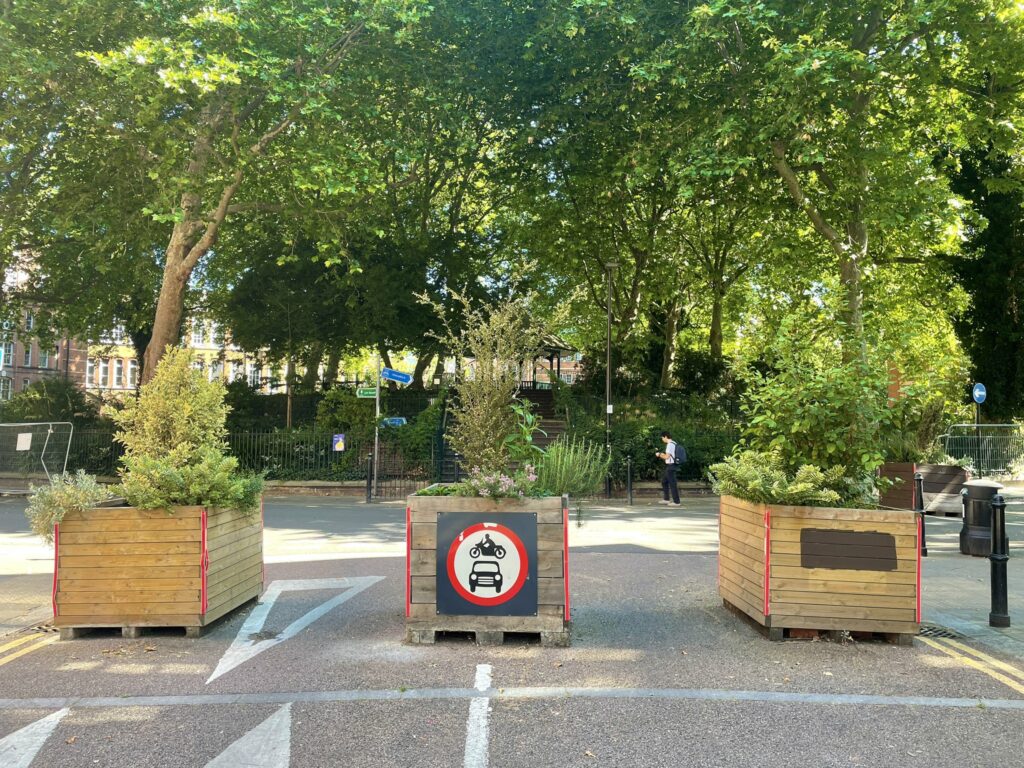

Residents have secured a “massive” legal victory to save three low-traffic streets in east London, after the Court of Appeal ruled today that the decision to axe the schemes was unlawful and ignored the city’s overall transport plan in what has been described as a “huge precedent for London”.
In September 2023, Tower Hamlets Council, led by its pro-car mayor Lutfur Rahman, voted to remove three Low Traffic Neighbourhoods (LTNs) in the borough, despite a series of consultations showing that a majority of residents were in favour of retaining the traffic-calming measures.
The Liveable Streets in question were introduced by the previous Labour administration between 2020 and 2022 in Columbia Road, Arnold Circus, and Old Bethnal Green.
Rahman, whose Aspire Party holds 22 of the borough’s 45 seats, after first gaining control in 2022, has spent his time in office rolling back initiatives aimed at reducing motor vehicle traffic and promoting active travel, which he claims have increased congestion and contributed to more CO2 emissions in the area.
The decision to axe the three LTNs (leaving only one, on Canrobert Street, remaining), however, sparked a furious backlash from local residents, the campaign group Save Our Safer Streets branding the move “extreme, undemocratic, and dangerous”.
The group also pledged to launch a legal challenge against what it said was a decision that ignores what residents want, as well as “making the air dirtier and making cycling and walking more dangerous at a time when people need cheap forms of transport more than ever”.
That crowdfunded campaign, which raised over £100,000, was brought to the Court of Appeal in November after mayor Rahman won a previous hearing at the High Court in December 2024.

But on Thursday, the Court of Appeal ruled that Rahman had acted unlawfully in removing the Bethnal Green LTNs by failing to implement the borough’s local implementation plan [LIP].
The judges found in favour of the campaigners on one of the three points of law which as a result led them to conclude that the schemes’ scrapping – which has been left in limbo due to the ongoing legal proceedings – should be “quashed”.
In the judgement, Lord Justice Singh concluded Mr Rahman had breached the Greater London Authority Act 1999 by ignoring the borough’s LIP and London mayor Sadiq Khan’s drive to reduce car use in the capital.
The court, however, rejected the campaigners’ other points of appeal, namely that Mr Rahman failed to run a fair consultation prior to removing the LTNs and that he failed to follow the correct procedures.
“I recognise that there are strong and differing views about low traffic neighbourhood schemes in the London Borough of Tower Hamlets and as between the Mayor of Tower Hamlets and the Mayor of London,” the judge said.
“I also recognise that both the relevant mayors are democratically elected by their respective electorates.
“It is not the task of this Court to assess the merits of LTNs in general or the particular scheme in this case.
“I have reached the conclusion that the [campaigners’] arguments on issues (2) and (3) must be rejected as a matter of law but the argument advanced by the [campaigners], and supported by [Transport for London], on issue (1) in this appeal succeeds as a matter of law.”
Responding to the judgement, Save Our Safer Streets posted on social media: “After two-plus years of legal battles, the Court of Appeal has ruled in our favour.
“Councils can’t just tear out schemes without Mayor of London’s approval. A huge precedent for London.”
“Thousands of local residents will be extremely pleased and relieved that the Court of Appeal has ruled that the decision to remove our popular low traffic neighbourhood was unlawful,” added Save Our Safer Streets member Ted Maxwell, who said the ruling was pivotal in the fight to reduce car dependency and improve the health of residents.
“This is a victory for local people who came together when they saw that their community stood to lose the safer streets they really value.
“This means the Mayor of Tower Hamlets must now accept that our safer streets are here to stay and he should look for a better use of £2.5m of public funds.
“Whenever they are asked, people say they want more help to walk, wheel or cycle around the borough.
“We would like to see the council listen to the views of residents, schools, GPs, the Met Police, and TfL and work with them to make transport policy decisions that people actually want.”
That sentiment was echoed online by active travel campaigner Laura Laker, who wrote: “This is significant news for schemes delivered across London in the last nine years.
“It means politicians can’t simply ‘rip out’ LTNs and bike lanes they don’t like. Some of those running in May’s elections are going to have to rethink their pledges.”

> Children take to the barricades to save School Street
Ricardo Gama, a partner at law firm Leigh Day, which represented the residents in their legal battle, said: “Our client is delighted that, after a legal battle that has gone on for more than two years, the Court of Appeal has agreed that it would be unlawful for Tower Hamlets council to rip up the safer streets schemes.
“In a context where the Mayor of London’s transport strategy promotes low traffic infrastructure, and Tower Hamlets had agreed a plan to implement the Bethnal Green low traffic schemes, this judgment confirms that the Tower Hamlets’ mayor cannot unilaterally go against that strategy.”
Before the LTNs were introduced in the early 2000s, over 8,000 motorists a day used Old Bethnal Green Road, with many drivers treating it as a ‘shortcut’ that passed four primary schools.
Following Rahman’s decision to scrap the schemes, the Metropolitan Police revealed that they had proved instrumental in reducing anti-social behaviour and crime in the area, which had previously been subject to so-called “car bars” frequented by partiers who had been drinking in nearby Shoreditch.
In fact, according to papers published by the council’s cabinet, 59 per cent of residents in Bethnal Green supported retaining the traffic-calming schemes, while 58 per cent of those surveyed in Arnold Circus were also in favour of the initiatives.
The council report also confirmed that air quality and road safety has improved both within the areas where the schemes have been implemented, as well as on boundary roads, while rat-run traffic in Bethnal Green has been reduced and serious road traffic injuries almost eradicated entirely.
“Walking and cycling infrastructure, such as low traffic neighbourhoods, plays an important role in making our streets safer and encouraging more active travel across London,” Transport for London, described as an ‘interested party’ in the case, said in a statement.
“We are very pleased with the court’s decision in this case, which provides welcome clarity on the scope of London boroughs’ legal duties to implement and retain schemes funded by TfL to implement the Mayor’s transport strategy.”



















8 thoughts on ““Our safe streets are here to stay”: Mayor’s “dangerous” decision to axe low traffic neighbourhoods deemed unlawful, as campaigners hail “huge precedent for London””
I think you mean “convicted
I think you mean “convicted corrupt criminal, Luftur Rahman”…..
Reportedly – along with many
Reportedly – along with many (most?) of his fellow Aspire Party Councillors.
Tower Hamlets Council is akin to a rogue state – riddled with corruption at every level, with Councillors fully complicit in this and seemingly fully supported by a good chunk of the local residents who share the same values.
I don’t think you need to say
I don’t think you need to say ‘reportedly’ when the reports were of a court case that led to them being banned from public office?
“first gaining control in 2022” is curious wording, even more so as the real first time Rahman was in power the abuse of that power was widely reported. Or maybe there’s some convoluted way in which the corrupt and criminal first period of power doesn’t count because the current party was registered in a different way or something?
The Controversies section of
The Controversies section of his Wikipedia article is quite extensive.
Tom_77 wrote:
Seems like a nice chap. He’d fit in well with RefUK.
You mean “… with “Reform UK
You mean “… with “Reform UK Party Ltd”…” ?
eburtthebike wrote:
His morals and manner of conducting business do seem to align with Reform UK Party Ltd, but I can imagine other Reform members not being happy with his tone of skin.
I heard today most folk are
I heard today most folk are in favour of 20mph zones/ LTN’s etc, but they think they are in the minority and dont speak out. Good to read the Tower Hamlets residents did speak out !