



Cannondale has launched its CAAD14 aluminium road bike, and it looks like a classic CAAD design with a horizontal top tube and high seatstays, but with modern features like internal cable routing and UDH (Universal Derailleur Hanger) compatibility.
> What is UDH and is it the future of all bikes? SRAM’s Universal Derailleur Hanger explained
“Not carbon, not sorry.” That’s the tagline that Cannondale is using for the CAAD14, and that sums up its approach here.

Rather than trying to look and perform like carbon, the new CAAD14 in many ways appears like a return to CAAD (Cannondale Advanced Aluminium Design) designs of old. Cannondale has concluded: aluminium is CAAD’s greatest strength, let’s celebrate the brand’s aluminium heritage rather than apologise for not being carbon. Back come the classic silhouette and big tubes with those smooth welds for which Cannondale has long been famous. With disc brakes and internal routing, it’s very clearly a modern bike, but it’s also very clearly a Cannondale CAAD bike.
We won’t go into too much of a history lesson here, but Cannondale has been making high-performance bikes from aluminium (or ‘aluminum’ as they say in the USA) since 1983, starting with the ST500 sports touring bike. Although that model didn’t have the CAAD label, it had many of the features that eventually became CAAD.
The CAAD name first appeared in 1996. The CAAD designs have developed greatly over the years to keep up with changes in the market, but many thought the CAAD13 (below), introduced in 2020, was a slight misstep, with carbon-esque tube shapes, uncharacteristically non-smooth welds, and dropped seatstays. Well, maybe not a misstep exactly, but the CAAD13 didn’t exactly make the most of the CAAD heritage.

Murray Washburn, Cannondale’s director of global product marketing, says, “CAAD13 was a great bike. Anybody who rode it knows it was incredibly smooth, it was light, it did everything you wanted it to do, but we designed CAAD13 to look like the Gen 3 SuperSix Evo. The tube shapes, the frame silhouette, it all mimicked what we did with the carbon SuperSix Evo, so rather than allowing aluminium to do what aluminium does best, we were trying to make aluminium look like carbon… To make a nice, easy price-point jump from aluminium up to carbon.
“And despite the fact that it was a great bike, got great reviews and sold really well, it lost something in the process. It lost the smooth welds, it lost the Cannondale CAAD look, and it failed to stir the soul of the Aluminati in the same way that CAAD has traditionally done.”
Aluminati is the name that Cannondale gives to fans of aluminium frames.
Long story short: it was time for a rethink.
Back to its roots
Cannondale’s senior industrial designer Tanner Van De Veer says, “We took a step back and asked ourselves: how do you rebuild an icon?

“The answer was surprisingly simple. You design to the material. You go back to the roots by optimising for the material. We could create the best riding experience for the segment, and remind the industry just how good aluminium can be when treated properly. And that led us to the conclusion: not carbon, not sorry. Build something so desirable that someone would think twice about buying the carbon bike.
“That’s when it clicked. The signature was back. A classic CAAD silhouette, horizontal top tube high stays, double diamond… We were one step closer, but we still weren’t there yet. The proportions, the lines, the complexity: it was all still too carbon. Things were too thin, surfaces, overworked, tapers and lines too extreme.
“So, how do you really bring that signature home? What do you look at for CAAD that makes it truly special? It’s more than just that classic racy line. It’s a smoothness and attention to the joints and the welds, the way everything comes together, inflated tubes and proportions with simple but thoughtful cross sections. It’s also taking things and making them modern. It’s not just a retro throwback. It’s taking what works and bringing it into the world of today’s best bikes.

“And all that brought us to CAAD14: a classic, a love letter to its heritage, unapologetically CAAD, but wholly modern too. It’s not trying to be some price-point imitation of carbon. Well executed, but not overdone. No frills, no fluff, but thoughtful and sophisticated design, honest to its material and its intent. And it’s crafted as a celebration of aluminium details and nuance, big tubes and smooth welds, all wrapped up in an aggressive stance that just looks fast.”
Will Gleason, Cannondale’s road product manager, says, “CAAD is about taking a classic and making it modern. It’s about offering something different in a sea of sameness. It’s about standing out. It’s about being unapologetically true to aluminium. It’s about vibrance. It’s about reactivity. It’s a ride feel that makes you just want to keep riding. It’s not a carbon bike. It never wanted to be a carbon bike. It’s not sorry about that.”

As well as looking backwards to CAAD designs of yesteryear for inspiration, Cannondale has added plenty of modern features. With the previous-generation CAAD13, the disc brake hoses ran externally at the front end before heading internally at the top of the fork and down tube, but Cannondale has now brought its Delta fork steerer tube over to the CAAD range to take everything internally. With Delta – first introduced on the fourth-generation SuperSix EVO in 2023 – the steerer is shaped like a pizza slice, allowing the hoses to be routed internally through the head tube and inside the headset.
The hoses can be routed internally through the stem, and from there into the frame, or they can run externally – but inconspicuously – on the underside of the stem and then dive into the head tube. Cannondale offers different dust covers to achieve the setup you like.
The fork has also been updated.

“It is a brand new fork,” says Will Gleason. “We are using airfoils in the fork legs, bringing that modern fork technology to this bike, but we wanted to make sure that the transition from fork crown to head tube was as classic and timeless as possible, so it is its own standalone fork that matches really nicely with that oversized aluminium head tube.”
Whereas the Cannondale CAAD13 used a Hollowgram 27 SL carbon seatpost with an aerodynamic, truncated airfoil D-shaped profile, CAAD14 takes a round 27.2mm design.
CAAD14 also follows the trend back towards BSA threaded bottom brackets, and it comes with space to fit tyres up to 32mm wide (CAAD13 was officially designed for tyres up to 30mm, although many users reported successfully running 32mm tyres).
Long and low geometry
The CAAD14 is built to a long, low geometry. Although it’s available in fewer frame sizes than the SuperSix Evo (six rather than eight: 48, 51, 54, 56, 58, 61cm), the stack: reach ratios are similar.

“[The CAAD14] is slightly more aggressive than Evo, and that is really due to the fact that we wanted to throw back to classic CAAD geometry,” says Will Gleason. “That’s what allows us to get this straight top tube and long silhouette. It was all about making sure we hit that style while also offering a super sporty, classic riding geometry.
“It allows us to hit a steering geometry that is agile, playful, very reactive – things that CAAD has always been known for.”
The ride
How does the Cannondale CAAD14 ride? We’ve not taken one for a spin, so all we can report is what Cannondale has told us.

Will Gleason says, “[Compared with the SuperSix Evo] CAAD is pared down, it’s stripped down, it’s raw, and yes, it’s not as fast, but it has a ride feel and a sensation that just can’t be beat. There’s a buzziness to the ride feel, an urgency and acceleration when you get up and put the power down on CAAD14. The bike just wants to jump. The bottom bracket is super-stiff, and it just wants to accelerate. You throw this bike into a corner and the front end is rock solid. You can dive full speed into a crit corner at 30mph and come out the other side, no questions asked.
“It is this sensation, this vibrant ride feel, that only aluminium can offer. It doesn’t necessarily have the smoothness and the whooshing of carbon, but that’s intentional. We want this bike to be all about emotion and pure fun. So hop on and you’re going to get that classic Cannondale CAAD ride feel that just wants to go and go and go, and you’ll be smiling the whole time.
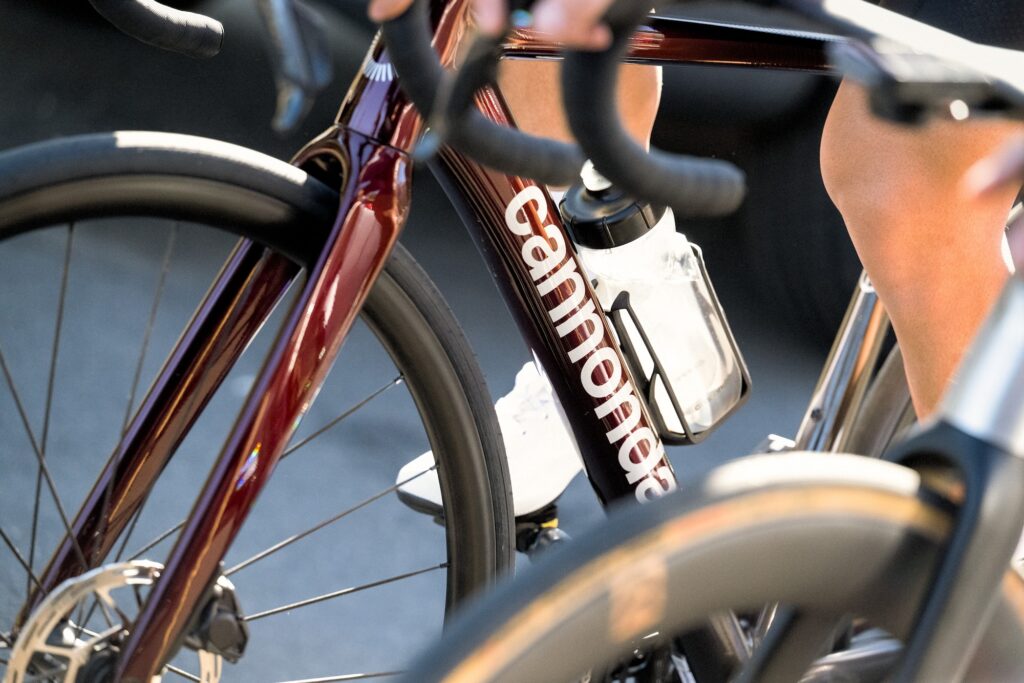
“You’ve also got to talk about aerodynamics. SuperSix Evo is a bike that has aero bike-level aerodynamic performance, so when you come down a hill, it just wants to accelerate. As that hill levels out, it keeps holding speed.
“CAAD has big, round tubes – you don’t have all this integrated airfoil technology – so as you come down a hill and the road flattens, you feel that you’re fighting the wind a little bit. But the rider who just wants to have a good time will have more engagement, more emotion with CAAD than Evo, because they’re trying to do different things.
“That’s the idea with CAAD. SuperSix is smooth and elegant. CAAD is fun and reactive.
CAAD14 builds
As mentioned, Cannondale is keen to celebrate the aluminium-ness of the CAAD14 and that’s nowhere more obvious than with the CAAD14 1, the range’s halo product.
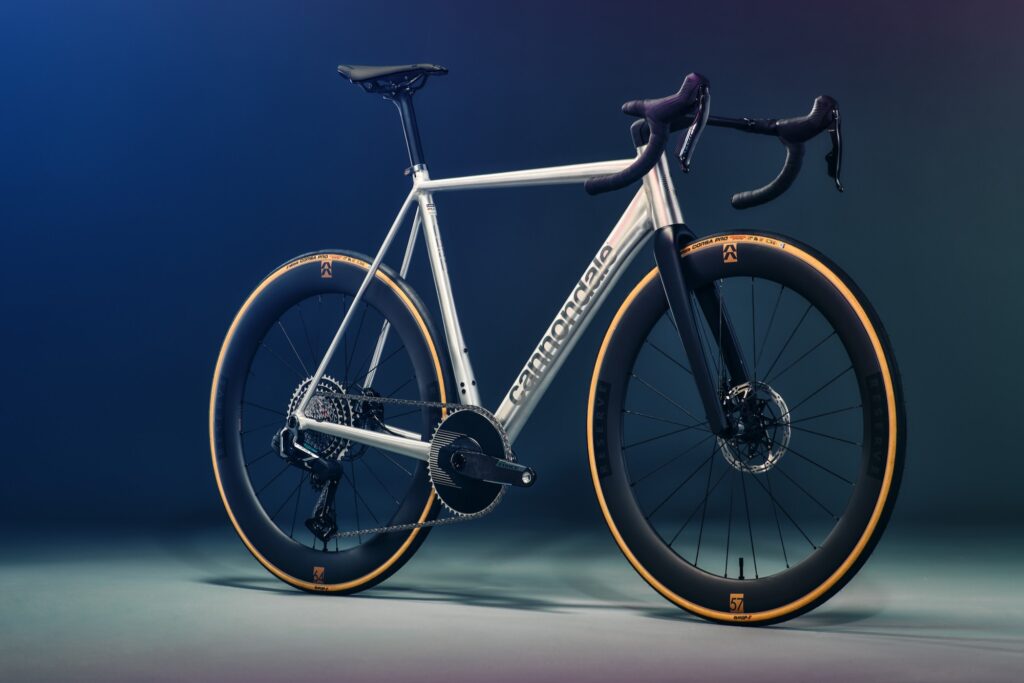
“This is us showing what is possible when you put the coolest, dopest stuff you can find on a beautiful aluminium frame,” says Will Gleason. “These are raw colourways; about as raw as it gets.
“We take the best frames off the line, we hand brush them, throw a logo on and just a whisper of clear coat, giving you this really right, but industrial true-to-the-material finish. You see the welds, the brushing, some of the brazing marks… It’s all about celebrating the craftsmanship and the hand-built nature that goes into these frames. We want to stand up and wear that aluminium badge proudly.
“This is going to be super-limited. This is very much a showpiece. There are going to be about 300 of them globally.”

The CAAD14 1 is built up with a SRAM Force AXS wireless groupset and Cannondale claims a weight of 7.9kg (based on a size 56 frame). It’s priced at £7,500.
The other two complete bikes in the range come with painted frames. The CAAD14 2 (£4,250) gets a SRAM Rival groupset and a claimed weight of 8.8kg, while the CAAD14 3 (£2,995) is built up with Shimano 105 – in its mechanical incarnation – and weighs a claimed 9.3kg. This one is available in Chalk White and in Barbecue Black.

“We had to do a black one,” says Will Gleason. “We have been making black CAAD 105 bikes for 20-30 years, so we had to do one. That black bike is just murdered out – super-mean; it’s a really great looking bike for the money.”
Cannondale claims a raw (unpainted) frame weight of 1,280g, and 1,410g for a painted model.

You can also buy the CAAD14 as a frameset for £1,750.
It’s disc brakes throughout the range – no rim brakes – and there are no mudguard (or fender, as they say in the USA) mounts.
“It was an intentional decision to stay true to the history of CAAD,” says Will Gleason. “The CAAD13 was the only CAAD that ever had fender mounts. We wanted to strip the bike down and go back to its true racing roots with as clean and seamless a silhouette as possible – no extra holes or mounts, just pure classic race performance.”
CAAD14 1 £7,500
Groupset SRAM Force XPLR AXS, (including power meter chainset)
Gearing 1×13 (50T chainring, 10-46T cassette)
Wheels Reserve 57|64 Carbon rims, DT Swiss 370 hubs
CAAD14 2 £4,250
Groupset SRAM Rival AXS
Gearing 2×12 (48/35T chainrings, 10-36T cassette)
Wheels DT Swiss E1800 Spline rims, DT Swiss 370
CAAD14 3 £2,995
Groupset Shimano 105 7100 (mechanical)
Gearing 2×12 (50/34T chainrings, 11-34T cassette)
Wheels Cannondale RD 2.0 Disc rims, Shimano TC500 hubs













38 thoughts on ““Not carbon, not sorry”: Cannondale launches aluminium CAAD14 road bike with classic silhouette and modern features”
Not Carbon, priced like it is.
For £700 less you could get a TCR carbon framed bike with an equivalent spec.
““The CAAD13 was the only CAAD that ever had fender mounts”
Someone has forgotten the CAADX
Or they (rightly, IMHO) think the CAADX was a completely different bike?
My 2013 CAAD8 has mudguard mounting holes…. Admittedly they/people may not regard that as a “proper” CAAD.
That red frameset could be in my future, if some deals pop up.
CAAD, with the classic looks, without the annoying squeaky BB30(a), with disc brakes? Yes please.
The price of this is several thousand £ from being competitive. Alu with 2nd tier groupset for the price of carbon with top tier, bonkers.
I’d like a CAAD14 track in raw finish, please.
Not carbon. Not aluminium price.
Really Cannondale? What are you thinking?
That pricing is laughable. I’m not sure who would buy this over a cheaper carbon bike, and that’s coming from someone who has owned a caad 5, 7, 10, 12, a system six and a super six.
I would also like to say how much I appreciate road.cc for using the term alu/aluminium not fucking ‘alloy’ like every other outlet. Makes my pedant brain itch.
Your brain can’t be that pedantic otherwise you would want the term to be aluminium alloy, assuming the frame isn’t made from 100% aluminium.
This is a fair point. I just dislike the term ‘alloy’ given steel is an alloy. As mentioned below – ‘alloy’ for all metal bikes or none.
If you rode a pure aluminium bike your pedant brain would soon be more than itching after you had bumped your noggin on the road when the frame failed. “Aluminium” bikes are always actually an aluminium alloy with magnesium, silicon or zinc added to make it strong enough for the use purpose. You could be pedantic and say journalists should say “aluminium alloy” rather than just “alloy”, but if they only say “aluminium” then, pedantically, they are wrong.
But pedantically any bike frame made out of metal is an alloy frame as steel is an alloy and titanium is alloyed with various other metals as well.
So if you’re going to be properly pedantic, it’s okay just to say a steel frame, because steel is always an alloy, but you should always say aluminium alloy or titanium alloy, not just aluminium or titanium or just alloy.
Surely a pedant would be fine with just saying “alloy” for any of those, because it is technically correct (the best kind of correct), even if it’s pretty uninformative by itself?
Replying to OnYerBike
And so the circle is closed!
I’m just sorry they don’t hand polish the welds.
On a £7500 bike? Blimey, want the earth, some people…
The painted bikes all appear to have welds smoothed out with some kind of filler – I don’t think it’s achieved by polishing and smoothing the welds. The “raw” (clear coated lacquer on the brushed aluminium) frame on the top-end limited edition I’d think filler can’t be used there, cause it’d be visible and look ridiculous.
I like the welds on the “raw” look myself, prefer them to the filler-smoothed ones on the other frames (and is what my CAAD10 has too).
I’m not saying all the haters here can’t be right, but would really like to hear the view from someone who actually knows about the productions costs of alu and carbon frame. I really don’t buy into the argument that just because it’s alu it is always that much more cheaper to manufacture – as with carbon there are plenty of variables to play with when manufacturing an alu frame that surely also affect cost. Prove me wrong.
Literally everything about producing an aluminium alloy frame is cheaper than doing the same with carbon: to start with, the raw materials are much cheaper, then production is much less labour-intensive for aluminium alloy frames with much of the work being done by hydroform machines rather than the precise hand-laid sheets in moulds of carbon, and development and tooling costs are lower as you don’t need to develop a specific mould for the frame.
That is generic info and assumptions – interested in more detailed and authoritative knowledge: like prices for carbon+epoxy vs different alu tubes for a particular type/quality of frame. How much does an “hydroform machine” cost? Can one do all types of tubes seen here? How long does it take for a routine carbon frame manufacturing process vs alu? Also for example, a cheap carbon can come out of an “open mould” – how much does that cost vs different alu frames? Not asking for somebody for encyclopedia on the matter. But some info that goes beyond what everybody already knows and goes beyond the lame and boooooooriiiiiiing comments like “crazy price for an aluminium bike!”
Okay, you asked a question, I answered it to the best of my existing knowledge without searching the Internet, if you’re just going to be snotty and rude why don’t you just go and find out the information for yourself? Why do you expect someone else to do the work for you?
I think the mistake you’ve made there is in reading it literally as a request for information, instead of an assertion of opinion as fact thinly disguised as Just Asking Questions.
Why are you being rude? I was not “snotty. Just stated that I was looking for more than it provided. And I am not expecting anyone to answer my questions, but hoping that someone would/could.
And to mdavidford: you seem to have difficulties in understanding that there can be opinions and questions expressed in a comment, without that meaning that they are therefore “thinly disguised” one way or another.
As you are presumably a grown adult you shouldn’t really need to be taught about good manners, but clearly you do: you asked a question and I answered it in good faith. OK, the answer didn’t have the detail you were demanding, there was still no need to say “That is generic info and assumptions” and that it’s “info that everybody knows.” That’s being rude and indeed snotty, you could simply have politely said yes, I see that but I was hoping somebody might know specific figures. To answer someone like that and then claim they’re being rude when they mildly point out your own rudeness is pathetic.
Sure, I could have done all that. And please accept, that my intention was not be rude. But please also look in the mirror. Your own reply to my original comment, simply put, was just a list which seemingly undermined my original argument entirely. No “I see your point, but…”; no “This is my five cents…” Any chance that comment might be taken as rude, condesending or something similar? Also in your second comment, you posited me as someone acting superior and wanting others to do chores for him, when I had done no such thing. Lastly, you wrote “…you’re just going to be… rude” and I wrote “Why are you being rude?” Why is mine a “claim” and yours “a mild pointing out”?
So when you do see that also pathetic person looking back at you in the mirror, what do you say?
But actually, feel free to keep whatever reply you want to give to yourself since at least I will not be reading it. I will not use any more of my time and energy on this discussion.
So in other words you weren’t actually asking an honest question, MDF was quite correct; you were putting your own point of view as if it was completely correct and challenging anyone to prove you wrong. Next time you want to make a point (a pretty stupid one, incidentally) then just make it instead of asking questions and wasting the time of people who are answering in good faith then being rude when they do.
I could not help myself and came back to see your reply. But it was worth it! How quickyl do you fall from your moral horse, and are in no hurry to get back, are you? What a joke!
What you seem to be completely incapable of comprehending is the ability for self reflection, learning and admitting one is wrong about something. I’ve never made any attemps my hide my own opinions etc. But that does not mean that if for example one, in this case, replies to my questions in a manner that shows them to be wrong, I will not change my mind. Hence “prove me wrong”. You did not. Get over it.
I was not in any way trying to prove you wrong, I was courteously answering your question which I foolishly believed to be genuine. If I’d realised that you are an insecure egotist who reacts with rudeness and aggression to anything he sees as contradiction I wouldn’t have bothered. Thanks for the amusement though, loftily stating “But actually, feel free to keep whatever reply you want to give to yourself since at least I will not be reading it. I will not use any more of my time and energy on this discussion” and then coming back not only to read but to reply. Narcissistic egotism is a hard master to ignore, eh?
‘aluminium alloy’ 🥰
I think that’s missing the point. It could well be that the price is perfectly justified by the cost of production.
The point is that if that is the case – if producing this frame costs as much as producing a good quality carbon frame (not even talking about cheap Chinese carbon; the frameset price is on par with a Giant TCR Advanced Pro) – then why would you choose this bike?
The main selling point of aluminium frames has long been that they are cheaper than carbon, without sacrificing much performance (can still be fairly light, stiff etc.). If it’s no longer cheaper, then it seems like there’s no rational reason to buy this bike – you’d only be doing it for nostalgia, or because you want something a bit different.
Too tired to think about this properly now, but yeah, fair point. Indeed, I was a bit surprised when reading this article that Cannondale really did not seem to go with virtually any performance claims vis-a-vis carbon, old CAAD frames etc, but as you mentioned, nostalgia and other emotions. I guess I do question some of the more sweeping performance argument regarding alu vs carbon, because e.g. you can make extremly light and aero frames from alu as well. And I recall reading old bike magazines when alu started replacing steel and people were complaining about the noodly alu frames. Which at some point just turned into complaints about stiff alu frames vs steel/carbon/other alloys without many times”proper science” in my opinion to back these claims. And I see some of that in arguments about “carbon is better and more expensive vs alu is cheaper and more crap”. One more thing, Cannondale’s prices vs many other brands seems to me to extend beyond this carbon vs alu issue – I do recall reading reviews about carbon Cannondale bikes that seemed expensive as well. Hence to a certain extent my “call” to try and more specifically figure out why Cannondale’s prices are what they are. Rant over.
Gorgeous bike, but 7.5k? My Whyte Devon does every thing that does (with better tyre clearance) @ 1/6 of the price.
Good to see the old shape back, I have a CAAD10 with 105, it’s literally the best bike to ride that I’ve had (I’ve had a few!). I’ve also got a Supersix Evo in the newer shape which I love too, obviously it’s faster and more comfortable than the CAAD10 but not as much fun. Mad that the cheapest version here with 105 weighs 9.3kg, My old CAAD10 is 8kg and cost me 2 and half grand less (albeit second hand, but in perfect condition).
The £7,500 model does seem overpriced. A similarly-specced Mason Definition for example (ok, not exactly the same sort of bike, but very well reviewed alu frameset, same groupset, and the most expensive Hunt Aerodynamicist wheels available from the stock build list) comes out £2k cheaper.
The entry level CAAD14 on the other hand is very similar to the equivalently specced Mason (£2,940 vs £2,910 / £2,982 including shipping).
Yeah much more expansive than the brand new Giant Propel aero bike which is undoubtedly going to be a superior bike for racers (speed, weight, comfort)