



The men’s Giro d’Italia ended yesterday in Rome, but on Saturday, Lorena Wiebes won the opening sprint of the women’s Giro before being disqualified later that evening for racing on an underweight bike – around 20g under the UCI’s 6.8kg minimum weight limit.
Wiebes’ SD Worx-Protime team said in a statement that the Dutch rider used the same bicycle on multiple occasions this season, although it has been noted by numerous observers online today that her bike for stage 1 of the Giro had a single chainring, rather than a double set-up. Case closed, surely? Not exactly, because Wiebes has in fact already used the bike with a 1x setup already this season, suggesting it couldn’t (or shouldn’t) have been the sole reason for the underweight bike.

The Union Cycliste Internationale (UCI), the world governing body for cycling, enforces a set of technical regulations that must be adhered to in all UCI-sanctioned events, and one of those regulations is the minimum weight for bikes. Article 1.3.019 of the UCI’s technical regulations specifies: “The weight of the bicycle cannot be less than 6.8 kilograms” (15.99lb).
This weight excludes any accessories that can be removed during an event, such as water bottles and bike computers. However, bottle cages and mounting systems are considered part of the bike, as they remain attached during the event.
According to the race jury, the Dutch champion completed the stage on a bike “non-conforming to minimum weight requirements”, SD Worx later confirming that the commissaires found her bike to weigh 6.78kg – around 20g under the UCI’s 6.8kg minimum weight rule.
View this post on Instagram
SD Worx fired back almost immediately, “The team has serious questions about the bicycle-weighting procedures at the Giro d’Italia Women. For example, there was a weight difference of more than 50 grams between the first and second weighing of Wiebes’ bicycle after the finish of the stage in Ravenna.”
The rule on minimum bike weight was first introduced in 2000, originally intended to ensure safety and robustness of bikes used at the top level of professional racing, particularly at a time when there were many new lightweight carbon bikes.
However, over the years there have been calls to scrap the UCI’s 6.8kg minimum bike weight limit. In 2015, we covered a piece on the UCI weight limit and its potential removal. At the time, the UCI’s technical manager, Mark Barfield, said in an interview with CyclingTips that the existing minimum weight rule was under review, potentially altering it to reflect the advances in road bike technology.
That was 11 years ago, and since then, we’ve seen many manufacturers demonstrating that they can make structurally sound bikes weighing under 6kg.
View this post on Instagram
> Should the UCI’s 6.8kg bike weight limit finally be reduced? We weigh up the pros and cons
The team added: “Wiebes has ridden this bicycle on multiple occasions this season, always with the same setup. She achieved numerous victories on this bike. Moreover, earlier this year, the bicycle was weighed by UCI officials after several races in which Wiebes won sprint finishes convincingly.
“On each occasion, the bicycle’s weight was found to be comfortably above the 6.8-kilogram limit. The team therefore does not understand how the very same bicycle could now suddenly be measured below the minimum weight requirement.”
Though some social media observers came to the conclusion that Wiebes and SD Worx must have been in the wrong because her chainring configuration was different at other races, after contacting the team road.cc understands the statement appears to be referring specifically to the 1x configuration used at the Giro, rather than suggesting Wiebes has ridden an identical bike setup across the entire season. In that context, she has used the same 1x chainring setup in multiple races, with Wiebes also alternating between 1x and 2x configurations depending on the event, as is increasingly common in the pro peloton.

For Stage 1 of the Giro d’Italia Women she opted for a 1x setup, a configuration commonly used by sprinters in flat races. This wasn’t the first time she had used this setup, meaning that if her bike was underweight at the Giro because of the single chainring, then it should have been at other races too.
In response to our request for clarification, SD Worx told road.cc: “She has raced on this set-up prior to the Giro this year. During UAE Tour she rode the 1x chainring and in Milan–Sanremo. Last season she also rode the Simac Ladies Tour on a 1x chainring.”
Thijs Zonneveld noted that at In Flanders Fields – Wevelgem, where Wiebes’ bike was reportedly weighed, she was racing with a 2x setup, but this illustrates that she has alternated between configurations across the season rather than using a single fixed setup throughout.
Were SD Worx guilty of a slightly semantically muddled initial statement? Arguably, but it’s looking increasingly likely the bike Wiebes presented to the UCI at the Giro was identical to one the governing body had weighed earlier in the season.

From a component perspective, SRAM’s Red AXS power meter crankset in a 2x configuration has a claimed weight of around 580g depending on specification, while Wiebes’ Red 1 setup with an aero chainring typically sits in the 540-580g range.
While around 20g of weight saving could theoretically be attributed to component choice, the fact Wiebes had used the bike in multiple previous races with a 1x configuration suggests that this is unlikely to be the sole explanation. There are many things that could have come into play, including discrepancies in protocol and equipment, temperature, altitude, and wind conditions during the weighing process.
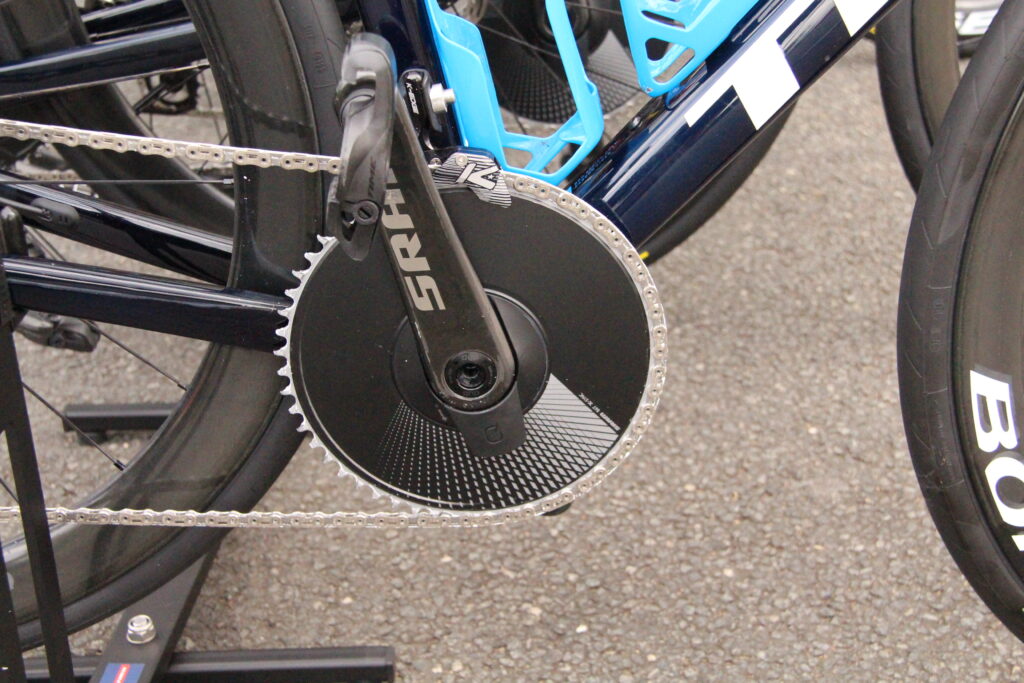
Speaking to NOS, team manager Erwin Janssen said, “It is sad. These are the bikes we always ride. We have never experienced anything like this before. “The first measurement was 70 grams under the limit. If that weighing equipment has been taken up to altitude, it has to be recalibrated.
“We heard that did not happen. When we weighed the bike ourselves after the finish, indoors, without wind, and with our own equipment, it was above 6.83 kilograms. How is that possible?”
Unfortunately, there was little the team could do after the jury determined that Wiebes’ bike was under the minimum weight limit. However, the case is likely to have wider repercussions, with SD Worx indicating that they are going to hold the UCI liable for the damages incurred.



















32 thoughts on “Was Lorena Wiebes disqualified from the Giro d’Italia because of switch to 1x chainring setup? The mystery surrounding the SD Worx rider’s underweight bike”
I’ve seen mechanics adding a weight under the bottle cage to bring the whole bike up to 6.8 kg when they have the shallowest rim wheels on, could it be something as simple as somebody just forgot that?
@Rendel Harris could be, though given the stage was pan flat I’d have thought the whole peleton were on deep rims so doubt it was the wheels.
I think Rendel meant the counter-weight was forgotten, to compensate for losing the front mech and one of the chainrings; the bike was changed over to 1x according to this article.
@mark1a Indeed – though I could have made it clearer!
@NickSprink You misunderstand me, I meant that as mechanics do that for different wheels, possibly they also add an extra weight if they switch to a 1x set up to compensate for the missing FD and chainring and someone forgot or miscalculated that.
Not to nit pick, but ….. With a change to 1x you will normally lose the front derailleur, change the rear cluster (or whole wheel), and possibly change out the rear derailleur. And, unlikely, a change in the crank length.
I assume there won’t be a resolution to this as the weight has been taken and I assume the bike returned so thats that. Seems ridiculous that 20g under a weight limit can invalidate a stage win. I understand rules are rules but are the scales well enough calibrated to be within the level of accuracy required to call 20g under a confirmed failure?
@mctrials23
It would be a struggle to find scales that can reliably and repeatedly weigh something of around 7kg to an accuracy of 20g (that’s about 0.3%!!), in the circumstances they would be required to be used at a cycle race. The outcome is unfortunate, but that’s just how it is. The rule would be meaningless if it could be applied with a ‘well it’s only a few grammes’ attitude.
@njblackadder you generally have to prove that a rule was broken to enforce it and if the equipment used to suggest someone has broken the rules has a margin of error that is greater than the amount someone has apparently broken the rules by, that rule cannot be enforced.
Fair point.
@njblackadder
Weight weenies confidently weigh their bikes to the nearest gramme 😉
Seems a 6.800kg check-weight should be used?
A given mass will weigh less at higher altitude above sea level. Did the UCI measure the weight on a summit finish?
This issue is avoided if the UCI use a certified SI 6,800 g check weight: they could just compare relative weights (several times and take the average) to see whether the bike weighs less.
@Pub bike I think I remember reading somewhere that the difference between weight at sea level and weight at the summit of Mount Everest is 0.06%, so probably not a major factor in the difference between Ravenna (4m above sea level) and Sevres (27-93m above sea level) where Le Grand K, the standard weight, is kept.
@I love my bike Weight Weenies confidence will be misplaced if they believe that they can weigh their bikes to the nearest gram! There are no consumer level scales available with that degree of precision.
The suggestion of comparing the weight of the bike to a laboratory tested and certified 6.800kg weight is a good one. If the bike is placed on one side of a balance and the 6;8kg weight on the other. The bike either goes up, or it goes down. If it goes up, it’s underweight. Even so, there are certain provisos, The scales must be indoors in a draft proof enclosure. The design of the scales, and the placing of the bike and weight must be such that the centres of gravity of bike and weight are equidistant from the pivot.
@njblackadder that’s a pretty easy measurement to make with a decent budget. 5- and 7- digit scales are common.
I have a Mettler Toledo XS32001L which would work great. It weighs to 32 kg with readability of ±0.1 g, accuracy about ±0.3 g. It was about $7000 / £5000 when I bought it a few years back.
Travel with that and a traceable 6.8 kg test weight in a custom padded box, and you’d be golden.
You’d hope they had a nice 6.8kg standard…
@ktache right! That would be so easy.
@andystow Thanks for that. Just shows, you are never too old to learn something new. I had no idea such accuracy was so readily available and at a price that shouldn’t be prohibitive for an organistaion such as the UCI.
@njblackadder Exactly!
Gravity around the globe varies by around 0.7% apparently so the only way to be sure is a 6.800kg check weight measured where the Si unit was decided at in Paris.
Also depends hugely on how it’s measured, just try your bathroom scales on a carpet and then on a very solid floor. Basic physics will be proved that some of that downward force is going into compressing the carpet, the same would apply to anything hand held round the back of a tent as was this case I believe!
It does, but with Ravenna (where Wiebes’ bike was weighed) and Paris being on quite similar latitudes the difference in gravity is only about 0.003 m/s2 or 0.03% so SD Worx would have an uphill task claiming that was responsible for the 0.26% underweight alleged.
@mikewood Carpet doesn’t have magic anti-gravity properties, although it may seem like that if parts of the underside of the scale that are not intended to make contact with the floor are resting on carpet fibres. The remedy is to place the scales on a hard level floor covering and try again.
@Pub bike It’s not the shorting out to the underside of the scales, it’s the fact that a non-hard surface has compressed and the force needed for that will be subtracted from the measurement on the scale. Hand held scales like luggage scales can never be accurate as the squidgy bit between the hand and the floor will compress albeit to a minor degree but 0.3% is a minor degree
@mikewood Yeah, it’s a wonder why so many people use Ozempic and other weight loss jabs when they could just stand on a piece of carpet and lose weight immediately.
@mctrials23 Other websites are reporting they were using a Kern CH 15K20 scale and that it has an accuracy of +/- 20g and a ‘linearity’ of +/- 40g.
On that basis she shouldn’t have been penalised unless the measured weight was lower than 6.76 kg?
@mctrials23 ” Seems ridiculous that 20g under a weight limit can invalidate a stage win.”
I do understand that. On the other hand, the line had to be drawn somewhere and it had to be a specific number.
If the rule wasn’t specific, we would all be complaining how arbitrary the officials’ decisions are!
Please note, I am taking no sides on whether the weighing itself was conducted properly.
@tomlew Oh I agree but if you are disqualifying people for a weight issue when you are talking about 20g, you need to be damn sure that the thing you are using to measure it is 100% accurate.
Or are internet froth-peddlers incapable of understanding the difference between ‘several races’ and ‘all the races’? 🤔
Weightgate, they’re calling it.
Other riders apart from Wiebes must have had their bikes weighed. If the scales had been mis-calibrated it could be expected that there would have been more disqualifications.
@captain_slog why? If the scales are 30g out and everyone elses bikes were 6.83kg or more then it wouldn’t matter. Do they weight everyones bikes or just the people who come in the top X positions.
You can’t rationalise that just because only one person came in under that the scales are accurate.
@mctrials23 Wiebes bike actually measured 6.73 kg the first time it was measured. So 2 measurements, and those came out to 6.73 and 6.78 kg.
I’m going to assume their weighing process is fancier than me weighing my carry on luggage.
On that basis they must have a standard weight item that is say 1kg or 6.8 kg on which to calibrate the scale.
If that’s the case, I see no mention of stuff like tyre sealant – 20g is very minimal in terms of fluid, could it be a tyre issue?
Worth noting her bike was measured twice and measured 6.73 and 6.78 kg. The scale has a reproducibility of 20 g according to the vendor, so presumably they did something to give the most favourable outcome to the team on that second weighing. The team says their scale said 6.83 after the race.
It is quite possible that the bike was underweight and that it was the team that had the miscalibrated scale.
The commissaires are likely weighing a lot more bikes, and one hopes the UCI as a governing body has much more incentive to have formulated and apply proper calibration processes. If they had a bad scale, then would that not have also resulted in /other/ bikes from /other/ teams /also/ coming under weight?
The simplest explanation here is that SD-Worx fucked up.