



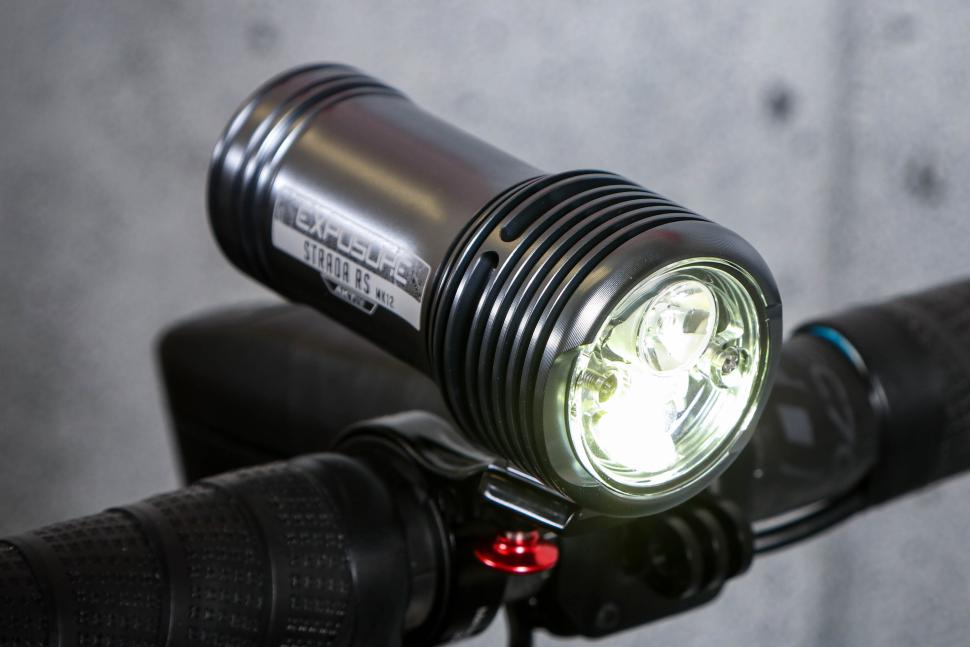
The Exposure Strada MK12 RS AKTIV is powerful and extremely well made, plus it’s impressively light for such a big unit. The beam is far too diffuse for truly dark roads, however, while the readout and mode-switching don’t work well on the bike. For unlit roads it’s a good secondary to a more focused spot lamp, but that may not be what you expect from a £325, 1450-lumen unit.
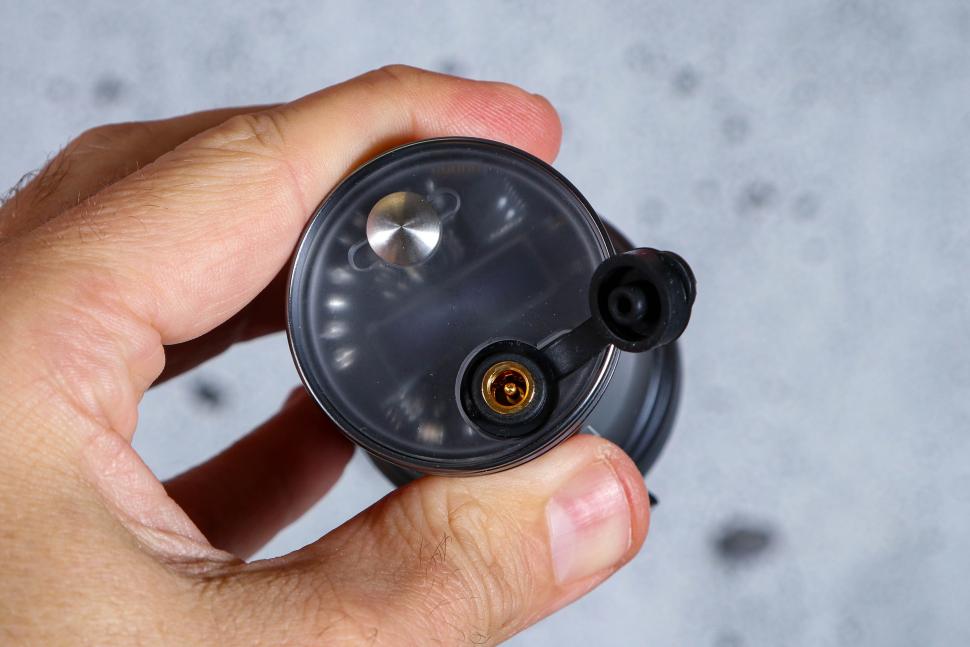
Straight out of the packaging this looks and feels lovely; both the light and the clamp have the sort of crisp, exact fit and finish you expect for the premium price, while the materials all feel excellent. The machined, anodised and laser-etched aluminium body is immaculate; the function button is a solid steel nub; and the crystal clear lens and hazy rear plastic (hazy to give a lovely soft, coloured-LED glow) feel utterly reliable. Even the charging port’s captive rubber bung is shaped perfectly inside to match the socket and outside with a pleasing 3D logo.
That packaging includes a zipped clamshell case, which is great for storing the smart charger and the light itself, as both are fairly bulky.
Single-tap the steel button and an OLED screen lights up under that frosted rear plastic, giving you the make, model and battery level as a percentage. The slots make it look like the button slides, but it doesn’t. Double tap it and the light switches on. The screen now tells you the PGM value – the program it’s set to – and the remaining burn time in hours and minutes. It’ll update that burn time as you cycle through the high, medium and low settings of your chosen program.


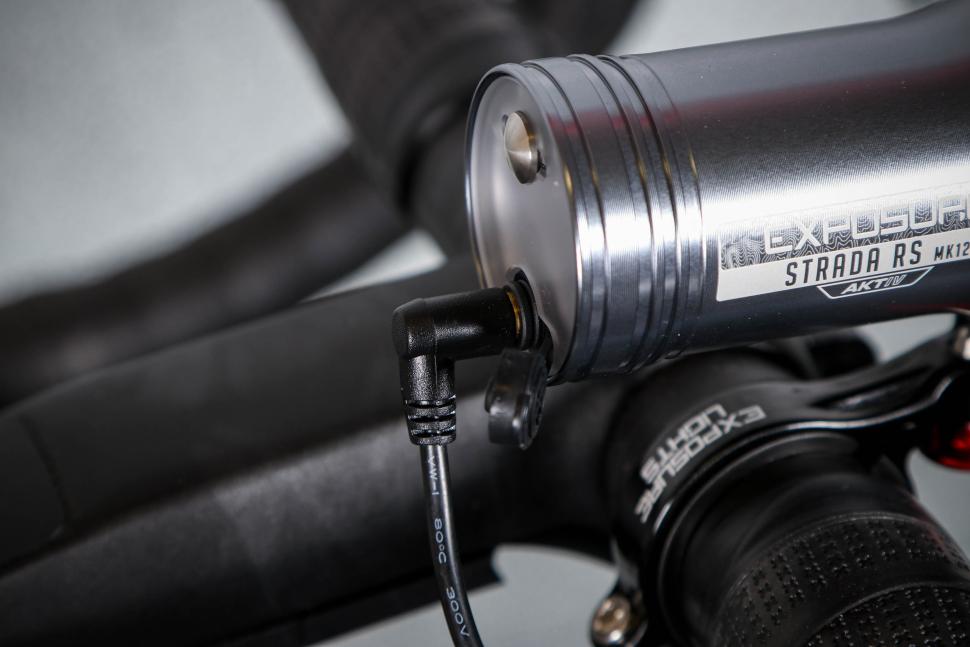
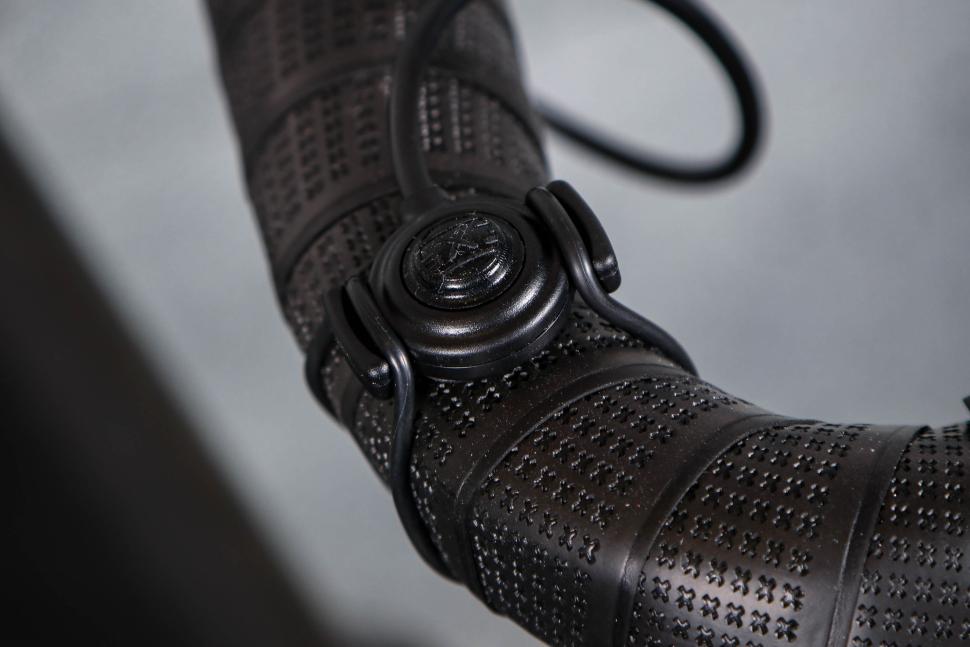
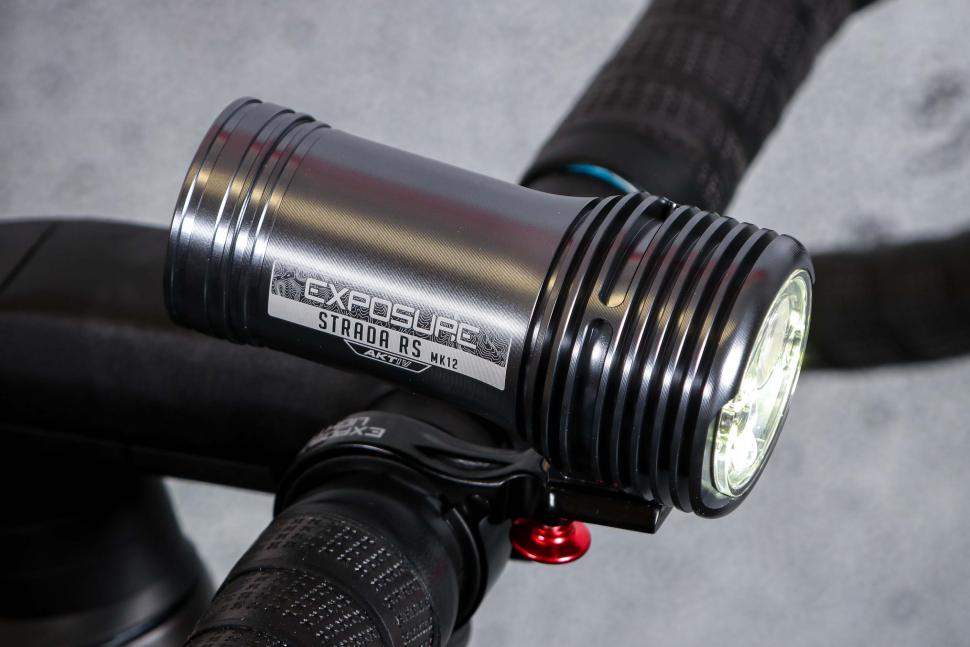
This is great until you’re riding, when you can’t see it. Maybe I’m not bendy enough, but I could never flatten out enough to actually see the now vertical readout. To view my remaining battery life I had to stop and crouch beside the bike.
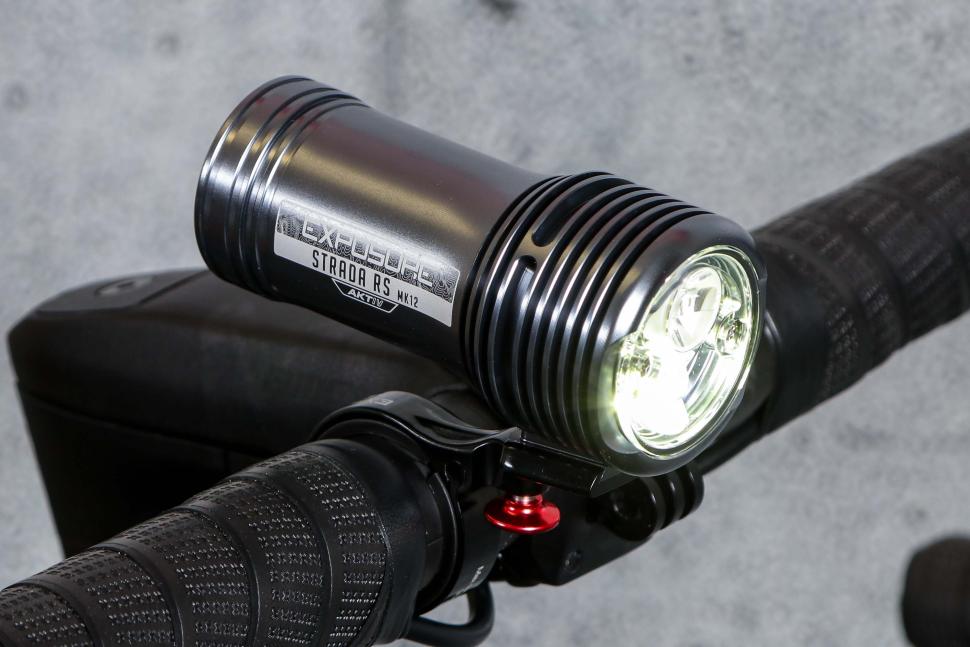
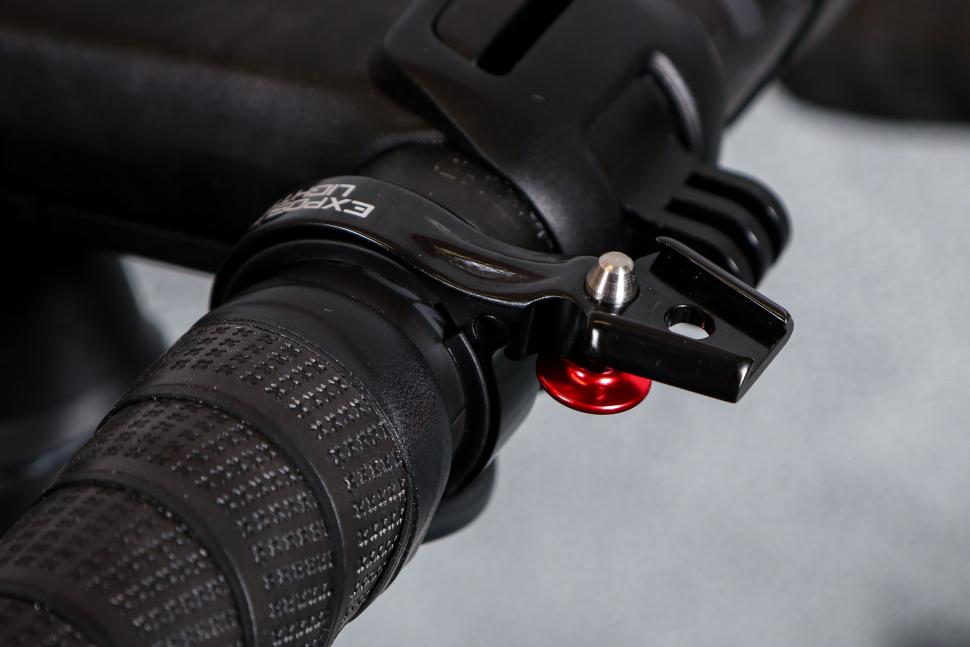
It’s actually easiest to take it off the bike to read the screen, as the clamp’s all-metal quick release works very well. Its wedge-shaped interface means there’s zero play once it’s in, and the neatly designed two-part metal band clamps similarly securely to the handlebar. Fitted properly it’s never going to droop or slip so you can’t see ahead/can see the readout.
Not that I could see nearly as far ahead as I was expecting given the 1,450 lumen output. The lens is very diffuse, throwing plenty of light nearby and to the sides with no dark spots or steps, but it peters out far too rapidly for safety at speed when you’re away from street lights.
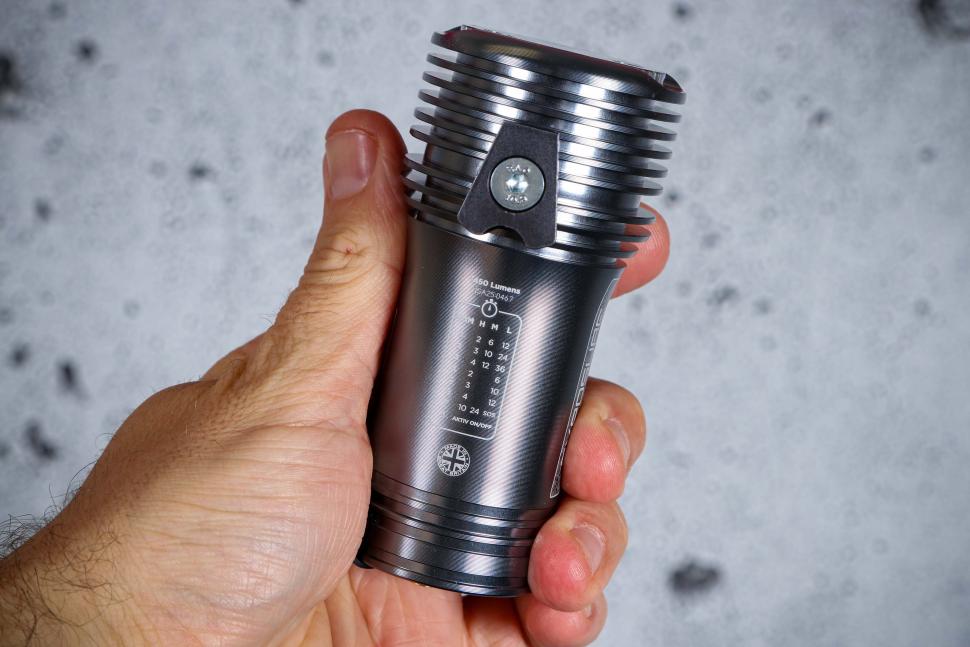
On my first ride I thought I’d put it in the wrong mode and wasn’t getting full power, then ran into a further problem. To change the modes you need to program the light using the table etched into the body, but not only could I not remember how to get it into programming mode, I couldn’t see the table. You need a second torch for that. Consequently I completed the ride in setting I had, which was just as well as it turned out it was in the highest setting (PGM 1) after all. It’s just surprisingly dim.
You could of course take the instruction leaflet with you, but there isn’t one. The only paperwork constitutes legal warnings in roughly 1,000 languages and instructions to use the QR code to download the manual. There’s also a link to the PDF on the product page, should you prefer.
The lack of a manual is slightly annoying given how unintuitive this can be. For instance, you might think that when the smart charger’s LED goes green and the OLED screen says it’s 100% charged, that it’s 100% charged. The instructions tell you it actually needs another hour.
You might also think the rear LEDs are telling you the battery level when you switch the light on, but it turns out they’re telling you the mode. For three seconds, anyway. This seems redundant, as the screen also tells you the mode… or does once it’s finished reciting the make and model. Wait three seconds and then the LEDs denote battery level. Remember to remember that.
As battery level lights (green, amber, red and then flashing red) the LEDs are very useful, as they glow softly through the frosted rear panel and show at a glance – unlike the unviewable screen – roughly how much juice you’ve got left.
Despite the headline output, this only gave me enough vision for around 18-20mph on unlit country lanes. There you really need a far-reaching beam to pick out debris, especially in the wet when the road and everything dragged onto it is a gloomy black or brown. The MK12 RS just doesn’t cut it at any real speed.
On lit roads, however, you arguably don’t need 1450 lumens in the first place. The light will at least dip automatically when it detects oncoming headlights, as denoted by the AKTiv part of the name. It works, and if you don’t want it dipping you can switch it off. Just go into programming mode and find PGM 8, obviously. Okay, not obviously.
To my mind, the MK12 RS’s 1,450 lumens are wasted. Yes, the peripheral lighting is extremely good so you get few surprises from the hedges and verges, but one of my favourite lights – the Magicshine Allty 1500 – does just fine for peripheral lighting and lets me ride at 35mph+ in confidence in the same places. It has almost identical power, but a far more usably focused lens. Direct comparison showed the MK12 RS penetrates somewhere between half and a third of the distance the Allty does.
In fact, simultaneous testing revealed I could see usefully further with Exposure’s own Boost MK2, which at 325 lumens has not even a quarter of the power. For unlit sections of anything but climbing I routinely relied on the Boost to add some much needed illumination to the MK12’s efforts.
The claimed runtimes seem reliable. After one cold 1hr 30m ride on full power, it displayed 40% charge and 48 minutes left, and actually did hit zero (now indoors) after another 48 minutes. However, it didn’t shut down, which eventually became disconcerting… is dropping past zero bad for the battery? Why doesn’t the timer recalculate? Is there an auto-cutoff coming? The manual doesn’t cover any of this. After an hour running in what the light still said was high mode, but steadily dimming as it continued to flash zero, I switched it off.
On plugging it in for charging the screen registered 18% battery. My guess is that either the timer is calculating the point the voltage can no longer support full power (which is not zero charge), or perhaps showing preset tables.
The lack of a power step-down or auto shutdown is a good thing if you’re caught a little short on the roads, as there’s no abrupt reduction (or sudden complete darkness) to worry about. It gets even harder to see ahead with it as it wanes, though, so it’s not something to rely on deliberately.
The claimed charging time of six hours is probably accurate; I timed it from flat to 100% on the smart charger in five hours, though while the light itself said 100% at that point, the charger LED was still red. After another 15 minutes it turned green. However at that point it still needs another hour – though there’s nothing telling you that besides the manual, and nothing timing that hour but you.
You can use the separate supplied USB cable and a phone charger/computer port instead, but it’s slower, especially in the case of a port.
Basically I feel this light is beautifully made and poorly designed. The OLED screen needs to be visible while riding to be truly useful, while having it display codes like PGM 1 and M00145 feels old-fashioned and unintuitive. Tuning the power output (or more accurately the runtime, as that’s how Exposure frames it) is also user-unfriendly as it involves turning the light off and entering a numbered programming mode that needs a chart to decode.
In case you were wondering, M00145 is an error, but just means the voltage is very low. Exposure says to ignore it. What fun! Worrying error codes that aren’t even errors.
Even with this light all set up and running well, the lens design means it just doesn’t throw enough light far enough down the road to ride unlit sections at any meaningful speed. It’s a powerful light, but doesn’t feel like one. It’s also an expensive light, and while it physically feels like one, there are still things that stand out in the wrong way; the omission of a printed manual niggles, for instance, as does the included remote being a clunky wired thing when this light’s often far cheaper competition routinely feature wireless.
Value
You don’t have to spend £325 on this Exposure to get 1450 lumens.
The Ravemen K1800, for instance, is brighter, also has an aluminium body, has a greater water resistance rating, comes with a wireless remote and gets excellent life from its presumably bigger battery – it matches the Exposure at two hours on full power despite the extra 350L output. It’s £99.99.
The Sigma Buster 1600 is also brighter with a good beam pattern and long run times, and though the mode switching could be better it’s £109.99, while the Zefal Supervision F1500 Front Light is clunky-looking but very bright and effective for £124.99. The Zefal is also as easy to find at a big discount as it is at full price.
Go just slightly less powerful with a Magicshine EVO 1300 and you can get an extremely well-made (and still extremely bright) headlight good enough to earn a ‘road.cc recommends’ badge for just £79.99.
Speaking of Magicshine, I reviewed the Allty 1500 a full five years ago and that unit remains my go-to light – even for bad-weather night rides in the deep space voids of Welsh forests. It’s a banger, and the updated Allty 1500S, which comes with a wireless remote and an OLED screen you can actually see (it’s on top), is £89.99.
Cheaper still, the Gaciron KIWI-1200 Anti-Glare Bike Front is just £47.35, or £69.91 with a wireless remote and an aluminium out-front mount. The unit I reviewed two years ago is also still in regular use as a backup, and also still works extremely well.
For more options, check out our best front lights buyer’s guide.
Overall
The Strada MK12 RS may be lovely both physically and on paper, but in use, sadly, it’s disappointing. Even if you master the awkward programming and rely on the coloured LEDs instead of the nice but obscured OLED screen, it feels far dimmer than it really is thanks to its heavily stunted reach. I wouldn’t honestly recommend it against the competition if it were £100, but at three times the cost of alternatives with markedly superior performance, it unfortunately makes no sense at all.
Verdict
Beautifully built from premium materials, but performance and usability are in short supply
All the deals displayed on our review pages are pulled from a constantly updating database feed of the best affiliate deals available. The criteria for deciding on what are the best deals is who is offering the lowest, delivered price. In most cases we will be showing the very best deal available online, but sometimes you may be able to find an item cheaper. If you can please feel free to post a link in the comments box below. To find out more about affiliate links on road.cc click here.
road.cc test report
Make and model: Exposure Strada MK12 RS AKTIV
Size tested: 1450 Lumens
Tell us what the light is for, and who it’s aimed at. What do the manufacturers say about it? How does that compare to your own feelings about it?
Exposure says: “The RS, Road Sport, AKTiv features a Road-Specific Beam Pattern and an upgraded 1450 lumen output; once AKTiv is selected the light will sense oncoming light sources and auto dim when a vehicle is approaching, no button or thinking required. Also with the specific cut out to allow side illumination to ensure the rider is visible through 240° and graphics are positioned to remind that the Strada can be mounted either way up without a change to beam pattern or technology. There is also a remote switch included which allows the rider to take control if desired.”
Tell us some more about the technical aspects of the light?
LEDs
2 x White XPL2(W3)
IP Rating
IP65
Max Lumens
1450
Battery
6,800 mAh Li-Ion
Runtime
2 – 36 Hours
Charging Time
6 Hours
Weight
203g
Material
Anodised 6063 Aluminium
Dimensions
Length 102mm
Head Diameter 49mm
It’s more 90’s PC than 2020’s smart phone in its approach to the user interface.
Two hours on full power, six hours to recharge.
Seriously lacking in reach for its power.
You can get similar performance and robustness for around one third of this money.
How does the price compare to that of similar products in the market, including ones recently tested on road.cc?
Not well – this is extremely expensive compared to a great many lights of similar or even superior performance.
Tell us how the light performed overall when used for its designed purpose
Unfortunately, not well. It’s awkward to program and feels far dimmer on the road than the numbers suggest.
Tell us what you particularly liked about the light
Fantastic build quality, excellent clamp and lovely looks. It’s also surprisingly light for its size.
Tell us what you particularly disliked about the light
It only lights up the road for a very short distance, and feels far less powerful than it is. Also it’s awkward to program, the OLED screen is unusable while riding, and the price is very high.
Did you enjoy using the light? Overall, no.
Would you consider buying the light? No
Would you recommend the light to a friend? No
Use this box to explain your overall score
The high quality materials and construction impress, and it’s obvious a lot of thought has gone into the details. Unfortunately, less thought seems to have gone into usability. This feels like a product that 15 years ago would have ruled, but that has barely changed since (not saying that’s the case; just that’s how the design feels). As beautifully formed as it is, the competition is building smaller, brighter, higher-specced, easier to use and equally robust lights for far, far less money. It’s still an above average product in many aspects, but sadly no more than that.
About the tester
Age: 48 Height: 183cm Weight: 78kg
I usually ride: Vitus Zenium SL VR Disc My best bike is:
I’ve been riding for: 10-20 years I ride: A few times a week I would class myself as: Experienced
I regularly do the following types of riding: general fitness riding, mtb,

18 thoughts on “Exposure Strada MK12 RS AKTIV”
It’s worth pointing out that
It’s worth pointing out that the approach to modes/programming is broadly shared all Exposue lights, and you do get used to it eventually. And changing the programme is not something you have to do often, let alone on-the-fly.
One could argue that there are probably too many programmes and too much redundancy – I tend to leave my front light (a Sirius) in Programme 1 and then just choose between High/Medium/Low (or flashing). The other programmes just let you choose a “High” that is not quite as high as the High in Pg1 but still higher than medium in Pg1; etc. And then there are the programmes that are the same as the other programmes but only have High and Low, in case cycling through Medium is too much effort for you.
So personally I would say as downsides go, it’s not a dealbreaker – yes it’s a bit confusing at first, but you soon get over it.
Yes and it does have the
Yes and it does have the programs printed on the underside of the light.
I agree with some of the criticisms of the reviewer but I’d add in the postives of very long run times and the availability of a repair service.
I sent one off for water ingress and it was less than £30 to repair.
I’m a big fan of mode 8 on my
I’m a big fan of mode 8 on my helmet mounted Axis. Very low low, good mid and top high. Tap on middle. Suits my mostly off road commute, for which it has been going strong for nine years now. Button has never been great, and flash stopped during the nights of the beast from the east. I let moisture in when not attaching the red eye after charging, but a couple of days in the bucket of drying pellets we use for little dehumidifiers around the flat sorted that. Had to dry again after third day of Henk. Heaviest rain I’ve done for a while, this commute for sure.
Hope seem to be getting out of lights, trying to find another battery has not been easy recently. When finally moving on for the on the bike sets, it will probably be a big MTB unit from Exposure. They tempted me with an stvzo 4k lumen, very gravel or both road/MTB, around start of COVID, but it was never released.
The new Expsoure MTB lights
The new Expsoure MTB lights are amazing, USB C, super fast charging, much amazing display! I’m running a Diablo as a commuter/off road helmet light (when running the non dynamo wheels) and a Race 19 for dark off road stuff, been super impressed!
While I appreciate you don’t
While I appreciate you don’t mind the controls personally, I’m not convinced that ‘you do get used to it eventually’ is a great selling point.
Sure, you’re not going to change the programming on the fly, but only because it’s so incredibly awkward – that’s my point. Most lights don’t treat it as programming in the first place, and let you cycle through outputs with single presses.
I personally like to click back the power on long climbs or town sections to save battery, then go brighter again when the speeds require it. It’s nice to have that control, and I couldn’t find any benefits to locking it away in a programming mode. Or am I missing something?
I didn’t say the controls are
I didn’t say the controls are a great selling point; I said they’re not a dealbreaker. So for someone who thought the light was good otherwise, I would suggest it shouldn’t put them off. Although I appreciate the controls weren’t the only thing you didn’t like.
And as I also said, the point is you can still cycle through outputs with a single press – that’s what the high/medium/low “modes” within each “programme” are. So if you want to click back the power on long climbs or town sections to save battery, then go brighter again when the speeds require it, you absolutely can, without changing the “programme”.
I presume the point of the “programmes” is to let you fine tune the power output/runtime without needing to cycle through many different options. It looks like this model has 8 different constant output settings across the modes/programmes, and cycling through all of them could be tedious. Again – I’m not claiming this is a great selling point – I do think the number of different programmes and outputs is excessive.
That’s what I do – low
That’s what I do – low setting for uphill, then medium or high for downhill. Plus high when some driver is on full beam !
I only use 2 of the programs, so agree with your last point.
Exposure should put a laser
Exposure should put a laser 3d barcode on all their lights that opens a URL / web page with how to change the modes. It would save a lot of faffing about.
It’s a great light.
It’s a great light.
I have used Exposure for years so quite use to the programming eg :very easy to use!
Been using the Strada at my very modest 16mph (35mph?) on the way home in the pitch black and it’s perfectly adequate.Program 1.Low beam heading from work in lit streets,med unlit round lanes and high on the very Parix Roubaix section before town! No issues whatsoever?
Maybe you need the power when your riding 35 mph in the dark?!
As I explained in the review,
As I explained in the review, you don’t need more power at 35mph in the dark – I have less powerful lights that cope with long or steep descents very well.
I also found the Strada adequate at 16mph. I’m glad you like the light.
Light review but no picture
Light review but no picture of light in action?
I bought the 1700 lumen
I bought the 1700 lumen Strada Mk12 sb on cycle to work for commuting in November after I discovered the downside of the 750 lumen Lifeline I used before. Its a game changer on the mostly unlit Bath-Bristol cycle path early and late in winter. Like having a searchlight on the bike, most effective. I didn’t need to pay the extra for Activ switching, the mode switch button is perfectly well in reach and you get used to it, plus I switch down 2 levels to avoid blinding oncomers who tend to let me know otherwise. The charging level is useful to know afterwards but I’ve never needed to look while actually commuting. The light will probably last a long time given its construction, I hope, given the price (also 325).
I have a Strada mk 8. The
I have a Strada mk 8. The programme table is on the underside the light. It’s not meant to be read on the go. You can programme the Strada lights at your leisure, but not on the road. For focussing on particular points, I use the two Exposure Joysticks mounted on my helmet. I also have a Garmin front light, the UT800. I forgot the Strada on my last home-work-home commute and I noticed its absence on the way back: I avoided all of the multiple potholes but I saw them later than I would have liked.
I recommend that no one rides in the dark with just one front light: if one fails you have none. Start with a see-by front light and a be-seen front light. Sometimes people say ‘too bright’, so you learn when to turn the power of the see-by light down or off, or perhaps go another way.
“You can programme the Strada
“You can programme the Strada lights at your leisure, but not on the road.”
I know, that’s my point. Much of the competition don’t need programming and can be easily adjusted on the road.
This review seems weirdly
This review seems weirdly biased towards 1 time set up issues.
Does anyone get their light fully sorted on the first ride out? dont most of us do a dinky test ride to check?
My point is that many lights
My point is that many lights don’t need a test ride to sort out, and are easily adjusted while riding. I’m not sure how that counts as bias?
Yes the review is biassed towards classic lazy internet reviewer who talks only about first impressions, not using it dat to day. A single photo of the light on your handlebars would have gone some way to convincing people you actually used the light rather than imagining you did.
Yes, the table isn’t intuitive but it’s also genius. Once they’ve got it set on the program that works for them, most people never touch it again. It’s then super, super easy to use. I leave mine on program 1, high/med/low. You press once to cycle through the modes or press and hold for a flash. It couldn’t be much easier and is simpler than any other make. It’s also all I need for long commutes and training rides from the city to dark country lanes and canal paths.
The light throw is ample for roads even at high speed. It’s deliberately dipped. Those other brands you mention are probably dazzling other road users.
Yeah – the SIX that are in the article is just trying too hard – a single one would have been much more convincing.