



The row over Lorena Wiebes’ controversial expulsion from this week’s Giro d’Italia continues to rumble on, with the Dutch champion’s SD Worx-Protime team now claiming they are being ignored and “brushed off” by the UCI as they prepare to take legal action following the decision to disqualify Wiebes for riding an underweight bike.
The Giro d’Italia Women descended into chaos at the weekend after Wiebes won the race’s opening stage to Ravenna, only to be told hours later that she had been disqualified from the race after her bike, a Specialized Tarmac SL8, had failed to meet the UCI’s minimum weight rule.
According to the race jury, the Dutch champion completed the stage on a bike “non-conforming to minimum weight requirements”, Wiebes’ SD Worx-Protime team later confirming that the commissaires found her bike to weigh 6.78kg – 20g under the UCI’s 6.8kg minimum weight standard.
After the news broke, sending shockwaves through the Giro, SD Worx fired back almost immediately, arguing that there are some “serious questions” to be asked of the UCI’s bike-weighing procedures at the Giro and the discrepancies in the jury’s scales.
“There was a weight difference of more than 50g between the first and second weighing of Wiebes’ bicycle after the finish of the stage in Ravenna,” the team, which has indicated that it will take legal action against the jury’s decision, said in a statement.
“Wiebes has ridden this bicycle on multiple occasions this season, always with the same setup. She achieved numerous victories on this bike. Moreover, earlier this year, the bicycle was weighed by UCI officials after several races in which Wiebes won sprint finishes convincingly.
“On each occasion, the bicycle’s weight was found to be comfortably above the 6.8kg limit. The team therefore does not understand how the very same bicycle could now suddenly be measured below the minimum weight requirement.”
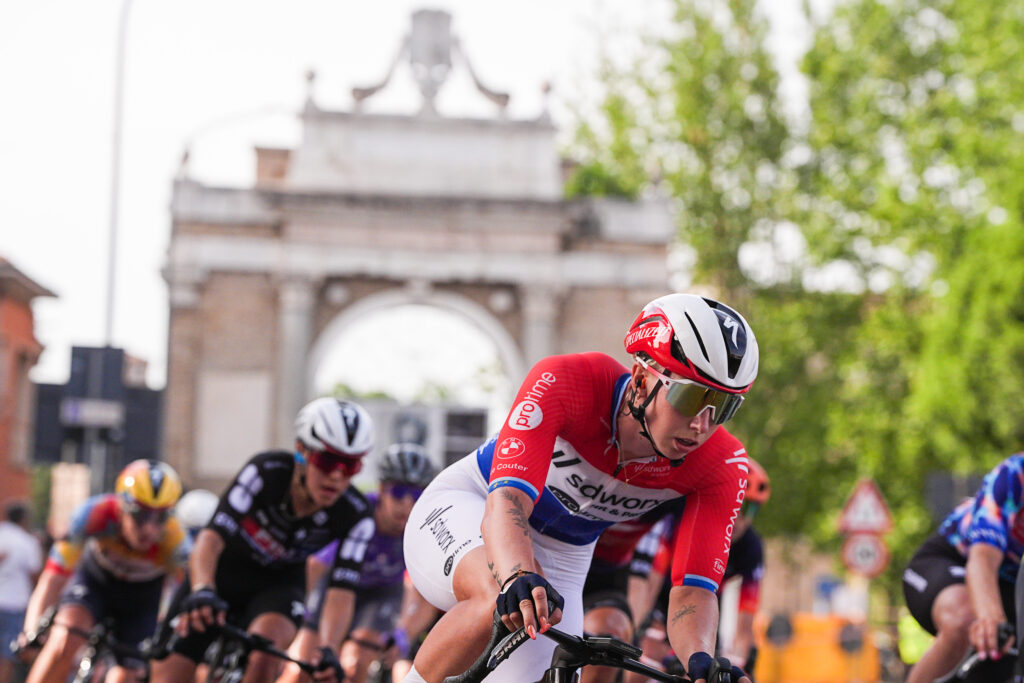
And now, SD Worx manager Erwin Janssen has reaffirmed the team’s commitment to taking the UCI to court, stating that he will “pull out all the stops” to secure justice for his star sprinter.
“We are going to hold the UCI liable and have hired a lawyer,” Janssen told Wielerflits on Thursday.
“Besides seeking some form of vindication, this disqualification also has a huge financial impact. It is difficult to say how large the damage is in euros, but you have to think of the prize money from multiple missed stages, the missed UCI points, and agreements in sponsor contracts. We are currently in the process of calculating all of that.”
The team manager also said he believes the case will end up at the Court of Arbitration for Sport (CAS), arguing that the UCI is refusing to co-operate with the team.
“It is very likely that it will go to CAS. The UCI is simply not responding. No one is answering the phone. Only our lawyer has been able to reach someone higher up at the UCI. It is simply bizarre that we are being brushed off like this,” he said.

Janssen also repeated his team’s claim that the UCI commissaires’ approach was unprofessional and resulted in a false reading.
“Cycling teams are expected to be professional through and through, while amateurs, semi-professionals have to perform such bike measurements in a very unprofessional manner,” he said.
“I am simply astonished by everything that went wrong. Normally, the team management in charge has to sign a measurement report; that didn’t happen this time either. And there was absolutely no possibility for a counter-assessment.”
Janssen continued: “The UCI is simply unyielding. They say: too light is too light. There is little understanding or flexibility, even though we never take risks with the bike. Lorena’s bike always weighed between 6.83 and 6.85 kilos, so it really is just due to the wind.
“That bike was blowing from left to right. From what I heard from experts, the wind can make a huge difference in a measurement. So we are currently investigating that as well.”
Since Wiebes’ disqualification, the UCI has also faced criticism from SD Worx’s bike sponsor Specialized, the American brand’s founder Mike Sinyard describing the Dutch champion’s expulsion as “very arbitrary”.
“Can you imagine if this was Mark Cavendish, Remco [Evenepoel], [Peter] Sagan, or any of the other men stars?” Sinyard asked on Leonard Zinn’s Substack.
“There’s no frigging way that they would’ve been thrown out of the complete race.”

As we reported earlier this week, the furore surrounding Wiebes’ disqualification prompted some online observers to conclude that it was the Dutch champion’s use of a single chainring set-up which caused her bike to fall below 6.8kg.
However, SD Worx later confirmed to us that Wiebes has in fact already used the bike with a 1x setup already this season, suggesting it couldn’t (or shouldn’t) have been the sole reason for the underweight machine at the Giro.
> Should the UCI’s 6.8kg bike weight limit finally be reduced? We weigh up the pros and cons
The UCI’s rule on 6.8kg minimum bike weight was first introduced in 2000, originally intended to ensure safety and robustness of bikes used at the top level of professional racing, particularly at a time when there were many new lightweight carbon bikes.
However, over the years there have been calls to scrap what many argue is an outdated rule based on older perceptions of bike technology. In 2015, the UCI’s then-technical manager, Mark Barfield, even admitted that the existing minimum weight rule was under review, potentially altering it to reflect the advances in road bike technology.
That was 11 years ago, and since then, we’ve seen many manufacturers demonstrating that they can make structurally sound bikes weighing under 6kg.
road.cc has contacted the UCI to ask the governing body about Janssen’s claims and whether its bike weighing procedure was carried out properly in Ravenna. We’re yet to receive a response.

















11 thoughts on ““The bike was blowing in the wind”: UCI won’t answer the phone over Lorena Wiebes bike weight saga, team claims – as Specialized founder asks: “Can you imagine if this was Mark Cavendish?””
As a metrologist, the equipment used, the procedure, and the regulation all appear to be comical. I’m going to write something up.
@andystow I’m amazed at how many people think the UCIs response and handling of this whole thing is remotely reasonable and hand wave it away as “they know the rules”.
@andystow I’d be interested in a metrologist’s take on all this. I know enough about metrology to know that it’s not always easy, and that there’s more ways to measure things wrongly than correctly
I have no idea if the UCI have handled this well or not but someone on a previous article asked the question “how come all of the other bikes that were weighed were okay?”
There’s a lot of conjecture on the accuracy of the scales and the methodology of the weighing but nobody else’s bike was under weight.
It could actually be, as Rendell suggested, that someone forgot to add some extra weight to the bike but SD Worx are not even contemplating this
@kinderje it’s quite possible that Wiebes’ bike was particularly light. My understanding is that, particularly for relatively flat stages, it’s quite normal for pro bike builds to weigh >7kg, as aerodynamics easily trumps weight.
There’s a Bike Radar article from last year (google it – links get blocked) that says the average bike weight in the men’s TdF last year was 7.497kg. I would expect the average to be slightly lower in the women’s peloton due to smaller frame sizes but not much (maybe in the region of 50g or so on average?)
I’ve probably had farts that weighed more than 20 g.
@adamrice Technically, they’re not farts
With apologies to Mr Zimmerman…
How many roads must a racer ride down
Before she gets a DQ?
How many lies must the UCI tell
Before they make sense to you?
The bike, my friend, was blowing in the wind
The bicycle was blowing in the wind.
It would make more sense to weigh bikes before the stage and then randomly check some afterwards to make sure they haven’t lost a suspicous amount of weight that couldn’t be accounted for by losing a bit a sealant.
@Sedis A certain number of bikes will be chosen before every stage to be weighed, though I don’t know if the same bikes are checked at the end or a new set of random selections are made.
Usual team and sponsor throwing dirt at the uci after the team let their rider ride an underweight bike, grown a pair and just take it on the chin you children