



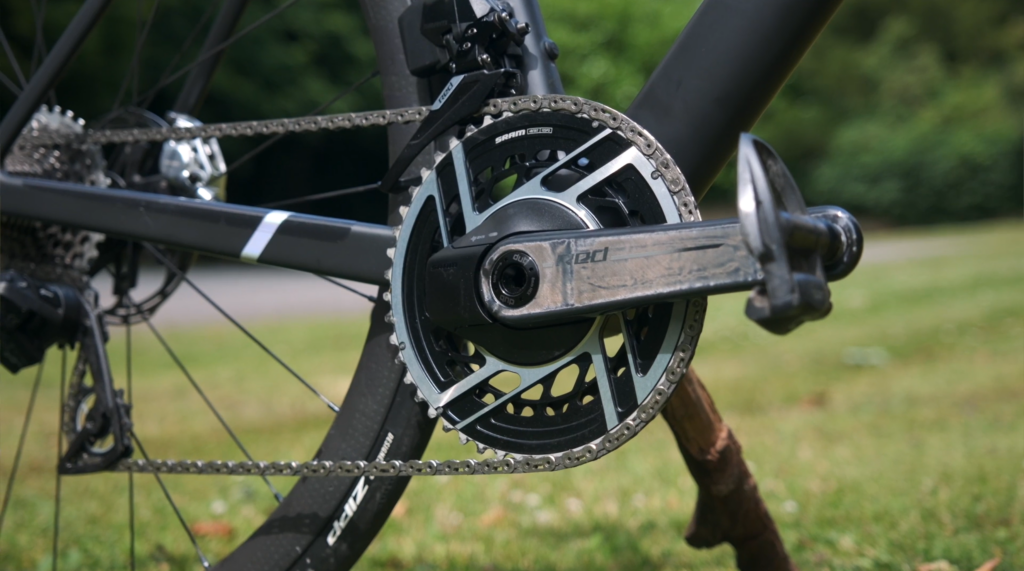
SRAM has hit out at the “deeply flawed” process which led the UCI to introduce its ill-fated gear restriction trial, after a Belgian appeals court this week upheld the decision to suspend the controversial in-race test, concluding that it failed to meet transparency and non-discrimination standards.
The components brand – the only leading manufacturer that would have been affected by the UCI’s proposed maximum gearing rule – described the ruling as “groundbreaking”, with the potential to influence how governing bodies across all sports exercise their power.
In a statement issued on Thursday, SRAM CEO Ken Lousberg criticised the UCI’s claims that its plan to restrict gearing in professional races to a maximum 54×11 ratio was based on safety concerns, arguing that “the science showed it wasn’t”.
Lousberg also called on the governing body to respond to this week’s ruling by reforming how equipment and safety concerns are regulated, including by rallying the sport’s stakeholders together and involving the World Federation of the Sporting Goods Industry, the IOC-recognised independent sports industry body, in the decision-making process.
“This case began as a dispute about our 10-tooth cog. This ruling is much bigger than that,” the SRAM CEO said this afternoon.
“The Brussels Court of Appeal has issued a groundbreaking ruling on how sports federations across Europe must exercise regulatory power. The Court upheld the Belgian Competition Authority’s previous findings that open, transparent, objective, and non-discriminatory governance is the legal standard for rulemaking in sport.
“It endorsed that reasoning in full, applying well-established European Court of Justice case law in a way that will guide federation governance well beyond this case, and sharply rebuking the UCI’s appeal.”
Lousberg continued: “Safety matters deeply to us, and it always has. While the UCI framed its gearing restriction as a safety measure, the science showed it wasn’t, and the process used to adopt the rule was deeply flawed.
“For SRAM, our legal action was always about how the stakeholders of this sport work together to improve every part of it, including rider safety, in a clear, transparent, and fair way. The Court rejected the UCI’s arguments on every ground, including the claim that safety justified the closed process it followed.
“What comes next is the work this sport has needed for a long time: building that process together, with the common goal of improving our sport.
“The WFSGI, as the neutral voice of the cycling industry, is the natural partner in that work alongside the teams, athletes, race organisers, and the UCI. The door is now open, and there should be a seat for everyone willing to help build the future the sport deserves through collaboration, not exclusion.
“The first step is straightforward: the UCI should bring the WFSGI into rulemaking as a full partner and start this reform now. SRAM is excited to get to work.”
> UCI to trial maximum gearing rule — but will it really make racing safer?
The long-running, costly saga for cycling’s governing body began last year, when the UCI announced its plans to trial a new maximum gearing rule at the final WorldTour event of last season, the Tour of Guangxi, as part of ongoing attempts to limit top speeds and reduce danger in the peloton.
Last September, SRAM launched legal proceedings against the UCI in a bid to halt the trial, the components giant arguing that capping rider gear choice in races violates EU competition law and would unfairly impact and penalise the brand’s riders and teams, without increasing safety.
In October, just days before the trial was due to take place in Guangxi, the Belgian Competition Authority (BCA) issued a ruling bringing a sudden stop to the UCI’s plans, arguing that the governing body’s basis for implementing the trial and determining new technical standards did not meet essential conditions of proportionality, objectivity, transparency, and non-discrimination.
The UCI then appealed that ruling, kicking off months of legal wrangling – a costly process that has reportedly eaten into the €300,000 SafeR fund ringfenced by the governing body to explore new race safety solutions – ultimately resulting in this week’s decision by the Brussels Market Court.
Throwing out the governing body’s appeal this week, the court criticised several parts of the UCI’s process, including its limited consultation with manufacturers like SRAM and the uncertainty over which races were selected for testing.
The judges also argued that the UCI lacked a clear evidential basis for choosing 54×11 as the gearing limit, while also failing to convincingly show why that particular ratio was necessary to improve safety in the peloton.
According to the court, the proposed trial was not presented as a safety experiment, but was instead put forward as an in-race test, which amended the UCI’s current regulations and carried sporting consequences for riders and teams, while also potentially affecting the market for groupsets.
The judges added that the trial carried with it a reputational risk for SRAM, whose equipment could potentially have been regarded as unsafe or unsuitable for professional racing – despite the UCI failing to make an adequate case for why their maximum gearing cap was safer.
The issue of gear restrictions, and whether they would make professional bike racing safer, has divided both cycling’s stakeholders and the peloton itself.
In early 2025, Wout van Aert and Chris Froome expressed support for limiting the size of gears that can be used in road races, with Van Aert arguing it “would make cycling a lot safer” by reducing the speeds and fighting for position on descents.
Both Van Aert and Froome have suffered horrific crashes during their career and agreed that limiting gears could be a solution to the apparent increased danger of modern racing, four-time Tour de France winner Froome suggesting that ultimately there may need to be a “discussion about limiting the progression of technology in the sport to accommodate for the safety aspect”.

However, in August, Tom Pidcock criticised the UCI’s attempts to overhaul equipment standards, reduce speeds, and increase safety in the professional peloton, branding the decision to introduce a gear restriction trial as a “smokescreen” hiding “more important issues”.
Pidcock argued that restricting gear choice, and therefore limiting top speeds, would “only make everything more dangerous” by bunching the peloton together on descents.
Pidcock’s stance was also supported by the head of engineering at the SRAM-equipped Red Bull-Bora-Hansgrohe squad, Dan Bigham, who argued at last year’s Tour de France that restricting gears will have no impact on speeds during races.
“If Wout van Aert, Tadej Pogačar or Mathieu van der Poel have a life-changing injury, or worse, we will have blood on our hands,” the 33-year-old said.
“We have the power to make changes. But restricting gear ratios simply distracts from making meaningful changes to rider safety.
“From my analysis, for reducing ratios to have an impact, we need to presume professionals would adhere to unrealistic cadence limits that aren’t supported by the literature.
“It’ll impact on as little as 0.01 per cent of a race and will arguably reduce speeds by no more than 0.5kph. All of this to change entire groupset design? It really doesn’t seem effective to me.”


















3 thoughts on ““The UCI framed its gear restriction as a safety measure – the science showed it wasn’t”: SRAM hits out at “deeply flawed” gear ratio trial and calls for “reform now””
“safety justified the closed process it followed”
UCI are indeed a bunch of morons.
It’s not anti-espionage so you’d have to keep your actions secret from adversaries. LOL.
The pro riders – as per what their representative body, the CPA, claim – overwhelmingly support the proposed rule, as far as I can tell from online news.
Have you covered that aspect at all?
(I have no opinion on whether or not a gear restriction would help safety – I’m not qualified; I can see some logic in the claims it would not, OTOH, the CPA seems to think it is worth trying; I just find it odd that the CPAs stance has been left out of road.cc’s coverage of this topic – very anti-UCI / pro-vendor coverage on it, except it was the CPA who helped advocate for this).