



In what could prove a landmark ruling for professional cycling, and how the sport approaches both tech and safety, the UCI’s appeal against the decision to suspend the governing body’s controversial gear restriction trial has been thrown out in court.
On Wednesday, the Market Court in Brussels ruled in favour of the Belgian Competition Authority (BCA), which last October had sided with components manufacturer SRAM in its legal dispute with cycling’s governing body, bringing a halt to the UCI’s plans to test its new maximum gearing rule at the season-ending Tour of Guangxi in China.
In its final ruling, the Brussels Market Court declared the UCI’s appeal against the BCA to be admissible and unfounded, leaving in place the suspension. The appeals court also criticised the UCI’s process for introducing the trial, ruling that it featured limited involvement from manufacturers, while failing to meet basic requirements of transparency, non-discrimination, and proportionality.

The judgement definitively brings an end to the UCI’s attempts to introduce its restricted gearing rule, officially known as the Maximum Gear Ratio Protocol, as it currently stands, though it does leave the door open for the governing body to adopt other safety-based legislation.
However, the court’s decision appears to have set a legal precedent which could have a significant impact on how these safety changes are pursued, especially when they concern equipment regulations and technical standards, specially those with potential economic consequences.
SRAM vs the UCI
SRAM had first launched legal proceedings against the UCI over the proposed changes in September 2025, the components giant arguing that capping rider gear choice in races violates EU competition law and will unfairly impact and penalise the brand’s riders and teams, without increasing safety.
As part of a raft of controversial safety regulations announced in early 2025, the UCI planned to trial its new maximum gearing rule at the final WorldTour event of last season, the Tour of Guangxi, as part of its attempts to limit top speeds and reduce danger in the peloton.
This proposed rule, a variation on the old junior gears system, marked the first technical gear limitation in modern professional cycling and aimed to cap the distance covered per pedal revolution to 10.46 metres – effectively limiting riders to a maximum gear ratio of 54×11 on 700c wheels.
Though we’ve seen many riders mix and match larger chainrings from other brands on their bikes in recent years, Shimano, Campagnolo, and FSA now all have maximum gear ratios of 54×11, meaning they would have been largely unaffected by the rule.
> UCI to trial maximum gearing rule — but will it really make racing safer?
However, the trial system would significantly impact SRAM-sponsored teams, whose riders use a 10-tooth smallest cog on the rear cassette. Under the new 10.46 metre cap, any combination exceeding 54×11 is now prohibited.
This means, under the UCI’s plans, SRAM riders using a 10-tooth cog would have been limited to a maximum 49-tooth chainring, ruling out the 50T and 54T setups that are common in the pro peloton, and the 54×10 configuration favoured by many of SRAM’s professional teams.
In its complaint to the BCA, SRAM argued that the proposed protocol was adopted by the UCI without consultation, transparency, or any safety justification, disadvantages SRAM-equipped riders in races, and distorts the drivetrain market, violating EU competition law.
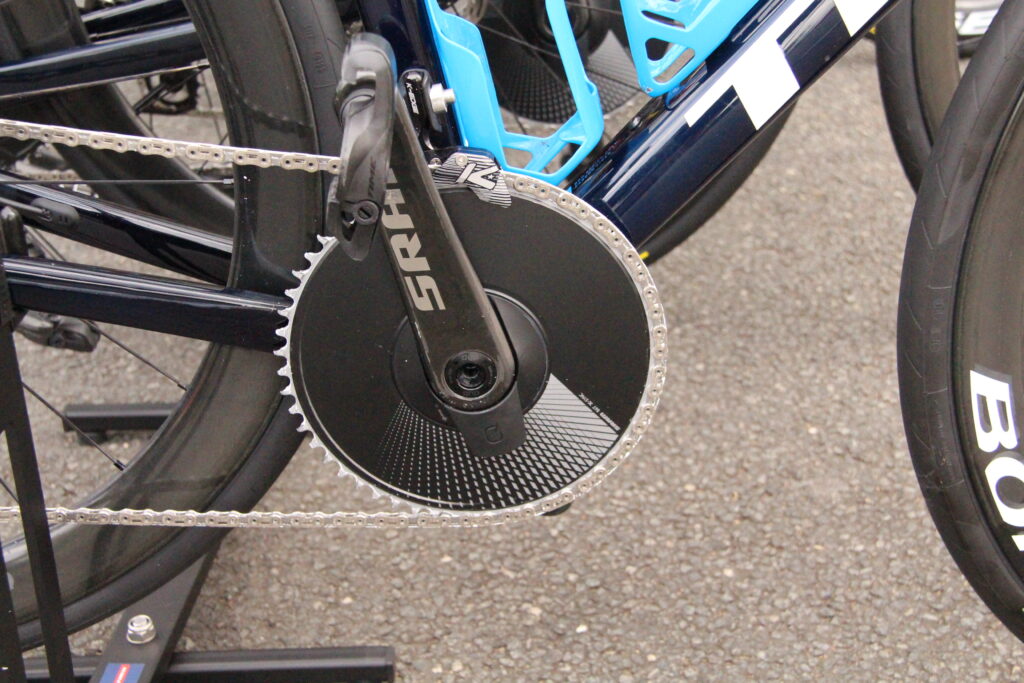
In October, just days before the trial was due to take place in Guangxi, the BCA issued a ruling bringing a halt to the UCI’s plans, arguing that the governing body’s basis for implementing the trial and determining new technical standards did not meet essential conditions of proportionality, objectivity, transparency, and non-discrimination.
The BCA claimed that the trial would have resulted in “undue restriction of competition between sports equipment suppliers”.
However, the UCI immediately launched an appeal and hit back at the ruling, noting its “surprise” at the intervention (and, rather bizarrely, the international character of the complaint), while also criticising SRAM and accusing it of failing to prioritise rider safety.
This week’s ruling – and what does it mean for cycling?
Throwing out the governing body’s appeal this week, the Brussels Market Court criticised several parts of the UCI’s process, including its limited consultation with manufacturers like SRAM and the uncertainty over which races were selected for testing.
The judges also argued that the UCI lacked a clear evidential basis for choosing 54×11 as the gearing limit, while also failing to convincingly show why that particular ratio was necessary to improve safety in the peloton.
According to the court, the proposed trial was not presented as a safety experiment, but was instead put forward as an in-race test, which amended the UCI’s current regulations and carried sporting consequences for riders and teams, while also potentially affecting the market for groupsets.
SRAM was also identified as the only major manufacturer affected by the trial, and that SRAM-sponsored teams would have been forced to modify their equipment at short notice or risk being unable to start any races included in the trial.
The judges added that the trial carried with it a reputational risk for SRAM, whose equipment could potentially have been regarded as unsafe or unsuitable for professional racing – despite the UCI failing to make an adequate case for why their maximum gearing cap was safer.

In a statement published in the wake of the court’s ruling, the BCA said: “In its judgment, the Market Court confirms the validity of the provisional measures ordered by the BCA and finds, in particular, that: (i) the BCA had jurisdiction to intervene in this case because of possible effects of the technical standard on the Belgian territory;
“(ii) the BCA rightly concluded that there was a prima facie restriction of competition due to the UCI’s failures to apply transparent, objective, and non-discriminatory criteria when developing the standard.
“(iii) the UCI failed to justify why the maximum gear ratio standard was necessary and proportionate to achieve the objective of improving rider safety; and (iv) the BCA correctly assessed the existence of a risk of serious, imminent and irreparable harm to SRAM and the cycling teams equipped with its drivetrain systems.
“In general, the Court emphasises that norms adopted by sports federations must comply with competition law requirements when they produce economic effects and need, in such a case, to be based on transparent, objective, and non-discriminatory criteria.”
The UCI was also ordered to pay costs and a procedural indemnity to the Belgian Competition Authority.
The saga surrounding the UCI’s restricted gearing trial is now effectively over, but it has the potential to have long-lasting implications for the sport.
If cycling’s governing body wishes to introduce new equipment regulations in the name of safety, it now must make a compelling case based on evidence, an industry-wide consultation, and sufficient process – or risk another drawn-out legal battle, while doing nothing to make the sport any safer.





















44 thoughts on “Is this the end for the UCI’s gear restriction plans? SRAM wins landmark appeal over controversial gearing trial as court rules governing body failed to show how new rules would improve safety”
It seems completely asinine that the UCI didn’t consider the changes required and SRAMs gear ratios when choosing where to place the marker on gear restrictions.
Seems with a bit of thinking they could have just made the maximum ratio 5:1 and encompassed the existing 50T chainrings on the SRAM gearsets, while being close to the 54×11 max for shimano.
@Gravel1-2 Of course the UCI didn’t consider it, cause it’s nuts to think SRAM somehow couldn’t produce an 11-X cassette. But SRAM doesn’t want to do that, cause 10-tooth cassette is one of their marketing points for their groupset and XDR.
This is a triumph of SRAM’s marketing department over common sense.
(the common sense being that the UCI should be able to set technical regulations, as it has always done, including setting gearing limits – which regulations never even mentioned 10-tooth to begin with!).
@Paul J It can still set technical regulations, just not ones that are biased against certain manufacturer’s existing equipment.
@Backladder 11-speed cogs were long ubiquitous, and there’s no technical challenge in SRAM making one.
There’s only a marketing department challenge.
Oh, the wider implications for sport for this ruling are just nuts too. So *no* sports body can now set its rules as it deems required, via the processes constituted for the sport, if some equipment maker somewhere feels they might be harmed by the changes to the sport’s rules.
Mad.
@Paul J If they went along to the court with proof that the changes would make racing safer then they would probably have won the case, they didn’t, probably because they can’t.
@Backladder How would you prove it when you’re not allowed to implement it?
Again, the idea for this gearing restriction came out of the SafeR initiative, to try improve safety in road cycling, which was formed with representation from the riders (CPA), the teams (AIGCP), the riders (the CPA), and the UCI. Of the 4 bodies, 3 were in favour, and my understanding is the gearing restriction is an idea that came originally from riders. Only the AIGCP were against it.
How are they meant to get “proof” of it really being safer if they can’t even try it out?
How is that cycling can not *COLLECTIVELY* govern itself and implement a measure with *OVERWHELMING* support from _within_ cycling – and /particularly/ from the people who are putting their skin and bones on the line when it comes to safety? Just because 1 company doesn’t like it – and not for any good technical reason!
That is madness.
(And I have great respect for SRAM, particularly their engineers – I’ve met a few, including Brian Jordan).
@Paul J
This is not about riding in the peloton as they don’t reach high enough speed to run out of gears, this is about descending and riders are spaced out enough there that they can gather data from the current races, if there was anything in it they would be able to detect a higher crash rate for SRAM riders. There are enough riders and races in a year for a representative sample.
@Backladder So you know better than the 80%+ of the professional racing cyclists represented by the CPA?
@Paul J Adam Hansen didn’t write “over 80% riders supported the idea”.
He only said “less than 20% were against”.
That is a HUGE difference.
@tomlew In an interesting coincidence, 20% also seems to be roughly the proportion of teams riding SRAM… 🤔
What’s truly mad is the fact that UCI bureaucrats issued new gearing rules that de facto excluded a major groupset manufacturer, also a supplier for 14 World Tour teams, combining women and men.
@MaxiMinimalist You realise this came out of the SafeR initiative, constituted from the racing stakeholders – teams, organisers and the riders – and it has the broad support of that body. In particular, the vast majority of riders are for it. Only the AIGCP was against.
@Paul J No, they were not for it. Even Adam Hansen says: “Only 20% percent were against it”.
If they were actually FOR it, he would’ve said that explicitly. His words suggest clearly that they were actually neutral – not against, but not supportive either.
Also, shame on you SRAM for bringing this case.
Paul, you sound like you work at the UCI.
It’s the UCI that should be ashamed here, for discrimination in favour of a supplier, Shimano, who just happens to be a major sponsor of the UCI.
@Dodonline what prevented SRAM from making a cassette with an 11-tooth as the highest gear?
nothing. nothing but their marketing.
@Paul J
Nothing but time and money, would the UCI compensate them?
@Backladder They make 11-tooth final cogs for other hub bodies to this day! Making a cog with slightly more metal and 11-tooth for XD/XDR would be trivial for them! Hell, I bet there’s some Taiwanese factory already making them (SRAM source production from Taiwanese manufacturers).
This is just mad, that because some equipment maker somewhere has made something, therefore the ruling body can no longer make technical regulations affecting things that have been made.
Who sets the rules, the governing bodies, or the marketing departments of vendors?
@Paul J The 12 speed AXS system uses different chains and spacing so its not just a simple copy and paste job unless you want the resultant shifting to be about as good as old fashioned 6 speed.
@Paul J Nobody is saying that SRAM couldn’t make an 11 tooth cassette. But why should they? The 10 tooth sprocket is an innovation. I have it on two of my bikes. It makes for a better overall experience. If SRAM riders were having accidents that Shimano ones weren’t then that would be a good argument for restricting innovation and competition. The UCI’s problem is that they can produce no evidence to justify it. We are left with the suspicion that the UCI are so puffed up with self importance that they are offended at the idea that laws might apply to them as well or that this specific regulation was really a corrupt attempt to benefit their sponsor.
Oh, I have no current association with SRAM. I did do some consulting work for them a number of years ago, have been at SRAM hq, and have met some of the engineers who design this stuff.
So.. if anything.. I have a bias *towards* SRAM.
Also, I have no association with the UCI, other than very very tangentially, by being a member of my national UCI-affiliated cycling body, so that I can avail of insurance, do some events, etc.
@Backladder I am sure SRAM can whip up the CAD for an 11-tooth for XDR and the new 12-speed chain very quickly, and have it emailed off to Taiwan for manufacture in a few hours.
Just daft to claim they can’t.
@Dodonline The gearing restriction is something that came out of consultation with *THE RIDERS*. You’re saying that something riders suggested to the UCI FOR SAFETY, supported by the VAST MAJORITY of riders (>80%), according to Adam Hansen of the CPA who **represent the riders**, can not be implemented in the rules cause SRAM have some marketing talking-point they need to push – even though SRAM could easily accommodate this gearing restriction if they wished?
Really, that’s where we’re at? A safety measure that has broad support from the RIDERS can not be implemented cause some manufacturer’s marketing department would get hurt?
@Paul J Why would a manufacturer be forced to change the whole mass production process because an idiot in UCI came up with an idea that changes nothing?
Modifying a mass-produced product is MUCH more complicated than you can imagine. Also that could mean sub-optimal operation of the RD, as the curvature of the whole cassette changes.
I’m pretty sure the same idea would’ve never been born if SRAM, not Shimano, was a sponsor of UCI.
They could have also chosen the ratio that matches 53×11 as that would almost exactly match the 48×10 ratio, and be a slower speed cut-off, but that would have meant that shimano would have to re-make their dura-ace 53 tooth chainring.
They chose an arbitrary figure for the trial, had no evidence to back it up and left one of the main equipment manufacturers and lots of teams potentially in the lurch with it. The UCI own all of this mess, not SRAM
They’ve massively messed this up and missed a big opportunity to do something about safety.
@Gravel1-2 The UCI did not specify any specific combination of cogs, they specified an overall development. If you ever watched the commissaires check junior’s bikes, back when junior’s had a gear restriction, you’ll have seen that they do not care about the cogs – they set the bike on a line, set the cranks at an easy to remember position, then walk the bike to another line, and the cranks have to make at least one full revolution. If the cranks do not revolve at least once, then it’s overgeared and it fails the test.
SRAM, and any else, would be free to use whatever cog combinations they want! Just as you say! Hell, they could even tweak the tyre diameter to help meet a limit.
@Paul J from what was reported when the gear restriction trial was originally announced, it sounds like the UCI had no plans to actually do roll-out tests and would just have been basing it on the gear combinations. Which in itself is emblematic of the UCI’s typical approach.
A development 10.46m happens to match exactly the roll out of 54×11 with a 28mm tyre. With pros often using 29mm or 30mm tyres (or even larger in races like Paris-Roubaix), it’s quite possible that even Shimano riders with 54×11 gearing would therefore fail a roll out test, if one were conducted.
By failing to propose such roll out tests and instead relying on gear combinations for enforcement, the UCI have again demonstrated a lack of interest in fair and consistent enforcement of their own rules.
I would also presume that the UCI came upon 10.46m as the limit by using the same calculation as me – i.e. it is the development of 54×11 with 28mm tyres. If safety and restricting speeds was the concern, surely a more logical approach would have been to decide a “top speed” and “maximum effective cadence” and then calculate the development backwards from there.
You’re correct. They didn’t specify a set number of cogs….they just specified to the cm an overall development that matches up almost exactly with 54×11 on 700c. It’s not a development of 10.5m, or 10m, it’s 10.46m, that happens to match up exactly with their sponsors cogs, and not their competitors-seems like they specified a number of cogs.
Had they produced the basis that said ‘we want a max pedalling speed of Xkph at Yrpm’ that would have been much more understandable, but they didn’t.
I’m sure that the riders are in favour of gear restrictions to improve safety, but I bet that the riders and teams on sram aren’t in favour of having a rule that puts them at a specific disadvantage vs Shimano riders.
The UCI seems dead set on spending a bunch of money on fighting this, whereas they’d have been better spending a fraction of that on some up front basis for the ratio.
@OnYerBike Many good points here.
The problem with a roll-out test is how impracticible it is. In theory, you could pass or fail the test just due to tyre pressure (or even tyre wear in extreme cases!), which is ludicrous, even if the idea itself may be considered good.
Defining specific gear ratios would be much, much simpler and easier to enforce.
@tomlew “Defining specific gear ratios would be much, much simpler and easier to enforce.”
And probably lead to the rapid development of larger diameter tyres to give bigger gears.
@Backladder on a 700c wheel adding even 5 mm of extra tyre height gives you less than 1% of extra roll-out. That is a trivial difference in speed for a significant difference in bike handling – clearly not worth the effort.
Not to mention how unrealistic it would be to test every bike individually.
BTW assuming the test is conducted before the race, what if the bike was tested at an unrealistically high pressure and then the tyres were deflated?
Or they just lost pressure due to an undetected micropuncture?
Or even funnier – assuming the test is conducted behind after the race, how could a tyre be tested after getting slashed after finishing the race, but before the test?
These all may sound outlandish, but these are actual possibilities. How would you imagine testing bikes in any of the above situations?
@Gravel1-2 How about picking a 4.8 ratio that exactly matches SRAM’s 48×10 gearing and Shimano/Campag can use the closest lower ratio and see if SRAM are still unhappy.
Or just 5:1, which would allow 50×10 for SRAM, and to all intents and purposes be indistinguishable from what they did pick. 🤷♂️
Surely this ruling can be used as a worthwhile precedent to fight back against the handlebar width restrictions too.
Claims that the rules were brought in “for safety” were distinctly lacking in justification of how it would have the intended impact on safety, and the concerns about discrimination were duly ignored.
Road.cc, I really think you should refer to Adam Hansen’s response to the SRAM court case and the background on this, published in Domestique in February. It has important context. In particular, this gearing restriction has _broad support_ across the racing community, particularly the racers themselves. This is important context that has been missing from the reporting.
Search for: Adam Hansen What everyone should know about the SRAM case… – it’s on the Domestique website.
The direct link (but then I think this comment will get stuck in moderation and never appear): https://www.domestiquecycling.com/en/news/what-everyone-should-know-about-the-sram-case/
@Paul J Interesting article, although the idea of restricted gears was very popular it seems to be only 6th on the list in terms of importance and I am in total agreement that the other 5 issues are much more important than restricted gears. The UCI seems to be concentrating on what is easy (gear restrictions) rather than what is important (course design, 3km rule, motorbike proximity, hookless tyres and barriers). They also seem to have forgotten the 5th stake holder in cycle sport, the equipment manufacturers, they are necessarily different from the teams as they all supply multiple teams and will have different viewpoints, perhaps SRAM initially sent their mechanics to discuss the proposed test because they wanted more information?
Among the other implications in the article, the idea that the riders do not feel they can speak out if they are given potentially dangerous equipment needs fixing, that wouldn’t be acceptable in any other job.
@Paul J It’s quite funny that AH refers to the 3-km rule. Studies show that it actually increases risk instead of reducing it. All AH has in support of his ideas is anecdotes, while actual evidence proves the opposite of what he says.
Also the case of hookless shows that the whole matter is controlled by sponsors anyway. It’s also funny how the gear limit was defined PRECISELY to make life harder for SRAM without affecting Shimano (who, accidentally, happen to be a major sponsor of UCI).
And even if he wants to refer to “us, the peloton”, there is no evidence on the actual opinion of the group. All AH says is “Less than 20% were against [gear ratio restriction”. Did you note he did not say how many actually supported the idea? That clearly suggests it wasn;t that many, so in fact most riders were NEUTRAL, not for the idea.
So while I do appreciate Adam Hansen as a rider, he talks BS here.
@tomlew It wasn’t just Adam Hansen, it was other riders (I know I’ve read other riders suggest this well before SafeR considered it). The race organisers association also supported it.
Could it be it wouldn’t have an effect? Sure, quite possible. I have no opinion on that – I wouldn’t have the standing/experience to form one (and neither would 99.9% of the online commentators on it either!) specifically on whether a gearing restriction would help safety or not.
However, I very much do think that it *SHOULD* be within the gift of the UCI, with the input of and consideration for the parties *directly involved in the racing* (i.e. the race organisers, the teams and [especially] the riders) to set the rules on this and try things out. And that should NOT be held hostage by the marketing department on equipment vendor!
@Paul J Nobody is denying that the UCI generally has the right to decide. The issue here is that the decision has no meritorical background whatsoever.
Also, the riders were not asked about a specific gear ratio, but about a restriction in general. That (together with the obvious manipulation in Mr. Hansen’s words) means that the claim that riders support the rule in its curent shape is simply invalid and unjustified.
“that should NOT be held hostage by the marketing department [or] equipment vendor!”
Well said! However, funnily enough, you don’t notice that the gear ratio defined in the rule is completely arbitrary, has no support in science, and – by pure coincidence – sits perfectly where it doesn’t affect Shimano but it does impede SRAM. Which actually proves the exact opposite of what you said in the quote above.
I’m not clear how Meritor’s truck drive components would be relevant here? I doubt anyone’s using them in the peloton.
I distinctly remember all the armchair engineers saying the SRAMs 10 tooth cog had massive efficiency losses and was therefore much slower than using an 11 tooth cog. So it’s ironic that it’s now the same people accusing SRAMs gearing of the crime of making bikes too fast.