



Wickedly straight, fiendishly long, and riddled with the kind of brutal pavé former Tour de France organiser Jacques Goddet described as “potholes, not cobblestones”, the Arenberg Forest, Paris-Roubaix’s first five-star sector, is difficult enough.
But this year, the infamous Trouée d’Arenberg has been made even more difficult by a rather niche subsection of thieves, who have been stealing multiple cobbles from the race route, leaving wide gaps in the already treacherous surface.
Of course, cobble theft on the Paris-Roubaix route is nothing new. For years, mischievous individuals have sneaked into the Arenberg Trench to prise a pavé-shaped souvenir from the Hell of the North – and make it that bit more hellish in the process for its participants.
But this year, the cobble theft at Paris-Roubaix has become so severe that race director Thierry Gouvenou has publicly criticised the vandals, who he says have left the volunteers tasked with repairing the classic’s iconic sectors with a race against time before Sunday, while also putting the peloton in danger.

“This is something we’re seeing more often,” Gouvenou told Het Nieuwsblad. “What people are doing here can be dangerous.
“What those people are doing can be life-threatening. Imagine what happens if a rider hits one of those holes. They ride over these sectors at 50 kilometres an hour.”
As is always the case in the lead-up to Paris-Roubaix, local teams have been working to restore and patch up the race’s cobbled sectors on a daily basis, filling in any large gaps, to ensure they can be traversed safely by the riders.
However, Gouvenou has warned that the volunteers are struggling to cope with the scale of the damage this year, with new gaps appearing every day.
Thieves aren’t the organisers’ only concerns on the Arenberg this week, with local wildlife also disturbing the Arenberg’s surface during the night this week.
“Those animals feel at home in the forest,” Gouvenou added. “They take leaves and branches onto the sectors.”
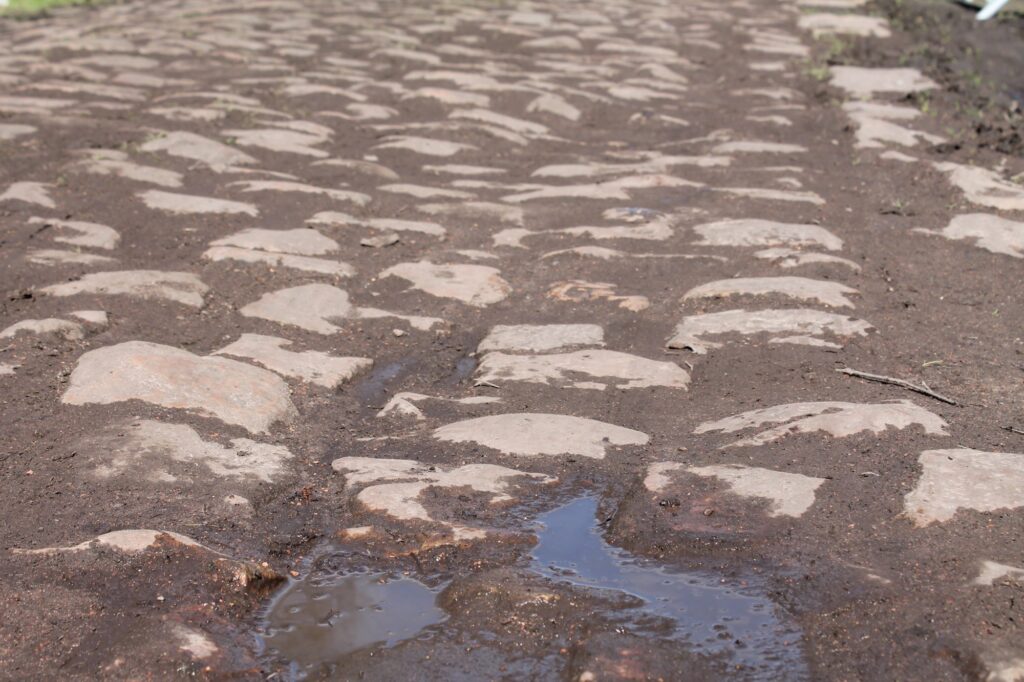
Nevertheless, the race director is adamant that it’s humans – and their muddied hands – who pose the greatest danger to the riders when they tackle the Arenberg on Sunday.
“We want to see a great race,” he insisted. “But it has to be on a course that is intact. The race is already hard enough.”
Even by the misshapen standards of the Hell of the North, the legendary Arenberg’s 2.3km stretch of jagged, unruly cobbles forms one of the pivotal moments in the men’s Paris-Roubaix, coming with around 95km to go as the action starts to heat up (it’s yet to be featured in the women’s version, however).
Despite its distance to the finish, it is often marked both by the crash-filled chaos contained within the forest, and, historically, the fight for position that precedes it on the approach from Wallers, with the bunch barrelling towards its gloomy entrance at speeds of over 60kph.
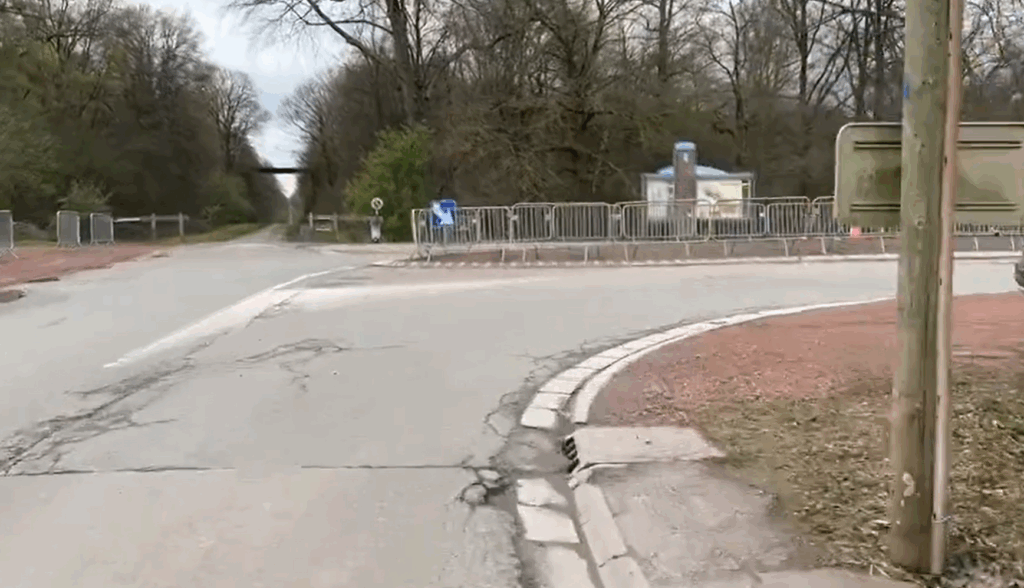
In a bid to make the run-in to the forest, and therefore the sector itself, safer, in 2024 organisers ASO decided to introduce a series of sharp bends just before the start of the Trouée d’Arenberg, forming a motor racing-style “chicane”.
That decision was made after the CPA pro riders’ union urged the organisers to introduce a method to slow down the riders, but divided opinion in the build-up to the race.
And while the F1-style chicane proved relatively uneventful in the end, it was replaced last year by a “small detour” around Arenberg’s mining site, which the men’s peloton will once again navigate this Sunday.











12 thoughts on “Paris-Roubaix cobbles stolen from Arenberg Forest as race director slams “life-threatening” theft”
How selfish can people be?
Although TBH I’ve been tempted to pinch Mount Ventoux. It would look great in my garden. Maybe I could turn it into a rockery?
You’d not be the first. Doesn’t mark1a of this parish has a half-scale model of the Koppenburg behind the bike garage?
Yeah – there used to be a whole range there at one point, and now look at it.
“My friends went to see a Monument but all they bright me was this lousy rock”.
…granite setts ethically sourced from Cumbria, no secteurs or hellingen were harmed during construction.
I’ve got a piece of Mt Ventoux on my desk at home. It’s now on the fourth (?) iteration of this piece – I’ve taken back the old one and returned home with a new one each time I’ve been back since my first visit. Irresponsible, I know, but despite being a little piece of limestone, it has plenty of meaning to me!
That reminds me of a story a few years ago. The person who won the annual biggest liar of the year award at the Santon Bridge Hotel in Cumbria told a tale in which he claimed that nobody had climbed to the top of Everest, he was the only one to summit Everest, because he chipped the summit off and took it home, and made a rockery out of it.
Argh. Edit function! brought…
Or badgers. Badgers steal them for setts.
Sounds like a load of cobbles to me.
Local animals and humans disturbing the Arenberg! OMG!
…how is the fine line drawn between rough and smooth pave?
…between nature and artifice?
…no wonder Gravel is booming.
You idiots, just stop souveniring the pave for your fake Roubaix trophies. It’s pathetic egotism.
Get a gravel bike, go bush beyond the pave and get out of your own head.
Your entry for Stupidest Comment of the Year on Road.cc has been safely received. Obviously we can’t guarantee anything with nearly eight months to go but I’d say you’re in with a very good chance of at least a podium.